
冷战热斗Twilight Struggle
一句话概览
冷战热斗 是一款已收录于村了吗规则库的桌游,支持 2 人,原名 Twilight Struggle。
本页内容:一句话概览 · 游戏概述 · 1. 游戏组件 · 2. 游戏设置 · 3. 游戏流程 / 回合结构 · 4. 出牌规则 · 5. 行动点(Operations) · 6. 事件(Events) · 7. DEFCON 与军事行动 · 8. The China Card(中国卡) · 9. 计分与胜利 · 10. 锦标赛规则(可选) · 11. 中国内战变体(Chinese Civil War Variant) · 关键规则与常见问题 · 常见问题
冷战热斗 规则速览
以下规则速览由本站整理,与官方规则书表述不同,仅供快速上手参考。
游戏概述
1945年,二战的硝烟尚未散尽,美苏两个超级大国便展开了长达四十余年的全球争霸。冷战热斗(Twilight Struggle)是一款双人卡驱策略游戏,玩家分别扮演美国或苏联,通过在全球六大区域争夺影响力来主导冷战走向。游戏共10回合,每回合围绕手牌打出展开——卡牌既可作为行动点(放置影响力、调整掷骰、政变、推进太空竞赛),也可触发历史事件。核心机制包括:手牌管理与行动点分配、区域影响力争夺与计分、DEFCON核紧张度管控、太空竞赛推进,以及事件与行动点之间的取舍博弈。任一方达到20 VP、控制欧洲、或迫使对手将DEFCON降至1即获自动胜利;否则第10回合结束后全面计分定胜负。
1. 游戏组件
| 组件 | 数量/说明 |
|---|---|
| 地图板 | 1张(22″×34″),分6个大区 |
| 标记物板 | 2张 |
| 规则书 | 1本 |
| 玩家助记卡 | 2张(Player Aid Cards) |
| 卡牌 | 110张(Early War / Mid War / Late War) |
| 六面骰 | 2颗 |
2. 游戏设置
2.1 地图
- 6个大区(Regions):欧洲(Europe)、亚洲(Asia)、中美洲(Central America)、南美洲(South America)、非洲(Africa)、中东(Middle East)。
- 欧洲分为东欧(Eastern Europe)和西欧(Western Europe)两个子区;奥地利和芬兰同时属于两者。亚洲含子区东南亚(Southeast Asia)。
- 任何提及"Europe"或"Asia"的事件/规则均包含其子区。
- 中东在政治意义上包含利比亚和埃及;欧洲包含加拿大和土耳其。
- 每个国家空间有稳定值(Stability Number)。
- 战场国(Battleground States):名称以紫色高亮,与普通空间运作相同,但在计分和政变中有特殊规则。
- 美苏各有一个超级大国空间,不可放置影响力标记,但视为"相邻控制国"供事件和调整使用。
- 国家间连接线:棕色线 = 区内连接;红色虚线 = 跨区连接;黑色线 = 国家与超级大国间连接。
- 控制(Control)条件:己方影响力 ≥ 该国稳定值,且己方影响力超出对手影响力 ≥ 该国稳定值。
2.2 卡牌
- 共110张,每张含 Operations Point 值、事件标题、事件描述。
- 部分卡标注 SCORING,必须在抽到的当回合打出。
- 事件阵营标识:红星 = 苏联事件;白星 = 美国事件;红/白分裂星 = 中立事件。
- 事件标题后有星号(*)的卡:作为事件打出后永久移除游戏。
- 事件标题加下划线的卡:作为事件打出后面朝上展示在棋盘旁,直到被取消或游戏结束(永久事件)。
- 被弃置(非永久移除)的卡放入抽牌堆旁的面朝上弃牌堆。
2.3 初始设置
- 洗 Early War 牌堆,每人发 8 张。The China Card 面朝上放在苏联面前。
- 苏联先设置,共 15 个影响力:Syria 1、Iraq 1、North Korea 3、East Germany 3、Finland 1、Eastern Europe 任意 6。
- 美国后设置,共 25 个影响力:Canada 2、Iran 1、Israel 1、Japan 1、Australia 4、Philippines 1、South Korea 1、Panama 1、South Africa 1、United Kingdom 5、Western Europe 任意 7。
- 初始状态:太空竞赛标记置于轨道最左侧;军事行动标记归零;回合标记置于第 1 回合;DEFCON 置于 5;VP 标记置于 0。
3. 游戏流程 / 回合结构
3.1 总览
- 共 10 个回合(Turns),每回合代表 3-5 年。
- 初始手牌 8 张;Turn 4 起 Mid War 混入牌堆,手牌增至 9 张;Turn 8 起 Late War 混入牌堆。
- Phasing Player = 当前出牌的玩家。苏联始终先手。
- 牌堆用尽时洗混弃牌堆重建;带星号事件卡已永久移除,不参与洗混。
- 换阶段时(Turn 3→4、Turn 7→8):不加入弃牌堆,只把新阶段牌混入现有牌堆重洗;被忽略的弃牌留在弃牌堆,下次再洗。
3.2 每回合结构
| 阶段 | 内容 |
|---|---|
| A. DEFCON 恢复 | DEFCON < 5 时 +1(趋向和平) |
| B. 发牌 | Turn 1-3 补至 8 张;Turn 4-10 补至 9 张。The China Card 不计入手牌上限 |
| C. Headline Phase | 各自秘密选 1 张牌同时翻开;按 Operations 值(Headline Value)决定先后,平局美国先。计分卡 Headline Value = 0,总是后生效;双方都选计分卡则美国先。必须触发事件(即使对自己不利)。The China Card 不可在 Headline 使用。除非事件文本特别提及,Headline 阶段不获得 Operations 点数 |
| D. Action Rounds | Turn 1-3 共 6 轮,Turn 4-10 共 7 轮。苏联始终先手。每人每轮打 1 张牌。通常会剩余 1 张手牌(held card)。计分卡不可保留。牌不够则跳过剩余轮次 |
| E. 检查军事行动 | 判定是否因军事行动不足被罚 VP,然后军事行动标记归零 |
| F. 翻开保留牌 | 仅锦标赛:双方展示 held card,确保计分卡未被违规保留 |
| G. 翻转 The China Card | 若当回合被面朝下传递,则翻为面朝上 |
| H. 推进回合标记 | Turn 3 结束时混入 Mid War;Turn 7 结束时混入 Late War |
| I. 终局计分 | 仅 Turn 10 结束后执行 |
4. 出牌规则
- 卡牌只能以事件(Event)或行动点(Operations)两种方式打出。
- 不可放弃回合(不可不出牌、不可直接弃牌)。
- 打出对手事件的规则:若以行动点方式打出一张仅关联对手的卡,对手事件仍然触发(带星号则移除)。Phasing Player 决定事件在行动点之前还是之后执行。
- 若事件因前置条件未满足而无法发生:带星号的卡回到弃牌堆(不移除游戏)。
- 若事件被另一张事件卡禁止:事件不发生,卡仅作行动点使用,不移除。
- 若事件触发但无实际效果:仍视为已打出,带星号仍移除。
- 事件要求弃置某数值的卡时,更高数值的卡也满足。
- 被事件强制弃置的卡,其事件不触发(包括计分卡)。
- 卡牌文本与规则冲突时,卡牌文本优先(但计分规则 10.1.5 除外)。
5. 行动点(Operations)
行动点可用于四种用途,打出行动卡时必须将全部点数用于同一种用途。
5.1 放置影响力(Influence Placement)
- 逐个放置。必须放在己方已有标记的位置或其相邻位置(事件要求放置的不受此限,除非卡牌特别说明)。
- 费用:友方控制国 / 无主国 = 1 点/个;敌方控制国 = 2 点/个。若放置过程中控制权改变,后续标记按低价计算。
- 可跨大区、跨国家放置,但所有标记必须从已有标记或己方超级大国相邻国出发。
- 影响力标记可当"现金"拆分使用;数量不足时可用硬币/筹码替代。同国多标记叠放,大面值在上;影响力标记始终公开。
5.2 调整掷骰(Realignment Rolls)
- 1 点 = 1 次调整掷骰。可逐次声明目标。同一国家可被多次调整。
- 各掷一骰,高者可移除对手影响力 = 两骰之差。平局无效果。
- 骰子修正:每控制 1 个相邻国家 +1;在目标国己方影响力 > 对手 +1;己方超级大国与目标国相邻 +1。
- 调整永远不会增加影响力。
5.3 政变(Coup Attempts)
- 目标国必须有对手影响力;己方无需在该国或相邻国有影响力。
- 判定:骰子 + 卡牌 Operations 值 > 目标国 Stability Number × 2 则成功。成功时移除对手影响力 = 差值;若不够移除,补放己方影响力。
- 政变所用卡牌的 Operations 值计入军事行动轨道。
- 在 Battleground 国家政变:DEFCON 降一级。
- "free Coup roll" 可忽略当前 DEFCON 对该大区的政变限制,但仍遵守 Battleground 降 DEFCON 规则,且不计入必须军事行动。
5.4 太空竞赛(Space Race)
- 每回合每人最多打出 1 张卡尝试推进(特殊能力/事件可改变此限制)。
- 推进条件:卡牌 Operations 值 ≥ 轨道目标格要求的数值;掷骰命中格内列出的范围即成功。
- 太空竞赛轨道奖励:5 个格有分数——斜杠左边 = 第一名得分,右边 = 第二名得分。特殊能力仅第一名获得,第二名到达时立即取消。
- 特殊能力:
- 格 2(Animal in Space):每回合可打 2 张太空竞赛卡
- 格 4(Man in Earth Orbit):对手必须先选 Headline 事件
- 格 6(Eagle/Bear has Landed):可在回合结束时弃掉 held card
- 格 8(Space Station):每回合可打 8 个 Action Round
- 效果立即生效且可叠加。
- 用于太空竞赛的卡牌事件不触发,放入弃牌堆。
- 到达终点后不可再用太空竞赛。
6. 事件(Events)
- 可选择打出事件而非行动点。
- 东南亚计分卡(Southeast Asia Scoring):带星号,是唯一打出后被移除的计分卡。
- 永久事件(Permanent Events):标题加下划线,效果持续至游戏结束,放在地图旁提醒。
- Operations 值修正:修正可叠加,可影响 The China Card。仅适用于一方玩家,不可通过偷牌转移给对手。修正适用于所有用途(政变、调整等)。
- 被其他事件取消/限制的卡仍可作行动点使用。
- 战争事件(War Events):共 5 张——Korean War、Arab-Israeli War、Indo-Pakistani War、Brush War、Iran-Iraq War。无需双方在攻/防守国有影响力即可打出;成功得 VP,且无论成功与否均计入军事行动。
6.1 特殊事件机制
- Quagmire(流沙)/ Bear Trap(熊陷阱):受影响玩家下一个行动轮必须弃置一张行动值 ≥ 2 的卡牌,然后掷骰 1-4 才能取消此事件。每轮重复,直到成功或无合适卡牌可用。若无合适卡牌,该玩家该回合只能打出计分卡。
- Iran-Iraq War(伊朗-伊拉克战争):玩家选择伊朗或伊拉克为目标,掷 1 颗骰子,每有对手控制的与目标相邻国家则 −1;修改后骰值 4-6 为胜利。胜利效果:+2 VP,军事行动轨道 +2,将对手在目标国影响力替换为己方影响力。
7. DEFCON 与军事行动
7.1 DEFCON 轨道
- DEFCON 初始 5(最高/和平);降到 1 时游戏立即结束,导致降到 1 的 Phasing Player 输。
- DEFCON 不可超过 5。
- 在 Battleground 国政变:DEFCON 降一级。
- DEFCON 等级限制:
- 5:无限制
- 4:Europe 不可政变/调整
- 3:Europe、Asia 不可政变/调整
- 2:Europe、Asia、Middle East 不可政变/调整
- 1:游戏结束
- 每回合开始 DEFCON < 5 时恢复 +1。
- "improve" = 向高数字移动;"degrade" = 向低数字移动。
7.2 必须军事行动(Required Military Operations)
- 每回合结束时,每人必须完成军事行动数 ≥ 当前 DEFCON 等级;不足部分每点对手获得 1 VP。
- 政变和战争事件计入军事行动;调整掷骰不计入。
- 政变/战争事件打出时,Phasing Player 在军事行动轨道上移动 = 卡牌 Operations 值。
- 若以行动点打出卡牌触发了对手的战争事件,对手的军事行动标记移动。
- "free Coup roll" 不计入必须军事行动。
7.3 军备竞赛(Arms Race)
- 比较双方军事行动轨道上的数值。Phasing Player 军事行动值较多时得 1 VP;若同时达到"所需军事行动量"则得 3 VP(替代 1 VP)。
8. The China Card(中国卡)
- 可像手牌一样打出,不计入手牌上限。每次打出占 1 个 Action Round。
- 打出后面朝下立即交给对手;对手当回合不可再打出;回合结束翻面朝上。
- 若因事件传递,面朝上传递,新持有者当回合可打出。
- 不可打出的情况:Headline Phase;会阻止打出计分卡;被事件要求弃置时。
- +1 Operations 奖励条件:所有行动点必须全部用于 Asia(含 Southeast Asia)。
- Operations 值可被其他事件修正。
- 任何事件或牌荒不可强制打出 The China Card。
9. 计分与胜利
9.1 区域计分(Regional Scoring)
每个大区有对应计分卡;打出时按当前影响力计分。
- 区域控制等级:
- Presence:在该区域控制 ≥1 个国家。
- Domination:控制国家数 > 对手 且 控制 Battleground 数 > 对手;必须至少控制 1 个非 Battleground 和 1 个 Battleground。
- Control:控制国家数 > 对手 且 控制该区域全部 Battleground。
- 额外加分:+1 VP / 每个控制的、与敌方超级大国相邻的国家;+1 VP / 每个控制的 Battleground 国家。双方得分相减,净差在 VP 轨道上移动。
- 事件也可产生 VP。对手军事行动不足可得 VP。
- 不可被事件强制保留计分卡。
9.2 VP 轨道
- 范围 US-20(美国自动胜)到 USSR-20(苏联自动胜),起始 0。
- "获得 X VP" = 向该玩家有利方向移动 X 格。
- 同一事件双方均得 VP 时,只计净差。
9.3 胜利条件
自动胜利:
- 任一方达到 20 VP(所有 VP 结算完毕后判定)。
- 打出 Europe Scoring 时,控制 Europe 的一方立即获胜。
- 对手导致 DEFCON 降到 1。
终局胜利:
- Turn 10 结束后,所有区域全部计分(东南亚并入亚洲计算,不单独计分)。
- 终局计分时达到 20 VP 不触发自动胜利,但控制 Europe 仍自动获胜。
- 正数 = 美国赢;负数 = 苏联赢;零 = 平局。
10. 锦标赛规则(可选)
- 回合结束时双方必须展示 held card。
- 若持有计分卡 = "引发意外核战争",立即判负。
- 发牌时苏联先拿第一张,交替发至满手。
11. 中国内战变体(Chinese Civil War Variant)
- 在现有 China Card 规则基础上使用;与现有规则冲突时以本节为准。
11.1 中国内战空间
- 仅与苏联相邻;属于 Asia 但不属于 Southeast Asia;不影响任何计分卡。
- 仅苏联可在此放置影响力;美国不可用任何行动点或事件影响此空间。
- 苏联放置 3 点影响力后,标记归还,该空间剩余游戏忽略。
11.2 控制与影响
- 苏联需放 3 点影响力来控制;按正常影响力放置规则执行。
- 苏联放满 3 点前:The China Card 无人持有。Red Scare/Purge 和 Formosan Resolution 的打出禁令存在。
- 放满后:苏联立即获得 The China Card(面朝上,可立即使用);上述禁令立即解除。
- 若 The China Card 全局未被领取,终局计分时不计 China Card 持有 VP。
11.3 事件限制与特殊条件
- 苏联放满 3 点前:苏联不可打出 Red Scare/Purge 或 Cultural Revolution 作为事件;美国不可打出 Formosan Resolution 作为事件。以上卡仍可作行动点使用。
- 美国特殊条件:苏联尚未在中国内战区域放置 3 点影响力时,美国视为拥有中国牌(用于判断能否打出 Ussuri River Skirmish 或 Nixon Plays the China Card 作为事件)。
- 朝鲜战争修正:苏联尚未在中国内战区域放置 3 点影响力期间,苏联掷骰解算朝鲜战争事件时额外 −1。
关键规则与常见问题
易错规则
- 打出对手事件仍会触发:以行动点打出对手事件卡时,对手事件仍然发生(带星号则移除),且 Phasing Player 决定事件在行动点之前还是之后执行。
- Headline Phase 必须触发事件:即使事件对自己不利,也必须触发。但 Headline 阶段通常不获得 Operations 点数。
- Headline Phase 中打出对手事件时:对手执行事件文本,但出牌者为 Phasing Player(影响 DEFCON 判定)。
- 计分卡不可保留:任何时候不可保留计分卡到下一回合。锦标赛中违规持有计分卡直接判负。
- 放置影响力必须从已有标记出发:逐个放置,每个必须放在己方已有标记或其相邻位置(事件放置除外)。
- 敌方控制国放置费用翻倍:1 点/个 vs 2 点/个,但放置过程中控制权改变后按低价计算。
- 政变在战场国必降 DEFCON:无论政变成功与否,在 Battleground 国家政变都会使 DEFCON 降一级。
- 必须军事行动 ≠ 调整掷骰:只有政变和战争事件计入军事行动,调整掷骰不计入。不足部分每点罚 1 VP。
- 太空竞赛每回合只能打 1 张卡(特殊能力格 2 除外),且事件不触发。
- The China Card +1 条件:必须全部行动点用于 Asia(含 Southeast Asia)才有 +1 Operations 奖励。
- The China Card 打出后面朝下交给对手:对手当回合不可打出,回合结束才翻面朝上。因事件传递则面朝上,新持有者当回合可打出。
- 永久事件(加下划线)效果持续到游戏结束,带星号事件作为事件打出后永久移除游戏。
- 终局计分时达到 20 VP 不触发自动胜利,但控制 Europe 仍自动获胜。
- DEFCON 限制的是政变和调整,不限制影响力放置。
- free Coup roll 不计入必须军事行动,但仍遵守 Battleground 降 DEFCON 规则。
- Operations 值修正仅适用于一方玩家,不可通过偷牌转移给对手。
常见问题
-
Q:Headline Phase 中打出计分卡会怎样?
A:计分卡 Headline Value = 0,总是后生效。双方都选计分卡则美国先。 -
Q:以行动点打出对手的带星号事件卡,事件因前置条件未满足而无法发生,卡会被移除吗?
A:不会。卡回到弃牌堆,不移除游戏。 -
Q:以行动点打出对手事件卡,事件被另一张事件卡禁止,怎么办?
A:事件不发生,卡仅作行动点使用,不移除。 -
Q:The China Card 可以在 Headline Phase 使用吗?
A:不可以。 -
Q:被事件强制弃置的卡会触发事件吗?
A:不会,包括计分卡在内的所有被弃置卡都不触发事件。 -
Q:DEFCON 降到 1 时谁输?
A:导致 DEFCON 降到 1 的 Phasing Player 输,游戏立即结束。 -
Q:欧洲计分卡打出时有什么特殊胜利条件?
A:控制 Europe 的一方在 Europe Scoring 打出时立即获胜。 -
Q:调整掷骰可以增加己方影响力吗?
A:不可以。调整掷骰只能移除对手影响力,永远不会增加影响力。 -
Q:太空竞赛用的卡牌事件会触发吗?
A:不会。用于太空竞赛的卡牌事件不触发,放入弃牌堆。 -
Q:Quagmire/Bear Trap 无合适卡牌弃置时怎么办?
A:受影响玩家该回合只能打出计分卡。
常见问题(FAQ)
以下 6 条问答来自站内玩家的真实提问,答复由本站依据规则资料作答;答复内容保持原样,仅对提问做了去口语化的轻微整理。
七轮行动轮时,苏联始终能执行4个行动轮吗?
接着上面:这不是绝对的,存在几种会让苏联不恰好执行 4 个行动轮的情形。
1)牌不够时必须跳过(最关键的一条)
如果某名玩家手牌不足以执行当回合规定次数的行动轮,该玩家必须跳过剩余的行动轮,由对手把本回合打完。
- 所以若美国先出现牌不够,剩下的轮次由苏联接着执行,苏联可能超过 4 轮;
- 反之若苏联牌不够,苏联可能不足 4 轮。
- 正常情况第 4–10 回合每人发至 9 张、7 个行动轮,是够用的,通常回合结束时还会有剩余手牌(held card);但被事件强制弃牌、或因下面第 2 条消耗手牌,都可能把牌打薄。
2)Quagmire / Bear Trap(流沙 / 熊陷阱)
受影响玩家在其下一个行动轮必须弃置一张行动值 ≥2 的牌,然后掷骰 1–4 才能取消该事件;每轮重复,直到成功或无合适牌可用。若没有合适的牌可弃,该玩家这一回合就只能打出计分卡——这会挤占/影响其正常的行动轮使用。
3)太空竞赛第 8 格(Space Station)
抵达 Space Station 的玩家每回合可执行 8 个 Action Round。这直接改变「7 轮」的轮数结构;该能力立即生效、可叠加,且只有第一名获得,第二名到达即取消。这条对任何一方都成立,不是苏联专属。
4)The China Card 不能用来救场
China Card 可像手牌一样打出、占 1 个行动轮、不计入手牌上限;但规则明确规定:行动轮中「牌不够」不能强制打出 The China Card。也就是说,不能靠中国卡来填补因缺牌而被迫跳过的轮次;同样,事件也不能强制别人打出它。
5)计分卡不可保留
计分卡必须在抽到的当回合打出,不能留到后面回合。这会限制你「留牌凑轮次」的空间,但本身不改变轮数的计算方式。
小结:只要双方都有足够牌、没有 Space Station 造成的轮数变化、也没有 Quagmire/Bear Trap 之类的干扰,7 轮回合里苏联就是 4 个、美国 3 个;以上任一情形出现时,就不能一概而论。规则书中未找到「苏联在七轮回合中永远固定 4 个行动轮」这样的表述。
本内容仅供参考,如有冲突以说明书和身边大佬为准。
每回合是每个人否只有一张牌能作为事件打出?
结论:不是。规则书中没有「每回合每人只能打出一张牌作为事件」这样的限制。
一个回合中事件可以从多个渠道打出和触发:
- Headline Phase(头条阶段):双方各自秘密选 1 张牌同时翻开,这些牌的事件在本阶段生效。即使事件对自己不利也必须触发(除非事件文本特别说明,本阶段不获得行动点)。
- Action Rounds(行动轮):第 1–3 回合各 6 轮、第 4–10 回合各 7 轮;双方轮流,每轮打 1 张牌。每一轮打出的这张牌,都可以选择「作为事件」或「作为行动点」打出。因此限制的是「每轮一张牌」,而不是「每回合只能有一个事件」。
容易混淆的几点(条件与例外):
- 以行动点打出对手的卡,对手事件仍会触发:若一张牌只关联对手,即使你用它当行动点,对手的事件依然发生。所以一回合内实际触发的事件数还可能超过你主动当事件打出的数量。
- 爆出事件卡本身没有每回合数量上限:一回合内多轮都当事件打,是允许的。
- 真正存在「每回合一张」限制的是太空竞赛:一名玩家每回合最多用 1 张牌尝试推进太空竞赛;抵达第 2 格(Animal in Space)后该限制放宽为每回合 2 张(某些事件/特殊能力也可改变此限制)。这是太空竞赛的限制,与「打出事件」无关。
- The China Card 的每回合一次:它打出后立即面朝下交给对手,对手本回合不能再打,回合结束才翻面朝上;这占用一个 Action Round,属于该卡的传递机制,不是「事件每回合一张」的规则。
关于「计分卡」的相关限制:计分卡必须在抽到的当回合打出,且不可保留;Southeast Asia Scoring 带星号,是唯一打出后被移除的计分卡。这和「事件数量」无关。
没有找到的内容:规则书中没有出现任何「一名玩家每回合只能以一个事件的形式打出一张牌」的规定。
本内容仅供参考,如有冲突以说明书和身边大佬为准。
战争事件会增加核危机等级吗?
结论:战争事件本身不会改变核危机等级(DEFCON)。
具体做法与说明:
- 战争事件(Korean War、Arab-Israeli War、Indo-Pakistani War、Brush War、Iran-Iraq War 这 5 张)被归类为军事行动(Military Operations)。结算时你只需把自己的军事行动标记沿军事行动轨道前进等于该牌行动点值的格数(若以行动点打出而触发对手的战争事件,则由对手前进其军事行动标记)。
- 军事行动轨道和 DEFCON 轨道是两回事。原文只把「战争事件」「政变」列为军事行动,并没有说战争事件会影响 DEFCON。
会实际改变 DEFCON 的情形(原文写明的只有这些):
- 在战场国(Battleground)发起政变——不论成功与否,DEFCON 降一级。
- 卡牌事件文本明确要求升/降 DEFCON 的,按卡面执行(“improve”即朝高数字移动,“degrade”即朝低数字移动)。
- 每回合开始时若 DEFCON 低于 5,则恢复 +1(朝向和平)。
- DEFCON 降到 1 立即引发核战、游戏结束,由导致其降到 1 的出牌方(Phasing Player)判负。
关于例外/条件: 除上述情形外,规则原文里没有找到「战争事件会改变 DEFCON」这一条。所以打出一张战争事件,除非该牌文本自身写明、或该次行动附带政变,否则 DEFCON 不变。
本内容仅供参考,如有冲突以说明书和身边大佬为准。
打出对方的事件牌要执行事件吗?
结论:要执行。即使你只是把这张牌当行动点(Operations)打出去,只要它的事件只关联对手,对手的事件仍然会发生。
具体做法:
- 此时由对手执行事件文本,就当作他本人打出这张牌一样。
- 由出牌方(Phasing Player,也就是你)决定该事件在行动点之前还是之后结算。
- 若该事件标题后带星号(*),事件被打出后永久移除游戏。
三种例外:
- 事件因前置条件不满足而无法发生(例如某张前置牌尚未被打出,或事件描述的条件未达成):事件不发生;此时带星号的卡回到弃牌堆,不移除游戏。
- 事件被另一张事件卡禁止(例如被某张卡禁止作为事件打出):事件不发生,该卡仅作行动点使用,不移除。
- 事件触发但无实际效果:仍视为该事件已打出,带星号的话仍然移除。
补充: 若你以行动点打出的这张牌同时触发了对手的战争事件,该战争事件同样发生,并且由对手在军事行动轨道上前进与卡牌行动点值相等的格数。
本内容仅供参考,如有冲突以说明书和身边大佬为准。
回合有几个行动轮次?
结论:
- 第 1~3 回合:每回合 6 个行动轮次(Action Rounds)。双方轮流各打 1 张牌,各打 6 张。
- 第 4~10 回合:每回合 7 个行动轮次。双方轮流各打 1 张牌,各打 7 张。
条件与相关细节:
- 苏联玩家永远先进行自己的行动轮,然后是美方;双方轮流出牌,每轮 1 张。
- 每张牌所要求的行动必须全部结算完毕,下一方才能开始自己的行动轮。当前出牌方称为「Phasing Player」。
- 通常所有行动轮结束后,每人会剩 1 张手牌(held card),可留到后续回合使用;但计分卡永远不可保留。
- 例外一(牌不够):若某玩家手牌不足以完成本回合所需的行动轮次数,该玩家只能跳过剩余行动轮,由对手把本回合完成。
- 例外二(太空竞赛能力):当玩家太空竞赛到达第 8 格(Space Station)时,每回合可打 8 个行动轮。该特殊能力立即生效且可叠加。
本内容仅供参考,如有冲突以说明书和身边大佬为准。
冷战热斗里苏方在DEFCON2打出奥运会以后美方如果反对会算谁输?
结论:算苏联输——如果这张奥运会是苏联作为出牌方打出、美国选择反对(抵制),DEFCON 从 2 掉到 1 触发核战争,那么责任落在打出该牌的当前出牌方(Phasing Player)苏联头上,苏联判负、游戏立即结束。
具体逻辑:
- 奥运会事件在 DEFCON 2 时,若有一方选择反对/抵制,DEFCON 就降到 1。
- 规则对 DEFCON 降到 1 的处理是:导致 DEFCON 到 1 的出牌方(Phasing Player)输,而不是“反对的一方”输。也就是说,谁把这盘牌打出去、谁承担责任。
- 所以在本例中:苏联出牌方 = 苏联担责;即便实际是美国的“反对”动作把 DEFCON 拉到了 1,输的仍是苏联。
反向对照:如果换成美国在 DEFCON 2 打出奥运会、苏联抵制,则是美国输。
所以关键不在“谁反对”,而在“谁打出了这张牌”。谁出牌,谁为 DEFCON 降到 1 负责。
本内容仅供参考,如有冲突以说明书和身边大佬为准。
去哪查完整规则
想核对具体规则细节、卡牌效果或某个回合的结算方式,可以在村了吗里选中这款游戏后直接提问。
同类桌游
规则原文(Markdown)
本站收录这款游戏的规则原文 2 个文件,此处内联渲染 2 个,可直接展开阅读或下载。
rules_zh_冷战热斗_500.md54.5 KB
Twilight Struggle 冷战热斗
单人规则
翻译:几几大人
译者前言:其实作为一名接触TS时间并不算长的玩家来说,TS带给我的史诗感、神秘感和代入感是空前的。由于在下对于桌游Solo玩法的热衷,使我异常幸运的找到了这个Solo规则并且立刻着手翻译起来。这篇规则内容比较复杂,繁琐,一般熟悉TS的玩家如果不通读几遍,或者手头没有游戏本体,学习起来也会颇为吃力,所以我并建议你首先应该玩过几次TS基础规则为好。但我相信一旦你能够顺利完成这次的变体游戏规则那么你一定乐在其中,对于作者和翻译者来说,也是我们最希望看到的。最后,因为在下英文和TS的水平都十分有限,所以花费了一定的时间和精力。如果翻译结果中出现各种错误,希望大家指正并谅解,如果有需要,我会汇集勘误做一次更新。
简介:冷战热斗(英文名:TwilightStruggle以下简称TS)是经典的2人重策类战棋游戏。我们在进行单人游戏(Solo)改编的时候力求还原双人游戏时候的对战效果。我们经过了大量的测试来确保原本游戏中的元素都能够保持平衡。我们在每一轮游戏开始的时候都会用一些诸如卡牌轮抽修正等机制,来弥补双人对战中的那种直面焦灼的状态感的缺失。设计者的目的就是为了让你用你自己的游戏风格去影响AI,再反过来对付你自己。换句话说,你的对手不是别人,恰恰正是你自己。
译者注:
-
规则中凡是带“你”的内容,都是指实际玩家,而非AI。AI这里指的是虚拟对手。
-
规则为了方便玩家阅读,把代表不同内容的文字都做了一下记号:A. 美国,苏联,地名B.【卡牌名】,【影响力】C. 重要内容,其他重要内容,强调内容D. 大段落标题E. 关键信息
游戏设置:
1.找个舒服的地方开始玩(至少要够大)。要知道一旦你要SoloTS的话,这可是要花上3\~4个小时的时间的,如果你喜欢多多思考,这时间恐怕还得往上加。
-
选择一个超级大国,美国或者苏联。(你的对手则为AI)
-
准备这些卡牌:
a.把【中国牌】】面朝上放到苏联那边
b. 找出所有【记分牌】(3张早期和4张中期),然后单独组成一叠牌。这叠牌除了记分以外,还有至关重要的作用。
C. 把所有早期牌洗混,然后面朝下放置在游戏版图旁
- 准备游戏版图(这里的分配点数是重点,多读几遍)
a.所有游戏Token照常放置(核爆级别、回合标识、VP记分标识、版图上标识放置的影响力等等)
b.投两枚骰子,根据他们的数值,然后按照如下指示摆放:(需完整看完)
i. 两枚骰子中,取一枚数值最小的骰子(我们后面叫”低骰“),如果点数大于1,那么根据这个数字,两个势力分别作出如下选择:
-
苏联:将等同于该数值的影响力放在波兰上,且不超过4
-
美国:(三选一)a. 投出4、5、6—一西德放【4点影响力】b. 投出3一一法国放【3点影响力】c. 投出2—一意大利放【2点影响力】
ii.然后,苏联有额外的【6点影响力】,美国有额外的【7点影响力】,放置在带有初始影响力标识的国家上。再接下来,按照下面的国家顺序放置额外的【1点影响力】:
1.苏联:芬兰,捷克斯洛伐克,南斯拉夫,奥地利和保加利亚。
起始布局:
两骰之中最低者决定
游戏起始时影响力的
摆放次序。
- 美国:法国和/或意大利(如果其中一个/两个都没有任何影响力),西班牙,希腊,丹麦,比荷卢和瑞典(瑞典仅当低骰为1时才可放置)。注意:除非低骰值为4+,否则西德在游戏开始时不会有任何影响力。a. 因此,如果我们投出了1/1这样的骰型(两枚骰子都为1)后,那么苏联的6个国家和美国的7个国家就都只有【1点影响力】。如果低骰值为4+,那么苏联将会放【4点影响力】到波兰上,芬兰和捷克斯洛伐克分别会有【1点影响力】。美国则会有【4点影响力】在西德上,然后法国、意大利和西班牙各有【1点影响力】。
c.把其他的游戏配件放到靠近版图的地方,方便将来使用。
- 挑战(可选):为了更有挑战性,你可以对VP值做出如下调整:
a. 给对方2VP:困难
b. 给对方4VP:挑战
c. 给对方7VP:专家
游戏玩法: (游戏最多进行10轮,每回合进行6或7回合)
- 玩家手牌准备阶段。接下来还有一套手牌轮抽机制,用来表明游戏第一轮中可以摆放影响力的地区,我们在下面也会看到。
a. 只在第一轮(游戏开始阶段)
i. 第一步(轮抽):抽6张手牌,选择3张保留,剩下的面朝下,放到AI那里。
- 均衡OP值:你手中卡牌的OP值不可大于AI手牌的OP值。可以相等。
轮抽手牌:决定玩家的每轮手牌并建造一个“手牌堆”
2.你可以保留任意的事件卡牌:你自己的/共用的/AI的。经过一段时间的训练后你应该能做出较好的选择。但是如果你是第一次玩的话,我建议你尽量多选择你自己的事件牌。
ii. 第二步:给自己和AI各抽取1张牌(不能看)。
iii. 第三步:重复第一步
iv. 第四步:重复第二步
- 每名玩家现在的手牌数量为8
V. 第五步:分别将自己和AI的手牌洗混,然后面朝下放好。
b. 只在第二轮和第三轮(冷战早期)
i. 第一步:为没有手牌的玩家抽取1张牌,除非,该玩家有【中国牌】(不管面朝上还是面朝下)。如果是这样的话,把【中国牌】放到该玩家的手牌中,该玩家不得抽牌。
抽牌:
在此阶段,牌
会从牌库中抽
取,未抽到的
不能查看。所
以你并不知道
某些卡牌的内容。
ii. 第二步:从牌堆中抽6张牌,进行轮抽行动(均衡OP值,保留3给对方3)
1.额外奖励分数:如果你选择保留的3张牌的OP值总数与AI的OP值总数差值为3或者更高的话,你获得1VP。
iii.第三步:各抽1张牌,不看内容给手牌数量为4的玩家。(当然也有可能因为上一回合打出【中国牌】或者其他事件牌导致手牌超过5张的情况出现)
iv. 第四步:抽4张牌,进行轮抽行动(这次是保留2,给出2)
v. 第五步:各抽一张牌,不看内容给手牌数量为7的玩家。
- 现在每名玩家的手牌应该各有8张。
vi. 第六步:洗混每个玩家的手牌,面朝下放好。
vii.第七步:如果【中国牌】没有洗混入手牌堆,那么将其面朝上展示。
c. 第四轮开始(冷战中期/晚期)
i. 第一步:为没有手牌的玩家抽取1张牌,除非,该玩家有【中国牌】(不管面朝上还是面朝下)。如果是这样的话,把【中国牌】放到该玩家的手牌中,该玩家不得抽牌。
ii. 第二步:从牌堆中抽6张牌,进行轮抽行动(均衡OP值,保留3给对方3)
- 额外奖励分数:如果你选择保留的3张牌的OP值总数与AI的OP值总数差值为3或者更高的话,你获得1VP。
iii.第三步:各抽1张牌,不看内容给手牌数量为4的玩家。(当然也有可能因为上一回合打出【中国牌】或者其他事件牌导致手牌超过5张的情况出现)
iv. 第四步:从牌堆中抽6张牌,进行轮抽行动(均衡OP值,保留3给对方3)
1.额外奖励分数:如果你选择保留的3张牌的OP值总数与AI的OP值总数差值为3或者更高的话,你获得1VP。
v. 第五步:各抽一张牌,不看内容给手牌数量为8的玩家。
- 现在每名玩家的手牌应该各有9张。
2.如果有玩家手牌超过9张,则必须随机弃掉多余的手牌。
vi. 第六步:洗混每个玩家的手牌,面朝下放好。
vii.第七步:如果【中国牌】没有洗混入手牌堆,那么将其面朝上展示。
2. 进行一轮游戏:
a. 进行玩家区域划分:游戏中东南亚和亚洲被视作不同的区域(为了决定主要和次要区域)。【中国牌】打出来时可以不考虑这点。
i.决定主要和次要区域:
1.第一步:翻开记分牌堆的第一张牌,这将作为这一轮游戏的主要区域。放在记分牌的左边。
用来决定区域的 记分牌堆
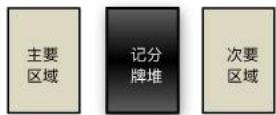
在1、2、3游戏轮的时候,被翻开的卡牌不能都是冷战早期记分牌
回合设置/区域设置示例:
牌库顶上摸一张记分牌。欧洲记分出现,欧洲成为主要区域。放在牌堆左边。接下来摸到中东记分,因为这是早期牌,所以不使用,再摸一张。摸到南美记分。这时候就可以用南美来作为次要区域。将中东记分洗回记分牌堆。
如何放置OP在主要/次要/其他区域:
10P:1/1/不允许
2OP:2/1/1
30P:3/2/1(多的算浪费)
40P: 4*/3*/2*
*【中国牌】允许放置亚洲/东南亚后多得到1op。所以你可以在亚洲/东南亚放置5/4/3。同样【中国牌】也允许改变每回合一个国只能放2点的规则。用【中国牌】在亚洲/东南亚一个国家可以最多放3点。
a. 包括其中所有的国家,以及与这些国家相邻的国家。(举例:如果中东是主要区域并且你在伊朗有影响力一一非控制一一那么你可以在巴基斯坦或者阿富汗放置影响力)
- 第二步:翻开第二张记分牌,来决定是否要进行抽牌。
a. 如果翻开的两张牌都是冷战早期牌,并且是在第一、二或者三轮游戏的时候,我们需要进行额外的抽牌行动。如果满足抽牌行动,那么我们把刚抽到的第二张牌放在旁边,再抽一张记分牌,如果还是早期牌那么我们继续抽一张记分牌。
b.翻开的早期/中期记分牌算做该回合的次要区域。把牌放在记分牌堆的右 边
玩家可以在次要区域放置影响力,但作为惩罚,不管你在次要区域放置了多少OP,都要减去1OP,结果最低不低于1。次要区域不考虑相邻国。如果中东是次要区域,那么巴基斯坦就无法放置影响力。
- 举例:如果你有3OP但是你想要在次要区域放置影响 力那么你就只能放置2OP
3.当区域决定后,你可能就会已经展示了要么一张早期和一张中期的记分牌,或者两张中期的记分牌,或者第三轮后,两张早期记分牌。
a.将这两张记分牌以外的,其他被展示的记分牌洗回记分牌堆
- 如果你想要把影响力放到非记分牌区域怎么办?
a.只有你自己可以选择这个动作(AI不行),以2:1的比率进行每1点影响力的投放,你可以放置到任何你想放置的国家。尽管如此,假如【中国牌】打出后,所有的OP都用到了亚洲,但还是可以用额外的1OP。也就是说,如果亚洲记分牌没有被翻开那么你还是可以放置【3点影响力】在亚洲的,就算是都放在一个国家也是可以的。
i.任何多余的OP将会被浪费,比如你使用了一张3OP的牌
ii. 你必须至少要有2OP才可以选择这个行动
b. 头条阶段:按照接下来的步骤进行行动(你先选择一张手牌,然后AI再翻开一张牌,然后进行结算),除非你自己在太空竞赛中已经处于第四名的位置,并且AI并未提前取消查看AI头条行动的特权。多利用主要和次要区域记分牌来帮助你进行选择。
i.你自己:从手牌堆顶上摸三张牌,必须选择一张打出。
1.如果你在太空竞赛领先至第四名,且AI并未取消特权,那么AI将会首先进行它的”选择“。然后你可以根据AI的选择来决定你的行动。
- 把剩下的两张牌以任意次序放到手牌堆的最下面。
ii.AI:翻开手牌堆上的第一张牌作为头条打出。
1.如果是你专属牌,那么AI将继续翻牌直到翻出一张非你专属牌为止。
a. 如果,极端情况下,一张非你专属牌都没有,那么AI将会打出OP值最低的牌。
b.其他的牌洗混重新组成手牌堆
2.如果翻开不是你专属牌,可以的话,将它作为头条打出。(有些牌无法作为头条打出,比如【中国牌】,那么继续翻牌直到可以为止
a. 如果AI在太空竞赛中领先至第四名,然后你并未取消特权,那么AI就会继续翻开卡牌直到有一OP值大于等于你的头条的OP值的牌出现。(且是非你专属牌)
i.如果AI是美国的情况下,当任何时候【背叛者】被打出来的时候,这张牌立刻取消你(苏联)头条事件。
ii. 如果找不到能够大于或等于OP值的牌的话,则使用它OP最低的牌来进行头条阶段。
iii.如常结算头条(OP相等美国先触发事件)。根据卡牌的内容、放置影响力点数、区域国家次序(下一页)等内容来决定Ai如何进行行动。
1.如果AI需要在头条阶段放置影响力,无特殊要求的话,它会选择优先加在欧洲。看下面的AI影响力放置次序。
2.如果你想要放置影响力,如果没有特殊要求,那么只能放到主要和次要区域(次要区域没有-1OP的惩罚)
c.出牌:苏联每回合都会先行动,除非你用美国且该轮为记分回合,那么这回合你先行动。
i. 影响力放置限制:不论是你还是AI,每一回合中,使用卡牌OP值对一个国家放置不能超过【2点影响力】(【中国牌】除外)。但其他方式比如政变或者事件则可以。
影响力放置限制:你和AI都无法在一个回合放置在一个国家超过2点的影响力。【中国牌】例外。
ii. 你的行动回合:摸手牌堆顶上两张牌(根据上一回合的情况可能只摸一张或者不摸)然后决定你的出牌。把另一张牌放到手牌堆底。
1.选择如何使用你的牌,记录下你的政变或调整影响的行动。如果你打出【联合国干预】,只能取消对方的事件。
a. 什么时候你可以政变?只有下面的条件存在才可以:
i. 如果你的军事行动点数为0且AI多于你
ii.如果是第四轮且你并没有足够的军事行动点数
b. 什么时候你可以调整阵营?任何时候。
iii. AI行动回合:翻开手牌堆的第一张牌。根据该卡牌内容做出以下选择:(注意:AI在记分回合时永远第二个行动)
- 如果本回合不是记分回合:
行动回合次序:苏联每回合都先行,除非你是美国并且该回合为记分回合。你在记分回合总是处于先手。
a. 且该卡牌是【联合国干预】:那么继续翻牌直到一张你专属牌出现为止,这轮使用这张牌的OP值。其他卡牌洗回AI的手牌堆。如果没有这样的牌,那么将【联合国干预】放到一旁,重新翻开一张牌作为头条。
b.AI玩家什么时候可以太空竞赛?如果翻开的卡牌是你专属的事件牌,而且Ai还未进行太空竞赛(或者某些情况下打出了第二张牌),并且该牌有效,那么这张牌将会用作太空竞赛。记得把太空竞赛标识翻面。
i.如果无法进行太空竞赛,那么将会使用其OP值,或者【中国牌】来代替打出。
C. 如果翻开的牌是共有牌或者AI专属牌:看下卡牌事件是否会在这些条件结束后发生。如果不发生事件,则OP将会用于记分回合(下面说明)
- 如果本回合是记分回合:在下列行动选项中选出最合适的:
a. 重要事项:如果事件相对比单纯放置点数,更对主要区域有重大影响时(更高的记分,更多的国家可以控制等),必须进行下列选择。参考下文:
b. AI影响力放置方式:
决定AI行动方式:
本规则最复杂的地方就是AI如何放置影响力。简而言之,如果AI翻开的是你专属牌那么在非记分回合,它会尝试太空竞赛。在记分回合AI的目的则是增加它的潜在得分。
具体考虑顺序如下:
-打出的事件
- 控制战场国
- 控制非战场国
- 强化现有战场国,然后是非战场国
- 扩张至战场国
- 扩张至非战场国
如果放置影响力无法影响分数,AI则会选择在记分区域政变或者调整阵营。
“增加/扩张”定义:
增加/扩张=在一个国家放置1点或者2点影响力。AI已有影响力的国家优先考虑,除非一个更好的记分选择存在,比如打破一个属于你的毗邻超级大国的战场国控制权。
注意:AI永远会选择放置1点优于使用2点换1点的行动。
1.放置影响力总是优先于进行政变/调整阵营行动。就算再有优势也AI也遵循此条。
2. 放置要点:每一步只优先考虑是否能够用来得到记
分,然后再考虑扩张。建议参考区域/国家次序。
a. AI能够在战场国非战场国拥有的最高影响力,是能够达到控制目的的+1或者0。你对于一个国家的影响力,会影响所有大国对该国的总影响力。举例:如果你在法国有【2点影响力】,那么AI就可以拥有最多【6点影响力】(2+3点原始安定值+1=6),如果你没有任何影响力,则AI最多可以拥有【4点影响力】。当然,政变或者改变影响力可以允许AI拥有超过其上限的影响力。
b. 提醒:每回合每个玩家在一个国家可以放置的最大的影响力为【2点影响力】。但是,游戏中有可能会需要3或者4点OP值里放置【2点影响力】。AI会选择尽可能少的OP值来放置影响力。
C. 注意:当放置影响力达到了控制一个国家的最低影响力要求值,或者任意情况符合这种条件时,则需要重新考虑是否可以进行新一轮的影响力放置。举例:当放置影响力并控制了一个非战场国,且控制值超过+2国家的情形发生的时候此选项不再考虑。
-
选项1:增加或扩张影响力到一个去得到控制所需最低影响力,或者,清除你的控制。(优先考虑靠近超级大国,然后是最容易控制的)对于上面例子中的法国来说就是【5点影响力】。最能得分的优先考虑。这一选项并不考虑AI有可能会控制一个非战场国。
-
选项2:增加或扩张影响力到一个战场国去得到控制所需最低+1的影响力,优先考虑安定值高的国家,或者类似的你控制国家的邻国。这一选项并不考虑AI有可能会控制一个非战场国。
-
选项3:增加或扩张影响力到一个毗邻超级大国的非战场国去得到控制所需最低影响力,优先考虑AI的影响力和最容易控制的。
-
选项4:增加或扩张影响力到一个非战场国去得到控制所需最低影响力,最容易控制的优先。这点很重要的是可以得到一个区域的【存在】,而且在控制值不超过+2国家的时候可以选择。
AI影响力放置次序:
欧洲:
美国:西德,法国(中期开始),意大利,加拿大,西班牙,英国,希腊,单买,瑞典,比荷卢,土耳其,挪威。苏联:懂得,波兰,罗马尼亚(中期开始),芬兰,捷克斯洛伐克,南斯拉夫,奥地利,匈牙利,保加利亚。
中东:
美国/苏联:伊朗,埃及,伊拉克,利比亚,以色列,沙特阿拉伯,约旦,叙利亚黎巴嫩,海湾诸国。
亚洲(包括东南亚):
美国/苏联:巴基斯坦,朝鲜,泰国,韩国(朝鲜战争作为事件打出后),印度,日本(美国:中期开始),阿富汗,马来西亚,缅甸,印度尼西亚,老挝/柬埔寨,菲律宾,太晚,越南(苏联:中期开始),澳大利亚。
中美洲:
美国/苏联:巴拿马,墨西哥,古巴(中期开始),萨尔瓦多,尼加拉瓜,哥斯达黎加,危地马拉,海底,洪都拉斯,多米尼加。
南美州:
美国/苏联:委内瑞拉,阿根廷,巴西,智利(【智利总统阿言德】打出之后,或者晚期开始),巴拉圭,哥伦比亚,乌拉圭,秘鲁,厄瓜多尔,玻利维亚。
非洲:
美国/苏联:南非,扎伊尔,阿尔及利亚,尼日利亚,安哥拉,苏丹,突尼西亚,津巴布韦,埃塞俄比亚,博茨瓦纳,撒哈拉诸国,摩洛哥,象牙海岸,喀麦隆,东南非诸国,索马里,西非诸国,肯尼亚。
你可以将以上次序自由更改。你的对手表现的越有趣,你的游戏体验会越不同。
AI政变限制:
AI不会去政变一个有自身安定值+你对其影响力大于5的国家。这时AI可能会考虑调整阵营
-
选项5:增加或扩张影响力到一个相邻的拥有AI影响力的战场国去得到控制所需最低影响力。举例:巴基斯坦与中东相邻,如果此时AI对伊朗有影响力的话就可以选择该选项。如果有多处地区,选择最容易被控制的国家。
-
选项6:在所有AI所拥有影响力战场国都增加【1点影响力】,最容易被控制的国家优先。如果类似选择很多,且你与AI共同拥有一个国家,那么AI就选择这个国家。否则,高安定值的国家优先考虑。
-
选项7:对一个主要区域的战场国、或者相邻区域的战场国(与主要区域【相邻】)进行扩张,如果可能则占领。该选项与选项5类似,只是战场国没有任何AI的影响力。
-
选项8:对所有AI有影响力的非战场国增加【1点影响力】,最容易被控制的优先。如果类似选择很多,且你与AI共同拥有一个国家,那么AI就选择这个国家。否则,高安定值的国家优先考虑。
-
选项9:对一个主要区域的非战场国、或者相邻区域的非战场国(与主要区域【相邻】)进行扩张,如果可能则占领。
C. 如果使用OP来放置影响力并不会改变潜在得分的可能/位置,并且AI尚未领先,且或,在该区域存在,它会对:一个战场国,一个与超级大国相邻的国家,或一个区域内的非战场国进行政变/调整阵营的行动(如果核危机允许),最低安定值的优先。只有当结果有可能使AI在主要区域得分的前提下才允许选择如此做。
i. 被政变或者调整的国家安定值必须等于或者小于使用卡牌的OP值。
ii. 政变是可选的么?只有当一个国家的总值(安定+影响力)小于等于5的时候才可以进行。举例:如果古巴有你的【3点影响力】,那么古巴无法作为AI政变的目标(3+古巴安定值结果大于5)
iii.调整阵营只有因为没有国家可以被政变,或者核危机等级+你的影响力,其结果大于等于6的时候(政变不可能成功),才被选择。
1.战场国优先被选择必须遵循以下条件:a. 国家拥有小于等于3影响力b. 无修正国家优先修正值不超过-1的国家c. AI不会调整那些它已有影响力的国家d. 参考区域/国家次序
d.如果AI在主要区域与你持平或者领先,并且OP值/事件不会影响它的分数位置,那么查看卡牌(非记分牌)的事件是否可以发生。
【中国牌】限制:
AI如果在主要区域领先,
则无法使用将【中国牌】
作为一种选择打出,也无
法政变或者调整阵营。
【中国牌】只能用来放置影响力。
i. 如果是共有牌或者AI专属牌,那么AI就会按照上面的顺序发生行动;AI放置影响力到次要区域。一个没有AI存在的并且连接了其他区域的国家,比一个连接了很多相同区域国家的国家更重哟。
ii. 如果是你的事件牌,优先考虑太空竞赛。或者AI要么进行政变(核危机允许),要么在次要区域进行调整。按照以下顺序:(【中国牌】在这种情况下不能使用)
-
选项1:优先考虑对一个战场国,或者安定值小于等于OP值的与超级大国相邻的非战场国发动政变,且安定值+影响力小于等于5。
-
选项2:优先考虑对一个战场国、一个邻近超级大国的非战场国,或者安定值小于等于OP值的非战场国发动调整。
-
另外,如果国家有数值相等的情况,优先考虑最低安定值和最影响力的国家。如果仍然相等,选择不与AI拥有影响力的国家相邻的国家。
e. 如果没有任何选择可以让AI改善它的积分位置,而且是游戏后期;或者AI扮演苏联而且在某一个区域作为主要区域时,却没有该区域的任何存在的情况下,那么使用影响力将不会有任何惩罚机制,而且这些影响力将会按照AI放置影响力次序的方式放置在欧洲。
3. 【中国牌】(无法用于头条、政变或者调整)
a. 如果以下条件发生,那么AI选择使用【中国牌】:
i.该牌于上一个回合最后被放置在手牌堆里,且这回合被翻出
ii.AI已经在本回合打光所有手牌,但仍然还有下一个回合可以行动
iii.【中国牌】属于AI,但又不在它的手牌堆里(比如游戏开始时),并且这一回合是记分回合,并且翻开的牌是你专属牌。1.被翻开的你的事件牌被移动到AI手牌堆的最下边
b. 【中国牌】额外影响力:不论是谁,当使用【中国牌】并将所有影响力放置在亚洲/东南亚时,额外增加1点OP值,这额外的1点OP值可以当做第三点影响力放置在一个国家上。
C. 你可以选择随时使用【中国牌】,如果【中国牌】面朝上并属于你(并非手牌)。你使用的时候必须要先从手牌堆抽牌。
i. 如果【中国牌】被移进你的手牌堆,那你只能等抽到的时候再用了。
1.如果任何玩家需要交出【中国牌】,那么不管什么情况都要交出。如果需要搜索手牌堆来找【中国牌】,那么找到后,手牌堆要重新洗匀。
d.注意:如果亚洲或者东南亚为主要或者次要区域,那么【中国牌】的影响力放置在可以在亚洲东南亚的任意地点。亚洲和东南亚对于非事件产生影响力的牌来说,是属于两个不同的区域。
iv.将带星的事件使用完毕后移除,剩下的面朝上,形成弃牌堆。
3.结束一个回合,记分,或者决定下一和会是否为记分回合
a. 如果是记分回合,在玩家都完成行动后记分。整个游戏中最多会有17个积分回合以及一个最终积分回合。
i. 最早的一次记分回合会发生在冷战早期的第三回合,最晚的一次有可能是在第六回合。
1.当下一张冷战早期记分牌这回合被翻开并且决定主要区域时,一次记分回合就只会从冷战早期的第三回合或以后才发生。看下面例子。
ii. 冷战中期/晚期记分回合会发生在第三和第六回合,不论记分牌是否被翻开。
b. 决定下一轮的主要和次要区域(如果可能)
i. 如果最后一回合打出的是本轮第一个,或者唯一的记分牌,将接下来的2张记分牌翻开来决定主要和次要区域。
1.特例:最后一张记分牌在冷战早期是不会被翻过来的。所以,如果记分回合在第五或者第六回合,那么你就要翻开一张(第五回合)、或者不翻(第六回合)记分牌。至少在最后一个回合保留一张记分牌。
ii. 如果最后一个回合不是记分回合,将主要区域牌放置一旁,然后要么将次要区域牌放到次要区域牌处,或者,如果没有牌面朝上,那么抽一张牌作为下一轮新的主要区域牌。所以,一个非记分回合之后,将会只有一张面朝上的主要区域牌。
1.进程变化:从第四轮(冷战中期)的第三回合开始,将记分牌堆最底下的牌拿出来(不能看),与之前两回合用过的两张区域牌一并洗混然后放置到记分牌堆最底部。
a. 全轮示例(冷战早期)
早期战争记分:
早期每轮只有一次记分回合。最早可以发生在第三回合,最晚发生在第六回合。
中期/晚期战争记分:中晚期每轮将会有两个记分回合,一次在第三回合,一次在第六回合。
i. 第一回合:欧洲(主要)和南美(次要)被翻出,放好并开始游戏。
ii. 第二回合:南美(主要)移动到欧洲的位置,取代欧洲成为主要区域,无次要区域。
ii. 第三回合:东南亚被翻开(主要),放置之前南非的位置。无次要区域。
iv.第四回合:中东被翻开(主要)放置之前东南亚的位置),此回合为第一个记分回合,无次要区域。
v. 第五回合:拉丁美洲(主要)和亚洲(次要)被翻开,设置好
vi. 第六回合:亚洲(主要)移动到拉美的位置,无次要区域。
b. 冷战中期轮,东南亚已被移除,示例:
i. 第一回合:中东(主要)和亚洲(次要)进场,开始游戏
ii. 第二回合:亚洲(主要),无次要
iii. 第三回合(记分回合):(把中东和亚洲还有记分牌最下面一张洗混然后放到记分牌堆最下方)拉美(主要)被翻开(记分回合/生要区域),无次要,最后记分环节将会在所有人完成自己的行动后开始,从你先开始行动。
iv.第四回合:南美(主要),欧洲(次要)
v. 四五回合:欧洲(主要),无次要vi. 第六回合(记分回合):中东(主要)被翻开,无次要,最后记分环节将会在所有人完成自己的行动后开始,从你先开始行动。
vii.第七回合:亚洲(主要)被翻开,无次要因为这是这一轮的最后一个回合。注意:非洲在本次示例中并未出现。
4. 一轮结束:
a.在6(早期)、或7回合结束后,一轮结束。按照以下动作进行下一轮:
i. 注意查看你自己的军事行动点数,AI不因为军事行动点数失分。
-
核危机状态恢复一级
-
军事行动点数归零
ii.把打出的记分牌洗混,在卡牌轮抽后放置好。如果上一轮南亚记过分,则需要把东南亚记分牌移走。
iii.如果因为进入不同战争时期或者卡牌抽完了,就把需要新加入的牌加入并重新洗混。
iv.按照上面的规则继续游戏。准备好本轮的玩家手牌,当中期的时候记得有一些小变化:手牌持有数变为9
5. 游戏结束条件:
a.游戏未算分立即结束的情况:
i. 游戏中任一玩家获得20VP
ii. 如果在你的回合核危机等级为0,你输掉游戏。AI永远不会因此输掉游戏,卡牌中关于核危机的内容被自动忽略,其余的事件照常发生。
iii. 欧洲在记分时被玩家控制:
-
AI控制则AI胜利
-
你控制欧洲,并且你的分数属于正分(必须领先对手,0不算),你胜利
3.【战争游戏】牌被打出
b.十轮游戏后,全区域记分后VP标记在0的哪边,哪边就获胜。注意:最终记分时东南亚属于亚洲。6. 胜利级别:
a. 分数<0或者AI分数超过20,你输了
b. 分数=0,平局
c. 分数1\~3,旗开得胜
d. 分数4\~6,战果累累
e. 分数7\~9,实力碾压
f.游戏结束前得到20+分数,或者游戏结束时10+,TS大神
卡牌附录:下面卡牌的内容表明了AI何时可以发动事件。除非下面内容说明,或者事件点数小于该牌OP值,则AI必须使用OP值来放置影响力。你可以任意使用属于你的牌,除非下面对于你有明确说明。事件按卡牌编号排版,名称按照战棋会中文译名翻译,可方便玩家快速查考,与本规则英文版顺序(按首字母)不同。
额外说明:
-
如果任何时候,AI被要求搜索弃牌堆,但没有相应的牌,或者没有弃牌堆,则从手牌堆顶上摸牌直到摸到符合条件的牌。
-
如果需要从对方手里抽牌的结果是【中国牌】,则此次抽牌无效,再抽一张。如果是为了事件去满足OP值(比如【困境】),【中国牌】可以被抽取。按照需要重洗手牌堆。
-
如果不是记分回合,相比起占领一个城市,AI会选择扩张。
冷战早期:(AI只会触发那些符合条件的事件)
.1【亚洲记分】
· 2【欧洲记分】
· 3【中东记分】
•4【躲避与掩护】:头条/非记分回合:如果可以得到2+VP,或者在任何记分回合中如果获得VP可以游戏胜利。以上两个条件满足时都可以触发该事件。
.5【五年计划】:头条/非记分回合;
·6【中国牌】
·7【社会主义政府】:头条/非记分回合(如果对记分有好处)
.8【菲德尔·卡斯特罗】:头条/中美洲或非记分回合;
·9【越南起义】:头条,亚洲东南亚/非记分回合
:10【封锁】:头条/非记分回合;你可以通过改用这个回合抽取的另外两个牌来取消该事件。如果该事件取消,你必须打出另外一张牌。如果对象是AI:AI必须翻牌直到OP值3+的牌被翻出来,并被弃置,如果没有则事件照常发生。
•11【朝鲜战争】:头条/非记分回合(如果美国在朝鲜至少有1点影响力且无修正值,或者美国影响力3+且有+1修正值))
·12【罗马尼亚颠覆】:头条(只要使用1点影响力就可以触发)/欧洲或非记分回合如果增加或者移除2+影响力
·13【阿拉伯-以色列战争】:头条/非记分回合(为修正值为0或-1,但如果要赢则仍需要胜利一次)*此括号为非记分回合要触发该事件的条件(下同)
·14【经济互助委员会】:头条/非记分回合(如果AI可以控制2个或更多的城市)
·15【埃及总统纳赛尔】:头条/非记分回合除非1点影响力可以对记分有效果
·16【华沙条约组织成立】:头条/欧洲记分回合
·17【戴高乐领导法国】:头条/欧洲或非记分回合(只有在3点影响力全可以移除的情况下)
•18【逮捕纳粹科学家】:头条/非记分回合;如果AI太空竞赛落后。
·19【杜鲁门主义】:头条(除非可以移除影响力,否则重抽)/欧洲或非记分回合(如果2+影响力可以被移除)
:20【奥运会】:头条/非记分回合:抵制奥运会的行动只会阻值另一方游戏胜利,并且如果核等级为2则不会选择此项。如果你选择抵制奥运会,那么AI可以在亚洲放置影响力(次序:巴拿马,泰国,委内瑞拉,阿根廷,尼日利亚,扎伊尔)且不会遭到惩罚。
·21【北大西洋公约组织】:此事件永远不发生:只用作OP值。如果在头条阶段抽到,重新抽牌。
·22【独立的红色】:头条(除非使用了2+的影响力否则抽另一张牌)/欧洲或非记分回合如果可以得到3+点影响力
·23【马歇尔计划】:头条(如果可以放置6+点影响力,或者2+个国家可以被控制)/欧洲或非记分回合(如果2+个国家可以被控制)
·24【印度-巴基斯坦战争】:头条/非记分回合:向能够给AI提供最大好处的方向进攻,而且如果在头条阶段,有0或者1个相邻的控制的国家,或者在非记分回合有0个相邻的控制的国家,则只触发事件。如果以上选择没什么区别,印度进攻巴基斯坦。
.25【遏制政策】:头条/只限第一轮
•26【建立中情局】:头条/非记分回合;你必须按照OP值递减的顺序排列排列你手牌(最高到最低)中的AI专属牌,然后将其余(共有/你专属)的事件牌按照OP值递增的顺序(OP最高放在你的手牌堆最下方),然后洗牌。如果对象是AI:你可以查看AI的手牌但不要改变次序。
·27【美日共同防卫协定】:只限头条
·28【苏伊士运河危机】:头条(如果3+的影响力可以被移除,否则重新抽牌)/非记分回合但只能在4点影响力被移除的情况下触发。从法国、以色列和英国移除影响力。从第一个国家开始,如果可能,移去2
:29【东欧剧变】:头条/欧洲记分回合:如果在记分回合,该事件的效果大于使用放置影响力的OP值,则触发。
:30【去殖民地化】:头条/非记分回合:先尝试控制多个互不相邻的战场国,如果没有,就尝试控制相邻的非战场国。战场国的控制要试着给AI扩展最好的机会。
.31【红色恐怖/清洗】:头条/只限第一轮
:32【联合国干预】:(无法在头条阶段使用)可以在任意回合使用:AI将会一张张翻开直到你专属的牌出现,这张牌的OP将会被用来放置影响力。将其余的拍重新洗回AI的牌堆中。如果没有找到,那么这张牌将会以1OP来被使用。如果你选择打出【联合国干预】,那么你只可以取消你该回合摸到的另外一张牌。
:33【去斯大林化】:头条/非记分回合:当AI拥有至少两个“超过”所需基本控制影响力的国家才出发该事件,用来扩张到至少两个不同的区域的至少两个战场国。如果AI可以做到这点,那么它就会这么做。战场国次序为:巴拿马,泰国,委内瑞拉,阿根廷,尼日利亚,扎伊尔,或者控制以上其中一国和两个或以上非战场国。
·34【禁止核爆试验】:头条/非记分回合:如果可以获得2+VP,或者获得游戏胜利,则触发。
·35【台湾决议】:头条/在亚洲记分回合中:在记分回合中,假如额外的影响力是多余的,且它会对记分有好处,那么它才会被触发。
·103【背叛者】(这张属于冷战早期牌):只限头条:该回合不能打出使用OP值,除非手牌中只剩下【中国牌】和这张牌。如果出现在摸牌过程中则放到牌库底部并重新摸一张。
冷战中期:
·36【局部战争】:头条或任意行动回合(如果可以,记分区域有限被选择,战场国优先于非战场国)。否则,选择次要区域的一个战场国或欧洲的任意一个国家(战场国优先于非战场国)。0修正值的国家永远优先被选择。如果没有,那只考虑-1修正值的国家,否则事件不发生而是放置影响力。
· 37【中美洲记分】
· 38【东南亚记分】
·39【军备竞赛】:(非头条阶段)/非记分回合(如果AI的军事行动点数多于你。否则将它所用到的军事行 动点数和现在的核危机作比较,看是否能够得到3VP)
·40【古巴导弹危机】:头条(只有当影响力可以被移除时)/欧洲记分回合(将核危机改为2,同时从你控制的西德/土耳其移除2点影响力,条件是比放置OP值更有利于记分。忽略内容中其他文字)
•41【核潜艇】:只限头条(如果AI这轮是第一次政变,则政变2次,按照伊朗,利比亚,埃及和伊拉克的顺序。这些国家优于非战场国。)
·42【困境】:头条或非记分回合(如果你受到影响,摸两张牌,如果两个都是1OP,则你不投点并且失掉你的回合。你可以选择不投点只弃牌然后不进行这一回合。如果AI受到影响,翻开牌堆直到一张2+OP的你专属牌出现。如果没有,选择一张2或3或4(按顺序)OP值的牌。然后投点看事件是否被取消。在选择后如果多余的牌被摸到,重洗AI的牌库。)
•43【战略核武器裁减谈判】:头条或非记分回合或记分回合领先(AI会在弃牌堆由上至下翻牌,获得第一张它翻到的3+OP值的AI专属牌。最后重洗牌库
•44【捕熊陷阱】:头条或者非记分回合(如果AI受到影响,AI抽牌直到一张美国2+OP值的牌出现,否则在投骰子之前,选择一张2或3或4(按顺序)OP值的共有牌。事件仍旧被触发。如果你受到影响,你只能使用你抽到的两张牌去进行阻挡。你可以选择不弃牌并且略过你本回合的行动。)
·45【首脑会议】:头条或非记分回合(只有当相等或者占优时。如果需要,在头条阶段重新摸牌。如果事件被打出过了,AI会将核危机恢复一个等级。)
·46【我如何学会不再担忧】:头条或非记分回合(AI将核危机设置到5并得到5点军事行动点数)
·47【军事独裁】:头条或中美或南美记分回合(如果可以,按照AI在主要区域的放置影响力次序放置影响力,然后再考虑那些AI拥有最少控制影响力的国家。如果没有的话,政变一个2安定值的战场国,对一个2安定值,然后一个1安定值的国家考虑进行调整阵营。AI会想要得到最多的国家)
,48【厨房辩论】:头条或非记分回合(只有当可以得到2VP时。如果需要,在头条阶段重新抽牌)
•49【导弹嫉妒】:头条或非记分回合(如果由你打出,讲AI的手牌堆展示出来,并选择最高OP值的牌如果3+的你专属牌被交换。如果需要,洗牌并随机抽取。选择后重洗AI的手牌。如果由AI打出,你必须选择最高OP值的牌。如果有同价值的牌,你自己选择一张。)此后,将此牌交给对手并作为下一行动回合的牌来使用其OP值。
·50【“我们将埋葬你们的”】:头条或非记分回合(如果核危机为2则该事件无法被选择。如果强制执行事件作为OP值使用并且核危机为2的话,不降低核危机。AI不会被迫进入核战争。)
.51【勃列日涅夫主义】:头条或只限于第一轮
·52【葡萄牙王国瓦解】:头条(只有在两个城市都不控制时。如果有需要就重新摸牌)或非洲记分回合(如果可以在区域内有更大的效果)
•53【南非动荡】:头条(只有在控制值不超过+2的国家情况下才可以打出,如果超过,重新摸牌)/非洲记分或非记分回合(当美国控制南非,并且控制权可被夺取,或者苏联已经控制了2个邻国时,南非专属这个选项才被选择。否则必须占领一个国家,或者对两个国家进行扩张
·54【智利总统阿言德】:头条或者南美记分回合(只有当AI没有控制智利时打出,如果需要,在头条阶段重新抽牌)
·55【德国总统维利·勃兰特】(英文版作者忘记录入)
·56【穆斯林起义】:头条(要触发事件必须能够移除至少4+影响力,否则重新抽牌。)或非记分回合(必须能够移除至少5+影响力。)如果目标是战场国则考虑一下顺序:伊朗,利比亚,埃及和伊拉克。这些国家优于非战场国。
.57【反弹道导弹条约】:头条/所有回合(只结算事件)
.58【文化大革命】:头条或第一个行动回合(如果可以得到【中国牌】,否则抽另一张牌)/之后的行动回合仅仅当可以得到VP并获得胜利时。
·59【花朵力量】:头条(只有当领先5+VP时,否则抽另一张牌)
·60【U-2侦察机事件】:头条/任意回合(只有在会获胜时)
.61【石油输出国组织】:头条或非记分回合或记分回合如果OP值无效(只有当2+VP可以获得时才被考虑。如果需要,在头条阶段摸另一张牌)
·62【“独行枪手”】:头条或非记分回合(你必须按照OP值递减的顺序排列排列你手牌(最高到最低)中的AI专属牌,然后将其余(共有/你专属)的事件牌按照OP值递增的顺序(OP最高放在你的手牌堆最下方)。然后洗牌。)
·63【殖民后卫】:头条或非记分回合(参考AI的影响力放置次序。如果可以,邻国不放置任何影响力。如果可以,尝试获得2+个国家的控制。)
·64【归还巴拿马运河】:头条或中美记分或南美记分或非记分回合(必须可以控制/破坏到至少一个城市或扩张到两个城市。如果需要,在头条阶段重新摸牌
•65【戴维营协议】:头条或中东或非记分回合(只有在能得到控制1+战场国或者2个国家的情况下)
·66【傀儡政府】:头条或非记分回合(如果可能,控制两个非邻国)
·67【向苏联出售谷物】:头条(3+OP值的AI专属事件,或者共有牌,否则抽另一张牌)/任意行动回合(根据对手的位置使用事件,否则改用OP值)
·68【约翰·保罗二世当选教皇】:头条(交换2+影响力)/欧洲或非记分回合(如果交换了3点影响力)
·69【拉丁美洲敢死队】:头条或中美记分回合(AI会立刻对中美进行政变。顺序为战场国,超级大国邻国,然后是非战场国。如果没有,OP值将用作在中美的影响力放置,卡牌效果仍旧触发。)
·70【美洲国家组织创立】:头条或南美或中美记分回合(记分然后更弱的区域被优先选择,优先考虑分数然后再是国家的连通)
,71【尼克松打出中国牌】:头条或非记分回合(AI必须拥有【中国牌】)
·72【埃及总统萨达特驱逐苏维埃】:头条或中东记分或非记分回合(只有在苏联在埃及有影响力,或可以得到控制权)
·73【穿梭外交】:(非头条阶段,抽一张牌)/中东记分或亚洲记分(当打出时,卡牌的效果必须能够改 变记分)
·74【美国之音】:头条或非欧洲记分的任意其他回合(除非无效果)记分区域优先考虑。除非主要区域可以得到支配或控制,否则比起非战场国,AI会优先选择控制最多的战场国。
·75【解放神学】:头条或非记分回合(参考AI的影响力放置次序。如果可以,邻国不放置任何影响力。如果可以,尝试获得2+个国家的控制。)
·76【乌苏里江冲突】:头条或亚洲记分或非记分回合
·77【“不要问你的国家能为你做什么”】:头条/非记分回合(查看AI的手牌然后将所有你专属的事件牌丢弃,抽牌后然后重洗AI手牌堆)对你:你不可以看你抽到的牌,并且在抽牌后重洗你的手牌堆。
·78【美洲进步同盟】:头条/非记分回合(只用做 2+VP)
· 79【非洲记分】
.80【“一小步......”】:头条或非记分回合(只有当太空竞赛落后)
· 81【南美洲记分】
冷战晚期:
·82【伊朗人质危机】:头条或非记分回合(如果苏联不控制伊朗)
•83【铁娘子】:头条(如果可以从英国和/或美国拥有对阿根廷的控制且不会因为添加影响力而失去时可以打出)/任意回合(只有VP可以让美国获胜)
·84【里根轰炸利比亚】:头条或非记分回合(只有苏联在利比亚有影响力时才触发。如果你是苏联并且再利比亚有3+的影响力的话,AI会触发事件并获得2VP而不是1VP。如果苏联在利比亚没有影响并且此事件发是头条的话,摸另一张卡来代替
,85【星球大战】:头条或非记分回合(如果在主要区域领先)找一张你首先摸到的3+的美国牌打出。
·86【北海石油】:此事件永远不发生:只用作OP值。如果在头条阶段抽到,重新抽牌。
.87【改革家】:头条或欧洲记分或非记分回合或任意其他记分回合(如果OP值在记分回合并无特殊影响)
•88【轰炸海军陆战队兵营】:头条或中东记分或非记分回合(只有当美国在黎巴嫩有影响力时,并且可在1+的城市里清除控制或者获得控制)头条阶段如果需要的话可以重新摸牌。
,89【苏联击落韩国航空公司-007航班】:头条或一周记分或非记分回合(核危机为2时不可打出。如果AI强制性打出,则只有VP受到影响。如果AI是苏联,不会导致核战争)
·90【开放】:头条/任意其他回合(只有当【改革家】打出后,或者等到2VP可获得胜利时)
:91【奥尔特加当选尼加拉瓜总统】:头条或中美记分或非记分回合(只有当美国在尼加拉瓜和其邻国有影响力时)头条阶段如果需要的话可以重新摸牌。
·92【恐怖主义】:头条/非记分回合(如果【伊朗人质危机】被打出)/记分回合(如果OP值无效果)
·93【伊朗门丑闻】:此事件永远不发生:只用作OP值。如果在头条阶段抽到,重新抽牌。
•94【切尔诺贝利】:头条(效果等到第一个记分回合出现时才发动,并保护该区域)/记分回合(只有当AI在某记分区域领先时,才可保护该区域)
·95【拉丁美洲债务危机】:头条或非记分回合(如果你受影响,3+的牌必须在2长被摸到的牌里,或者你这回合打出的牌,否则事件被触发)
·96【推倒柏林堵墙】:头条或欧洲记分或非记分回合(只能用在得到/破坏东德的控制权上)头条阶段如果需要的话重新摸牌。
·97【“邪恶帝国”】:头条或任意回合(只有在会获胜时)
·98【奥德里奇·艾姆斯】:头条或非记分回合(如果你被影响,弃掉你最高OP值的专属牌,如果没有,则改为弃掉最高OP的共有牌(【中国牌】除外)。然后将你手里的AI专属卡按照递减的方式排列,然后把共有/你专属的牌进行递增顺序排列,拼在一起。如果你是美国玩家,你必须按照这个顺序打牌,并且再本轮内不会再进行“摸两张卡并选择其一”的行动。)
·99【部署潘兴II型导弹】:头条/欧洲记分回合(如果移除影响力会影响记分,或者VP可以获得胜利)/非记分回合(如果VP可以获得胜利)
·100【战争游戏】:头条或任意回合(只有在会获胜时)
.101【团结工会】:头条或欧洲记分或非记分回合
·102【两伊战争】:头条(修正值为0或者-1)或非记分回合(修正值为0或者-1且有可能获得游戏胜利)
可选事件:
,104【剑桥五杰】:头条(在现在的主要和次要战场放置影响,参考AI的次序)或任意记分回合(只有在有可能破坏一个战场国的控制的前提下,在该国可以放置1点影响力)
:105【英美特殊关系】:头条或欧洲记分或非记分回合(只有非被控制的英国的邻国)头条阶段如果需要的话重新摸牌。
·106【北美防空司令部】:头条或非记分回合(放置在能够得到控制权的战场国上(早期冷战时出现的区域接着是最弱的区域))
:107【切·格瓦拉】:头条或中美记分或非记分回合(最低安定值(1或者2)的战场国先被选择然后是非战场国。如果成功则重复。如果可以,选择记分区域或者一个新区域)
·108【我们的人在德黑兰】:头条(抽5张牌,留下美国或共有牌,洗进手牌堆)或非记分回合(只在第四到第九轮)
.109【尤里和萨曼莎】:只限头条
.110【出售售机载空中警报控制系统】:头条或中东记分或非记分回合(只有在美国不控制沙特阿拉伯
时)头条阶段如果需要的话重新摸牌。
AI影响力放置次序(大字速查)
欧洲:
美国:西德,法国(中期开始),意大利,加拿大,西班牙,英国,希腊,单买,瑞典,比荷卢,土耳其,挪威。
苏联:懂得,波兰,罗马尼亚(中期开始),芬兰,捷克斯洛伐克,南斯拉夫,奥地利,匈牙利,保加利亚。
中东:
美国/苏联:伊朗,埃及,伊拉克,利比亚,以色列,沙特阿拉伯,约旦,叙利亚黎巴嫩,海湾诸国。
亚洲(包括东南亚):
美国/苏联:巴基斯坦,朝鲜,泰国,韩国(朝鲜战争作为事件打出后),印度,日本(美国:中期开始),阿富汗,马来西亚、缅甸、印度尼西亚、老挝/柬埔寨,菲律宾,太晚、越南(苏联:中期开始),澳大利亚。
中美洲:
美国/苏联:巴拿马,墨西哥,古巴(中期开始),萨尔瓦多,尼加拉瓜,哥斯达黎加,危地马拉,海底,洪都拉斯,多米尼加。
南美州:
美国/苏联:委内瑞拉,阿根廷,巴西,智利(【智利总统阿言德】打出之后,或者晚期开始),巴拉圭,哥伦比亚,乌拉圭,秘鲁,厄瓜多尔,玻利维亚。
非洲:
美国/苏联:南非,扎伊尔,阿尔及利亚,尼日利亚,安哥拉,苏丹,突尼西亚,津巴布韦,埃塞俄比亚,博茨瓦纳,撒哈拉诸国,摩洛哥,象牙海岸,喀麦隆,东南非诸国,索马里,西非诸国,肯尼亚。
你可以将以上次序自由更改。你的对手表现的越有趣,你的游戏体验会越不同。
AI放置影响力演示:
在接下来的演示中AI放置影响力的决定是按照本规则书来的。AI的每一次行动都代表了AI所占的立场(选择的超级大国)并放置影响力因为事件并非都有利于记分区域。提醒:如果事件属于你的战鹰,AI有可能选择去正政变一个其安定值等于或者小于卡牌OP值的战场国(只要安定值+现有影响力不会超出5)。如果出现相类似的情形,按照区域/国家次序来,其中拥有最少影响力的国家将会优先被政变。
南美记分回合(提醒:在所有记分回合中,AI永远排进行后手行动)
1OP:
苏联:放置1点在阿根廷或政变哥伦比亚如果是你专属牌且可以在区域内占优。
美国:放置1点在巴拿马(在南美放置影响力并不会改变它的潜在记分。因此参考AI影响力放置次序,因为在哥伦比亚有影响力,那么它可以在巴拿马就可以放置影响力了。)
2OP:
苏联:放置1点在阿根廷和巴西(取得两个战场国的控制)或政变哥伦比亚
美国:用2点去放置1点影响力在委内瑞拉和巴拿马(平衡区域(减少己方分数并增加对方分数)并且使对方扩张)或者,如果是你的专属事件,政变阿根廷(如果核危机允许)。
3OP:
苏联:用3点在哥伦比亚放置2点(取得控制权)。(获得区域控制,相比政变,AI会优先选择放置影响力取得控制,)
美国:用2点:1点在委内瑞拉,1点在巴拿马(平衡区域并控制一个战场国)或者政变阿根廷,如果是你专属事件。
4OP:
苏联:用3点:2点在哥伦比亚(取得控制)1点在阿根廷。
美国:用2点去放置1点在委内瑞拉,2点在巴拿马(平衡区域并控制战场国)或政变阿根廷,同上。
亚洲记分回合:
1OP:
苏联:1点在老挝/柬埔寨
美国:1点在韩国
2OP:
苏联:1点在老挝/柬埔寨,1点在朝鲜
美国:用2点区放置1点在朝鲜
3OP:
苏联:1点在老挝/柬埔寨,用2点在韩国放置1点
美国:用2点放置1点在朝鲜,1点在韩国
4OP:
苏联:1点在老挝/柬埔寨,用2点在韩国放1点,1点在朝鲜
美国:用2点放置1点在朝鲜,1点在韩国,1点在菲律宾
中东记分回合:
1OP:
苏联:1点在叙利亚
美国:1点在约旦
2OP:
苏联:1点在叙利亚,1点在伊朗
美国:用2点放1点在埃及
3OP:
苏联:1点在叙利亚,2点在伊拉克
美国:用2点放1点在埃及,1点在约旦
4OP:
苏联:1点在叙利亚,2点在伊拉克,1点子巴基斯坦
美国:用2点放1点在埃及,1点在约旦,1点在伊拉克
欧洲记分回合:
10P:
苏联:1点在罗马尼亚
美国:1点在西德
2OP:
苏联:1点在罗马尼亚,1点在波兰
美国:2点在西班牙/葡萄牙
3OP:
苏联:1点在罗马尼亚,用2点放1点在西德
美国:2点在西班牙/葡萄牙,1点在西德
4OP:
苏联:1点在罗马尼亚,用2点放1点在西德,1点在波兰
美国:2点在西班牙/葡萄牙,1点在西德,1点在阿尔及利亚
中美洲记分回合:
1OP:
苏联:1点在巴拿马
美国:对巴拿马调整阵营
2OP:
苏联:1点在巴拿马,1点尼加拉瓜
美国:2点在墨西哥
3OP:
苏联:1点在巴拿马,1尼加拉瓜,1点洪都拉斯
美国:2点墨西哥,1点古巴
4OP:
苏联:1点在巴拿马,1尼加拉瓜,2点洪都拉斯
美国:2点墨西哥,用2点放1点在巴拿马
非洲记分回合:
1OP:
苏联:1点苏丹
美国:1点南非
20P:
苏联:1点苏丹,1点埃及
美国:1点南非,1点苏丹
3OP:
苏联:1点苏丹,1点埃及,1点阿尔及利亚
美国:2点南非,1点苏丹,
4OP:
苏联:1点苏丹,2点埃及,1点阿尔及利亚
美国:2点南非,1点苏丹,1点博茨瓦纳
谢谢阅读。
下载 MarkdownTS_Rules_Deluxe.md150.3 KB
TWILIGSTSTRUGGLE
THE COLD WAR, 1945-1989
Deluxe Edition by Jason Matthews & Ananda Gupta
RULE BOOK
T A B L E O F C O N T E N T S
Introduction. 2 10. Scoring and Victory 10
2. Components 11. Tournament Play
3. Game Setup. 3 12. The Chinese Civil War Variant .
Game Sequence 3 A Late War Scenario .
5. Card Play Game Credits .... 13
6. Operations Designer Optional Rules 13
Events 8 Extended Example of Play. 14
8. DEFCON Status and Military Operations 8 Card Histories 2 1
9. China 9 Designer’s Notes .. 3 1

1.0 INTRODUCTION
“Now the trumpet summons us again — not as a call to bear arms, though arms we need, not as a call to battle, though embattled we are — but a call to bear the burden of a long twilight struggle...”
—John F. Kennedy, Inaugural Speech, January 1961
In 1 945, unlikely allies slew the Nazi beast, while humanity’s most devastating weapons forced the proud Japanese Empire to its knees in a storm of fire. Where once there stood many great powers, now stood only two. The world had scant time to sigh relief before a new conflict threatened. Unlike the titanic conflicts of the preceding decades, this conflict would be waged primarily not by soldiers and tanks, but by spies and politicians, scientists and intellectuals, artists and traitors.
Twilight Struggle is a two-player game simulating the forty-fiveyear dance of intrigue, prestige, and occasional flares of warfare between the Soviet Union and the United States. The entire world is the stage on which these two titans fight to make the world safe for their own ideologies and ways of life. The game begins amidst the ruins of Europe as the two new ‘superpowers’ struggle over the wreckage of the Second World War, and ends in 1989, when only the United States remained standing.
Twilight Struggle inherits its fundamental systems from the carddriven classics We the People and Hannibal: Rome vs. Carthage. It is a quick-playing, low-complexity game in that tradition. Event cards cover a vast array of historical happenings, from the Arab-Israeli conflicts of 1948 and 1967, to Vietnam and the U.S. peace movement, to the Cuban Missile Crisis and other such incidents that brought the world to the brink of nuclear annihilation. Subsystems capture the prestige-laden Space Race as well as nuclear tensions, with the possibility of nuclear war ending the game.
These rules are organized into numbered sections, with some sections further subdivided into subsections (for example, 2. 1 and 2.2). In a number of places in the rules, you will see references made to rules sections and subsections that are related to the one you are reading.
Additionally, terms that have specialized meaning within these rules, such as ‘Influence’ or ‘Battleground’, are consistently capitalized to allude to their specialized context within the rules.
2.0 COMPONENTS
A complete game of Twilight Struggle includes the following:
• One 22” by 34” Map Board
• Two sheets of markers
• One Rules Booklet
• Two Player Aid Cards
• 110 Cards
• Two 6-sided dice
2.1 THE GAME MAP
“From Stettin in the Baltic to Trieste in the Adriatic, an iron curtain has descended across the continent.”
—Winston Churchill
2.1.1 The map is divided into six Regions: Europe, Asia, Central America, South America, Africa, and the Middle East. A region is a group of geopolitically connected nations, normally in close geographic proximity. Europe is divided into two sub-regions, Eastern Europe and Western Europe. Two historically neutral countries (Austria and Finland) are categorized as being in
both Eastern and Western Europe. Asia also contains a sub-region, Southeast Asia. The country spaces that comprise a region share a map color. Sub-regions have shades of the same color.



DESIGN NOTE: Although not exactly geographically correct, the Middle East includes Libya and Egypt for political purposes, while Canada and Turkey are included in the Europe Region.
2.1.2 Any event, rule, action, or card that refers to ‘Europe’ or ‘Asia’ includes the associated sub-regions.
2.1.3 Each space on the map represents a country or bloc of countries (hereafter simply called a country). Each country has a Stability Number representing the country’s overall stability, independence and power.

2.1.4 Battleground States. While most states have their names on white, Battleground countries operate the same way as normal spaces but have special rules for scoring (see 10.1) and coup attempts (6.3). Their country name is highlighted in purple for easy recognition.
2.1.5 There are two spaces on the map representing the geographic locations of the United States and the Soviet Union. They are out of play for Influence Markers, but are considered “adjacent controlled countries” for the purposes of events, and realignments (6.2.2).
2.1.6 Countries are connected to one another via the black, red and brown lines on the map. Brown lines represent connections within a region. Red dashed lines represent connections between countries in different regions. The black lines indicate connections between countries and superpowers. A country is considered adjacent to all other countries to which it is connected.
DESIGN NOTE: Being adjacent is not entirely a reflection of geography. Several countries that share physical boundaries do not have connections in the game. This is not a map error but is part of the mechanics of the game and the political situation of the times.
Control

Influence
USSR Control
USSR Influence
2.1.7 Controlling Countries: Each country on the map is considered Controlled by one of the players, or it is uncontrolled. A country is considered Controlled by a player if:
• The player has Influence points in the country greater than or equal to the country’s Stability Number, and
• The player’s Influence in the country exceeds his/her opponent’s Influence in that country by at least the country’s Stability Number.
EXAMPLE: To Control Israel (Stability Number 4), a player must have at least 4 Influence points in Israel, and must have at least 4 more Influence points in Israel than his/her opponent has.
2.2 CARDS
2.2.1 There are 110 cards used in the game. Each card contains an Operations Point value, an Event Title and an Event Description. Some cards are labeled SCORING, which must be played sometime during the turn they are drawn.
2.2.2 Each card has a symbol to indicate which superpower is associated with its Event, as follows:
• Cards with a Red star only are associated with the USSR
• Cards with a White star only are associated with the US
• Cards with a split Red/White star are not associated with either side.
(See 5.2 for the effect of playing cards whose Events are associated with your opponent’s superpower.)
2.2.3 Cards may be played in one of two ways, as Events or Operations.
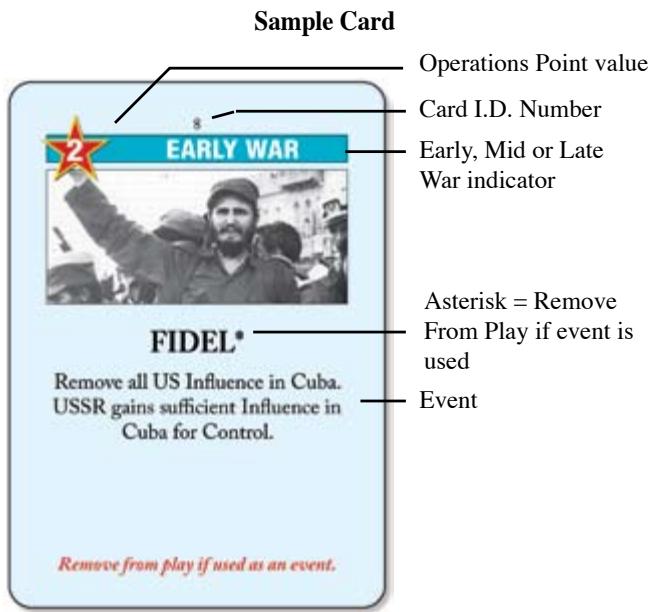
2.2.4 Many cards have an asterisk following their Event title. When these cards are played as Events, they are removed permanently from the game.
2.2.5 Cards that have their Event title underlined are displayed face-up on the side of the game board until they are cancelled (or the game ends).
PLAY NOTE: Player’s may also indicate the play of underlined events with the numbered card reminder markers. They may be placed on map in the Events in Effect Box.
2.2.6 Cards that are discarded (not permanently removed from the game) are placed in a face up pile adjacent to the draw pile.
2.3 MARKERS
The game includes various markers to assist play:

US Space Race

US Space Race—card played

USSR Space Race

USSR Space Race—card played

Defcon Status

Action Round
US Military OP marker
USSR Military OP marker

Turn Marker

VP Marker

DEFCON Restrictions Reminder
Card Reminder
Card Reminder Back
3.0 GAME SETUP
3.1 Shuffle the Early War cards and deal each player 8 cards. In addition, place ‘The China Card’ face up in front of the USSR player. The players are allowed to examine their cards prior to deploying their initial Influence markers.
3.2 The USSR player sets up first. The USSR places a total of 15 Influence markers in the following locations: 1 in Syria, 1 in Iraq, 3 in North Korea, 3 in East Germany, 1 in Finland, and 6 anywhere in Eastern Europe.
3.3 The US player sets up second, placing a total of 25 Influence markers in the following locations: 2 in Canada, 1 in Iran, 1 in Israel, 1 in Japan, 4 in Australia, 1 in the Philippines, 1 in South Korea, 1 in Panama, 1 in South Africa, 5 in the United Kingdom, and 7 anywhere in Western Europe.
3.4 Place the US and USSR Space Race markers to the left of the Space Race track. Each player places his Military OP marker on the zero space of their respective Military Operations Track. Place the Turn marker on the first space of the Turn Record Track. Place the Defcon marker on the 5 space of the DEFCON Track. Finally, place the VP marker on the Victory Points Track on the zero space.
4.0 GAME SEQUENCE
4.1 Twilight Struggle has ten turns. Each turn represents between three and five years, and will involve six or seven normal card plays by each player. At the beginning of the game, each player receives eight cards from the Early War deck. At the beginning of turn 4, the Mid War deck is shuffled into the draw pile and the players’ hand size increases to nine. At the beginning of turn 8, the Late War deck is shuffled into the draw pile.
4.2 The Phasing Player is the player whose Action Round is currently being played.
4.3 When there are no cards remaining in the draw deck, reshuffle all discards to form a new draw deck. Note that cards played as Events with an asterisk (*) are removed from the game when they are played, and are not shuffled into the new draw deck.
4.3.1 Deal all cards remaining in the draw deck before reshuffling, except in turns 4 and 8 (see 4.4.).
4.4 When moving from the Early War deck to Mid War, or from Mid War to Late War, do not add in the discards to the deck—instead add the Mid War or Late War cards (as appropriate) to the existing deck and reshuffle. The ignored discards remain in the discard pile for now, but will be reshuffled into the deck in the next reshuffle.
4.5 A turn in Twilight Struggle has the following structure:
A. Improve DEFCON Status
B. Deal Cards
C. Headline Phase
D. Action Rounds
E. Check Military Operations Status
F. Reveal Held Card (Tournament only)
G. Flip ‘The China Card’
H. Advance Turn Marker
I. Final Scoring (after Turn 1 0 only)
A. Improve DEFCON Status: If the DEFCON level is lower than 5, add one to the DEFCON status (towards Peace).
B. Deal Cards: Each player receives enough cards to bring their total hand size to 8 on turns 1 -3. On turns 4- 1 0, players should receive enough cards to bring their total hand size to 9. ‘The China Card’ is never included in this total.
C. Headline Phase: Each player secretly selects a card from their hand. Once both players have made their choice, they reveal their cards to each other simultaneously. These cards are called ‘Headline cards’ and their Events take place in this phase (and if the event title has an asterisk, are removed from the game normally). To determine which Event takes place first, look at the Operations value on each card; that is its Headline Value. The card with the higher Headline Value takes effect first. In the event of a tie, the Headline Event played by the US player goes into effect first.
• Scoring cards may be played during the Headline Phase. However, they are considered to have a Headline Value of zero (0) and always take effect second. If both players select a scoring card as their Headline Cards, the US player’s scoring card takes effect first.
• Players must create a Headline event, regardless of whether the event helps them or their opponent.
NOTE: If playing an opponent’s event during the Headline phase, your opponent implements the event text as if they had played the card themselves. However, the player of the headline card would be considered the phasing player for purposes of the DEFCON status (see 8.1.3).
• ‘The China Card’ may not be played during the Headline Phase.
• Unless the headline event specifically refers to availability of operations points, neither player receives operations points from cards played during the headline phase.
D. Action Rounds: There are six Action Rounds in turns 1 to 3 and seven action rounds turns 4 to 10. Players alternate playing cards, one per Action Round, for a total of six cards during turns 1 to 3, and seven cards during turns 4 to 1 0. The USSR player always takes his or her Action Round first, followed by the US player. All actions required by each card must be resolved before the next player starts his or her Action Round by playing a card. The player taking his or her Action Round is called the ‘Phasing Player’.
• Ordinarily, a player will have a card left over after the completion of all Action Rounds. This card is considered ‘held’, and may be played in subsequent rounds. Scoring cards may never be held.
• If a player has insufficient cards to take the requisite number of actions for the turn, that player must sit out of the remaining Action Rounds while the opposing player completes the turn.
E. Check Military Operations Phase: Each player determines if they are penalized Victory Points for failing to perform enough Military Operations during the turn (see 8.2). Each player then resets his Military Operations markers back to zero.
F. Reveal Held Card: During Tournament or competitive play, both players should reveal any held cards to their opponents to ensure that all required scoring cards are played during the round. Since this detracts from some elements of secrecy in the game, it is not necessary to use this rule in a non-competitive environment.
G. Flip China Card: If ‘The China Card’ was passed face-down during the turn, flip it face-up now.
H. Advance Turn Marker: Move the Turn Marker to the next turn. If it is the end of turn 3, shuffle the Mid War cards into the draw deck. If it is the end of turn 7, shuffle the Late war cards into the draw deck.
I. Final Scoring: At the end of turn 1 0, perform Final Scoring as described in the Scoring rules.
5.0 CARD PLAY
5.1 Cards may be played in one of two ways: as Events or Operations. Ordinarily, players will hold one card in their hand at the end of the turn. All other cards will be used for events or operations. Players may not forgo their turn by declining to play a card, or by discarding a card from their hand.
5.2 Events Associated With Your Opponent: If a player plays a card as an Operation, and the card’s Event is associated only with his opponent, the Event still occurs (and the card, if it has an asterisk after the Event title, is removed).
NOTE: When playing a card for operations and it triggers your opponent’s event, your opponent implements the event text as if they had played the card themselves.
• The phasing player always decides whether the event is to take place before or after the Operations are conducted.
• If a card play triggers an opponent’s Event, but that Event cannot occur because a prerequisite card has not been played, or a condition expressed in the Event has not been met, the Event does not occur. In this instance, cards with an asterisk Event (marked *) are returned to the discard pile, not removed from the game.
• If a card play triggers an opponent’s Event, but play of that event has been prohibited by a superseding Event card, then the Event does not occur, and the card remains in play for Operations points only.
• If a card play triggers an opponent’s Event, but the event results in no effect, the Event is still considered played, and would still be removed if it has an asterisk.
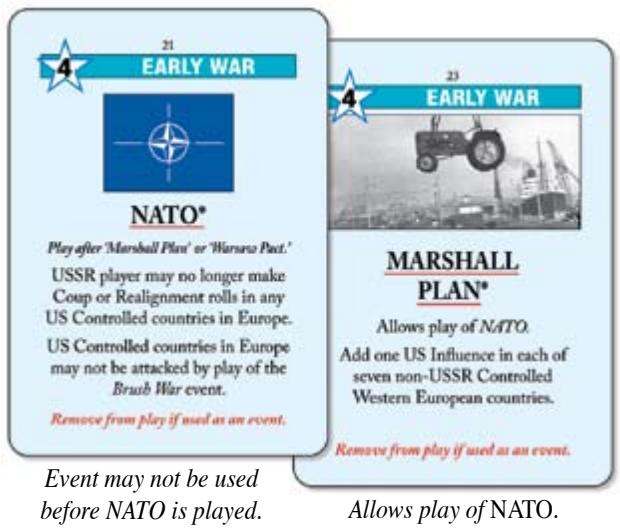
EXAMPLE 1: The USSR player plays the ‘NATO’ card before the ‘Marshall Plan’ or ‘Warsaw Pact’ cards have been played. The USSR player would get the benefit of the 4 Operations points, but the US would not get the ‘NATO’ event. However, despite being asterisked, the ‘NATO’ card would not be removed from play. It would be placed in the discard pile to be reshuffled and possibly played later.
EXAMPLE 2: The US player plays ‘Arab-Israeli War’ for 2 Operations. However, during his previous Action Round he played ‘Camp David Accords’ which prohibits play of ‘Arab-Israeli War’ as an Event. The US player would still conduct 2 Operations, but the USSR player would not get the benefit of the Event, and the card would not be eliminated from the game.
EXAMPLE 3: The USSR Player plays ‘Alliance for Progress;’ however, the US Player does not control a Battleground country in either South or Central America. Nevertheless, the Event is considered played, and the card would be removed from the game after the USSR player’s round.
EXAMPLE 4: The USSR player plays ‘Star Wars’, but the US player is ahead on the Space Race track. The result is no effect and the ‘Star Wars’ card is returned to the discard pile.
5.3 When a card played as an Event requires the play or discard of another card of a specific value, a higher valued card will always satisfy the requirement.
EXAMPLE: The ‘Quagmire’ card requires the US player to discard a 2 Operations card. If the US plays a 3 Operations card, the requirement is still met.
5.4 When an event forces a player to discard a card, the Event on the discarded card is not implemented. This rule also applies to Scoring cards.
5.5 Except as noted in rule 1 0. 1 .5, card text that contradicts the written rules supersedes the written rules.
6.0 OPERATIONS
Operations can be used in the following ways: to place Influence markers, to make Realignment rolls, to attempt Coups, or to attempt advancement in the Space Race. When a card is played as an Operations card, the player must choose to use all of the Operations points on one of the following options: Marker Placement, Realignment rolls, Coup Attempts or a Space Race attempt.
6.1 PLACING INFLUENCE MARKERS
“Everyone imposes his own system as far as his army can reach.” —Joseph Stalin
6.1.1 Influence markers are placed one at a time. However, all markers must be placed with, or adjacent to, friendly markers that were in place at the start of the phasing player’s Action Round. Exception: markers placed when required by an Event are not subject to this restriction, unless specifically stated otherwise on the card. If the amount of influence is sufficent to gain control of the country, place the marker on its darker side.
6.1.2 It costs one (1) Operations point to place an Influence marker in a country that is friendly-Controlled or uncontrolled. It costs two (2) Operations points to place an Influence marker in an enemy-Controlled country. If a country’s Control status changes while placing Influence markers, additional markers placed during that Action Round are placed at the lower cost.
EXAMPLE: The US player has 2 Influence markers in Turkey and the USSR player has none. Therefore, the US controls Turkey. The USSR player uses a 4 Operations point card to place Influence markers. When placing markers in Turkey, the first marker costs 2 Operations points. However, after placement of the first USSR influence marker, the US no longer exceeds USSR influence in Turkey by the Stability Number of 2, thus, a second or third Soviet influence marker would only cost 1 operation point per marker. If the US player started with only 1 influence marker in Turkey, the US player would not control Turkey. Therefore, any Soviet influence placement would only cost 1 operations point per marker.

EXAMPLE: The US player controls Turkey and Greece and the USSR player controls Syria and Lebanon. Neither player controls Romania and Bulgaria
6.1.3 Influence markers may be placed in multiple regions and multiple countries up to the number of Operations Points on the card played.
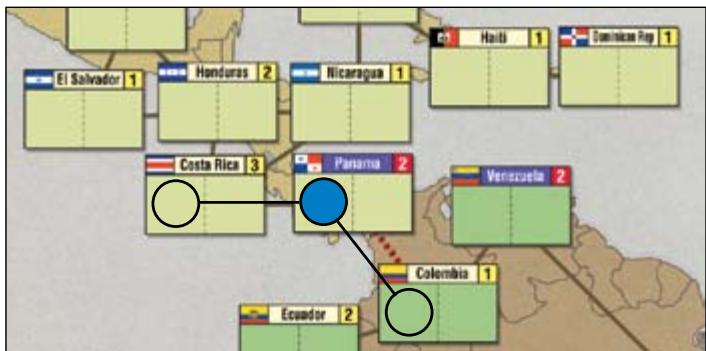
EXAMPLE: The US player has existing markers in Panama and South Korea. The US player uses a 3 Operations Point card to place more influence. The US player may place Influence markers in both Costa Rica and Colombia. However, he cannot place Influence markers in Costa Rica and then Nicaragua. On the other hand, since Influence markers are already present, he could use any remaining operation points to strengthen South Korea or its neighboring countries.
6.1.4 Influence markers may always be placed in any country that is adjacent (connected) to the phasing player’s superpower space.
6.1.5 Influence markers are treated like cash. Players may ‘break’ a large denomination into smaller denominations at any time. Additionally, the number of Influence markers included in the game is not an absolute limit. Small poker chips, coins or wooden blocks can be utilized to substitute in the event of a marker shortage.
6.1.6 If a player has two or more markers in a country, place the larger denomination on top. Influence markers are open to inspection at all times.
6.2 REALIGNMENT ROLLS
6.2.1 Realignment rolls are used to reduce enemy Influence in a country. To attempt a Realignment roll, the acting player need not have any Influence in the target country or in any adjacent country—although this improves the chance of success greatly. When using a card for Realignment rolls, the player may resolve each roll before declaring the next target. Countries may be targeted for Realignment more than once per Action Round.
6.2.2 It costs one Operations point to make a Realignment roll. Each player rolls a die and the high roller may remove the difference between the rolls from their opponent’s Influence in the target country. Ties are considered a draw, and no markers are removed. Each player modifies his die roll:
• +1 for each adjacent controlled country,
• +1 if they have more Influence in the target country than their opponent,
• + 1 if your Superpower is adjacent to the target country.
EXAMPLE: The US player targets North Korea for Realignment. There are 3 USSR Influence points in North Korea, while the US player has none. The US player has no modifiers—he does not control any adjacent countries and has less Influence in North Korea then the Soviets. The USSR player has +1 because North Korea is adjacent to the USSR and +1 for having more Influence in North Korea then the US. The US player gets lucky and rolls a 5 while the USSR player rolls a 2 which is modified to 4. The result is the USSR player must remove one Influence point from North Korea.
6.2.3 No Influence is ever added to a country as a result of a Realignment roll.
6.3 COUP ATTEMPTS
6.3.1 A Coup represents operations short of full-scale war to change the composition of a target country’s government. A player attempting a Coup need not have any Influence in the target country or in an adjacent country to attempt the Coup. However, your opponent must have Influence markers in the target country for a Coup to be attempted.
6.3.2 To resolve a Coup attempt, multiply the Stability Number of the target country by two (x2). Then roll a die and add the Operations points on the card to it. If this modified die roll is greater than the doubled stability number, the coup is successful, otherwise it fails. If the coup is successful remove opposing Influence markers equal to the difference from the target country. If there are insufficient opposing Influence markers to remove, add friendly Influence markers to make up the difference.
6.3.3 Move the marker on the Military Operations track up the number of spaces equal to the Operations value of the card played.
EXAMPLE: The US player plays a 3 Operations card to conduct a coup attempt in Mexico. The US player has no Influence in Mexico; the USSR player has 2 Influence points. First the US player adjusts his marker on the Military Operations Track to
show that he has spent three points on Military Operations this turn (see 8.2). Then he rolls the die for a 4 and adds his Operations Number (3) to get a 7. He now subtracts twice the value of Mexico’s Stability Number (2x2=4) from this result to get a final total of 3. This is the number of Influence markers he may remove from/add to Mexico. First, the US would remove the 2 Soviet Influence markers, then place 1 US Influence marker.

6.3.4 Any Coup attempt in a Battleground country degrades the DEFCON status one level (towards Nuclear War).
6.3.5 Cards that state a player may make a “free Coup roll” in a particular region may ignore the geographic restrictions of the current DEFCON level (see 8.1.5). However, a “free Coup roll” used against a Battleground country would still lower DEFCON as per 6.3.4.
6.4 THE SPACE RACE
“We go into space because whatever mankind must undertake, free men must fully share . . . I believe that this nation should commit itself to achieving the goal, before the decade is out, of landing a man on the moon and returning him safely to the earth.” —John F. Kennedy
6.4.1 The Space Race track contains a marker for each superpower. Operations points may be spent by a superpower to attempt to move its marker to the next box on the track. To do so, play a card with an Operations point value equal to or greater than the number shown on the track into which you are attempting to advance. Roll the die: if the number falls within the range listed in the target box on the Space Race track, move your marker to the new box.
6.4.2 A player may only play 1 card per turn in an attempt to advance in the Space Race. Exception: Space Race Track Special Abilities and certain Events may alter this one-card limitation, or advance the superpower’s marker on the Space Race track.
6.4.3 Advancing along the Space Race track results in an award of Victory Points, a special ability, or both. Five boxes on the Space Race track are marked with two numbers divided by a slash, e.g. Lunar Orbit has the numbers 3/1. The left-hand number is the number of Victory Points awarded to the first player to reach that box; the right-hand number is the number of Victory Points awarded to the second player to reach that box. Victory Points granted take effect immediately. All Space Race Victory Points are cumulative.
6.4.4 Special abilities are granted only to the first player to reach the space. The special effect is immediately cancelled when the second player reaches that box.
• Upon reaching space 2 (Animal in Space), the player is allowed to play two Space Race cards per turn (instead of the usual one).
• Upon reaching space 4 (Man in Earth Orbit), the opposing player must select and reveal his or her Headline Event before the player with a ‘Man in Earth Orbit’ makes his/her Headline Event selection.
• Upon reaching space 6 (Eagle/Bear has Landed), the player may discard their Held Card at the end of the turn
• Upon reaching space 8 (Space Station), the player may play eight (8) Action Rounds per turn.
The effects of these special abilities are immediate and cumulative.
EXAMPLE: The USSR player successfully reaches space 2. He may play a second Space Race Card during his next Action Round. If the USSR player reached space 4 before the US player had reached space 2, the USSR player could play two Space Race cards per turn, and require the US Player to show his Headline Phase event before selecting his own.
6.4.5 Regardless of text on the card, an Event discarded to make a die roll to advance on the Space Race track is not implemented.
The card is placed in the discard pile.
DESIGN NOTE: The Space Race is your ‘safety valve.’ If you hold a card whose Event is a good one for your opponent, and you don’t want the Event to occur, you can dump it on the Space Race (provided it has enough Operations points to qualify for an attempt to move forward).
6.4.6 If a player reaches the final box in the Space Race, no more cards may be expended in the Space Race by that player for the remainder of the game.
7.0 EVENTS
“Do you, Ambassador Zorin, deny that the USSR has placed and is placing medium – and intermediate – range missiles and sites in Cuba? Yes or no? Don’t wait for the translation! Yes or no?” —Adlai Stevenson, U.S. Ambassador to the United Nations
7.1 A player may play a card as an Event instead of Operations. If the Event is associated with his or her own superpower, or is associated with both superpowers, it takes effect as directed by the card’s text.
7.2 The Southeast Asia Scoring card has an asterisk following the Event title, and is the only scoring card removed after play.
7.3 Permanent Events: Some Event cards have an underlined title, e.g. Flower Power. This indicates that the effects of these Events last for the duration of the game. When such cards are played as Events, place them to the side of the map, or place their markers on the Turn Track, as a reminder of their ongoing effects.
7.4 Some event cards modify the Operations value of cards that follow. These modifiers should be applied in aggregate, and can modify ‘The China Card’.
EXAMPLE: The US player plays the Red Scare/Purge event during the Headline Phase. Ordinarily, all USSR cards would subtract one from their Operations value. However, for his Headline card, the USSR played Vietnam Revolts. This event gives the Soviet player +1 to all operations played in SE Asia. For his first play, the USSR chooses ‘The China Card’. He plays all points in SE Asia for 5 operations points. This is modified by the Vietnam Revolts card, giving the USSR player 6 operation points. However, the US Red Scare/Purge card brings the total down to 5 operations points.
7.4.1 Events modifying the Operations value of a card only apply to one player. The modifier is not transferable to their opponent by virtue of a card taken from their opponent’s hand.
EXAMPLE: The USSR player has played ‘Brezhnev Doctrine’ as an Event, and therefore receives a +1 Operations value modifier for all of his cards. If the US player steals one of his cards, for example by playing ‘Grain Sales to the Soviets’, the US player does not benefit from a +1 Operations value modifier on that card.
7.4.2 Events modifying the Operations value of subsequently played cards do so for all purposes.
EXAMPLE 1: If the Soviet player has played ‘Red Scare/Purge’ on the US player, and the US player played a 2 Operations card for a Coup, the US player would only add 1 to his Coup roll for the value of the card, and would receive 1 point of the Required Military Operations track.
EXAMPLE 2: If the Soviet player played ‘Brezhnev Doctrine’ earlier in the turn, he could play a 1 Op card to make a required roll under ‘Bear Trap’.
EXAMPLE 3: If the US player played ‘Containment’ earlier in the turn, he could play ‘CIA Created’ subsequently and use 2 Ops.
7.5 If an Event becomes unplayable due to its cancellation or restriction by another Event card, the unplayable Event card may still be used for its Operations value.
7.6 War Events: There are 5 “War” Events in the deck: Korean War, Arab-Israeli War, Indo-Pakistani War, Brush War, and Iran-Iraq War. These Events may be played regardless of the absence of either player’s influence points in either the attacking or defending countries. If there is no influence at risk in the war, the Event’s player still receives victory points upon success, and required military operations irrespective of success (see 8.2.4)
8.0 DEFCON STATUS ANDMILITARY OPERATIONS
“Strange game. The only winning move is not to play.” —“Joshua” the N.O.R.A.D computer from Wargames.
8.1 The DEFCON Track
8.1.1 DEFCON status measures nuclear tension in the game. The DEFCON level begins the game at its maximum ‘peace’ level of 5. It can go down and back up due to events and actions by the players, but if, at any point, it decreases to 1 , the game ends immediately.
8.1.2 The DEFCON status may never Improve above 5. Any event that would Improve the DEFCON status above 5 has no DEFCON effect.
8.1.3 If DEFCON 1 status is reached, nuclear war breaks out and the game ends immediately. The phasing player is responsible for the status marker moving to DEFCON 1, and loses the game.
EXAMPLE: The US player plays Olympic Games, and the DE-FCON status is at 2. The USSR player boycotts the game. The

DEFCON status is degraded to level 1, and nuclear war is triggered. The US player, as the phasing player, has lost.
8.1.4 Any Coup attempt in a Battleground country degrades the DEFCON status one level.
8.1.5 The consequences of the DEFCON status levels are on the DEFCON Track, and are reproduced here:
• DEFCON 5: No effect
• DEFCON 4: No Coup or Realignment rolls are permitted in Europe.
• DEFCON 3: No Coup or Realignment rolls are permitted in Europe or Asia.
• DEFCON 2: No Coup or Realignment rolls are permitted in Europe, Asia, or the Middle East.
• DEFCON 1: Game over. The player responsible for the status going to 1 (the Phasing Player) loses the game.
PLAY NOTE: Players may place a DEFCON Restriction marker in the region to serve as a reminder that no Realignment or Coups are permitted.
8.1.6 Improve DEFCON Status Phase. At the beginning of any turn in which the DEFCON status is lower than 5, Improve the DEFCON status by 1.
8.1.7 Improve & Degrade. In all cases, when the rules or cards indicate to ‘improve’ the DEFCON status, this means to move the DEFCON marker to a higher DEFCON number, while ‘degrade’ means to move the DEFCON marker to a lower DEFCON number.
8.2 Required Military Operations
“Restraint? Why are you so concerned with saving their lives? The whole idea is to kill the bastards. At the end of the war, if there are two Americans and one Russian left alive, we win.”
—Gen. Thomas Power, U.S. Strategic Air Command
8.2.1 By the end of each turn, each player must have played a certain number of Military Operations. Failure to do so gives Victory Points to your
opponent. The number of Military Operations required each turn is equal to the current DEFCON status number. If fewer Military Operations are carried out, the opponent gains 1 VP per unplayed Military Operations point.
EXAMPLE: At the end of the turn the US player has spent two points in Military Operations. If the DEFCON level is currently at 4 the USSR player would gain 2 Victory Points.
8.2.2 Coup attempts and war events are Military Operations.
Realignment Rolls are not considered Military Operations.
8.2.3 When Operations points are played in a Coup attempt, or when a War Event card is played (e.g., Arab-Israeli War, Korean War, etc.), the phasing player moves his marker on the Military Operations track a number of spaces equal to the Operations value of the card.
8.2.4 If a player uses a card for Operations points, and thereby triggers a War Event associated with his opponent, his opponent’s Military marker is moved on the Military Operations track as directed by the Event text.
EXAMPLE: The US player uses the ‘Arab-Israeli War’ card for Operations points, thereby also triggering the War Event (as it is associated with the Soviet Union player). In addition to the Event taking place as directed on the card, the USSR player moves his Military Operations marker two spaces on the Military Operations track.
8.2.5 Events that allow a free Coup roll do not count towards required Military Operations.
9.0 CHINA
9.1 China’s role in the Cold War is abstracted through ‘The China Card’. Either player may play ‘The China Card’ as if it were part of his regular hand. ‘The China Card’ does not count towards the hand limit.
9.2 Every play of ‘The China Card’ counts as one of the Actions (6 or 7) that a player is permitted during a turn. As a result, players may have more cards left in their hand than usual, if ‘The China Card’ is played.

9.3 When ‘The China Card’ is played, it is immediately handed to your opponent face down. It may not be played again by your opponent this turn. At the end of the turn, it is flipped face up, ready for your opponent to play.
9.4 If ‘The China Card’ is passed as a result of an Event, the card is passed face up and may be played by the new owning player during the same turn.
9.5 ‘The China Card’ may not be played:
• during the Headline Phase,
• if it prevents the play of a Scoring card, or
• as a discard required by an Event.
9.6 To receive the bonus +1 Operations point indicated on ‘The China Card’, all of the Operations Points on the card must be spent in Asia (including Southeast Asia).
9.7 The Operations Point value of ‘The China Card’ may be modified by other Event Cards.
9.8 Play of ‘The China Card’ can never be compelled by events or a shortage of cards during the action rounds.
10.0 SCORING AND VICTORY
The object of the game is to score Victory Points (VPs). Regional Victory Points are scored through geographic Influence
over the six Regions. VPs can also be received through the play of certain Events. Each region has its own ‘scoring card’. Playing a scoring card causes Victory Points to be scored, based on how much influence each superpower has in that region at the time the card is played.
PLAY NOTE: Trying to play scoring cards to coincide with your superpower’s peak influence in a region is often a crucial factor in winning the game.
10.1 SCORING
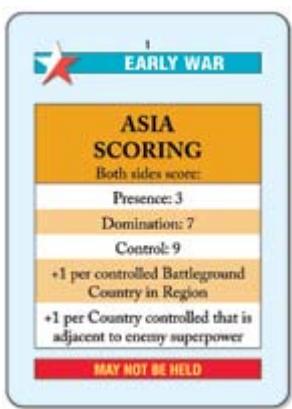
10.1.1 The following terms are used during Regional Scoring:
Presence: A superpower has Presence in a Region if it Controls at least one country in that Region.
Domination: A superpower achieves Domination of a Region if it Controls more countries in that Region than its opponent, and it Controls more Battleground countries in that Region than its opponent. A superpower must Control at least one non-Battleground and one Battleground country in a Region in order to achieve Domination of that Region.
Control: A superpower has Control of a Region if it Controls more countries in that Region than its opponent, and Controls all of the Battleground countries in that Region.
10.1.2 Players score additional points during Regional Scoring, as follows:
• + 1 VP per country they Control in the scoring region that is adjacent to the enemy superpower
• + 1 VP per Battleground country that they Control in the scoring region.
• Victory points are then cumulated for both players, and the net difference between the two scores is marked on the Victory Point Track.
EXAMPLE: The USSR plays the Central American Scoring card. The USSR controls Cuba, Haiti and the Dominican Republic. The United States controls Guatemala, and has 1 point of influence in Panama. The USSR player would therefore get points for Dominating Central America (3 VPs) + 1 VP for control of a battleground country (Cuba). +1 VP for Cuba’s being adjacent to your opponent’s home nation for a total of 5 VPs. The United States would receive 1 VP for presence in Central America since he controls Guatemala. Since the United States only has 1 Influence point in Panama, he does not control it, and therefore controls no battleground countries. That is why the USSR player scores Dominance points. He controls more battleground countries (Cuba) and more countries overall. He also meets the “at least one non-battleground country” test through control of either Haiti or the Dominican Republic. Having calculated relative victory points, 5 VPs for the USSR, and 1 VP for the US, you subtract the US VPs from the Soviets, and move the VP point track a net 4 spaces toward Soviet victory.
10.1.3 Playing certain card Events may result in Victory Points being scored.
10.1.4 Victory Points may be scored due to your opponent’s failure to perform the number of required military operations during the turn (8.2).
10.1.5 A player may not be forced to Hold a Scoring Card through the effects of an Event(s).
10.2 The Victory Point Track
10.2.1 The Victory Point Track shows a range of scoring possibilities from US-20 (US automatic victory) to USSR-20 (USSR automatic victory). At the start of the game, place the VP marker in the center of the chart, on the box marked At Start. This box represents zero points, or total equilibrium of the two sides. This box should be counted as a space when players’ scores are adjusted.
EXAMPLE: If the scoring marker is on the USSR-1 box, and the US player scores 2 VPs, the marker should move 2 spaces to the US-1 box.
10.2.2 Wherever a card states that the player ‘gains’ a Victory Point, this means that the VP marker is moved that many spaces in that player’s favor, i.e., if the VP marker is on the 1 0 space (US winning) and the USSR player gains 2 VP, the marker is moved to the 8 space on the VP track.
10.2.3 If both players earn Victory Points from the same card or Event play, apply only the difference in Victory Points awarded.
10.3 VICTORY
10.3.1 Automatic Victory. There are several ways to achieve an automatic victory in Twilight Struggle:
• The instant one player reaches a score of 20 VP, the game is over and that player is the winner. NOTE: All VP awards (for both players) that are scored during an event or scoring card must be applied prior to determining automatic victory.
• If either side Controls Europe, that side wins when the Europe Scoring card is played.
• Nuclear War: A player may also win the instant his opponent causes the DEFCON level to reach 1.
10.3.2 End Game Victory. If neither side has achieved victory of any kind by the end of turn 10, then every Region is scored as if its regional scoring card had just been played (these new VPs are added to the current score). Southeast Asia is not scored separately: it is included in the Asia scoring calculations. Every Region’s score must be calculated before final victory is determined. Reaching 20 VPs does not result in Automatic Victory during scoring at the end of turn 10; however, Control of Europe does grant automatic victory to the controlling player, regardless of scoring elsewhere.
Once all regions have been scored, victory goes to the player who has accrued most VPs. If the VP marker is on a positive number, the US wins; if the VP marker is on a negative number, the USSR wins. If the VP marker is on zero, the game ends in a draw.
11.0 TOURNAMENT PLAY
These rules are optional, and are not required for ‘friendly’ play. They are simply offered as guidelines on conducting Twilight Struggle as a competitive tournament game.
11.1.1 During tournament play, all cards held at the end of the round should be revealed to your opponent. This prevents accidental or deliberate holding of scoring cards.
11.1.2 Any player found holding a scoring card during the Reveal Held Card phase is said to have started an accidental nuclear war, and loses immediately.
11.1.3 During tournament play, the Soviet player should receive the first card of every deal. The deal should alternate back and forth between the players until they have received their full hand size. A player may receive consecutive cards in a deal if they require more cards than their opponent.
12.0 THE CHINESE CIVIL WAR VARIANT
The Chinese Civil War Variant is meant to be played within the context of the existing rules regarding the China Card (see 9.0). However, where these rules conflict with existing rules or event card text, this section of the rules takes precedence.

12.1 The Chinese Civil War space
The Chinese Civil War space is considered adjacent to the Soviet Union and only the Soviet Union. The space is considered to be in Asia, but not South East Asia. It does not affect any scoring card. The only action that may be taken on the Chinese Civil War space is the placement of Influence Points by the Soviet player. The US player may not use Operations or events of any kind to effect the Chinese Civil War space. Once the Soviet player has placed 3 Influence Points on the Chinese Civil War space, it has no further effect. The markers may be returned to the Soviet player’s pool, and the Chinese Civil War space is ignored for the remainder of the game.
12.2 Control
The Soviet Union must place three Influence on the Chinese Civil War space to Control it. Soviet Influence is placed in the Chinese Civil War space according to the rules for placing influence in countries (see 6.1). If the China card remains unclaimed throughout the game, no player receives the victory point for possession of the China Card during end game scoring.
12.3 Impact of Control
Until the Soviet Player has placed 3 Influence Points on the Chinese Civil War space, the China Card is in no player’s possession. Once the Soviet player had placed 3 Influence Points into the space, the player immediately receives the China Card face up and ready for play. Additionally, the ban on play of the Red Scare/Purge and Formosan Resolution events is immediately lifted.
12.4 Event Restrictions
Until the Soviet player has placed 3 Influence Points on the Chinese Civil War space, the Soviet player may not play Red Scare/Purge nor Cultural Revolution as events. Additionally, the US player may not play Formosan Resolution as an event. These cards may be played for Operations Points normally.
12.4.1 Special US Condition: For the purposes of playing Ussuri River Skirmish or Nixon Plays the China Card as events, the US is deemed to be in possession of the China Card if the Soviet Player has not yet placed the 3 Influence Points on the Chinese Civil War space.
12.4.2 Until the Soviet Player has placed 3 Influence Points on the Chinese Civil War space the Russian player subtracts an additional 1 when rolling for the resolution of the Korean War event.
12.4.3 Events made unplayable or restricted due to 12.4 are still playable for Operations points as per rule 7.5.
| UK Denmark | Italy Norway | Benelux | W. Germany (5/1) |
| Israel | Iran | Pakistan | Turkey |
| Zaire | Somalia | Kenya | Nigeria |
| Japan | South Korea Taiwan | Philippines (3/1) | |
| Thailand | Indonesia | Australia | Malaysia (3/1) |
| Nicaragua | Panama | Haiti | Honduras |
| Venezuela | Chile | Argentina | Colombia (2/1) |
A Late War Scenario for Twilight Struggle
By Volko Ruhnke
C3i Magazine #19, copyright RBM Studio
If you’ve played with your TS set as much as I have, you may find the Early and Mid-War event cards looking a little worn compared to the less often used Late War events. For those of you who would like to dive right into the post-Quagmire era and try out the cool possibilities of a Landed Eagle, Star Wars, and Chernobyl, or Aldrich Ames, the Hostage Crisis, and Terrorism, here’s a scenario that cuts to the chase.
My sense of the game-turn structure is that the turns roughly represent the following years:
$$
\mathrm { T u r n } \ 1 = 1 9 4 5 – 1 9 4 8
$$
$$
\mathrm { T u r n } 2 = 1 9 4 9 - 1 9 5 2
$$
$$
\mathrm { T u r n } 3 = 1 9 5 3 – 1 9 5 6
$$
$$
\mathrm { T u r n } 4 = 1 9 5 7 – 1 9 6 0
$$
$$
\mathrm { T u r n } ~ 5 = 1 9 6 1 \AA - 1 9 6 4
$$
$$
\mathrm { T u r n } 6 = 1 9 6 5 – 1 9 6 9
$$
$$
\mathrm { T u r n } \ 7 = 1 9 7 0 – 1 9 7 4
$$
$$
\mathrm { T u r n } 8 = 1 9 7 5 – 1 9 7 9
$$
$$
\mathrm { T u r n } 9 = 1 9 8 0 – 1 9 8 4
$$
$$
\mathrm { T u r n } 1 0 = 1 9 8 5 – 1 9 8 9 .
$$
Thus, the Late War period would begin in 1975, say, with the Fall of Saigon. So I have used that date (and a dose of interpretation of history into the TS fabric) to set the influence and events for the opening of the Late War Scenario.
To my surprise, the US appears to begin the post-Vietnam era in a decidedly strong position in game turns. Whether or not the dominoes have fallen, the US still dominates Asia, for example. Play of the scenario showed that a US Automatic Victory is well within reach, so the Soviet player in this scenario wins just for engineering a more graceful decline of the Socialist experiment.
Have fun, and please try to avoid The Day After….
Markers:
• Turn at 8
• DEFCON at 4
• Space Race at Soviet Space Walk; US Eagle Landed
• VP at -4
Events in play counters
US/Japan Pact, Marshall Plan, NATO, Warsaw Pact, DeGaulle, Flower Power.
Control and Influence
• US Dominates South America and Asia
• Soviets Dominate Middle East.
Mark influence as minimum needed for control by the indicated side except where shown as (US#/Sov#).
US Control:
Dominican Republic
Soviet Control:
| E. Germany | Poland | Hungary | Czechoslovakia |
| Bulgaria | Cuba | North Korea | |
| Iraq | Syria (0/3) | India | Afghanistan |
| Libya | Algeria | Ethiopia | Zimbabwe |
| Angola (1/3) | Laos (0/2) | Vietnam (0/5) |
SE African States (0/2)
Neutral with Influence--
Spain (1/0) France (3/1) Romania (1/3)
Jordan (2/2) Egypt (1/0) South Africa (2/1)
Finland (1/2) Burma (0/1) Peru (2/1)
Yugoslavia (1/2)
Saudi Arabia (2/0)
Cards:
Remove all Early and MidWar * (Removable) Events EXCEPT Bear Trap, Camp David, John Paul, Panama Canal..
Give China Card to Soviet player.
Shuffle remaining Early, MidWar, and Late War cards together and deal to begin Turn 8.
Victory:
After Turn 10 final scoring or if US plays WARGAMES event, US must have 20+ VP or Soviet player wins.
DESIGNER OPTIONAL RULES
These rules were also playtested by the designers during the development of Twilight Struggle, but for various reasons were dropped by the wayside on the road to publication. Players seeking some variety in the play of the game may find these rules interesting and worthwhile. Tournament GMs are welcome to incorporate some or all of these rules into their tournaments, provided notice is given to players.
Realignment Rolls
We tried many variations on the rules for Realignments. One of the great design challenges in TS was figuring out a simple system to handle superpower-directed political change that wasn’t violent enough to count as a Coup attempt. We are happy with the rules we arrived with, but if players wish to see some of the other paths we tried, here they are. They can be played with separately or all together.
Realignment rolls are not subject to geographic DEFCON restrictions. That is, countries in any regions may be targeted for Realignment rolls regardless of the current DEFCON level.
The phasing player may not lose Influence in a country targeted for Realignment.
Operations points may be used to purchase both Influence markers and Realignment rolls, at normal costs, but Influence markers may not be placed in a country already targeted with a Realignment roll during the current action round, and Realignment rolls may not be targeted at countries that have had Influence markers placed in them during the current action round.
The Space Race
A player who “dumps” a card on the Space Race may, at his choice, elect not to roll the die (thus forgoing any chance of advancing on the track).
Game Credits
GAME DESIGN: Jason Matthews & Ananda Gupta
DEVELOPMENT: Jason Matthews
DEVELOPMENT ASSISTANT: George Young, and William F.
Ramsay, Jr.
ART DIRECTOR: Rodger MacGowan
BOX ART AND PACKAGE DESIGN: Rodger MacGowan
MAP: Mark Simonitch and Guillaume Ries
COUNTERS AND RULES LAYOUT: Mark Simonitch
PLAYTESTING: Greg Schloesser, Bill Edwards, Marvin Birnbaum, Brad and Brian Stock, Peter Reese, Joe Rossi Jr., Greg Kniaz, PJ Glowacki, Steve Viltoft, Doug Austin, Shawn Metcalf, Steve Kosakowski, Ken Gutermuth
PROOFREADING: Kevin Duke, Tom Wilde
PRODUCTION COORDINATION: Tony Curtis
PRODUCERS: Tony Curtis, Rodger MacGowan, Andy Lewis, Gene Billingsley and Mark Simonitch
Special thanks to Charles Féaux de la Croix, David Wilson, Ben & Marcia Baldanza, and Dave Kurtz.
Extended Example of PlayExtended Example of Play
What follows is an example of play taken from the finals of the Boardgame Players Association online tournament. This final features two of the finest Twilight Struggle players in the country— Chris Withers and Stefan Mecay. Stefan has won every Twilight Struggle tournament held at the World Boardgaming Championships. Chris, on the other hand, was the only player to hand Stefan a defeat in the preliminary rounds of this tournament.
In this game, none of the optional cards are in play. Additionally, the two players have bid for sides. Chris wins the bidding and chooses the Soviets. Stefan takes the underdogs, but due to bidding his US begins the game with an additional four Influence Points. These points may only be placed in countries eligible for US Influence during the game setup.
To help players follow along, the number of Influence Points in a country after the action is performed is indicated in parenthesis. The number before the slash is US influence and the number after the slash is USSR influence (US/USSR). If the number is bold and with a “C”, it indicates control.
Soviet Setup: 4 IP to Poland (0/4C), 1 IP to East Germany (0/4C), 1 IP to Yugoslavia (0/1).
US Setup: 2 IP to West Germany (2/0), 4 IP to Italy (4C/0), 1 IP to France (1/0);
Bonus Bid = 1 IP to Iran (2C/0), 2 IP to France (3C/0), 2 IP to West Germany (4C/0).
This is a fairly standard setup. Note that the decision on where to put your starting influence is made AFTER you examine your starting hand. The Soviets have locked down Poland and East Germany. They’ve put 1 Influence in Yugoslavia to threaten Italy and Greece. That 1 IP is always a risk, as it can be flipped by Independent Reds.
Stefan is attempting to deprive the Soviets of any obvious first coup locations by using the bid IPs to strengthen Iran. Furthermore, he has bolstered the US position in Western Europe, such that an initial European Scoring Card would result in US dominance.
TURN 1
Headline Phase
Soviet: Olympic Games (2 Ops) US: Mideast Scoring (0 Ops)
In this phase both players choose a card from their hand. The event on that card will then be implemented. The card with the highest operations is implemented first. In the event of a tie, the US Card is implemented first.
Stefan has made a risky choice by playing the Mideast Scoring card right off the bat. Had the Soviets played a headline card that allowed them to place Influence, those IPs would certainly have plopped down in the Mideast making this stealth play a potential nightmare. Unfortunately for Chris, his headline card is a nonthreatening effort to nail a couple of early victory points.
The US Scores 4 for the Mideast Scoring (control of Iran) and the Soviets win the first post-war Olympics. The net result is US +2.
Action Rounds
USSR Action Round 1: NATO (4 Ops) to Coup Iran. Rolls 6, US influence = 0, Soviet Influence 4. Soviets gain 4 Mil Ops, and DEFCON drops to 4.
This is the classical opening move. Iran is the linchpin to the US

1: At Start setup in Europe and upper Middle East.
position to the Middle East and ultimately to the South Asian prizes of Afghanistan, Pakistan and India. Because of the extra influence from the starting bid, it takes a larger card to ensure success. Chris does so with a big roll. Mr. Truman must be asleep at the wheel while the dominoes are falling.
US Action Round 1: Formosan Resolution (2 Ops) as Influence points. Adds 1 to Malaysia (1/0) and 1 to Columbia (1/0).
Stefan appears to be creating a bit of a dilemma here for the Soviet player. He is threatening the key Asian battleground in Thailand while also threatening to break out in South America. Without an interesting event, the Soviet player can only deal with one of these problems via a coup. The South American play is an illustration of mid-term planning. However, a key to good Twilight Struggle play is switching the tempo of the game by putting your opponent on the defensive. Doing so requires players to stop reacting, and engage in a little planning. That’s exactly what Stefan is trying to do.
USSR Action Round 2: De-Stalinization (3 Ops) as the Event. Adds 1 to Chile (0/1), Venezuela (0/1), Thailand (0/1) and Malaysia (1/1) taken from Finland (0/0), Yugoslavia (0/0) and 2 from Iran (0/2).
Unfortunately for Stefan, Chris’ Soviets have the perfect counter. Chris would probably have preferred to have a little more influence on the board before he started reshuffling it to deal with Stefan’s challenge, but still, this will do. Suddenly, Chris is on the offensive in both South America and Asia.
US Action Round 2: Containment (3 Ops) to Coup Thailand. Rolls 1 , No effect. US gains 3 Mil Ops, and DEFCON drops to 3.
Swing and a miss. This was a major missed opportunity for the
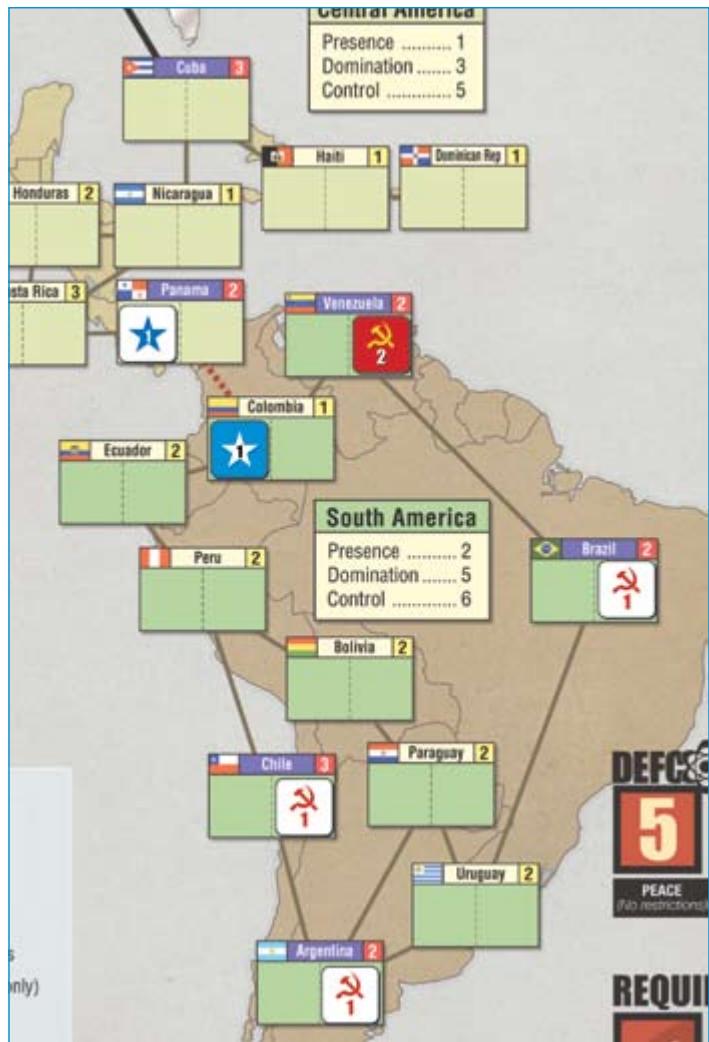
2: South America at the end of USSR Action Round 4.
Americans. The Soviets felt compelled to move into Thailand even though it was still under a Coup threat given the DEFCON level. US success here would have t
内容过长,此处只内联前一部分;完整内容请下载或到规则页阅读。
下载 Markdown原文为社区整理/出版社公开资料,版权归原作者,仅供个人学习查阅。