
UnforgivenUnforgiven
一句话概览
Unforgiven 是一款已收录于村了吗规则库的桌游,支持 2 人,原名 Unforgiven。
本页内容:一句话概览 · 常见问题
这游戏怎么玩
- 本站已收录这款游戏的规则资料,可以在对话里直接提问规则细节。
常见问题(FAQ)
以下 1 条问答中 0 条来自站内玩家的真实提问,其余 1 条为本站整理的常见疑问;答复内容保持原样。
Unforgiven支持几个人玩?
2 人。
去哪查完整规则
想核对具体规则细节、卡牌效果或某个回合的结算方式,可以在村了吗里选中这款游戏后直接提问。
同类桌游
- 卡坦岛德式
- 工业革命:伯明翰德式
- 勃艮第城堡:特别典藏版德式
- 方舟动物园德式
- 卡卡颂抽象
- 瘟疫危机传承:第一季美式
- 阿瑞迪亚:勇踏征途美式
- 重塑宇宙德式
- 幽港迷城美式
- 埃多拉的德鲁伊德式
规则原文(Markdown)
本站收录这款游戏的规则原文 1 个文件,此处内联渲染 1 个,可直接展开阅读或下载。
UNF_Rules_KS.md37.1 KB
UNFORGIVEN THE LINCOLN ASSASSINATION TRIAL

A tense, legal duel by Tom Butler
GAME OVERVIEW
Unforgiven revisits the 1865 trial of Mary Surratt, considered by many to be the most controversial trial of the 19th century. Surratt was tried for her role in the assassination of President Abraham Lincoln, and was executed on July 7, 1865. Now is your chance to revisit history. As either the prosecution or the defense, your role is to convince the 9-member military jury that Mary Surratt is guilty...or innocent.
“Passion governs, and she never governs wisely,"
— Benjamin Franklin, one of America's Founding Fathers.
OBJECTIVE
By rolling dice, using resources, and drafting cards from a shared card display, you will build an argument to convince the jury of your case. Your argument is your personal display of the cards you've drafted, representing key witnesses and other pieces of evidence you will use to win the game. At the conclusion of the third and final phase of the trial, whoever has accumulated the most trial points (TP) will successfully convince the jury and win the game. However, there are two other ways that the trial could end: you establish your case beyond a reasonable doubt, or you successfully convince four jurors. These alternate win conditions mean that the trial can take many twists and turns, tilting justice first in favor of one side, and then the other.
COMPONENTS
84 Trial Cards:
• 28 Phase 1 cards
9 Juror Tiles
14 Trial Dice
• 28 Phase 2 cards
2 Reference Cards
1 Juror Board
1 Dice Bag
• 28 Phase 3 cards
40 Sway Tokens
1 Justice Marker

Credits
Game Design: Tom Butler
Game Development & Rules Editing: Dr. Sam Hillier
Graphic Design: Nicholas Avallone
Photo Colorization: Milan Stojanovik
Copyeditor & Lead Playtester: Barry Miller
We would like to thank the United States National Archives, Library of Congress, and the Abraham Lincoln Presidential Library and Museum for many of the images used in this game, under the Creative Commons Attribution 2.0 license.
© Copyright 2021 Green Feet Games
Card and Tile Anatomy
Unforgiven uses both trial cards and juror tiles. Trial cards come in one of six different types:

Evidence (White) provides 3 types of evidence for drafting new cards into your argument

Appeals (Gray) provides 3 types of appeals used for convincing jurors and drafting cards
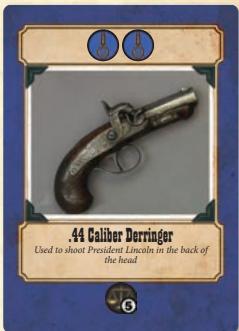
Reasonable Doubt (Blue) moves the justice marker on the reasonable doubt track, potentially giving you an instant victory
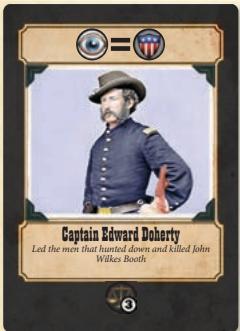
Rhetoric (Black) gives you ongoing special abilities
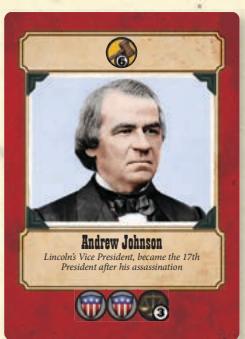
Fact (Red) gives you trial points at the end of the game

Press Baron (Sepia) gives you an immediate bonus of free trial dice, but at the cost of skipping your next turn
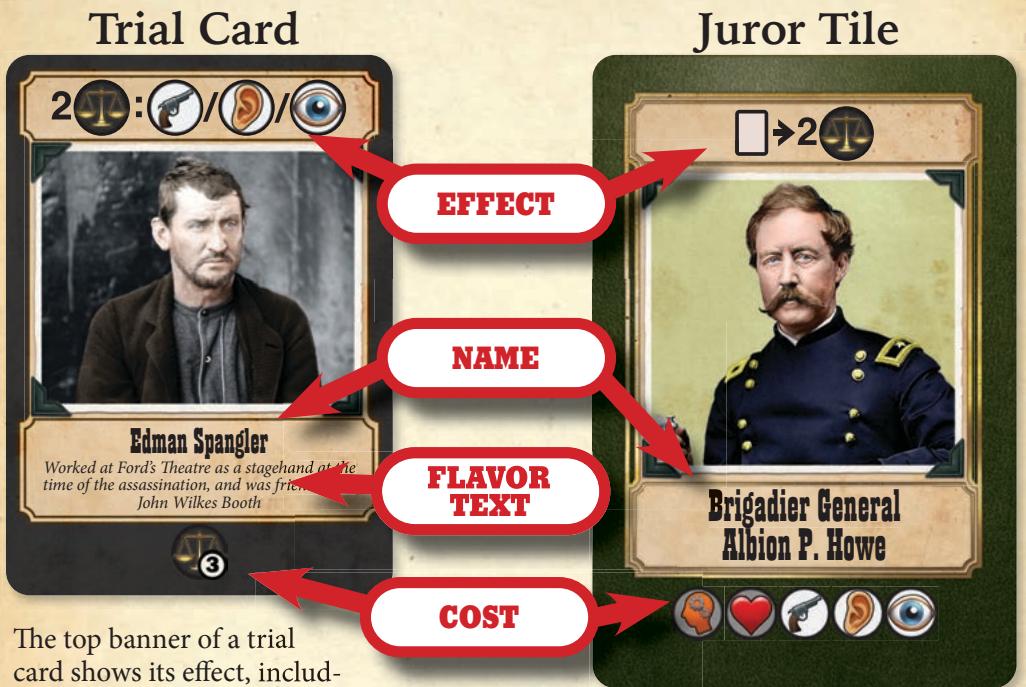
ing any resources it provides, while the bottom banner shows the cost you must pay to draft it into your argument.
A colon in the effect of a card indicates a cost: pay the left hand side in order to receive the right hand side's benefit. For example, Edman Spangler lets you pay 2 sway to produce either a Physical, Hearsay, or Eyewitness resource.
A card with no icons on the bottom banner has no cost - it is free to draft.

Juror tiles represent the 9 men who will decide the fate of Mary Surratt. The top banner of a juror tile shows its effects, including any resources it provides, while the bottom banner shows the cost you must pay to convince an available juror.
When you convince a juror, turn it sideways to indicate that you have received its benefit (jurors can only be convinced a single time).
A military commission is a judicial tribunal authorized by and constituted under the laws of war during a state of war consisting of commissioned officers to try offenders against the laws of war.
Trial Dice
Unforgiven uses trial dice to represent the changing nature of public opinion and current events during such a public and controversial trial. Each face on a trial die represents a different dice action that you can take (see dice actions, page 16).

You will select a trial die at the start of each phase, and you can gain more by drafting certain cards, convincing certain jurors, or by exchanging sway for dice.
Not all trial dice are the same! 'There are four designs with 3 or 4 copies of each. Some focus on resources, while others focus on trial points and gallows. Some dice even have the powerful wildcard on them.
Icons
These are the most commonly used icons in the game. Other cards with more unique effects have their abilities explained in Appendix 1 and 2 (pages 22 - 24).

Hearsay Evidence

Eyewitness Èvidence


Physical Evidence
Card of the color shown

Appeal to Emotion

Appeal to Logic

Appeal to National Interest

Gallows

Trial Die

Sway
Trial Points

Wildcard

Take an Extra Turn
Headlines

SETUP
Whoever most recently had a run-in with the law (including a parking ticket, speeding ticket, etc.) is the first player, and decides who will play as the prosecution and who as the defense.
Because the Confederate government was still in operation (though on the run) and there were still military units fighting, it was ruled that the U.S. was still at war when the assassination was committed. Though the conspirators were not soldiers, the assassination was considered to be a “military" type act. Thus, Surratt and the other conspirators would be tried as part of a military tribunal.
Juror Board Setup
A Reasonable doubt track
B Deadlocked juror spaces
C Alternate persuasion costs
Appeal to emotion track
E Appeal to national interest track
F Appeal to logic track

Dice track

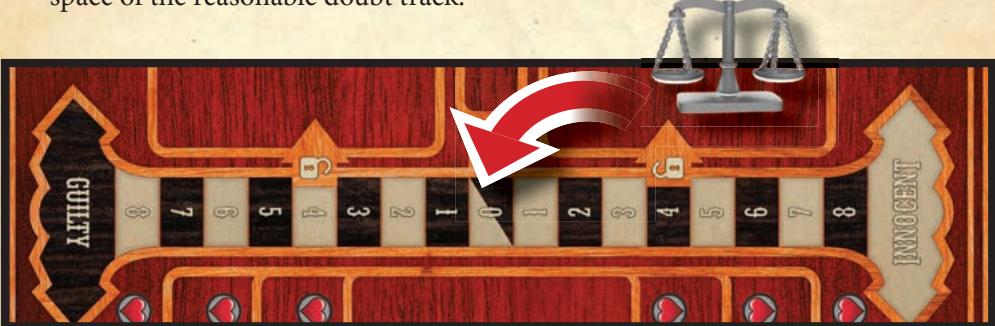
- Place the juror board between you and your opponent so that the “Prosecution" side of the board faces the prosecution player, and the “Defense" side faces the defense player. Place the justice marker on the 0 space of the reasonable doubt track.
-
Shuffle the 9 juror tiles and deal 3 to each player. Leave the remaining 3 facedown for now. From the 3 juror tiles you are dealt, take 1 and put it face-up in front of you, forming a hand of available jurors. Pass the remaining 2 to your opponent. From the 2 you are passed, take 1 and add it to your hand face-up. Pass the remaining tile to your opponent.
-
Put the last tile you received face-up on the blank space that has the unlock arrow pointing to it.

This is the deadlocked juror. When you advance the justice marker on or beyond the 4 spot on the reasonable doubt track, add this juror to your hand of available jurors. You must still convince this juror on a later turn. (see Moving the Justice Marker, page 19)
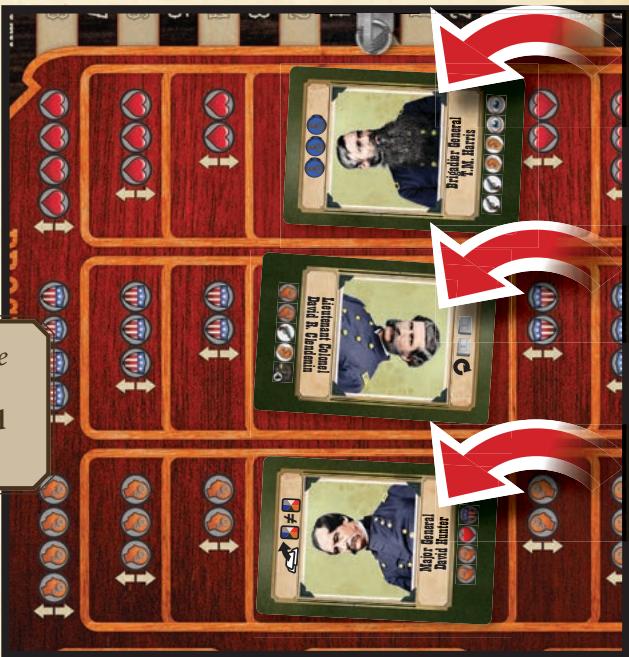
- Take the remaining 3 juror tiles and randomly place 1 each face-up in the center of the appeal to emotion, appeal to logic, and appeal to national interest tracks.
These three open jurors can be persuaded to your side by the corresponding appeal (see card actions, page 13).
-
Separate the trial cards into three piles, based on the number on their backs (I, II, or III). Shuffle each stack separately.
-
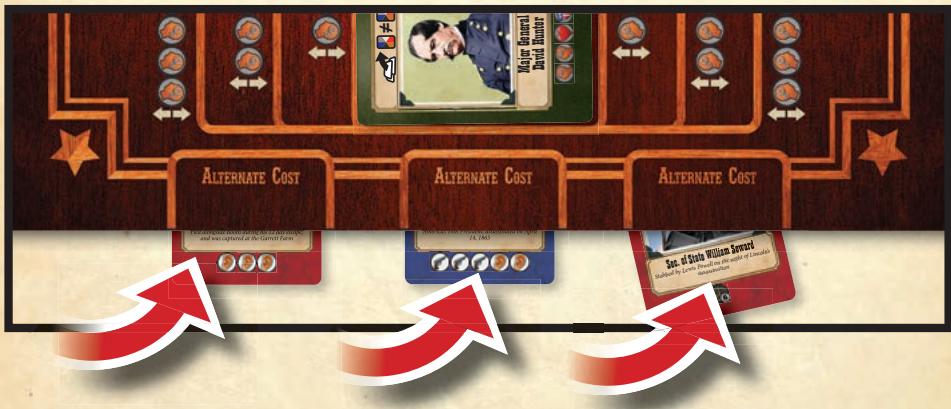
Take 3 Phase III trial cards at random and tuck them under the alternate cost spots on the juror board so that only their costs are showing. These cards provide an alternate cost for persuading the open jurors (see card actions, page 13). Note: If one of the Phase III cards has no cost, then the associated alternate persuasion action likewise has no cost.
- Add all 14 trial dice to the dice bag and give it a good shake. Then, fill the 5 spaces of the dice track with trial dice as follows. The prosecution player draws 3 dice from the trial dice bag and rolls them, and the defense player draws 2 dice from the bag and rolls them. The prosecution player then places one of their dice onto a space of their choice, keeping the result the same, followed by the defense player who places one of their dice onto a space of their choice, also keeping the result the same. Alternate between players until all 5 spaces have dice on them.

These trial dice are available for the players to select during the game. The dice closest to the prosecution are cheaper for that player to acquire, while those closest to the defense are cheaper for them. For your rst game, we recommend placing the 5 dice at random.
- The defense player randomly draws a single die, rolls it, and places it in the space above the '0' on the Reasonable Doubt track, keeping the result the same.
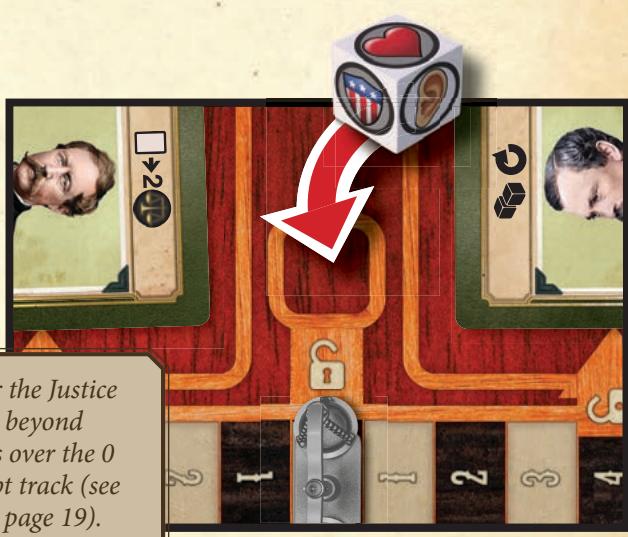
This die is obtained whenever the Justice Marker is moved either on or beyond the 4 space, or when it crosses over the 0 space of the Reasonable Doubt track (see Moving the Justice Marker, page 19).
Once complete, the juror board setup should look like this:

9. You and your opponent each take 5 sway. Place the rest in a supply nearby. Leave a space in front of you for your argument – the collection of trial cards you draft during the game – as well as for your hand of available juror tiles.
Trial Card Display Setup
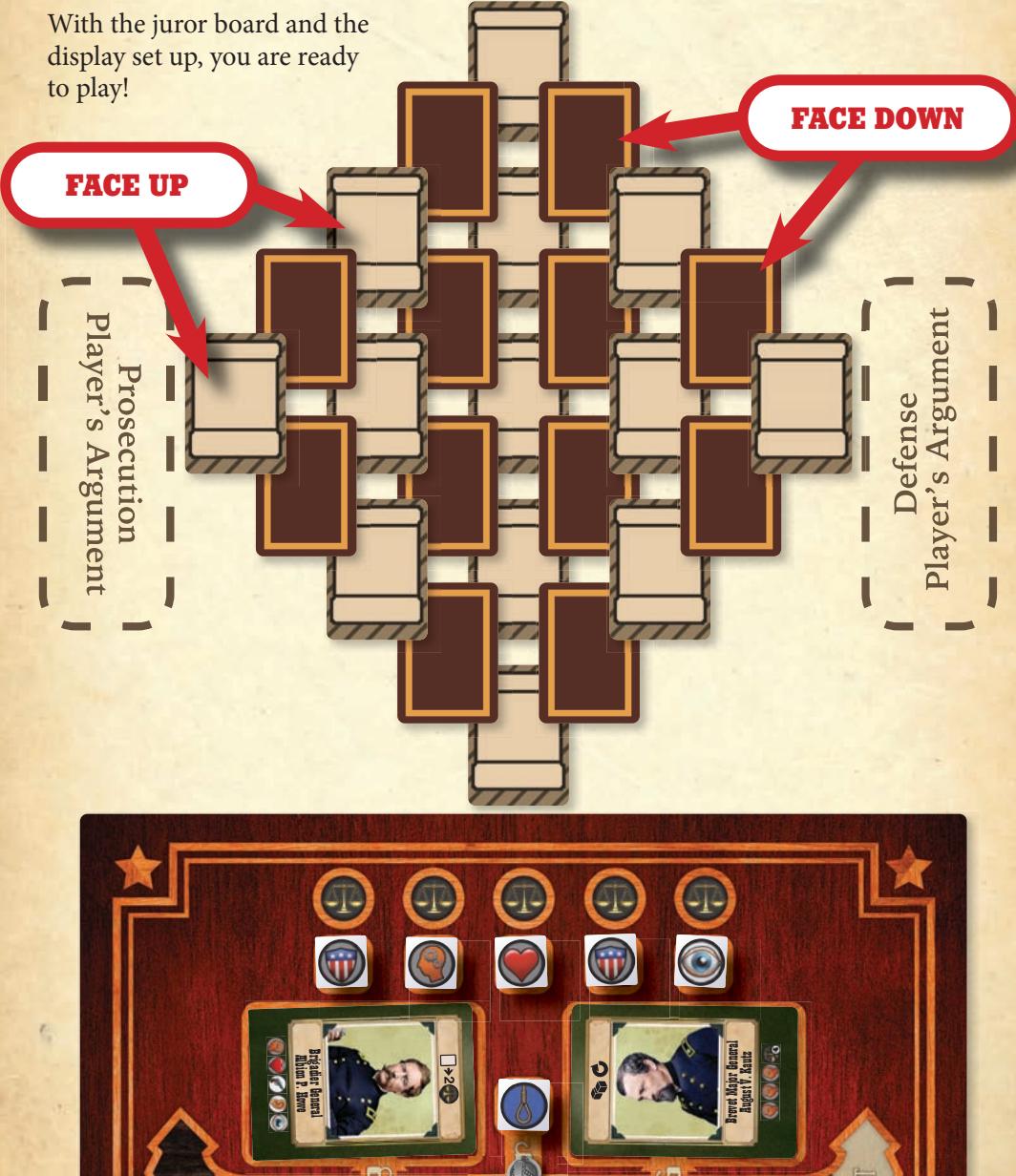
Each of the three phases of Unforgiven is set up in the same way. Deal the trial cards for that phase to form this display (hint: start with the five cards in the middle and work outwards):
After setting up the display for phases I and II, you will have 3 trial cards left over. Put those 3 trial cards aside; they will not be used this game. (Remember that 3 cards from the phase III deck were removed as part of the juror board setup). Leave space for a trial card discard pile beside the trial card display.
Trial Preparation
Each phase of the game begins with the first player selecting a single die from the dice track, and then the other player doing the same.
If ever there are no trial dice to select, leave the gap empty for now. The next time any trial dice are used, whoever used those dice chooses as many as are needed to ill any gaps, re-rolls them, and places them in spaces of their choice.
Anytime you need to select a tri-
al die, you always start at the space closest to you. You may skip over any number of dice by placing one sway beside each die you skip over before reaching your chosen die (do not place sway beside any empty spaces). If you do not have enough sway to make it all the way to a die, you cannot select that die. You gain any sway that is beside the die you select. Do not roll the die you select, but do keep it visible in front of you - trial dice results are public knowledge. During the course of the game you may spend your dice for actions, or pay sway to reroll them (see dice actions, page 16).
After both dice have been selected, fll in the gap you created by drawing and rolling a new trial die and placing it in the open space.
Example: Midway through the phase, the dice track looks like this:
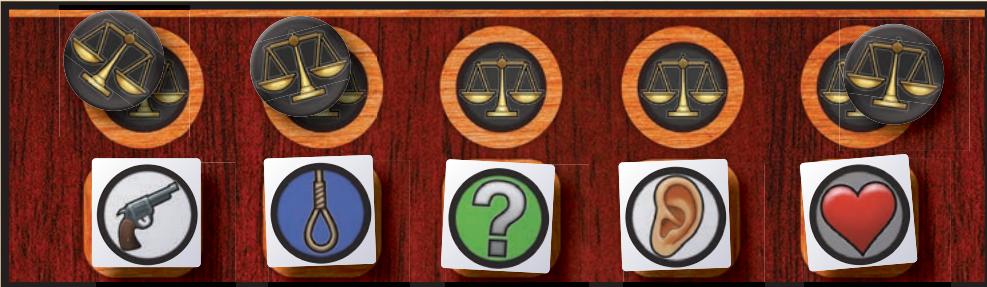
The prosecution player chooses to select the die, placing a sway token next to theand dice that were skipped over. The middle space is not yet refilled. The defense player then selects the die, placing a sway token next to the die that was skipped over. After both dice have been selected, 2 new dice are drawn, rolled, and placed into the gaps (prosecution puts the die they rolled in the middle, defense puts the die they rolled where the Hearsay die was taken from).
Anytime you are instructed to select a trial die, you will follow the same procedure as above. After selecting a die, fill the gap created with a new die before proceeding to your next action.
GAMEPLAY
A game of Unforgiven lasts for three phases. During each phase and starting with the first player, players will take turns taking card and dice actions until the phase ends (see page 18).
On your turn, you always choose a trial card from the display in order to perform exactly one card action. You may also perform any number of dice actions (you can do your actions in any order). After that, play passes to your opponent.
Card Actions
Choose a trial card from the display and then perform exactly one of the following actions:
• Draft the chosen card into your argument
OR
• Discard the chosen card to gain 2 sway
OR
• Discard the chosen card to persuade one of the three open jurors
OR
• Discard the chosen card to convince an available juror in your hand
The chosen trial card must be eligible: it must be face-up, and not covered in any way by any other trial card.
In the example at right, 5 trial cards are eligible:
If drafting or discarding a trial card leaves any face-down trial cards completely uncovered, flip those trial cards face-up. For example, drafting the eligible trial card in the bottom-right of the diagram above would leave the lowest face-down trial card uncovered, so it should be flipped face-up (it is eligible to be chosen next turn).

Card Actions (continued)
Draft the chosen trial card into your argument: You must have the proper resources and/or sway to pay its cost. If you cannot pay the cost, you cannot draft the card.
Paying Costs: In order to pay a resource cost, you must either have a card in your argument that produces that resource, or a trial die showing that resource. Each icon in your argument produces one of that resource. The resources on trial cards in Unforgiven never expire: a card that provides a resource will provide that resource for the rest of the game. Resources can be counted at most once when paying the cost of a card. Resources from trial dice, when used, are returned to the dice bag.
Once you draft a trial card, place it in your argument in front of you, and then perform its instant effects (if any; see card effects, page 19). It is helpful to group trial cards of the same type together, leaving only their top banner exposed.
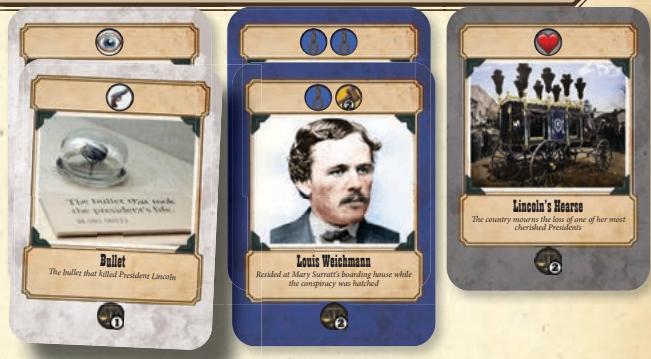
Discard the chosen card to gain 2 sway: Take 2 sway tokens from the supply, and place the trial card into its discard pile.
Discard the chosen card to persuade one of the three open jurors: Choose one of the three open jurors on the juror board that you wish to persuade. In order to persuade that juror, you must have the proper resources available to you.
Choose which cost you wish to pay to persuade the chosen juror:
• The default cost to persuade a juror to either side is indicated next to the tile's position on the juror board.
• You may instead pay one of the alternate persuasion costs (see page 8) of your choice. After paying that cost, remove the associated trial card from the game.
If you cannot pay either of the costs, you cannot persuade that juror.
Once you have paid the chosen cost, move it one space towards you. If you persuade a juror on the space closest to you, that juror is now convinced. (You do NOT pay the cost listed on the juror tile itself.) Perform its instant effects (if any) and place it sideways in front of you to show it is convinced. Finally, place the chosen trial card into its discard pile.
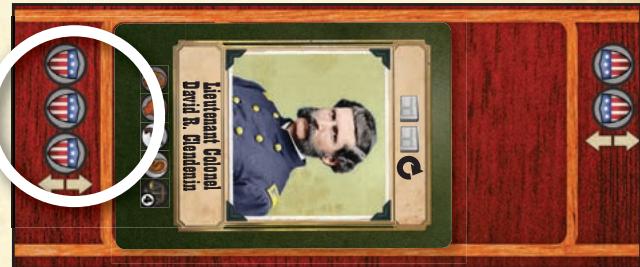
Example: The cost to persuade Lieutenant Colonel David R. Clendenin is either:

If you have the resources to pay one of these costs, discard the chosen trial card from the display to move that juror one space closer to you.

Discard the chosen card to convince an available juror
in your hand: You can convince any one of the available jurors in your hand. In order to convince that juror, you must have the proper resources to pay the cost of the tile. Once you've paid the cost, turn the juror tile sideways to indicate that it is convinced, and then perform its instant effects (if any). Juror abilities work the same as trial card abilities: they can provide additional resources or points, and several give you powerful instant abilities.
If you cannot pay the cost, you cannot convince that juror.
Finally, place the chosen trial card into its discard pile.
Instant Win Condition:
If you are able to convince 4 jurors, you immediately win the game!
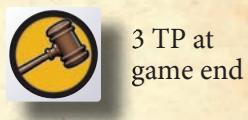
7 TP at game end
Dice Actions
At any time during your turn, you may exchange any number of your trial dice to receive a benefit based on the table of dice actions (shown on the following page). Dice can be used to gain resources to draft cards or convince jurors, exchanged for extra sway, or saved for powerful late-game effects. Notice that the more trial dice you exchange for certain benefits, the stronger those benefits become. There is no limit to the number of trial dice you can have at one time.
At any time, you may spend 1 sway to reroll one of your trial dice. You may also spend 3 sway (return it to the supply) to select a new trial die as outlined in trial preparation. You must still place a sway next to every die you skip over, starting from your side of the track.
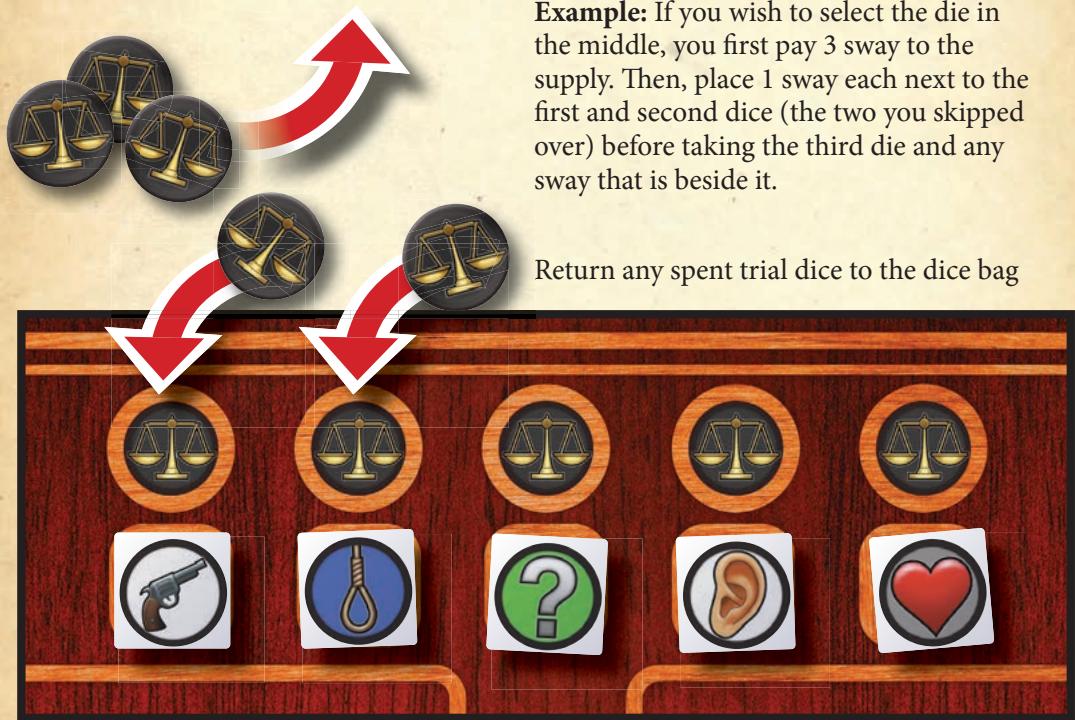
after performing your dice action. You can take as many dice actions as you wish on your turn.
Dice Actions

Provides 1 of that resource

Move the justice marker 1 space closer to you on the reasonable doubt track
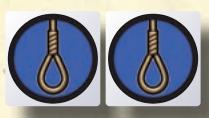
Move the justice marker 3 spaces closer to you on the reasonable doubt track

Move the justice marker 4 spaces closer to you on the reasonable doubt track


11 TP at game end

Counts as any other die face

Choose a trial card from any discard pile and add it to your argument without paying its cost

Convince any juror in your hand, or any juror on the board for free (this includes open and deadlocked jurors)

Any 1 Die: Gain 2 sway

Any 2 Dice: Gain 5 sway
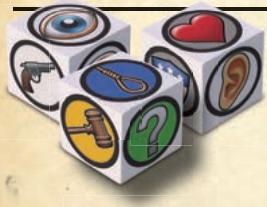
Any 3 Dice: Gain 8 sway
or Take an extra turn
or Objection! (see page 18)
Example: You want to draft a trial card that costs but your argument only provides and . Fortunately, you have a trial die showing . You may discard that trial die to gain a single )resource, allowing you to draft the chosen trial card.
Objection! is a powerful dice action that can be played on any turn to cancel any single action (card or dice) taken by the other player. After your opponent takes an action, pick up any 3 of your trial dice, slam them on the table and shout “Objection!" The opponent's action is canceled: it has no effect, and any trial dice or sway spent to pay for it are discarded. Return the 3 trial dice you used for this objection back to the dice bag.
Then, take the trial card that your opponent chose for their action and add it to your argument, performing any instant effects as if you chose the card yourself. Also, choose one of the open jurors and move it one space towards you (as if you persuaded a juror as an action).
Note that if a persuade juror or convince juror action is objected to, the juror tile is not discarded as part of the objection.
You may also use an objection to cancel your opponent's objection. The 3 trial dice they used for their objection are discarded, and your original action can be completed. They could object again, if they had another set of 3 trial dice...
End of a Phase
Each phase proceeds this way until there are no more trial cards left in the display. This triggers the end of the phase, or, if you just finished playing phase III, the end of the game.
Phases II and III are set up identically to phase I. In these phases, whoever has the justice marker furthest away from them decides who plays first. If the justice marker is on the 0 space, whoever went first in the previous phase decides who plays first.
Each player selects a single die from the dice track at the beginning of phases II and III, as outlined in Trial Preparation (see page 12).
CARD EFFECTS
What a trial card does depends on the icons at the top of the card. Some icons give a benefit immediately when the card is drafted, while others provide an ongoing benefit as part of your argument.
Cards with theicon give you that many sway tokens as soon as they are drafted.
Evidence (White) and Appeal (Gray) cards have icons that provide resources which can be used for drafting trial cards, and persuading and convincing jurors. Each evidence or appeal icon provides a single resource of the indicated type. Resources are never used up: a card that provides resources will provide those resources for the rest of the game. Resources can be counted at most once when paying the cost of a trial card or juror tile.
For example, having a card that providesin your Argument provides only one . You would need two such icons if you wanted to draft a trial card that costs
Some cards provide a choice of resources. This choice is indicated by a slash: a card that provides/ gives you your choice of either ) or but not both. A card that showsgives you both of those resources at the same time.
Example: You have a card that provides and . You could pay for a card that costs or or even but not one that costs or
Moving the Justice Marker
The first time that you move the justice marker on or beyond the 4 space closest to you, you must take the deadlocked juror tile from that space into your hand of available jurors. On a later turn, you may convince that juror by taking the convince an available juror action as usual. After acquiring this deadlocked juror, you also gain the die in the space above the 0’ on the Reasonable Doubt track.
You also gain this die any time you cause the Justice Marker to cross over the 0’ space from the other side of the track. Whenever you take this die, keep the result shown. Then draw and roll a new trial die to replace it.
Instant Win Condition
If you move the justice marker on or beyond the space closest to you (either Guilty’ or Innocent’), you immediately win the game!

Reasonable Doubt (Blue) cards have icons which move the justice marker closer to your end of the reasonable doubt track. When you draft any card with a in its effect, you immediately move the justice marker a number of spaces equal to the number ofon that card. After that, the provide no further benefit, though you still keep the card in your argument.
Fact (Red) cards, and others with the icon provide trial points (TP) at the end of the game. Some give a fixed amount, like 4 TP, while others depend on other cards in your argument. For example, a card might provide you with “1 TP for each reasonable doubt (blue) card in your argument," shown as . These values are calculated at the end of Phase III.
Rhetoric (Black) cards give you ongoing special abilities, though two (Mary Todd Lincoln and Sec. of War Edwin Stanton) simply provide a one-time sway boost. These ongoing abilities are always available to you once you've drafted the card. For example, Lincoln's Artifacts gives you a bonus sway each time you discard a trial card for the rest of the game.
Press Baron (Sepia) cards represent powerful figures of the burgeoning newspaper industry. They influence the mood of the trial by providing a one-time bonus of trial dice when drafted, letting you select those dice without paying any sway. 'Though they can tip the scales of justice in your favor, they force you to skip your next turn.
Note: Many cards have different types of icons in their effects, and these cards provide a combination of abilities. For example, Jefferson Davis provides . This card immediately moves the justice marker one space closer to you, and then provides an ongoing resource.
GAME END
There are three ways the game can end:
-
You move the justice marker on or beyond the space closest to you (either ‘Guilty' or 'Innocent').
-
You convince 4 jurors.
-
Phase III ends with neither of these conditions being met.
If the game ends at the end of Phase III, total up the number of trial points (TP) on all cards in your argument, including any trial dice, and all convinced jurors (available jurors in your hand do not provide anything for you). Whoever has the most trial points is the winner! If there is a tie, whoever has the justice marker closest to them wins. If the justice marker is on the 0 space, whoever has the least sway loses. If all players have the same amount of sway, then the game is declared a mistrial and neither player wins.
The Fate of Mary Surratt
"..the Commission do, therefore, sentence her, the said MARY E. SURRATT, to be hanged by the neck until she be dead, at such time and place as the President of the United States shall direct."
(July 7, 1865. The hanging of Mary Surratt, Lewis Powell, David Herold, and George Atzerodt)
If the prosecution player is the winner, they must now decide the fate of Mary Surratt. In reality, she was hanged alongside Lewis Powell, David Herold, and George Atzerodt. Many, however, thought that she deserved a different fate. Indeed, five members of the nine-man Military Commission signed a clemency request for Mary Surratt on the same day - June

30, 1865 - that the tribunal reached its verdict:
The undersigned members of the Military Commission detailed to try Mary E. Surratt and others for the conspiracy and the murder of Abraham Lincoln, late President of the United States, do respectively pray the President in consideration of the sex and age of the said Mary E. Surratt, if he can upon all the facts in the case, find it consistent with his sense of duty to the country to commute the sentence of death to imprisonment in the penitentiary for life.
The request for mercy was signed by: Major General David Hunter - president of the Military Commission; Brevet Major General August V. Kautz; Brigadier General Robert S. Foster; Brevet Brigadier General James A. Ekin; and Brevet Colonel Charles H. Tompkins.
President Andrew Johnson refused to commute her sentence, saying “she must be punished with the rest... she kept the nest that hatched the egg."
Was justice served in this trial? Or was it gravely blinded by passion? Did you rewrite history and alter the fate of Mary Surratt? Or is she truly unforgiven?
APPENDIX 1: TRIAL CARDS

"Oh Captain, My Captain" Reasonable Doubt (blue) cards cost your opponent 1 more sway to draft

Brevet Brig. Gen. Cyrus Comstock Worth 3 trial points for each of your convinced jurors

Captain Edward Doherty
You may use eyewitness resources as interest resources and vice versa, including while scoring trial points at the end of the game

Col. Henry Burnett
You may pay 4 sway to gain a single appeal to logic, emotion, or interest resource to use this turn

Colonel Lafayette Baker
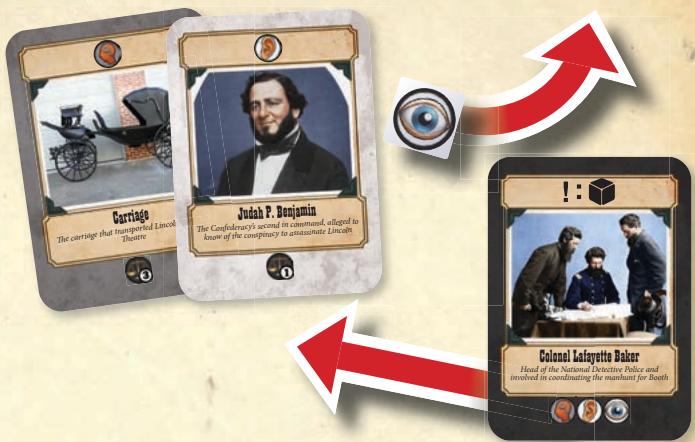
At the beginning of each phase, you can select an extra trial die (after both players have taken their dice for the phase). You must still place sway tokens on any dice you skip over on the track

Congressman John Bingham Worth 1 trial point for each of your remaining sway tokens

Edman Spangler
You may pay 2 sway to gain a single physical, hearsay, or eyewitness resource to use this turn

Frederick Stone
Fact (red) cards cost you one less resource (of your choice) to draft
Headlines
Each Headlines card is worth 1 trial point for every Headlines in your argument, including this one. (for example, if you have three of them, they are each worth three trial points each)

Henry Jarvis
Select 2 trial dice without placing sway on any dice you skip. Then, skip your next turn
I|II|III
Hon. Reverdy Johnson
Once per trial phase, you may re-roll any of your trial dice for free

Horace Greeley
Select 3 trial dice without placing sway on any dice you skip. Then, skip your next turn

JAG Joseph Holt
Move the justice marker one space closer to you for each pair of rhetoric (black) cards in your argument when this is drafted

James Gordon Bennett
Select 1 trial die without placing sway on any dice you skip. Then, skip your next turn

João Celestino
You may use physical resources as appeal to emotion resources and vice versa, including while scoring trial points at the end of the game

Lewis Powell
You may use hearsay resources as appeal to logic resources and vice versa, including while scoring trial points at the end of the game

Lucy Hale
Worth 2 trial points for each of your unused trial dice

Maj. Gen. Hunter's Raid
Whenever you discard a trial card, gain 1 additional sway

Powder Monkey
Whenever you advance on the reasonable doubt track, you gain 1 sway

Thomas Ewing Jr.
You may discard any trial die to gain a physical, hearsay, or eyewitness resource

Walter Cox
You may use a trial die showing physical, hearsay, or eyewitness as if it showed gallows

Lincoln's Artifacts
Whenever you discard a trial card, gain 1 additional sway

Scoring Cards
Any card with these icons scores that many trial points for each card of the matching color in your argument at the end of the game
APPENDIX 2: JUROR TILES
Brigadier General T.M. Harris

Gallows, Gallows, Gallows
Brevet Brigadier General James A. Ekin
Immediately gain 9 sway


Cost: Move the Justice Marker two spaces closer to your opponent
Brigadier General Albion P. Howe
Major General Lew Wallace
Immediately gain 2 sway for each evidence your argument
4 TP, take an extra turn after this one


Major General David Hunter
Lieutenant Colonel David R. Clendenin

Provides 2 Headlines, take an extra turn after this one
Brevet Major General August V. Kautz

Select 2 dice (without placing sway on any dice you skip) then take an extra turn

You may immediately draft up to 2 cards from the discard pile of different colors (ignore their costs)
Brigadier General Robert S. Foster

Provides one resource of your choice
Brevet Colonel C. H. Tompkins

7 TP
Collector's Edition Cards
The collectors edition of Unforgiven features three additional Trial cards and one additional Juror tile. To use these, simply add each trial card to its respective deck before setting up each phase (you will have 4 cards left after building the display instead of 3), and replace one random Juror tile with Justice Andrew Wylie before drafting Juror tiles in step 2 of setup.
x5 Last Hours of Abraham Lincoln

You may spend 2 sway to re-roll all the dice on the track and put them back in an order of your choice
Stay of Execution
Move the Justice Marker to the 0' Space of the Reasonable Doubt Track
Ely S. Parker
2 TP, and after drafting you may discard up to 2 cards from the trial card display (those cards have no effect)

Justice Andrew Wylie
You can discard 6 trial dice each with different icons to convince a juror from the other player (you also get its instant effect). It does not matter if the other player had convinced the juror or not; you can convince that juror (and receive its benefit) regardless
下载 Markdown原文为社区整理/出版社公开资料,版权归原作者,仅供个人学习查阅。