
Union PacificUnion Pacific
一句话概览
Union Pacific 是一款已收录于村了吗规则库的桌游,支持 2–6 人,原名 Union Pacific。
本页内容:一句话概览 · 常见问题
这游戏怎么玩
- 本站已收录这款游戏的规则资料,可以在对话里直接提问规则细节。
常见问题(FAQ)
以下 1 条问答中 0 条来自站内玩家的真实提问,其余 1 条为本站整理的常见疑问;答复内容保持原样。
Union Pacific支持几个人玩?
2–6 人。
去哪查完整规则
想核对具体规则细节、卡牌效果或某个回合的结算方式,可以在村了吗里选中这款游戏后直接提问。
同类桌游
- 卡坦岛德式
- 工业革命:伯明翰德式
- 勃艮第城堡:特别典藏版德式
- 方舟动物园德式
- 卡卡颂抽象
- 瘟疫危机传承:第一季美式
- 阿瑞迪亚:勇踏征途美式
- 重塑宇宙德式
- 幽港迷城美式
- 埃多拉的德鲁伊德式
规则原文(Markdown)
本站收录这款游戏的规则原文 1 个文件,此处内联渲染 1 个,可直接展开阅读或下载。
Union Pacific.md21.6 KB
WNION PACIFIC
Railroading for fun & profitRailroading for fun & profit
players: 2-6
age: 10 and up
length: 90 minutes
Contents: Contents:
Overview and components ..
Game Preparation ....
The railway system ...
The railway companies..
The share cards .
Playing the game .
Building track..
The Union Pacific railway company...9
Investing .
Dividend payments... .10
Special considerations of
dividend payments ...
Dividend payments
for the Union Pacific.. .11
Special considerations of
Union Pacific dividend payments.....11
Game end 12
Rules for two players .. 12
Overview
The Union Pacific is one of the largest railroad companies in America. Its rails connect many of the largest cities in America. To further enhance its range, it has arrangements with smaller companies to use their rails. This allows the Union Pacific to serve even more cities. The ten smaller companies are shown on the map with their starting cities and possible track sections they may build. Each track section connects two cities and has spaces for one or more trains. The number of spaces indicates how many companies may build track along the section. The players are shareholders of the railway companies and fight for the stock majorities in the companies. They also develop the railway systems by building track for the companies. By building track for the companies they have large holdings in, the players attempt to earn large dividends and end the game as the richest player.
Components: Components:
131 locomotives




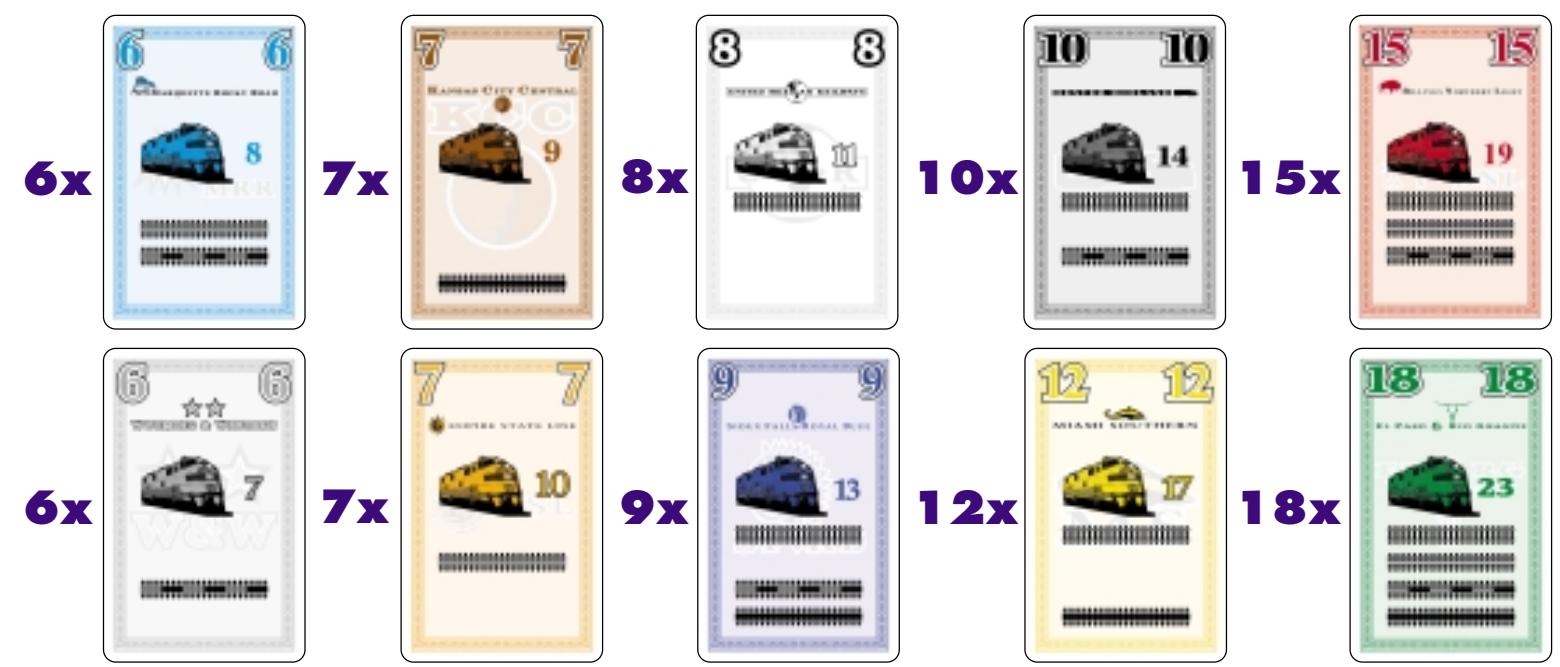
98 shares of the ten railway companies


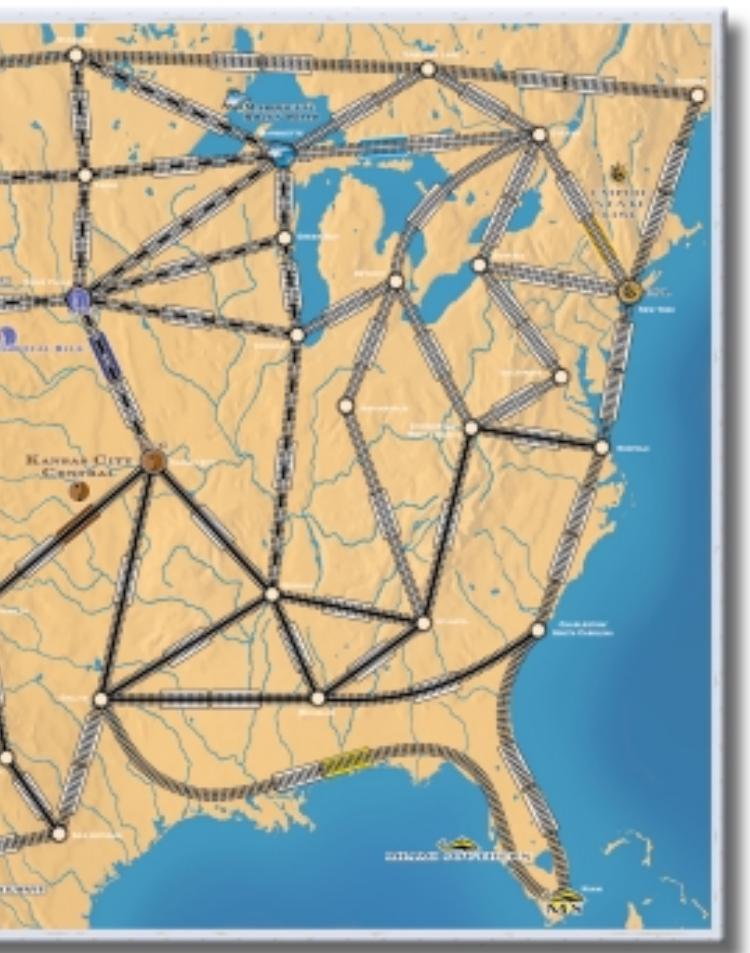
game board
150 bank notes



40 track cards
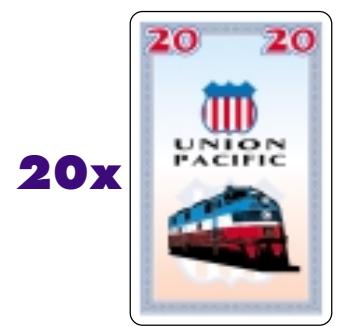
20 shares of the Union Pacific

game preparation game preparation

Numbered trays for the trains
Place the board in the middle of the table.
Choose a player to be the banker. He administers the bank notes and the trains.
Sort the bank notes and trains by color. Put the bank notes into the three angled trays designed to hold them. Put the trains into the numbered trays according to the numbers of trains of each color. For example, put the 23 green trains into the tray numbered “23”.
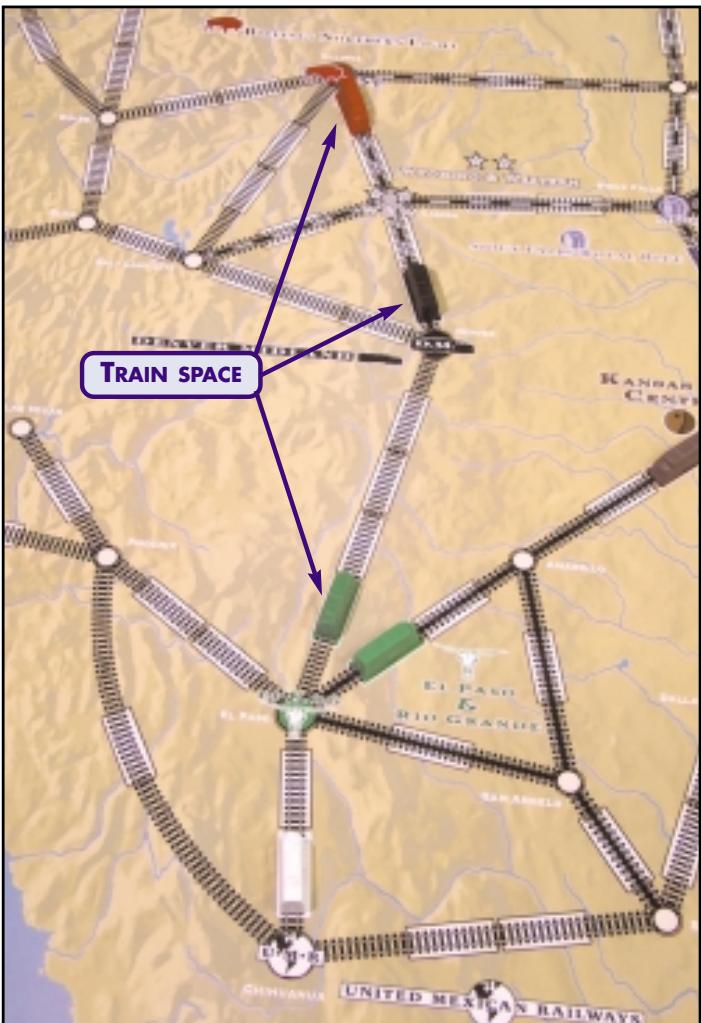
For each of the ten railway companies, one or two (for the El Paso & Rio Grande) train spaces are colored on the map. Place one train of the matching color on each of these 11 colored spaces on the map. Leave the remaining trains in their trays in the box until they are used.
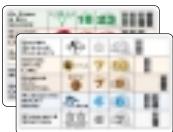
Each player takes one summary card with the share, train, and track information for the 10
railway companies which will have track on the board. As the Union Pacific does not build track, it is not included on the cards.
Shuffle the track cards and deal three to each player face down. Place the remaining track cards face down next to the board. When the last card is drawn during play, shuffle the discarded track cards
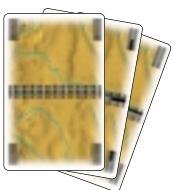
and place them face down next to the board.
Each player takes one share of the Union Pacific and adds it to the three track cards in his hand. Place the remaining Union Pacific shares in a stack next to the board.
4 face up share cards
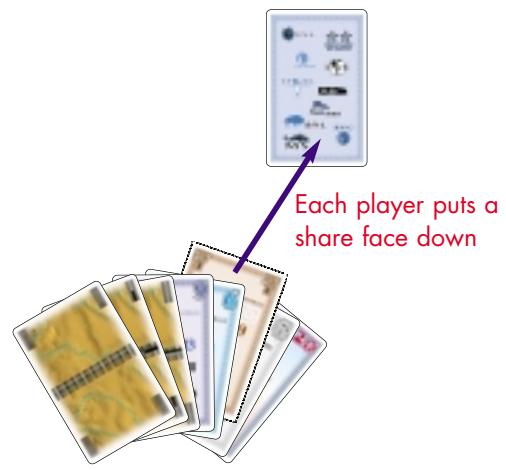
Shuffle the share cards of the other ten railway companies and deal four to each player face down. The players add these to the single Union Pacific share and the three track cards in their hands. All players select one of the five shares in their hands and place it face down on the table. The players turn these shares face up at the same time. These first shares are the players’ initial investments in the railway companies. The cards in the players’ hands should be kept secret from the other players.
Draw four cards from the share stack and place them face up next to the board.

Divide the remaining share cards into three groups. One group has six cards, a second group has 18 cards and the remaining cards form the third group. Shuffle three dividend cards into the large group and place it face down on the table. Shuffle the fourth dividend card into the group of 18 cards and place this group face down on top of the large group. Finally, put the group of 6 cards face down on top of the other groups. Put the entire stack next to the four face up share cards.


The railway system
The railway system on the board consists of track sections each of which connect two cities. Each section has one, two, three or four train spaces shown. The number of train spaces shown on a section determines how many different companies may use that track section for their routes. The train spaces are colored in the colors of the ten companies and a neutral eleventh color. The colored train spaces are the starting routes for the ten companies. The players use the neutral train spaces to build the routes for the ten companies. Each of the ten companies has a main train station. The stations are shown on the board with the company’s color and logo (called flag when referring to a railway company). The Union Pacific has neither a main station nor trains to build routes.
The four types of track
Within the railway system there are four different types of track. Except for the El Paso & Rio Grande (EP&RG), the companies are limited to one, two or three types of track for their routes. The summary cards and the share cards graphically display the types of track a player may use when adding to a company’s route.

The share cards
Each railway company has 6 to 20 share cards. Each share card shows the company’s name and flag, the total number of shares available, how many trains are available for track building, and the type of track the players may use to add to a company’s route.

Playing the game Playing the game
The youngest player begins. Play then follows clockwise until the game ends. On a player’s turn, he first draws a track card and adds it to his hand. Then, he may take one of two actions. Either he builds a track section, adding it to a company’s route (building track) and draws a share card or he plays one or more share cards from his hand (investing), placing them on the board.
A player draws a track card and then either builds track or invests.
Building track
1. Select a track card
The player selects one of his four track cards and places it face up on the stack of discarded track cards. This card determines the type of the track that he will place a train on.
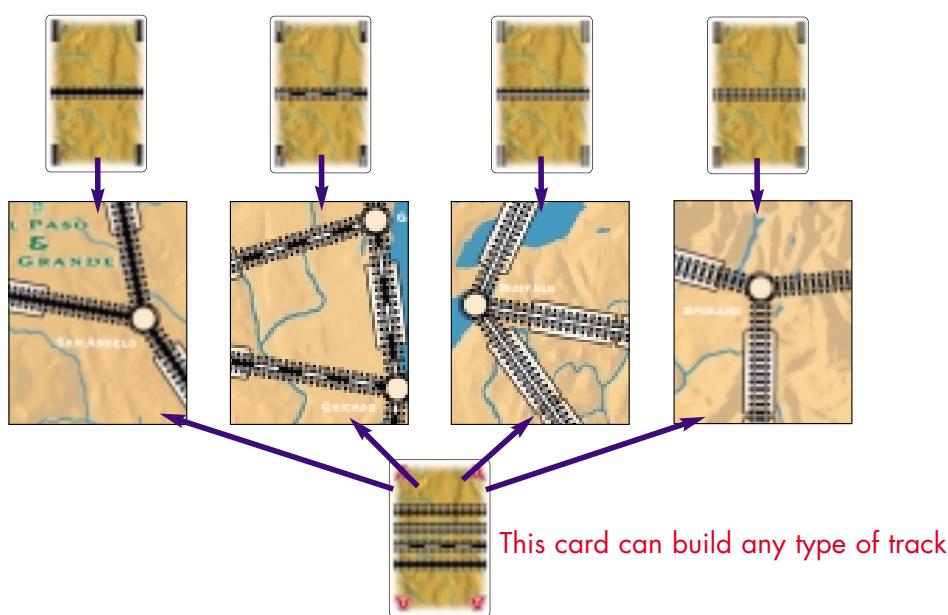
There are track cards for each type of track and generic track cards, which may be used for any type of track.
2. Select a company/train
Then the player takes a train from the box. It’s color corresponds to the color of the company he is building track for. A player may then place the selected train on an empty train space on the board, if the following conditions are met:
The type of track on the train space on the board must match the track card played.
The railway company whose train is played must be allowed to use the type of track where the train is played.
The train must be placed on an empty neutral-colored train space.
The railway company may have no train on the selected section of track.

Example: A second black train of the Denver Midland may not be placed on the track section between Denver and El Paso.
Example: The red trains of the Billings Northern Lights (BNL) on the track sections between Billings and Casper and between Casper and Salt Lake City are connected with the main station of the BNL in Billings. A player cannot place a red train on the track section between Denver and El Paso until either the Denver to Casper or Denver to Salt Lake City track sections have a red train and Denver is, thus, connected to Billings (or El Paso is connected to Billings via Miami).

The selected track section must connect to the company’s main station via track sections where the company’s trains have already been placed (see accompanying example).
There must be a train of the company’s color in the box. When all a company’s trains have been placed, the company cannot expand further.
A player may play trains for any company he chooses. He need not have nor plan to have shares in the company when he places a train for that company.
3. Draw a share card
After the player places a train he must draw a share card and put it in his hand. He may choose from the four face up share cards or the topmost card of the stack of face down share cards or a share card from the Union Pacific stack.
After building track, the player draws one of the four face up share cards or the topmost card of the face down share card stack or a card from the Union Pacific stack.

If he takes one of the four face up cards, he must replace it immediately with the topmost card from the stack of face down share cards. This ends the player’s turn.
Note: If the four face up share cards are from the same railway company, they are immediately removed from the game and put face down in the box. They are replaced by the topmost four cards from the face down share card stack. Shares removed in this way may not be examined later.
The Union Pacific railway company
The shares of the Union Pacific are treated the same as shares of the other ten companies. Whenever a player may draw a share card after track building, he can take a Union Pacific share instead of a share from one of the other ten companies. When the stack of Union Pacific cards is depleted, no more shares in the Union Pacific are available.
Note: After drawing a card, a player may exchange any share card from his hand for a card from the Union Pacific stack (if there are still cards available there). The share card can be the card just drawn or any other share in his hand (including a Union Pacific share). The player puts the Union Pacific share in his hand and puts the discarded share face down in the box. It is not shown to the other players and may not be examined later.
During investment, the Union Pacific shares are treated the same as the shares of the other companies. In contrast to the other companies, the Union Pacific does not have trains and cannot have track built on it behalf.
Investing
1. Play one or more share cards
After a player draws a track card to start his turn, he can decide to invest. To invest, he puts shares face up on the table. He plays either one or more shares of one railway company,
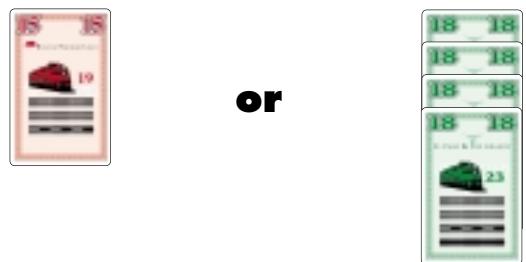
or one share from each of two railway companies.

Shares of the same company are displayed on the board by overlapping the shares. The player may use this action to add shares to those he has in a company or to place the first shares of a new company.
2. Discard a track card
The player ends his turn by discarding one of his four track cards. He may place no trains nor draw share cards when he invests.
Note: Only the shares on the table are considered as part of a player’s investment to earn dividend payments. The shares in a player’s hand are not considered during dividend payments.
Dividend payments
When a player draws a dividend card from the face down share stack, he immediately places it face up on the table, announcing a dividend. Before the dividends are paid, the player draws the next card from the stack to place in his hand or face up on the table as he had planned. If this second card is also a dividend card, a double dividend is paid. The dividends are paid, the dividend card is put in the box, and then play continues with the clockwise neighbor of the player who drew the dividend card.
EL Paso & Rio Grande has 2 trains: the value is \$3 million (2 trains + main station).
Sioux Falls Royal Blue has 5 trains: the value is \$6 million (5 trains + main station).


The amount of a company’s dividend is based on the number of trains that have been played for the company. One million is added to the dividend to represent the main station. At the beginning of the game all companies have a dividend value of \$2 million (1 train + main station), except the EP&RG which has a value of \$3 million (2 trains + main station).
As the game progresses, the value of a company’s dividend increases by 1 million for each train played for the company.
Not all shareholders of a company will receive dividend payments. The player with the most shares in a railway company is the primary shareholder and receives the current dividend
Dividends are paid only to the primary and secondary shareholders of a company.
value as calculated above. The player with the next most is the secondary shareholder and gets half of the above amount (rounded down). The banker distributes bank notes in the appropriate amounts to these shareholders.
Tip: To organize a dividend payment, the players should begin with the EP&RG and move through the rest in the order on the summary cards. After these are done, the dividend for the Union Pacific is paid.
Example of a dividend:

EL PASO & RIO GRANDE Worth = \$3 Million

Anna has 3 shares => primary shareholder
Frank has 2 shares => secondary shareholder
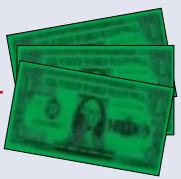
Anna has 4 shares => primary shareholder
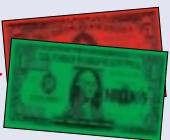
Bob has 2 shares => secondary shareholder

Gary has 1 share => He earns no dividend.
Clarissa has 1 share => She earns no dividend.
Note: Only the invested shares on the table are counted for the dividend payment. Share cards in the players’ hands are not counted.
Special considerations of dividend payments
If one player has all the invested shares in a railway company, he receives the amounts for both primary and secondary shareholder.
If several players tie for the most invested shares in a railway company, the amounts for both primary and secondary shareholder are added together and divided by the number of tied shareholders (rounded down). Shareholders who possess fewer shares in this company receive no dividend.
If there is a primary shareholder, but several players tied for secondary shareholder, the primary shareholder receives his dividend as usual. The tied secondary shareholders must share equally the amount for the secondary shareholder. As this amount is rounded down, it can occur that they receive nothing (see accompanying example).
There are four dividend payments during the game. They occur when the dividend cards are drawn. After the the fourth dividend payment is paid, the game ends.
Dividend payments for the Union Pacific
The Union Pacific (UP) will pay up to five shareholders a dividend instead of just 2. The value of the Union Pacific payments grows during the game. During the first dividend, Union Pacific shares have no value. For the following three dividends, the players receive their payments in the order of shares they own as shown in the table below (see also the example).
| Union Pacific (UP) dividend table | ||||
| 1st | 2nd | 3rd | 4th | |
| 1st shareholder $0 Mill. | $10 Mill. | $15 Mill. | $20 Mill. | |
| 2nd shareholder $0 Mill. | $8 Mill. | $12 Mill. | $16 Mill. | |
| 3rd shareholder $0 Mill. | $6 Mill. | $9 Mill. | $12 Mill. | |
| 4th shareholder $0 Mill. | $4 Mill. | $6 Mill. | $8 Mill. | |
| 5th shareholder $0 Mill. | $2 Mill. | $3 Mill. | $4 Mill. | |
Special considerations of UP dividend payments
If fewer than five players have invested in the Union Pacific, they receive only the payment for their position in the table. Unused table positions are not divided among these shareholders.
中 If several players tie for the most Union Pacific shares, the dividends from the table are added for the number of ties shareholders and divided by their number (rounding down, see example).
If several players tie for position lower than first, the allocation is handled as above by adding the position amounts and dividing by the number of players.
Example:
A company has a dividend value of \$7 million with 3 tied as primary shareholders. Each receives \$3 million (7+3 = 10/3 = > 3).
A company has a dividend value of \$5 millions. The primary shareholder receives \$5 million. With three tied for secondary shareholder, none of them receives a payment (5/2 = 2; 2/3 => 0 (rounded down).
Example:
In the 2nd dividend, the 1st UP shareholder receives \$10 million, the 2nd receives \$8 millions, etc..
Example:
If three players tie for the most UP shares for the 3rd dividend, each receives \$12 million (15+12+9 = 36/3 = >12)
Game end Game end
The game ends after the fourth dividend has been paid. The player with most cash is the winner. Cards in a player’s hand have no value.
Special rules for playing Special rules for playing with two playerswith two players
So that Union Pacific remains exciting and fun for two players, use the following rule modifications when playing with two.
à The game ends with the third dividend payment. The fourth dividend card is shuffled into the deck, but is not used in the game.
When the third dividend card is drawn, the players sort the four face up shares and the cards of the face down share deck according to the different railway companies. These sorted shares and the remaining Union Pacific shares belong to a imaginary third player.
Now the last dividend payments are made considering the imaginary third player as a shareholder. Since the largest dividend payments are earned in this last dividend, the imaginary player has a chance to win the game.
Dividend card variantDividend card variant
To avoid fast dividend sequences, we suggest the following changes for game preparation: After each player receives his shares and the four face up shares have been placed next to the board, remove 24 share cards and separate them into four stacks of six cards each. Then separate the remaining share cards into approximately equal stacks. Shuffle one dividend card into each of these. Then build the share card stack by placing one of the “dividend stacks” on the table. Place one of the six card stacks on that, follow with another “dividend stack”, a second six card stack, and so on until all cards are stacked into the share card deck.
| Reference table Union Pacific (UP) dividend payments | ||||
| 1st | 2nd | 3rd | 4th | |
| 1st shareholder $0 mill. | $10 mill. | $15 mill. | $20 mill. | |
| 2nd shareholder $0 mill. | $8 mill. | $12 mill. | $16 mill. | |
| 3rd shareholder $0 mill. | $6 mill. | $9 mill. | $12 mill. | |
| 4th shareholder $0 mill. | $4 mill. | $6 mill. | $8 mill. | |
| 5th shareholder $0 mill. | $2 mill. | $3 mill. | $4 mill. |
If you have questions, comments or suggestions, please write:
下载 Markdown原文为社区整理/出版社公开资料,版权归原作者,仅供个人学习查阅。