
Votes for WomenVotes For Women
一句话概览
Votes for Women 是一款已收录于村了吗规则库的桌游,支持 1–4 人,原名 Votes For Women。
本页内容:一句话概览 · 常见问题
这游戏怎么玩
- 本站已收录这款游戏的规则资料,可以在对话里直接提问规则细节。
常见问题(FAQ)
以下 1 条问答中 0 条来自站内玩家的真实提问,其余 1 条为本站整理的常见疑问;答复内容保持原样。
Votes for Women支持几个人玩?
1–4 人。
去哪查完整规则
想核对具体规则细节、卡牌效果或某个回合的结算方式,可以在村了吗里选中这款游戏后直接提问。
同类桌游
- 卡坦岛德式
- 工业革命:伯明翰德式
- 勃艮第城堡:特别典藏版德式
- 方舟动物园德式
- 卡卡颂抽象
- 瘟疫危机传承:第一季美式
- 阿瑞迪亚:勇踏征途美式
- 重塑宇宙德式
- 幽港迷城美式
- 埃多拉的德鲁伊德式
规则原文(Markdown)
本站收录这款游戏的规则原文 1 个文件,此处内联渲染 1 个,可直接展开阅读或下载。
22021 VfW Rules book low res.md31.6 KB
VOTESFOR WOMEN
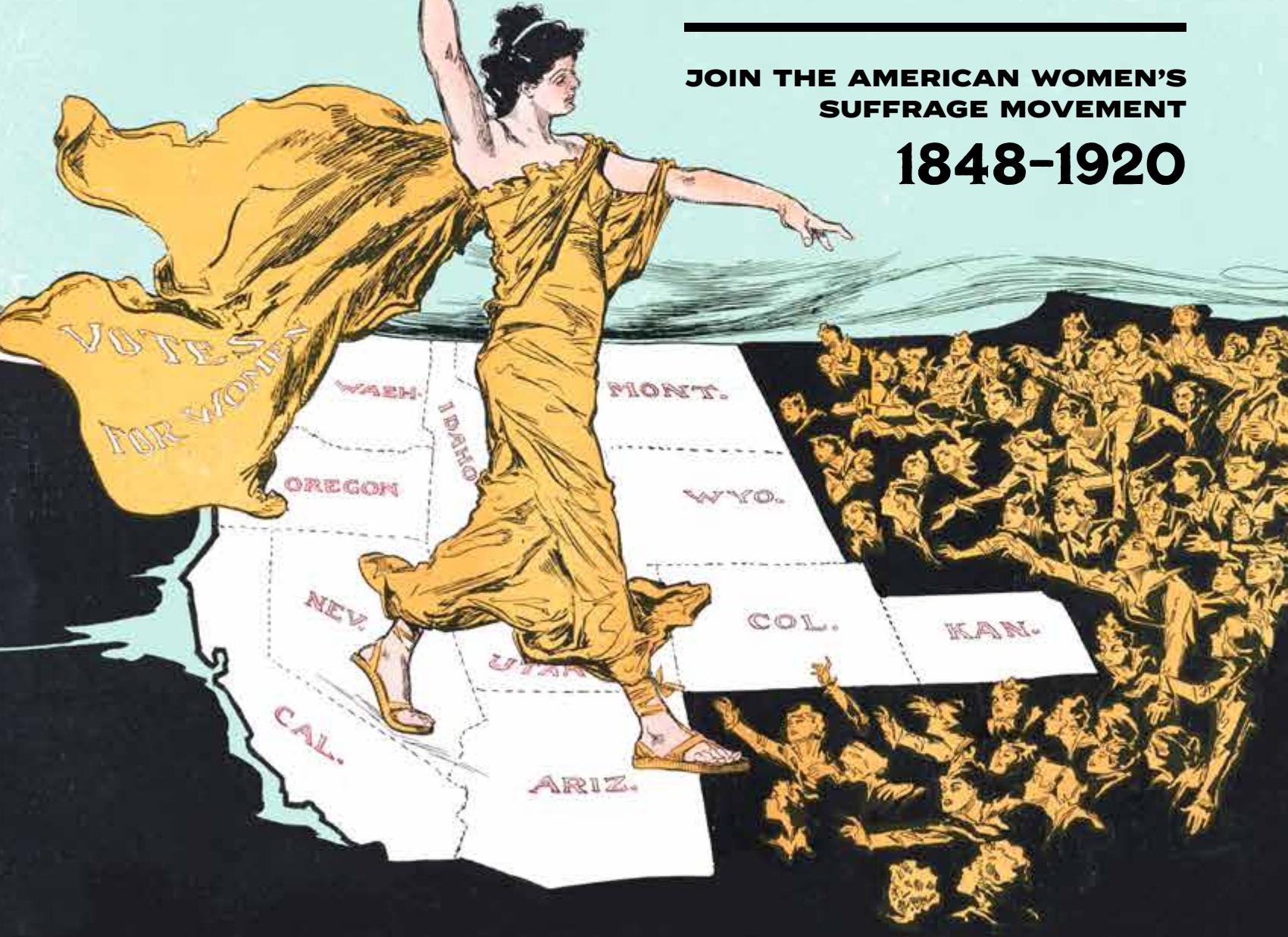
RULES OF THE GAME
“THE RIGHT OF CITIZENS OF THE UNITED STATES TO VOTE SHALL NOT BE DENIED ORABRIDGED BY THE UNITED STATES OR BY ANY STATE ON ACCOUNT OF SEX. CONGRESSSHALL HAVE POWER TO ENFORCE THIS ARTICLE BY APPROPRIATE LEGISLATION.'NINETEENTH AMENDMENT TO THE US CONSTITUTION
OVERVIEW
Votes for Women is an asymmetrical, two-sided game that revolves around the battle to ratify or reject the Nineteenth Amendment to the US Constitution. The Suffragist side will push Congress to propose the Nineteenth Amendment, and campaign to have 36 states ratify the Amendment. The Opposition side will try to prevent Congress from proposing the amendment or, failing that, to have 13 states reject the amendment.
Players will add or remove Congressional markers as support for the amendment waxes and wanes in Congress, while also placing Purple/Yellowcubes (Suffragist side) or Red cubes(Opposition side) to reflect their political power in individual states. When a player gains support in a state, they first reduce or eliminate their opponent's cubes, as needed, before adding their own cubes so that a state will only ever have Purple/Yellowor Red
Once the Nineteenth Amendment has been sent to the states for ratification (or rejection), the Suffragist side will place a Green check in each state that ratifies the amendment and the Opposition side will place a Red X in each state that rejects the amendment.
VICTORY CONDITIONS
If the Nineteenth Amendment has not been sent to the states for ratification by the end of Turn 6, the Opposition side immediately wins the game.
If the Nineteenth Amendment has been sent to the states:
• As soon as the 36th state ratifies the amendment, the Suffragist side immediately wins the game.
• As soon as the 13th state rejects the amendment, the Opposition side immediately wins the game.

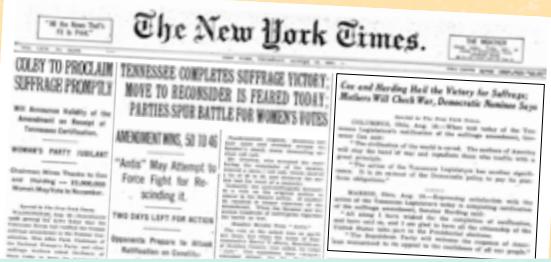
HISTORICAL DOCUMENTS Because of the importance of the history of the campaign to pass the Nineteenth Amendment, we have included a Historical Supplement & Designer's Notes booklet; a composite of all of the suffrage-related stories from the August 19, 1920 issue of The New York Times; and several historical documents that are described in the supplement

THE BOARD
The map of the United States is divided into six regions of eight states each:
West ①; Plains ②; South ③; Midwest ④; Atlantic & Appalachia ⑤; Northeast ⑥.
Each region has a Region Bubble ⑦ where Campaigners are placed when in the region.
Players will place a Purple cube , Yellow cubeor Red cubein a state to show their political power - and later, place a Green check or Red X in a state to show whether or not a state has ratified or rejected the Nineteenth Amendment.
Certain card events are Persistent Events. Cards with a rest of turn icon are placed in the “Cards in Effect for the Rest of the Turn" box. Cards with a rest of game icon are placed in the “Cards in Effect for the Rest of the Game" box. Cards with a ballot box icon are placed in the “Cards in Effect for Final Voting" box ⑧ ⑨ ⑩0.
The Congressional Track shows the level of support in Congress for women's suffrage. Players will add or remove Congressional markers to show the ebb and flow of support for the Nineteenth Amendment. The Turn Track ② uses the Turn marker to indicate what turn it is.

THE PIECES, DICE AND BUTTONS
There are:
Two standard Campaigners in each color: Purple (Suffragist) ①, Yellow (Suffragist) ② and Red (Opposition) ③, as well as two
alternate design Campaigners in each
color ④ ⑤ ⑥.
Only two Campaigners of each color will be used during the game.
65 Purple cubes ⑦, 65 Yellow cubes ⑧ and 60 Red cubes . Cubes are used to represent the political power of each side. The Suffragist side uses both Purple and Yellow (to represent the diversity of organizations and movements that worked for women's suffrage) while the Opposition uses Red.
36 Green checks ⑩ and 13 Red X's to signify if a state has ratified or rejected the Nineteenth Amendment.
Six Congressional markers ② to indicate the level of support for the Nineteenth Amendment in Congress.
• One Turn marker 13.
Six blue dice 14 with numbers 1-4, four red dice 15 with numbers 1-6, four white dice 16 with numbers 1-8. Also, two gray dice 7 and three black dice 8 used in Solitaire and Cooperative play.
Twelve Suffragist buttons of four designs 19 20 21 22, and six Opposition buttons of two designs 23 24. These buttons represent the organizational strength of each side and are used to re-roll unsatisfactory die rolls, to move a Campaigner to a different Region, to bid on Strategy Cards and to spend as directed by certain Event cards.
The game comes with extra pieces in case any are lost or damaged. We recommend that you set them to the side.
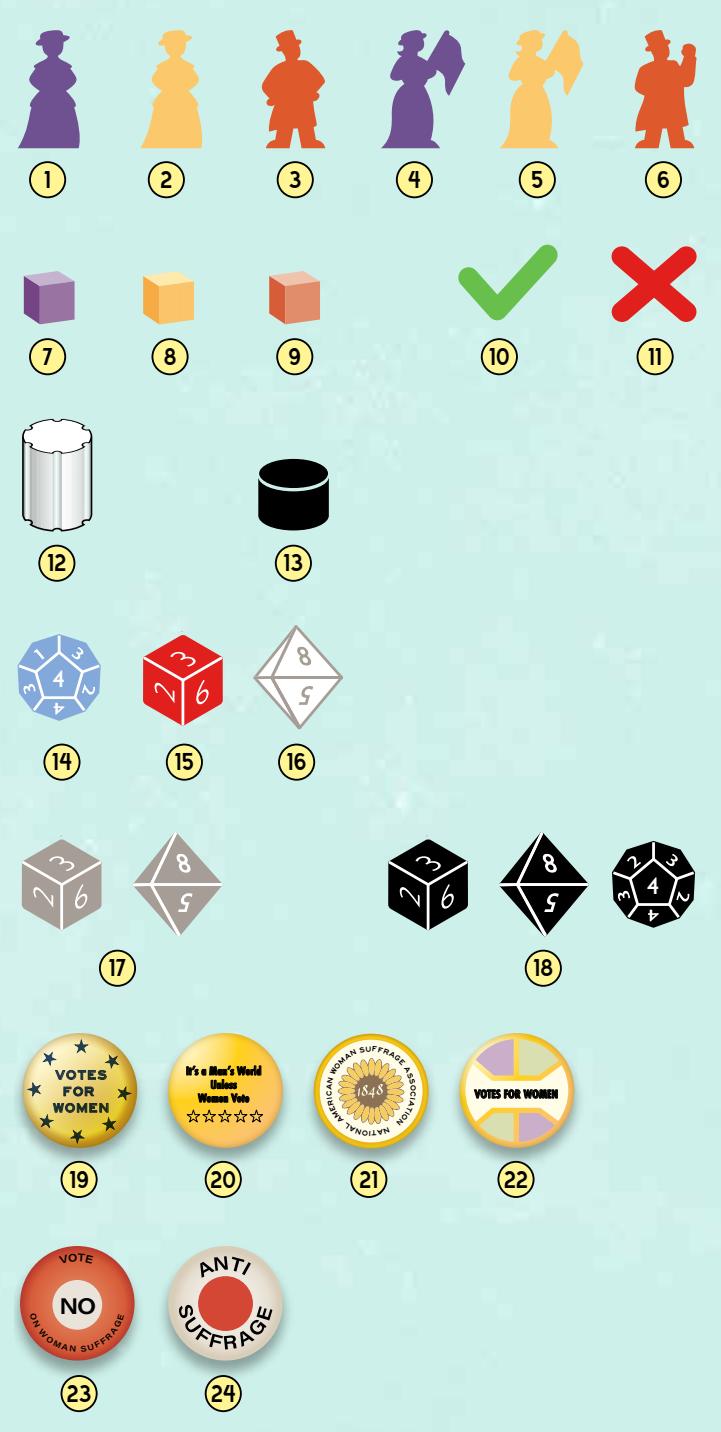
CARD & TEXT SYMBOL KEY


Suffragist Campaigner


Suffragist cube

Opposition Campaigner


Purple or Yellow cube
Green check

Congressional marker

Opposition cube

Red X


Die (d4, d6, d8)

Button
THE CARDS
There are five decks of cards:
• Suffragist Event deck (52 cards)
• Opposition Event deck (52 cards)
• Oppobot Event deck (42 cards)
• Strategy deck (12 cards)
• State deck (12 cards)
EVENT CARDS

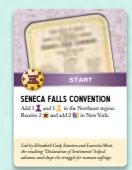
Each Event card includes Card Title ①, Card Era ②, Event text ③, Historical text ④, Persistent Event icon ⑤.
Each card has a Card Era that is used to create each players' Draw Deck. Late cards will be on the bottom of the deck, Middle cards will be in the middle of the deck and Early cards will be on the top of the deck. The Suffragist and Opposition decks each have one Start card – this card will be in the player's hand at the start of the game.
Some Event cards have a prerequisite – for example, Fifteenth Amendment can only be played if The Civil War is not in effect. A card is in effect if it is in the appropriate Persistent Event box.
Some Event cards require a player to roll a6and only take the action on a roll of 3-6. Otherwise, the Event card is discarded with no effect – even if it has a Persistent Event icon on it. A player may spend a to re-roll a6and may continue to re-roll as long as they have a to spend.
Some Event cards are Persistent Events and are marked with special icons. If played as an Event, these cards are placed on the board in the appropriate Persistent Event space.
Each space indicates the Persistent Event's effect.
There are two Event card icons that require specific explanation:
represents buttons. The Suffragist player will receive or spend Suffragist and the Opposition player will do the same in Opposition
allows the Suffragist player to place Purple and/or Yellow cubes. For example, if the Suffragist player is placing two cubes, they can place two Purple cubes, or two Yellow cubes, or one Purple and one Yellow cube.
STATE & STRATEGY CARDS
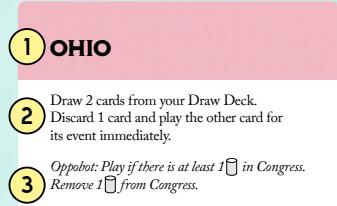
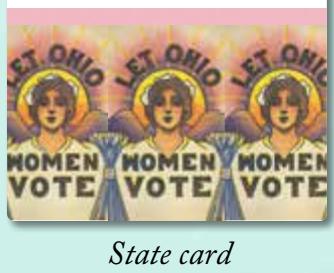
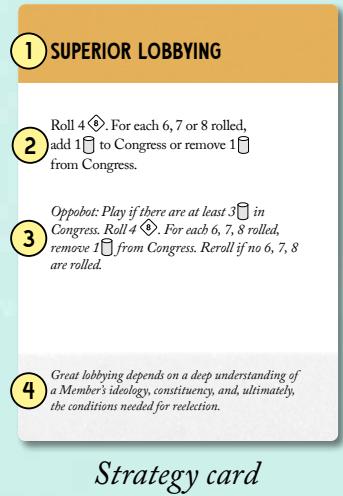
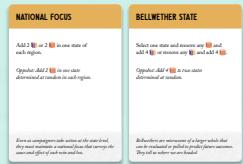
On each State and Strategy card is Card Title ①, Event text ②, Oppobot alternate text ③. Strategy cards also include Historical text ④. The State cards are color-coded to the region that they are located.
State cards can be claimed when a side has four cubes in that state, while Strategy cards are claimed either during the Strategy Phase or via Event card play.


SETUP
This is the setup for the two-player Competitive game.
• Set aside the Oppobot deck and the gray and black dice, as they will not be used in the Competitive game.
Place each player's cubes, Campaigners and markers on their side of the board (left: Suffragist / right: Opposition). Be sure to have exactly two Purple Campaigners ①, two Yellow campaigners ② two Red campaigners ③, six Congressional markers ④, 36 Green checks ⑤ and 13 Red Xs ⑥.
Shuffle the State deck and then set aside the top three cards (they will not be used this game).
Place, face up, the remaining nine cards ⑦ in two rows along the bottom of the board. Shuffle the Strategy deck and then draw three cards and place them to the right of the State cards ⑧.
Keep the rest of the Strategy deck nearby.
Each player creates their Draw deck as follows: Separate the event cards by their Era – Start, Early, Middle, Late. Shuffle the Late cards and place them face down. Then, shuffle the Middle cards and place them face down on top of the Late cards. Then, shuffle the Early cards and place them face down on top of the Late and Middle cards. Each player takes their Start card into their hand ⑩.
• Place the Suffragist buttons and Opposition buttons at the top of the board.
• Place the Turn marker 1③ on Turn 1 on the Turn Track. Keep the blue d4, red d6, and white d8 nearby 14.



XXXX 6


Adt ar6i de Adatic &cAgpuladia ng so mon thas 2 per stuts. Oppule usa nad aa is



SEQUENCE OF PLAY
The game consists of six turns. If neither player has won after six turns, the game goes into Final Voting. Each turn shares the following sequence of play:
-
Planning Phase
-
Strategy Phase
-
Operations Phase
-
Cleanup Phase
PLANNING PHASE
Each player draws six cards from their Draw deck. When added to either their Start card (on Turn 1) or their card held from the previous turn (on Turns 2-6), their hand should begin with seven cards.
STRATEGY PHASE
Please note that the Strategy Phase is skipped on Turn 1.
-
After looking at the available Strategy Cards, the Suffragist player announces how many they will commit to the Strategy Phase. The Suffragist player may commit zero
-
The Opposition player may then defer, match or supersede the Suffragist player's commitment. a. If the Opposition player defers, then the Suffragist player spends their committed and selects a Strategy card.
b. If the Opposition player matches, then both players spend that number of and neither player selects a Strategy card.
c. If the Opposition player supersedes, both players spend their – the Opposition player spends one more than the Suffragist player's commitment – and the Opposition player selects a Strategy card.
- If a Strategy card is selected by a player, that player places the card, face up, in front of them and another Strategy card is placed along the bottom of the board so there are three Strategy cards available for future turns.
OPERATIONS PHASE
There are six rounds in the Operations Phase. In each round, first the Suffragist player and then the Opposition player must play one card from their hand and may play one claimed Strategy or State card from in front of them.
When playing a card from their hand, a player has four options:
-
Play a card as an Event
-
Play a card for a Campaigning Action
-
Play a card for an Organizing Action
-
Play a card for a Lobbying Action
Play a Card as an Event
When a card is played as an Event, its event text is read and resolved. Some Event cards have a prerequisite for being played as an Event. If that prerequisite is not met, then the card may not be played as an Event. Some Event cards require a player to spend to play the Event – if the player does not have enough to spend, the card may not be played as an Event. Some Event cards require a successful die roll – if the die roll is a failure then the Event card is discarded without following the rest of the Event text. However, a player may spend a to re-roll a failed die roll.
After resolving the Event, the card is placed in the discard pile - unless the Event is a Persistent Event. Persistent Events should be placed in the appropriate box on the game board.
Play a Card for a Campaigning Action
When a card is played for a Campaigning action, the player rolls a 4 for each Campaigner they have in play (on the board). If the player is unsatisfied with the roll, they may spend a to re-roll all of the dice rolled.
Once satisfied with their roll, the player assigns a die to each of their Campaigners. Each Campaigner may then place the corresponding number of cubes, matching the Campaigner's color, in the states within the region that the Campaigner is in. The player may spend a to move the Campaigner to a different region, but all of the corresponding cubes must be put in the same region.Then the card is placed in the discard pile.
EXAMPLE: The Suffragist player has a and a in the Northeast. The Suffragist player rolls two
and rolls 1 and 1. The Suffragist player decides to spend and re-rolls 3 and 4. The Suffragist player assigns
the 3 to the and assigns the 4 to the. The
Suffragist player decides to place twoin Vermont
and one in Connecticut with the . The Suffragist
player also decides to spend one to move the to
the West region, and places four in California.
Play a Card for an Organizing Action
When a card is played for an Organizing action, the player takes as many as they have Campaigners in play. Then the card is placed in the discard pile.
Play a Card for a Lobbying Action
When a card is played for a Lobbying action, the player rolls as many6as they have Campaigners in play. For each 6 rolled, the player may add one to Congress or remove one from Congress. Then the card is placed in the discard pile.
ORGANIZATIONAL BUTTONS
★ are a sort of currency in the game that represent organizational strength. may be spent in the following ways:
- A may be spent to re-roll a die roll. If multiple dice were rolled, all of the dice must be re-rolled. A player may continue to spend to re-roll the same roll until their supply of is exhausted. A player may only spend a to re-roll their roll, never their opponent's roll.
Play a claimed State or Strategy Card
When playing a claimed State or Strategy card, the player may play the claimed card before or after playing a card from their hand. 'The text on the card is read and resolved, similar to a card played as an Event. After play, the card is removed from the game. A player may only play one State or one Strategy card per round.
CLEANUP PHASE
After the six rounds of the Operations Phase is the Cleanup Phase.
At the end ofTurns 1-5, any cards in the “Cards in Effect for the Rest of the Turn box" are placed in the appropriate discard pile. Each player should have one card in their hand to carry over to the next Turn. The Turn markeris advanced and the next Turn begins.
At the end ofTurn 6, if the Nineteenth Amendment has not been sent to the states for ratification, the game ends in an Opposition victory. If the Nineteenth Amendment has been sent to the states for ratification but neither player has won the necessary number of states for victory, the game advances to Final Voting. Any cards in the “Cards in Effect for the Rest of the Turn box” and “Cards in Effect for the Rest of the Game box” are placed in the appropriate discard pile.
-
A may be spent to move a Campaigner from one region to another region while a player is taking a Campaigning action. A separate must be spent for each Campaigner moved.
-
are committed during the Strategy Phase and spent as directed by the outcome of that Phase.
-
may be spent as directed by Event card text.
SENDING THE NINETEENTH AMENDMENT TO THE STATES
When the sixthis placed in Congress, Congress has passed the Nineteenth Amendment and sends it to the states to be ratified or rejected. Remove all of the from Congress – the Congressional portion of the game is complete.
For each state that has at least four, remove the cubes and replace them with a .These states have ratified the Nineteenth Amendment. For each state that has at least four, remove the cubes and replace them with a . These states have rejected the Nineteenth Amendment.
ADDING OR REMOVING CUBES IN A STATE
Only one side may have cubes in the same state at the same time. If a player is directed to add cubes in a state that contains opposing cubes, each cube that is to be added removes an opposing cube. Once a state is empty of cubes, then cubes of their color may be added.
EXAMPLE: There is one in California and the Suffragist player is adding twoto California. The Suffragist player rst removes the and then adds either a or a
CLAIMING STATE AND STRATEGY CARDS
The game begins with nine State cards available. When a player places their fourth cube in a state with a card, the player claims that State card and places it face up in front of them. The player does not lose the card if a subsequent play causes them to drop below four cubes in the state. New State cards are never put out – there are only nine State cards available per game.
The game also begins with three Strategy cards available. Strategy cards may be claimed either during the Strategy Phase or by play of certain Event cards. Any time a Strategy card is claimed,
As play continues, each time a state has four the cubes are immediately removed and replaced with aand each time a state has fourthe cubes are immediately removed and replaced with a . This only occurs after the Nineteenth Amendment has been sent to the states.
The moment that the 36th is placed, the Nineteenth Amendment is ratified by the states and the game ends in a Suffragist victory. Alternatively, the moment that the 13th is placed, the Nineteenth Amendment is rejected by the states and the game ends in an Opposition victory.
Whenever an Event directs a player to remove cubes of a particular color, this effect is limited to that particular color and only to what the opposing player has on the board. A player will never add their own cubes when directed to remove their opponent's cubes.
If a state has already ratified or rejected the Nineteenth Amendment – and therefore has a or in the state – cubes may not be added to that state.
a new one is drawn for the Strategy deck so that there are always three Strategy cards available.
Claimed cards are always placed face up in front of the player. A player may play one claimed card – State or Strategy – in addition to the Event card that they must play from their hand during a round of the Operations Phase. After a claimed card is played, it is removed from the game.
When the Oppobot claims a State or Strategy card, the Oppobot immediately plays that card for the Oppobot effect listed on the card.
FINAL VOTING
If after six Turns, the Nineteenth Amendment has been sent to the states but neither player has won the necessary number of states to win the game – 36 states for the Suffragist player or 13 states for the Opposition player – then the game enters Final Voting.
In Final Voting, the players take turns, starting with the Suffragist player, selecting a state to vote on the Nineteenth Amendment. Each player rolls a6 Either player may spend a to re-roll their die. If a player has cubes in the state, then the player adds that number of cubes to their total roll.
Whoever has the higher total wins the state and places either a √or in the state. The default is that the Opposition player wins all ties. However, if the Suffragist player had previously played Miss Febb Wins the Last Vote, then the Suffragist player wins all ties.
EXAMPLE: The Suffragist player has won 35 states and the Opposition player has won 12 states. Tennessee is the last state to vote and has two Both Voter Registration and Miss Febb Wins the Last Vote are in the “Cards in Effect for Final Voting” so the Suffragist player rolls a 8 and wins all ties. Because Voter Suppression was not played the Opposition player rolls a6. The Suffragist player has one remaining and the Opposition player has no remaining.
The Suffragist player rolls a 5 and the Opposition player rolls a 4. The Opposition player adds 2 to their roll for the two in Tennessee, so the Opposition player has a total of 6 and wins the state. But not so fast – the Suffragist player spends their last and re-rolls a 6! Now both players have a total of 6 and the Suffragist player wins the state because Miss Febb Wins the Last Vote allows the Suffragist player to win ties.
The Suffragist player places their inal – the states have ratified the Nineteenth Amendment and the Suffragist player has won the game!
PLAYING WITH TWO SUFFRAGIST PLAYERS
These are the rule changes for playing with two Suffragist players, either Competitive (versus one or two Opposition players) or Cooperative (versus the Oppobot).
• One Suffragist player will play Purple and use and
The other Suffragist player will play Yellow and use and
The players pool their together, regardless of who receives or spends them.
In Setup, the Purple player takes the Start card (Seneca Falls Convention) and the Yellow player takes an Early Era card at random as their “Start” card.
In the Planning Phase, each player draws three cards (instead of six), to bring the total number of cards in their hand to four.
In the Strategy Phase, the Yellow player makes the final decision on how many to commit and decides on who receives the Strategy card if victorious.
In the Operations Phase:
The Purple player plays the first, third and ifth round.
The Yellow player plays the second, fourth and sixth round.
If playing a card as an Event that has, the player may place cubes of either color.
When a card is played for a Campaigning action, the player rolls the number of dice equal to total Suffragist campaigners, but allocates the dice only to their campaigners.
EXAMPLE: There are three Suffragist Campaigners in play – two and one. If the Purple player takes a Campaigning action, they would roll three dice and allocate two dice to one and one die to the other . If the Yellow player takes a Campaigning action, they would roll three dice and allocate all three dice to the
When a card is played for:
An Organizing action: the Suffragist side takes as many as they have Campaigners in play – both and .
A Lobbying action: the player rolls as many as the have Campaigners in play – both and .
If the Opposition or Oppobot play Anti-Suffrage Riots, each Suffragist player discards one card at random and then draws one card from the Suffragist Draw Deck.
In the Cleanup Phase, the players may exchange their held card with each other if both players agree. The players may give or exchange any number of claimed State or Strategy cards with each other.
In Final Voting, the players will alternate picking states and rolling the die for their side. The order of state selection is Purple Player, Opposition/ Oppobot, Yellow Player, Opposition/Oppobot
PLAYING WITH TWO OPPOSITION PLAYERS
These are the rule changes for playing with two Opposition players Competitive (versus one or two Suffragist players).
The changes are very similar to playing with two Suffragist players except there is only a single color of Campaigners and cubes. The players pool their together, regardless of who receives or spends them.
In Setup, the First player takes the Start card (The Patriarchy) and the Second player takes an Early Era card at random as their “Start" card.
In the Planning Phase, each player draws three cards (instead of six), to bring the total number of cards in their hand to four.
In the Strategy Phase, the Second player makes the final decision on how many to commit and decides which player receives the Strategy card if victorious.
In the Operations Phase:
The First player plays the first, third and ifth round.
The Second player plays the second, fourth and sixth round.
In the Cleanup Phase, the players may exchange their held card with each other if both players agree. The players may give or exchange any number of claimed State or Strategy cards with each other.
In Final Voting, the players will alternate picking states and rolling the die for their side.The order of state selection is Suffragist Side, First (Opposition) Player, Suffragist Side, Second (Opposition) Player.
MANAGING THE OPPOBOT
These are the rule changes for managing the Oppobot either in Solitaire (against one Suffragist player) or in Cooperative (against two Suffragist players) mode of play
In Setup, set aside the Opposition deck and Opposition, as they are not used by the Oppobot. Remove and set aside the two Strategy cards with a that say “Do Not Use Versus Oppobot”(Change in Plans and Opposition Research) from the Strategy Deck.
Create the Oppobot Draw Deck as follows: Separate and then shuffle the cards from each Era – Early, Middle and Late. Remove and set aside the top two cards from each Era and then use the rest to create the Oppobot Draw Deck – Late cards on the bottom, Middle cards on top of the Late cards, and then Early cards on top of the Late and Middle cards. Place the three Start cards (The Patriarchy, NAOWS Forms, and War in Europe) face up near the Oppobot Draw Deck.
The Oppobot skips the Planning Phase.
In the Strategy Phase, after the Suffragist side announces the number of committed, the Oppobot rolls a 4. If the Suffragist side's commitment exceeds the die roll, then the Suffragist side selects a Strategy card. If the Suffragist side's
commitment equals the die roll, neither side selects a Strategy card. If the Suffragist side's commitment is less than the die roll, then the Oppobot picks a Strategy card at random and immediately plays it for the Oppobot effect listed on the card. Regardless of the outcome, the Suffragist side's are spent.
In the Operations Phase, the Oppobot will either play a card for the Event or play a card to take a Campaigning action. If it is the first round of Turn 1, Turn 3, or Turn 5, the Oppobot will play its face up Event card for the Event. Otherwise, the Oppobot draws the top card from its Draw Deck and determines if it is played for the Event or for a Campaigning action.
Several of the Oppobot Event cards say “Play if... – if the condition is met, then the card is played for the Event. Otherwise, the card is played for a Campaigning action. A card will also not be played as an Event if doing so would provide no benefit to the Oppobot. This occurs on the rare occasion that the event text directs cubes to placed in one region but all of the states in that region already have a or to reflect that the state has ratified or rejected the Nineteenth Amendment.
Some Oppobot Event cards addwithout specifying a state – the state is determined by using theand8dice. Thedetermines the Region and the8 determines the State within that region. Each Region is numbered 1-6 and each State within a region is number 1-8. If the Region and State rolled already has aor in the state, re-roll the 8 until a State that has not ratified, nor rejected, the Nineteenth Amendment is rolled. If all States in a Region have a √ or , re-roll the to determine another Region.
EXAMPLE 1: The Oppobot plays Conservative Opposition: Add 2 in any three states. The Oppobot rolls a 1 on the and a 4 on the 8, so add 2 in
Idaho (Idaho is State 4 in Region 1). Then the Oppobot does this two more times, rolling 2,1 and adds 2 in Montana and rolling 6,8 and adds 2in New Jersey.
EXAMPLE 2: The Oppobot plays Emma Goldman: Add in one state of each region. The Oppobot rolls a 8
six times, once for each region starting with Region 1
(West) and ending with Region 6 (Northeast) and placing in the State that corresponds to the number rolled.
When the Oppobot places a fourth cube in a state with a state card, the Oppobot claims that State card and immediately plays it for the Oppobot effect listed on the card.
When the Oppobot plays a card for a Campaigning action, roll a6to determine the Region and then move a to that region. If there is an available (unclaimed) State card from that region, the Oppobot will addto that State. If there are two available State cards from that region, the Oppobot will pick one at random. If there are no available state Cards from that region, then the Oppobot rolls the 8and will addto that State. Then roll the to determine the number ofto add.
If placingafter the Nineteenth Amendment has been sent to the states causes a to be placed and there are unused remaining from the roll, place those cubes in adjacent (or closest) states within that Region.
Remember that if there are two Oppobot Campaigners in play to do this twice – once for each.
In Final Voting, the Oppobot will always select the state with most, or if there are no states with then the state with the least.The Oppobot rolls the gray or gray in Final Voting.
For increased Oppobot difficulty, you can use the black during the Strategy Phase and Campaigning actions and use the black6or black during Final Voting. These dice have higher numbers.
下载 Markdown原文为社区整理/出版社公开资料,版权归原作者,仅供个人学习查阅。