
首都华沙Warsaw City Of Ruins
一句话概览
首都华沙 是一款已收录于村了吗规则库的桌游,支持 2–4 人,原名 Warsaw City Of Ruins。
本页内容:一句话概览 · 常见问题
这游戏怎么玩
- 本站已收录这款游戏的规则资料,可以在对话里直接提问规则细节。
常见问题(FAQ)
以下 1 条问答中 0 条来自站内玩家的真实提问,其余 1 条为本站整理的常见疑问;答复内容保持原样。
首都华沙支持几个人玩?
2–4 人。
去哪查完整规则
想核对具体规则细节、卡牌效果或某个回合的结算方式,可以在村了吗里选中这款游戏后直接提问。
同类桌游
- 卡坦岛德式
- 工业革命:伯明翰德式
- 勃艮第城堡:特别典藏版德式
- 方舟动物园德式
- 卡卡颂抽象
- 瘟疫危机传承:第一季美式
- 阿瑞迪亚:勇踏征途美式
- 重塑宇宙德式
- 幽港迷城美式
- 埃多拉的德鲁伊德式
规则原文(Markdown)
本站收录这款游戏的规则原文 1 个文件,此处内联渲染 1 个,可直接展开阅读或下载。
CAPITAL_instr_UK_11284_3_p1.md37.8 KB
Box cover ilustration: Tytus BrzozowskiIllustrations: Grzegorz Molas Game design: Filip Miłuński English translation: Anna Skudlarska and Russ Williams
A game for 2-4 players
• 105 city tiles + 3 player aids

Playing time: 60 minutes

Introduction
Warsaw is a unique city. It is said that it "survived its own death", and there is truth in this. Poland's capital was largely destroyed during the Second World War, and its reconstruction was an exceptional urban development process. Warsaw is a combination of elegant buildings from Saxon times, architecture from between the World Wars, socialist blocks, and modern buildings. Walking through the streets of Warsaw's Wola district, one can see this diversity at a glance. Modern glass office buildings stand next to pre-war automotive garages, and concrete block buildings touch elegant older houses, which show the signs of time's decay. Some call it a spatial mess, while others see in it the residents' determination. Both views are right, because that's how Warsaw is. Maybe not the most beautiful, but strong and determined. Nothing reflects the city's character more than its diverse buildings.
Goal of the game
Players jointly build Warsaw during 6 epochs, from when Warsaw first became the capital at the end of the 16th century, through modern times. Each player creates their own district of the city. At the end of each of the 6 epochs, districts give income and victory points to their owners. After 6 rounds, whoever has the most points wins.
Box contents: • Board

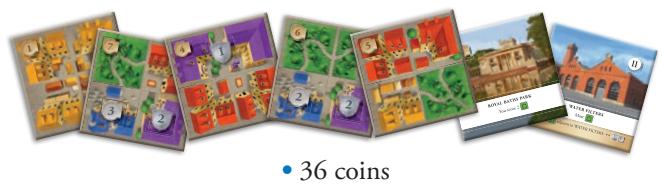

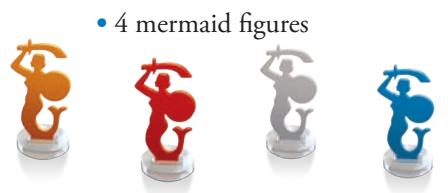
• Rules
Game preparation
-
Put the board in the middle of the table.
-
Divide the city tiles according to the numbers on their backs and shuffle each of the stacks separately. Place the 6 stacks face down on the appropriate spaces with Roman numerals on the board.
-
Place the 5 2-sided milestone tiles on the appropriate spaces on the board. Place each one with a random side face up.
-
Place the coins next to the board. They form the bank.
-
Each player receives:
• A starting tile, marked with “S" on the back. Each player places their starting tile on the table in front of them, with the park and residential buildings visible. These are the beginning areas of the players' districts.
• 6 coins as starting capital.
• A mermaid figure in a selected color. Place the mermaids on the 0 space of the victory point track on the board.
- Place the player aid cards within reach of all players. You are ready to play!
Sequence of play
The game consists of 6 epochs. In addition, there are wars at the end of the 3rd and 4th epochs. Each epoch consists of a construction phase and an income phase.
Construction phase
Shuffle the city tiles with the current epoch's number, then deal 4 tiles to each player. In a 2-player and 3-player game, there will be some unused tiles; return them to the box, unrevealed.
Each player chooses one of the 4 tiles, then places it face down onto the table. All players simultaneously reveal their selected tiles, and each player chooses one of two possible actions:
• Discard their tile to the box and take 3 coins from the bank.
• Pay the tile's cost in coins (shown on the tile's upper left corner) and build the tile in their district.
Rules of construction
• The new tile must touch (complete tile side to complete tile side) at least one other tile already in the player's district. (Touching only diagonally does not suffice.)
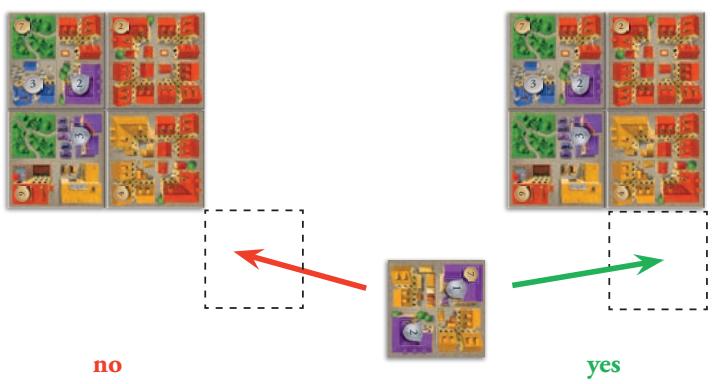
• A player's district can never be larger than a 3×4 or 4×3 rectangle of tiles. E.g. if a district is already 4 tiles wide, then it cannot be made wider, and its height cannot be more than 3. Thus a district has space for 12 tiles.

4×3

3×4
• A tile can be freely rotated to any of the 4 possible orientations before it is placed. After placement, a tile cannot be rotated later.
• All players build simultaneously.
Instead of placing a tile on an empty space, a player may choose to build on top of an existing tile. Simply place the new tile directly onto an existing tile, covering it completely. As a result, the new tile's price is reduced by the price of the older tile which it covers. If both tiles have the same price, then the player pays nothing. If the new tile's price is lower than the older tile's, then the player pays nothing and gets no money back. This action is called an overbuild. Overbuilding can be done on a single tile or on a stack of already overbuilt tiles.
Example: A player plays a tile with price 5 onto an existing tile with price 2, and so must pay only 3 coins.
Example: A player plays a tile with price 2 onto an existing tile with price 3. The player pays nothing (and gets no money back).
After all players have discarded or placed their tiles, they all pass their remaining tiles to the player on their left (in odd-numbered epochs) or on their right (in even-numbered epochs). Then the construction procedure is repeated: everyone simultaneously chooses one tile and discards or plays it. The construction phase continues in this manner until each player has discarded or built 4 tiles.
Types of areas
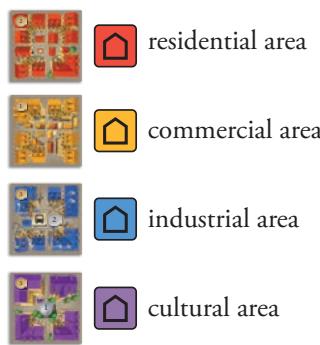
Each city tile is divided into 4 quarters. Each quarter has its own type of building, so a tile can have from 1 to 4 different kinds of buildings. Adjacent quarters (including adjacent quarters on different adjacent tiles) which have the same type of building are considered to be a single continuous connected area of that type (exception: public buildings and milestones). This is important for scoring, and during the operation of public buildings and milestones.
Public buildings and milestones are always separate individual areas, even if they are adjacent to each other. 'They also occupy an entire tile.

Example: Frame marks one residential area.

Example: Frame marks one park.

Example: Picture shows part of district with 4 marked areas. Residential area (A), commercial area (B) and 2 parks (C and D).
The marked spaces form single continuous connected areas.

Income phase
During the income phase, milestones are placed, and players receive coins and victory points. Follow the steps below in order:
- War (only in epochs III and IV).
World War I happens in epoch III. Each player must choose one tile from their district and discard it to the box.
World War II happens in epoch IV. Each player must choose two tiles in different squares from their district and discard them to the box. All tiles under the selected tiles are also discarded.
Players cannot discard tiles which would leave their district divided into separate groups of tiles. After each war, each district must be a single connected group of tiles.

- The player who best fulfills the condition on the milestone tile between the current epoch and the next epoch will receive this milestone tile. The player immediately builds it for free in their district. The milestone may be placed on an empty space or built on top of an existing tile. It is possible to overbuild onto a milestone later. (Their price is 0.)
In case of a tie for fulfilling a milestone's condition, first compare the tying players' money, and then (if money is equal) points. Whoever has less wins the tie! In the rare case in which the tying players have equal amounts of money and points, then no one receives the milestone, which is discarded.
- Players receive points and coins in the order printed on the player aid card. Different types of connected neighboring areas are used for scoring. An area consists of connected adjacent buildings of the same type. Only connections through adjacent sides are relevant: only touching diagonally through corners is not enough. But milestones and public buildings are always treated as separate individual areas, even if they are adjacent.
Players advance their mermaid along the score track when they gain points.
Scoring:
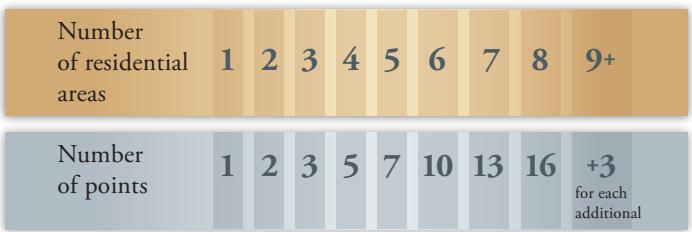
• The more residential areas adjacent to a single selected park in the player's district, the more points gained.
• Each commercial area gives 1 coin for each residential area adjacent to it.
• Each cultural area gives as many victory points as printed on its icon.
• Each industrial area gives as many coins as printed on its icon. A player also loses 1 victory point for each residential area adjacent to one or more industrial areas.
• Each tile with a transport icon gives 2 points. There must be at least
2 transport tiles in the district. Connected groups of transport tiles only count as one tile.
• Milestone buildings give their printed effect.
• Public buildings give their printed effect.

Example of scoring a player's entire district.
Scoring at the end of an epoch.
• Robert has 3 separate parks in his district (A, B, C). Robert chooses to use his largest park (A) for scoring. It has 5 different residential areas touching it. So Robert gains 7 victory points (as shown in the park scoring table).
• Robert has 4 separate commercial areas (D, E, F, G). They touch 1+1+1+2=5 residential areas. So he gains 5 coins.
• Robert has 4 cultural areas. They give 1+2+2+2=7 victory points.
• Robert has 3 industrial areas. They give a total income of 2+2+3=7 coins, but a residential area is touching one of them (H), so Robert also loses 1 victory point.
• Robert has 2 different transport areas. They give 2×2=4 victory points.
• Robert has 3 public buildings:
1) Warsaw School of Economics: this gives 1 victory point or 1 coin for each public building. Robert has 3 public buildings and decides to take use them all for victory points, earning 3 points. (He could, for example, have chosen to take 1 point and 2 coins, or to take 3 coins.)
2) Skaryszewski Park: this gives victory points for the longest straight line of tiles with a continuous park area. Robert's longest straight line of park (A) covers 3 tiles, so he gains 3 points.
3) Warsaw Steelworks: this gives 1 victory point for each separate industrial area. So Robert gains 3 victory points.
During this epoch's scoring, Robert received a total of 26 victory points and 12 coins.
End of game
The game ends after the 6th epoch. Then each player receives 1 point for each set of 5 coins which they now return to the bank. Then whoever has the most points is the winner. In case of a tie, the tying player with most remaining coins (0-4) wins the tie. If still tied, then players share their victory.
Arsenal

The owner loses 1 tile fewer during both wars. So they lose nothing in World War I, and they lose only 1 tile instead of 2 in World War II. But they may not chose the Arsenal to be the lost building!
A weapon storenouse ouit in 1o-4 on tne initiative of King Wtadystaw IV Vasa on the bastion next to so-called Sigismund's Embankments. Altered several times, in 1835 converted into a prison and in 1935-38 into the Municipal Archives. On March 26, 1943 near the building an action took place to rescue prisoners held by the Gestapo, including Jan Bytnar "Rudy". The building was burned down in November 1944 together with all the archival documents gathered inside. Rebuilt in 1948-50, it has been the seat of the National Archeological Museum since 1959.
Marywil

During each income phase, the owner freely selects one of their commercial areas to earn double. E.g. a commercial area with 3 adjacent residential areas earns 6 coins instead of 3.
A complex of buildings in the shape of a pentagon, built in 1695 for commercial, service and hotel purposes (mainly for merchants) at the junction of Senatorska and Wierzbowa streets on the initiative of Queen Maria Kazimiera ("Marysieńka"), Jan III Sobieski's wife. The building was designed by Tylman van Gameren, who placed the king and queen's apartments in the side wings and a chapel in the southern wing. In 1738-42 the collection of the Załuski Library was kept there. Significantly extended at the beginning of the 19th century and demolished in 1825 due to the construction of the Grand Theatre
Sigismund's Column

The owner always gains 5 coins instead of 3 when discarding a tile.
Władystaw IV built it in 1643-44 in honor of his father. It is the oldest secular monument in Warsaw. A bronze statue was placed on the column made of so-called chęciński marble.
In 1855 a fountain was built at the foot of the column (removed around 1930). In 1887 the column was replaced by a new one, made of pink granite from Italy. The monument was destroyed by Germans on the night of September 1, 1944. During the post-war rebuilding the statue was placed on a column made of strzegomski granite and was unveiled on July 22, 1949, on the opening day of the W-Z Route. Previous columns were preserved and can now be seen near the southern wing of the Royal Castle.
Jabłonowski Palace

The owner always gains 2 victory points when overbuilding. If the owner builds onto the palace itself, they gain 2 victory points, but afterward the palace's ability no longer works.
Built on Senatorska street in 1773-85.
In 1817-19 converted into the seat of the City Hall. Burned down during the January Uprising in 1863, then rebuilt and significantly expanded – enhanced with, among others, a watchtower for a Warsaw Fire Guard unit stationed on the City Hall's premises. The central part of the building contained a spacious ballroom, used, among others, as a meeting and exhibition hall. The building was destroyed during the 2nd World War and the ruins were pulled down in 1952. In 1995-97 the hall's façade was rebuilt as part of the construction of a modern office block complex in this place.
Collegium Nobilium

During each income phase, the owner gains 1 coin for each cultural area in their district.
A university-like school for sons ofmagnates and wealthy gentry, established by Stanistaw Konarski in 1740. A baroque building on Długa street was erected in 1743-54. In 1785 it was
rebuilt in the classical style. In the 19th century it was converted into the School of Artillery and Engineers Application, then into the seat of the Supreme Chamber of Accounts and the Supreme Administrative Tribunal. Destroyed in 1944 and rebuilt in 1950-56 to become the National Theater and Film School (now the Theater Academy)
Holy Trinity Evangelical Church
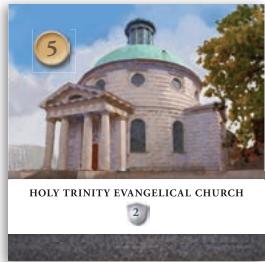
During each income phase, the owner gains 2 victory points.
The church was designed by Szymon B. Zug and built near what later became Matachowski Square in 1781. For a long time it was the biggest temple in the city. In 1825 Frederic
Chopin played the aeolomelodikon there in front of Tsar Alexander I. In 1857 Karol Beyer took the first panoramic photograph of the city from the church's dome. At the end of the 19th century, when W.H. Lindley was creating a plan of Warsaw, the cross on the dome was recognized as the geodetic center of the city. Destroyed in September 1939, initially rebuilt to be a concert hall, it has been an Evangelical-Augsburg temple again since 1956.
Royal Baths Park

During each income phase, the owner may score 2 parks instead of 1.
This vast palace-and-park complex owes its shape to King Stanistaw August Poniatowski, who after 1772 initiated the expansion of the Bath built by Stanistaw H. Lubomirski. By
the king's order the bath was expanded and turned into a palace on an island and numerous objects were erected in the park, including the Myślewicki Palace, the Island Theater, the White House and the Orangery with the Royal Theater. In 1817 the complex was sold to tsar Alexander I and new buildings were erected in, among others, the part of the park close to the Belvedere. Made available to the public after the 1st World War. The devastated park was restored and made available again in 1950s, while the rebuilding of the burned down Island Palace was inished in 1965.
Polish Telephone Joint-Stock Company
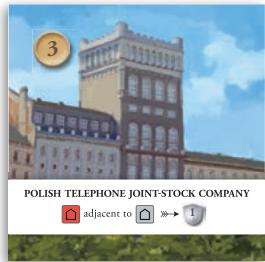
During each income phase, the owner gains 1 victory point for each residential area adjacent to at least one public building. (Being adjacent to more than one public building gives no additional benefit.)
Built in 1907-10, the seat of the Cedergren
company's telephone exchange was the highest building in the Russian Empire at the time when it was erected. In 1922 it was taken over by the Polish Joint-Stock Telephone Company (PAST). During the Warsaw Uprising the building was a subject of fierce fights which resulted in the insurgents controlling it and the Germans losing an important vantage point. It was rebuilt in a simplified form in 1950s-1960s and in 2000 it was given to the veterans' community, which led to topping it with Fighting Poland's anchor symbol.
Warsaw-Vienna Railway

During each income phase, the owner may sell 4 coins to gain 2 victory points or sell 2 victory points to gain 6 coins.
The first railway in the Kingdom of Poland connected Warsaw to Cracow (and then Vienna) in 1848. Started in 1845 on the section
between Warsaw and Grodzisk Mazowiecki, the line ended at the junction of Aleje Jerozolimskie and Marszatkowska streets (the Vienna Station). The railway became a strong spur for the development of the areas around the station and numerous industrial plants in the district ofWola. During the interwar period, due to the alteration of the Warsaw junction, the Vienna Station was replaced by the new Main Railway Station.
Warsaw University of Technology

The owner pays 2 coins fewer when building an industrial tile onto an empty space. (There is no discount when overbuilding.)
The oldest buildings among the premises of the University (established in 1915) were erected in 1899-1902 on Nowowiejska street for
the tsar's Polytechnic Institute (Main Building, Physics Building, Chemistry Building, Mechanics Building). During the 1st World War the premises held a German military hospital. In the interwar period new buildings were erected for the following departments: Chemical Technology, Electro Technology, as well as the Institute of Aerodynamics and the building of the Drafting Studio.
Skaryszewski Park
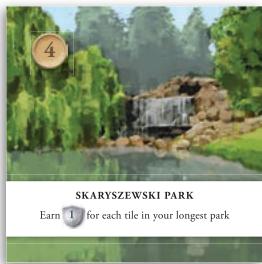
During each income phase, the owner gains as many victory points as the length (in tiles) of their longest park area, measured in a straight line of tiles horizontally or vertically. (So the maximum possible reward is 4 points.)
Created in 1905-22 according to Franciszek Szanior's design, on the area of the municipal pasture in Saska Kępa district. It included, among others: artificial lakes, a hill with a waterfall, a rose garden and numerous avenues. At the end of the 1920s sculptures were placed in the park: "The Rhythm", "The Bathing Woman" and "The Dancer". In 1929 it was named after Ignacy J. Paderewski. Due to ideological issues, after 1945 it lost Paderewski's name, which returned only in 1981. Edward House's monument had similar problems – unveiled in 1932, it was removed in 1945 and reconstructed in 1991.
WARSAW SCHOOL OF ECONOMICS □ → ①①
Okęcie Airport

During each income phase, the owner may sell 6 coins to gain 3 victory points, or sell 3 victory points to gain 9 coins.
The airport in Okęcie near Warsaw was established in 1926 due to the closing of the airport on the Mokotów Field as a military facility.
Around the grassy lift-off field hangars, barracks for the 1st Air Force Regiment and PZL's factories that manufactured military planes and their engines were built. In 1934 a temporary civilian airport was opened near the military one and it was initially supposed to function until a new airport in Goctaw was built. Since the authorities gave up on the idea of building an airport in Goctaw, after the 2nd World War Okęcie witnessed a gradual expansion of its civilian airport, which now is the biggest airport in the country.
Warsaw School of Economics

During each income phase, the owner gains 1 coin or 1 victory point for each public building they own. They may mix as desired, e.g. with 2 public buildings, the owner may choose to gain 2 coins, or to gain 1 coin and 1 point, or to gain 2 points.
The complex of buildings for the Warsaw School of Economics was created in 1925-30 according to the design by Jan Witkiewicz "Koszczyc". The first one was the building of the Experimental Works with a big lecture hall, built in 1926 on Rakowiecka street, and in 1930 the Library was erected near the planned Batorego street. It was a temporary seat of the National Library. After the war the Main Building was erected on the side of Al. Niepodlegtości street with numerous lecture halls and a characteristic roof in the shape of a pyramid. During the People's Republic of Poland era the school was called the Main School of Planning and Statistics
Prudential

The owner's district can be a square of 4×4=16 tiles instead of the usual smaller rectangle of 3×4 or 4×3. The Prudential Tower itself may be built outside the 3×4 or 4×3 area. If the Tower is lost during a war, or another tile is built onto it, the owner's district immediately shrinks back to
3×4 or 4×3, and the owner must discard tiles as needed to conform to that original limit.
The highest building of the pre-war Warsaw and Poland was created for the "Prudential" Insurance Company in 1933 according to the design by Marcin Weinfeld. Lower stories contained offices, while upper ones – luxurious apartments. Top two stories housed an experimental TV station, and the whole building was topped with a TV broadcasting antenna. Significantly damaged during the 2nd World War, it was rebuilt in 1950- 53 to house the "Warsaw" hotel, which functioned until 2002. Complete refurbishment of the skyscraper, supposed to bring back its pre-war look, started in 2010.
Main Railway Station
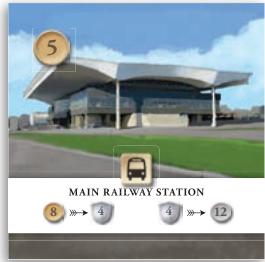
During each income phase, the owner may sell 8 coins to gain 4 victory points, or sell 4 victory points to gain 12 coins.
The most important railway station in Warsaw was made available to the public in 1975 and built near the pre-war main station which
was replaced by a commuter station, Warszawa Śródmieście. At the moment of opening it was one of the most modern stations in Poland, with an escalator, automatic doors, a spacious hall with counters and four platforms for long-distance trains. Together with the station, a complex of underground passages was created, for example, under what is now the Czterdziestolatka Roundabout. Not renovated for many years, considered one of the worst Polish stations at the beginning of the 21st century, it was modernized in 2010-12. In 2015-16 a mezzanine was built and numerous minor repairs were made.
Central Department Store
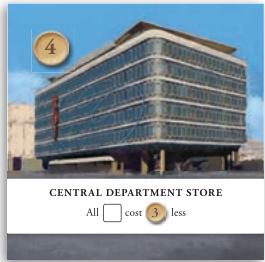
The owner pays 3 coins fewer when building any tile onto an empty space. (There is no discount when overbuilding.) This discount is cumulative with Warsaw University of Technology's discount when building industrial tiles.
Designed in 1947-48 in the post-war modernist style, a department store with big windows filling the whole elevation. Finished in 1951, when the socialist realism doctrine was in power and therefore heavily criticized by the government. Its interior burned down completely in a fire in 1975. After being renovated, it was turned into the Central Orphanage, named "Smyk" in the 1980s. As part of general refurbishment started in 2014, most of the building was pulled down – a new office-and-commerce building is to be built behind the renovated elevation.
Passenger Automobile Factory
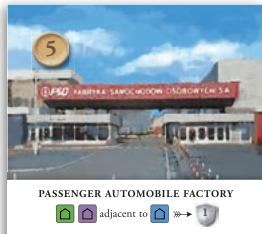
During each income phase, the owner gains 1 victory point for each park and culture area adjacent to at least one industrial area. (Park and culture areas adjacent to more than one industrial area give no additional benefit.)
The flagship automotive investment, finished in 1951 in Pelcowizna (Żerań district). The plant designed prototypes and then manufactured cars: Warszawa, Syrena and Polonez, and since 1996 – Daewoo. The most popular model – 1,4 million were produced – was the Polish Fiat 125p, manufactured in 1967-91. Beside production halls, the plant also had a track for experimental drives. In 2009 car production was suspended and some of the buildings were demolished.
Warsaw Steelworks

During each income phase, the owner gains 1 victory point for each industrial area in their district.
Its construction started in 1952 in Bielany district as part of the government's plan to create big socialist work places. It was launched
in 1957 as a cast steel foundry. In subsequent years (until 1968) further sections were opened: steelworks, a drawing mill and several rolling mills. In the 1970s about 10 thousand employees worked there, which contributed to numerous new housing estates being built in Bielany. Privatized in 1992, it now operates as part of the ArcelorMittal concern.
Copernicus Science Center

During each income phase, the owner gains 1 victory point for each cultural area in their district.
A modern science center opened in 2010 in Powiśle district. Beside an ongoing exhibition which encourages visitors to conduct their own
experiments and learn the laws of nature, the center houses physics and chemistry labs as well as a modern planetarium opened in 2011. The center also organizes numerous temporary exhibitions and co-organizes Science Picnics. It is one of the most popular places in the city, visited both by residents and tourists (over 1 million visitors a year).
National Stadium

During each income phase, the owner gains 2 victory points for each park area in their district.
Built in the place of the former 10th Anniversary Stadium (opened in 1955) due to Poland and Ukraine hosting the European Champi-
onship in 2012 – among others, the opening game of the tournament took place there. It has a capacity of 58.5 thousand, and if the field is used – up to 72.9 thousand. The stadium hosts various events, like concerts or book
fairs. Halls under the stands are used for temporary multimedia exhibitions. In 2013 the UN climate summit was held in a hall built on the field, and in 2016 the NATO summit.
Warsaw Rising Museum
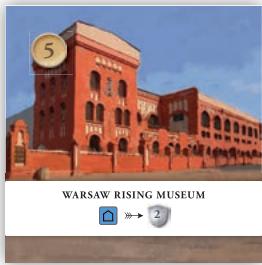
During each income phase, the owner gains 2 victory points for each industrial area in their district.
The museum was established in 1983 as a branch of the Historical Museum of Warsaw, but only after some renovation in 2004 did it
receive a permanent residence in the building of the former tramway power station at the intersection of Grzybowska and Przyokopowa. Besides the exhibit in the building, the museum grounds have a Freedom Park with a memorial wall with almost 10,000 names of fallen insurgents In 2012 the museum was recognized by the portal TripAdvisor as the biggest tourist attraction in Warsaw. The museum also hosts the Stefan Starzyński Institute, which promotes knowledge about Warsaw and its history.
City Center
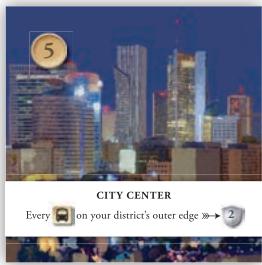
During each income phase, the owner gains 2 victory points for each transportation symbol on tiles on the outer edge of their district, i.e. on a tile which has an empty adjacent space, rather than being completely surrounded by 4 other tiles.
During the People's Republic of Poland era only a few skyscrapers were built in Warsaw. Only after 1989, in a new economic situation, did Warsaw start climbing up. Near the Palace of Culture, which had dominated the city's skyline for almost 40 years, new skyscrapers emerged, housing offices, hotels and luxurious apartments; some were designed by architects of international renown. Apart from buildings erected on empty lots, there is also a tendency to replace low buildings with skyscrapers (e.g., Ztota 44, Q22). The idea to build a group of skyscrapers in the immediate neighborhood of the Palace of Culture is still under discussion.
Golden Terraces

During each income phase, the owner gains 1 victory point for each commercial area in their district.
An office-and-commerce center built in 2002- 07 on a lot bordering the Main Railway Station. The whole middle section was covered
with a unique wavy glass roof with a surface area of over 10,000 m2. The complex also contains a multi-cinema and office buildings. In 2007 the center won the title of the best commercial design in the world at the MAPIC show in Cannes.
Warsaw University Library

During each income phase, the owner gains 1 victory point for each public building in their district.
The new building for the Warsaw University Library was built in 1996-99 on Dobra street. The modern hall houses the book collection
earlier stored in the old building on Krakowskie Przedmieście street as well as reading rooms, an office section and an entertainment-and-services one. In front of the building fragments of the so-called grate were placed – metal bookshelves from the old library. On the roof there is one of the biggest roof gardens in Europe, from which the city center and the channel of the Vistula river can be seen.
Wilanów

During each income phase, the owner gains 1 victory point for each residential area in their district.
A housing estate designed in the 1990s on the Wilanów Fields as a self-sufficient city within a city. The developers received guidelines
concerning, among others, the height of buildings and first floors intended for service functions. The construction of the first buildings started in 2002. The settlement houses the town hall of Wilanów district and the
Temple of Divine Providence is being built there. The developing settlement is a subject of numerous debates concerning its functionality and the residents' access to services, culture, education and healthcare.
Fountain Park

During each income phase, the owner gains 1 victory point for each tile in their largest park area.
The complex of four fountains is on the Square of the 1st Armored Division. The fountains were launched in 2011 as part of the 125th
Jubilee of the Municipal Water and Sewage Service. On Friday and Saturday evenings there are 30-minute multimedia "water-light-sound" shows which use LED spotlights and lasers.
Old Town

During each income phase, the owner gains 1 victory point for each space with an overbuilt tile. (A space having more than 2 tiles stacked gives no additional benefit.)
The oldest part of Warsaw, established by Mazovian Prince Bolestaw II at the end of the
13th century. Around the market square with a town hall a regular pattern of streets was planned out, with a parish church (currently the Cathedral of St. John) on the street leading to the prince's castle. It was surrounded by fortifications in the 14th century. The Old Town suffered from fires several times. In subsequent centuries it became squalid and poor. Partly revitalized in the interwar period, severely damaged during the 2nd World War. Rebuilt in 1952-54, including the reconstruction of the historical elevations of the tenements. In 1980 included on UNESCO's list of World Heritage Sites in acknowledgement of the efforts made to reconstruct the area.
Milestones
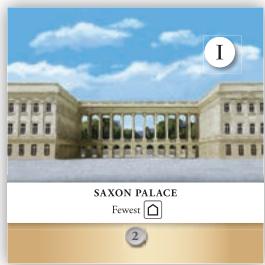
Saxon Palace
Wilanów Palace

Grand Theater

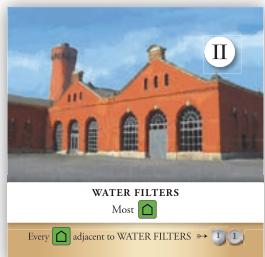
Water Filters
Awarded to the player with the fewest areas (of all types). In each income phase it gives 2 coins.
Awarded to the player with the most areas (of all types). In each income phase it gives 2 coins.
Awarded to the player with the most cultural areas. In each income phase it gives 1 victory point for each cultural area neighboring the Theater. (Maximum 4 points.)
Awarded to the player with the most park areas. In each income phase it gives 1 victory point and 1 coin for each park neighboring the Filters. (Maximum 4 points and 4 coins.)
Namiestnikowski Palace
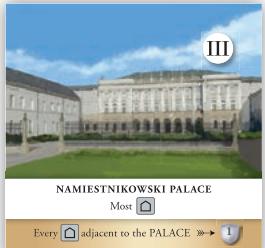
Awarded to the player with the most public buildings. In each income phase it gives 1 victory point for each public building neighboring the Palace. (Maximum 4 points.)
Wilson Square

Palace of Culture and Science
Awarded to the player with the most residential areas. In each income phase it gives 1 victory point for each residential area neighboring the Square. (Maximum 4 points.)

Metro

Awarded to the player with the most industrial areas. In each income phase it gives 1 victory point for each industrial area in the player's district. Immediately after the Palace of Culture and Science is built, all other players lose 1 victory point for each of their commercial areas.
Awarded to the player with the most transport symbols. In each income phase it gives 1 victory point for each transport symbol neighboring the Metro. (Maximum 4 points.)
W-Z Route
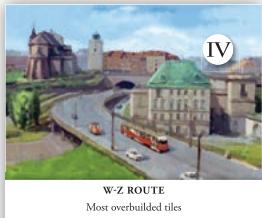
Awarded to the player with the most spaces with overbuilt tiles. In each income phase it gives 1 victory point and 1 coin for each overbuilt space neighboring the Route. (Maximum 4 points and 4 coins.)
EUROPA Market
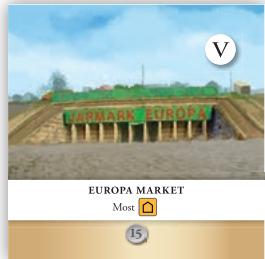
Awarded to the player with the most commercial areas. In each income phase it gives 15 coins.
Why does the game Capital have mermaids as pawns?

It's hard to imagine a more popular symbol of Warsaw, because the mermaid has been in the city's coat of arms since the middle ages! But the original mermaid was not half woman, half fish. The earliest images showed creatures with wings, two paws, and a tail. Only in the 17th century did the Warsaw mermaid take on its current appearance. There is a legend about two sisters - mermaids - one of whom swam to Copenhagen, and to this day we can see her at the port entrance. The second sister chose Warsaw, where she was captured by a greedy merchant. A fisherman's son freed her, and in gratitude she promised to protect the city, and thus she armed herself with a sword and shield. Currently in Warsaw there are several mermaid monuments and countless representations on buildings and in paintings.

Muzeum Powstania Warszawskiego

Dear customer!
Our games are packed with great care. However, if your game has any problems (for which we sincerely apologize in advance), you can file a complaint by emailing: service@granna.pl. Do not forget to include your name and address (street, house number and apartment, city, postal code, country) W and write what game piece is missing. ńskiego If you want to receive news by e-mail, please send e-mail to service@granna.pl with your name.
www.granna.pl
下载 Markdown原文为社区整理/出版社公开资料,版权归原作者,仅供个人学习查阅。