
无尽世界World Without End
一句话概览
无尽世界 是一款已收录于村了吗规则库的桌游,支持 2–4 人,原名 World Without End。
本页内容:一句话概览 · 常见问题
这游戏怎么玩
- 本站已收录这款游戏的规则资料,可以在对话里直接提问规则细节。
常见问题(FAQ)
以下 1 条问答中 0 条来自站内玩家的真实提问,其余 1 条为本站整理的常见疑问;答复内容保持原样。
无尽世界支持几个人玩?
2–4 人。
去哪查完整规则
想核对具体规则细节、卡牌效果或某个回合的结算方式,可以在村了吗里选中这款游戏后直接提问。
同类桌游
- 卡坦岛德式
- 工业革命:伯明翰德式
- 勃艮第城堡:特别典藏版德式
- 方舟动物园德式
- 卡卡颂抽象
- 瘟疫危机传承:第一季美式
- 阿瑞迪亚:勇踏征途美式
- 重塑宇宙德式
- 幽港迷城美式
- 埃多拉的德鲁伊德式
规则原文(Markdown)
本站收录这款游戏的规则原文 1 个文件,此处内联渲染 1 个,可直接展开阅读或下载。
worldwithoutendrules.md36.9 KB


ADDITIONAL INFORMATION ABOUT CERTAIN EVENT CARDS


After being accused of witcbcraft, Caris is
left with no otber choice. Sbe becomes a
nun in tbe Kingsbridge abbey.
Each player who forgoes his
or her action receives
1 medical
knowledge.
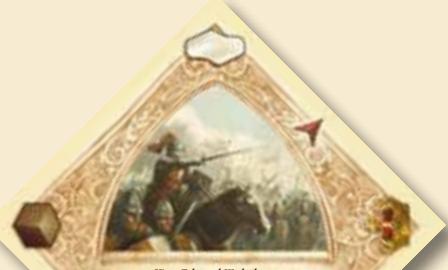
King Edward III declares a war against France. Skip the action phase and each player must discard 2 action cards without using them.
Because work...
As a reminder, you can use 1 gold to cover up the 2 on the market. Should you already be able to sell cloth, it is not affected by the price decrease.
After being accused...
Play one action card faceup and discard another action card facedown. You may not use either action.
King Edward I.…
If this is the first event card to be drawn in chapter I, it has no effect on any player who had to go before the royal court at the end of chapter I. Those players have been fortunate and do not need to discard two action cards
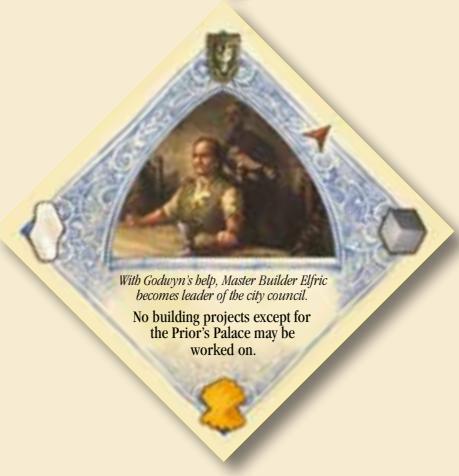
With Godwyn's help.. Cover up all other building projects on the board with covering tiles. You may not help build them nor make donations to them. At the end of the chapter, you add a resource to the Prior's Palace only.


In Kingsbridge...
Remove the house from a building space and return it to your supply. You may rebuild on building spaces emptied in this way.
Ralph Fitzgerald... In the rare event that you don't have any of the required goods, you have been fortunate and lose nothing.
Along with the plague...
First, play your action card as usual.
Then, let another player randomly draw a card from your hand to discard. You are allowed to look at the card that was drawn and discarded.
Merthin has realized...
Should there be insufficient resources in the supply, use some sort of replacement markers (coins, pieces from other games, etc.]. When this card is played, the Tower is completed, so the metal resource and victory points are awarded by the King [see page 6].
KEN FOLLETT WORLD WITHOUT END"
THE RULES
For 2-3 Builders, Aged 12 and Up
England in the years 1337 to 1361... The momentous events of the English Middle Ages affect the lives of the inhabitants of Kingsbridge. Here, nearly 200 years ago, Prior Phillip oversaw the building of the imposing cathedral called “The Pillars of the Earth." Now, farmers, wool merchants, and builders-the players-strive for wealth and prestige. In the process, they encounter numerous and diverse characters from Ken Follett's acclaimed novel. The rivalry between the priory and the city merchants colors the turbulent events of the time. Players must strike a delicate balance. You earn victory points for a pious and loyal life, as well as taking part in various building projects. You gain prestige caring for the ill during the plague. However, you still must eat before worrying about honor or glory. Difficult times make food and income hard to come by, especially when the King imposes high taxes to finance his wars. Too often, you keep very little from the money earned at the wool market. Your success may ultimately lie with the favor of important people. Many trades balance life in the “World Without End."
OBJECT OF THE GAME
The goal of the game is to score as many victory points as possible. The player whose scoring marker is the furthest along the victory point track at the end of the game wins Players gain victory points in various ways, primarily by taking part in various building projects and taking care of ill inhabitants.
See other sheet for a COMPONENT list & PREPARATION instructions
GAME PLAY
• The game takes place over 4 chapters (I through M], each of which consists of 6 rounds. There are 6 events in êach chapter (1 per round].
Each chapter represents a time period of several years, during which you and the other players may take part in various building projects, scoring victory points for them.
• At the end of each chapter, you must be able to pay mandatory duties. If you can't, you lose victory points and may face additional penalties.
• After chapter II, the city inhabitants become ill with the plague, and you and the other players may take care of them and score victory points.
• After chapter I, the winner is the player with the most victory points.
PLAYING A GAME ROUND
Each round follows the same sequence:
-
Reveal the Topmost Event Card & Resolve Any Immediate Event
-
Orient The Event Card
-
Receive Personal Income
-
Award Favor
-
Play 1 Action Card (Take Into Account Applicable Long-Term Events)
1. Reveal the Topmost Event Card & Resolve Any Immediate Event
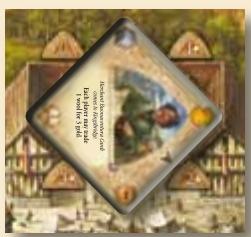
The player with the start player figure is the active player. That player draws the topmost event card from the pile and reads the event text out. The upper text is flavor text that refers to the novel and doesn't directly impact the game. The lower text is the event text that affects all players. If it is an immediate event (tan background], its effects are immediately carried out, before the event card is oriented. If the event gives the players a choice, the active player must decide first, followed by the remaining players in clockwise order. Example: When this event card is drawn, each player in clockwise order may decide whether or not to trade in 1 wool for 3 gold.

• Events with a blue background are long-term events and remain in effect for a longer time, potentially until the end of the chapter. They affect the action cards you play and thus their effects are only resolved later.

2. Orient the Event Card
• After revealing the event card, you [the active player) place it, face-up, onto the square city council space on the top edge of the game board. The event card orientation affects two elements of the game. First, it determines each player's personal income for the round. Secondly, it determines whose favor you (the active player) will receive this round (see Award favor, in the next column).
You may choose how to orient the event card when placing it onto the game board—you have 4 options as to how the event card is to be oriented. Your decision will determine which corner symbol will point to each player as well as how many spaces the favor marker will move.
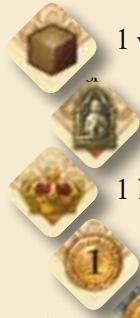
1 stone from the quarry
1 wood from the forest
1 grain from the field
3. Receive Personal Income
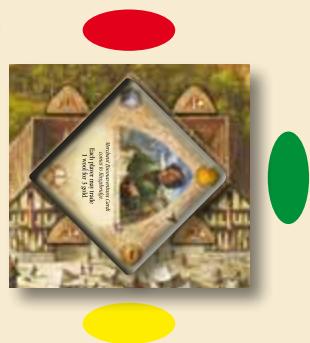
Each player now receives, as personal income, whatever is specified by the symbol on the corner of the event card that is pointing in his or her respective direction. For this reason, it is important that players not sit next to each other but rather around the table.
Note: The phrase “personal income” is used in the game only as a convenient term to describe this phase of the game. Medical knowledge, loyalty or piety are of course not income in the typical sense. Rather, they symbolize what you are doing in the current round. Someone who cares for the ill or reads the relevant books, for example, would gain medical knowledge. Those who lead a pious life gain piety, while those who remain true to those in the upper echelon of society are rewarded with loyalty.
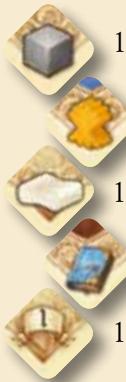
1 piety from the cathedral
1 wool from the supply
1 loyalty from the supply
1 victory point
1 or 2 gold from the supply
1 medical knowledge from the supply
Example: When the event card is oriented this way, red receives 1 stone, green receives 1 grain, yellow receives 1 gold, and blue receives 1 victory point.
You should place your personal income items behind your player screen. This of course doesn't apply to victory points, which are scored on the victory point track. Should multiple scoring tokens be on the same space of the victory point track, then they are simply stacked on top of each other.
Important: If the personal income that you are supposed to receive isn't available in the supply, you receive 1 victory point instead.
4. Award Favor
Each event card has a red direction arrow on one side. Depending on how the active player chose to arrange the card, this arrow will point to one of the numbers 0 through 3, located around the edge of the city council space.

• After you and the other players have received your personal incomes, move the favor marker along the favor track the number of spaces indicated by the orientation of the event card. Example: The direction arrow points to the 2. Move the favor marker forward 2 spaces.

• You [the active player) then receive an award depending on the space occupied by the favor marker.
Important: If you (the active player) didn't move the favor marker because the event card was oriented to point to the O, nothing happens. You only receive an award if you moved the favor marker.
The Favor Spaces

Queen: You receive 2 victory points, provided you have at least 1 loyalty.

Prior: You receive 1 piety from the cathedral.

Guild Master: You receive 1 victory point for each house you have built on the game board [with the House Building action, see below].

Prioress: You receive 2 victory points, provided you have at least 1 medical knowledge.

Merchants: You receive 1 wool from the supply.

King: You receive 1 victory point for each loyalty you have.

Earl of Shiring: You receive 1 grain from the field.
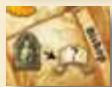
Bishop: You receive 1 victory point for each piety you have.


Outlaws: You must pay 1 gold to the supply. If you cannot do this, the event card may not be oriented in this manner.
Note: You don't have to pay any piety, loyalty, or medical knowledge, just show how much you have.
When the favor marker moves past the last space on the top half of the favor track [Bishop], it continues clockwise along the bottom half of the track [to the Queen].
• If the award that you are to receive isn't available in the supply, you receive nothing. Unlike the personal income, you do not receive victory points instead.
Note: Should one or more of the favor track spaces be covered up due to an event card's effect, these spaces aren't counted when moving the favor marker forward.
5. Play 1 Action Card
(Take Into Account Applicable Long-Term Events)
• Starting with you, the active player, each player in clockwise order, plays and resolves 1 action card. You choose that action card from your hand.
• Leave the action card you played face-up on the table in front of yourself.
• If a blue event card was revealed at the start of the round, you must take it into account when playing your action card. Should there be more than one blue event card along the edge of the game board [from previous rounds], they must all be taken into account.
The Action Cards

Grain: You receive 1 grain from the field.
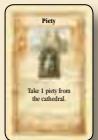
Piety: You receive 1 piety from the cathedral.
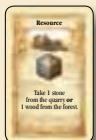
Resource: You receive either 1 stone from the quarry or 1 wood from the forest.

Building Project: You may use up to 2 resources to work on one building project. You receive 3 victory points per resource. You cannot use this action to work on two different building projects both resources must be used on the same project. However, you may choose to use two different resources [i.e., a stone and a wood]. Most building projects come into the game via event cards. The Bridge building project is already on the board at the start of the game, while the Tower project is only added to the board after chapter II. (For more information on building projects, refer to “Building Projects” on page 5).

Wool & Cloth Sales: You may sell as much wool as you wish at the wool market, along with no more than 1 cloth. You receive 2 gold for each wool sold and 4 gold for the cloth sold. You may sell only 1 cloth if you wish.
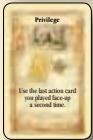
Privilege: You repeat the action you carried out in the current chapter's previous round lindicated by the topmost action card in your action pile).
Note: Carrying out the action associated with an action card is voluntary. You may always choose not to carry out the action. Additionally, if you play an action card whose action cannot be carried out, then nothing happens.
Example: You play the Grain action card but there isn't any grain left on the field.
For your first game: The 6 action cards described above have stars on them and are the only 6 cards you’ll need for chapter I, giving you a chance to learn how they work. Starting with chapter II, you will also have the other 6 action cards previously set aside at your disposal. You will still only play 6 action cards per round, but will now be able to choose from all 12. You only need to read this section of the rules, concerning choosing cards as well as the descriptions of the other 6 cards, after finishing chapter I.
The Game with All 12 Action Cards
After playing 1 action card, you also choose 1 action card to discard from your hand. Place this card facedown, with no effect, next to your previously-played action card.
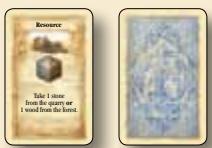
Thus, in each chapter, you will only be able to use 6 of your 12 action cards.
You will have to forego the remaining 6 actions.
You will end up with two piles in front of yourself: an action pile and a discard pile. Most rounds, each pile grows by one card. At the end of the chapter, all action cards will have been played or discarded. At the beginning of the next chapter, all 12 action cards are once again available to be played.
Note: Only discard a card if your action pile is larger than your discard pile (see page 7).
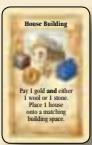
House Building: You pay 1 gold and 1 matching resource (either stone or wood) and build a house on an open space among the 14 building spaces located in the lower left hand corner of the game board. The type of resource required is indicated by the symbol on the space. Building houses lets you use the House Rent action to gain the income shown above the building space. Important: You may not build houses on two spaces that provide the same income.

House Rent: You receive income from up to two of the houses you previously built on the game board. If you have more than two houses on the board, you must choose which two you wish to receive income from. The income available to you is indicated on the building spaces. Some resources, such as piety and grain, may be scarce. If they aren't Some resources, such as piety and grain, may be scarce. If they aren't available, then you don't receive them as income.

Donation: You make a donation to one of the building projects currently on the board. Pay 1 gold and place one of your two donation seals onto the building project you chose. (For more information on donations, refer to “The Building Projects” on page 5.] Note: Should an event card prohibit further work on a building project, then you may not make a donation to that building project either.

Cloth Production: You may trade in either 1 wool for 1 cloth OR 2 wool for 2 cloth.
Medicine: You have a choice. You may either receive 1 gold and 1 victory point [for minor medical assistance) or, starting in chapter III, care for one (or more) of the plague-infected inhabitants of Kingsbridge. For that, you receive 2 victory points per inhabitant along with an additional benefit. (For more information, refer to “The Plague” on page 6.]

Favor: You move the favor marker exactly 1 space along the favor track. You then receive the award indicated by the space the marker is on [see page 3].
End of a Round
• If a long-term event was drawn during the current round, you now move it to the first event card space along the upper edge of the game board. Should that space already
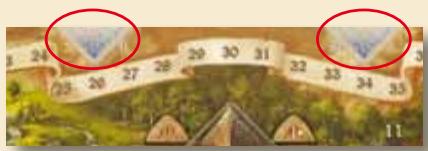
be filled, then you fill the second event card space instead. You may never have more than two event cards along the upper edge of the game board at once. Once both spaces are filled, then the third long-term event drawn will replace whichever previous event has been in effect the longest.
Note: There are never more than 3 long-term events possible in each chapter.
• You, the start player, give the start player figure to the player on your left [clockwise]. That player becomes the active player.
The new active player begins the next round by drawing and revealing the next event card. If it is a grey event card, resolve its effects immediately. Once the active player orients the card on the city council space, you and the other players each receive your personal income. The active player receives the favor award, and finally each player plays one action card (taking into account any long-term events] and discards another action card. 6 rounds are played in this way, after which the chapter ends.
End of a Chapter
After 6 rounds, the chapter ends. Read the text on the appropriate chapter card and carry out the instructions:
• Add one matching resource to each building project on the game board to symbolize construction progress. If a building project has both a stone and a wood space free, fill the stone space first.
Remove any covering tiles added to the board due to events. Should the tile covering the cloth market still be on the board at the end of the first chapter, then you remove that tile as well.
• Remove all long-term events from the game board. These events have no effect in the new chapter.
Finally, you and the other players must each pay mandatory duties (see below). If you cannot make the payment, then you will lose victory points and have to suffer a penalty at the start of the next chapter.
• If you have any piety, grain or gold left after paying duties, you may keep it for use in the next chapter.
• You, the start player, give the start player figure to the player on your left.
• If you just completed chapter I, where only 6 action cards are used, you and the other players each add the additional 6 action cards to your hands. Play the remainder of the game with the full rules (see pages 3-4].
• After chapter II, place the Tower building project along with the 11 plague markers onto the game board.
The Mandatory Duties
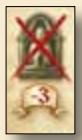
You must show that you have lived a virtuous and pious life. To this end, you must pay 2 piety, returning them to the supply (the cathedral). If you only have 1, pay 1. If you haven't been pious enough, you lose 3 victory points for each piety you cannot pay and must perform penance at the start of the next chapter.
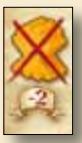
Additionally, you must show that you have enough food to sustain yourself. To this end, you must pay 2 grain, returning them to the supply (the field]. If you only have 1, pay 1. If you don't have enough food, you lose 2 victory points for each grain you cannot pay and must go begging at the start of the next chapter.
• Finally, you must pay taxes to the King. You (the active player) roll the tax die, which determines how much gold each player must pay. The taxation amount varies: pay 2 to 5 gold. If you can't pay your taxes in full, you must pay what you can. You lose 1 victory point for each gold you cannot pay and must go before the royal court at the start of the next chapter.

Penalties
Penance: If you have to perform penance because you didn't have enough piety at the end of the previous chapter, you must let another player randomly draw an action card out of your hand at the start of the next chapter. This card is discarded with no effect. After performing your first action of the chapter, you don't need to discard another action card.
• Begging: If you have to go begging because you didn't have enough food at the end of the previous chapter, you must forego your personal income in the first round of the next chapter.
Royal Court: If you have to go before the royal court because you couldn't pay your taxes in full at the end of the previous chapter, you only get to carry out 5 actions instead of 6 in the next chapter. At the start of the next chapter, you must play one action card and discard another in the same manner as usual; however you don't get to carry out the associated action. Going before the royal court replaces your normal action card phase.
Exception: Should the King Edward III leads a war against France' event card be the first card drawn in chapter II, then you do not need to discard an additional 2 action cards. All other players must carry out the event card's effect as usual.
Exception at the end of chapter IV: If you are short grain, piety or gold at the end of the game, you don't have to go begging, perform penance, or go before the royal court. Instead, your victory point losses will be doubled for each missing grain, piety or gold.
Example: If you are missing 1 grain and 2 gold, you don't just lose 4 victory points (2 for the grain and 2 for the gold) . Instead you lose double: for a total loss of 8.
Protection Against Penalties
If you pay 1 loyalty, you can avoid one penalty at the end of each chapter, regardless of the amount of your shortfall.

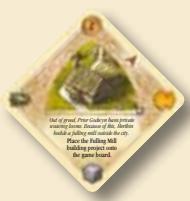
Example: The Fulling Mill is being built.
Important: You still lose the victory points.
You can protect yourself against multiple penalties, provided you pay 1 loyalty for each.
Example: You are missing 2 grain and 1 piety. You may pay 2 loyalty and avoid having to go begging and perform penance. However, you may also choose to pay only 1 loyalty and only be protected from one of the two penalties.
Note: The duties associated with the end of a chapter are summarized on the player screens provided for each player. The rules for begging, penance, and the royal court are also summarized on the summary cards.
Building Projects
Five building projects come into the game via event cards. As not all event cards are used in each game, it can happen that not all building projects will show up in each game. There are also two projects, the Bridge and the Tower, that are independent of the event cards. However, the Tower cannot be worked on until the start of chapter III. At that time, place the Tower building project onto the space intended for it on the game board.
When a building project comes into the game, place the appropriate building project tile onto the space intended for it on the game board. The building project is depicted on the event card; its name is shown by the appropriate space on the game board.

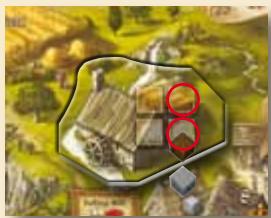
• When you play your Building Project action card, you can work on one project by placing either 1 or 2 of your own resources onto any free grey or brown building spaces on the building project tile (stone must be placed onto the grey spaces, wood onto the brown spaces].
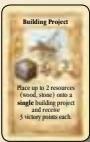
• You receive 3 victory points for each building space you fill.
• When building, you may fill the building spaces up in any order you like.
Example: You place 1 stone and 1 wood and receive 6 victory points.
• Special rules apply to the Tower's final (light blue] space [see “The Tower” on page 6].
Donations
• When you play your Donation action card, you can make a donation towards a building project (see above]. Pay 1 gold and place one of your donation seals onto the building project.
• When a building project is completed (which means that all its building spaces are filled), each player who
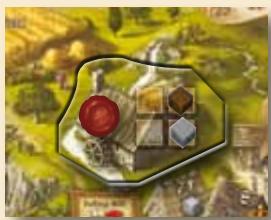
made a donation towards it receives the bonus indicated on the game board.
In most cases, this consists of 1 victory point along with an additional benefit.
Note: Should insufficient benefit resources be available, all donating players receive nothing.
• Multiple players may donate towards the same building project. However, you may not make 2+ donations towards the same project.
Example: Red and green each receive 1 victory point and 1 cloth.

• Once the building project is completed, the donating players get their donation seals back.
• Players receive 2 victory points for donating towards the Tower and the Chapel of the Virgin Mary; however no additional benefit is awarded.
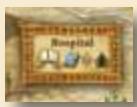
If you donated towards the Hospital, you may immediately care for a plague-infected inhabitant, provided that you have sufficient medical knowledge. If multiple players donated towards the Hospital, each player (starting with the active player) gets to care for an inhabitant in turn.
Plague
At the start of chapter III, the plague comes to Kingsbridge. In each of chapter III and chapter IV's rounds, the inhabitants of one house may fall ill. To this end, at the end of chapter I, mix up the 11 plague markers and place them, number side down, onto the 11 numbered locations on the game board: 10 houses and 1 forest hideout indicated by an outlaw [# 11].
Which particular house's inhabitants fall ill depends on the event card drawn in the round. Each of the 11 event cards for chapters ⅢII and IV are numbered from 1 to 11. When a new event card is drawn, before reading the event text, check to see which of the 11 locations' inhabitants have fallen ill this round. You turn the corresponding plague marker face up. Example: The inhabitants of house number 9 have fallen ill.
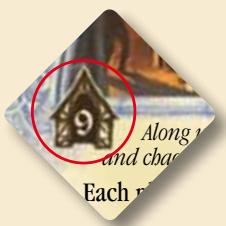
• The number on the plague marker shows how much medical knowledge is required to care for them. The amounts vary from 1 to 5. Èxample: To care for this house's inhabitants, you need to have at least 3 medical knowledge.
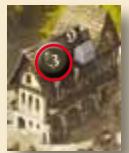
• To care for the inhabitants of a house, you must play your Medicine action card as well as have sufficient medical knowledge. You show your medical knowledge and specify which location you wish to care for.

For each location you care for, you receive 2 victory points as well as a benefit that depends on the location you cared for. The benefits are indicated by the symbols located at the various locations. The benefits can include victory points, gold, loyalty, cloth, etc. Example: For house nine, you receive 2 victory points and may immediately build a house on the game boārd without having to pay 1 building resource and 1 gold.

• You receive no additional benefit apart from the 2 victory points for caring for the outlaws (11) in the forest hideout.

Remove the plague marker for the location you cared for from the game. You return the medical knowledge you used back behind your player screenyou don't need to pay it.
If you have enough medical knowledge, you can use the Medicine action card to care for multiple locations. To do so, you need to have medical knowledge equal to or greater than the sum of the locations' requirements. Of course, when you care for multiple locations you also receive multiple victory points and benefits.
Should a number revealed in the chapter IV point to a house whose inhabitants are already ill (plague marker was revealed in chapter III] or who have already been cared for [plague marker was removed from the game], no new illness occurs, since nobody can fall ill from the plague twice.
The Tower
The Tower building project is a special case. As soon as its 8 regular building spaces [6 grey and 2 brown] spaces are filled, it is completed by filling the light blue building space at the top of the tower. The Tower, once completed, is the tallest structure in England.
• The King rewards the player with the most loyalty with a special metal resource from the royal mines. That player places it at the top of the tower [filling the light blue space) and receives 3 3 victory points. If multiple players are tied for the most loyalty, then one of them places the metal and each of them receive 1 victory point.
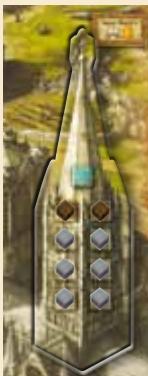

Note: Due to a certain event card, it may be that the Tower is completed immediately. In this case, fill any remaining spaces with stone from the quarry and wood from the forest, and check to see which player has the most loyalty and award that player the metal building resource and victory points.
• It may occur that the Tower isn't completed before the end of the game. In that case, the metal isn't awarded.
END OF THE GAME
The game ends after the fourth chapter. After paying your mandatory duties, you and the other players each count up your remaining resources. Each stone and wood you still have is worth 1 victory point. Every 2 gold you still have is also worth 1 victory point [victory points from gold are calculated by dividing your gold in half). Everything else is worth nothing. The player with the most victory points is the winner. You may have half victory points because of dividing your gold holdings in half.
• In the event of a tie, the winner is the tied player with the most piety. If there is still a tie, the player with the most loyalty wins, then the most medical knowledge.
Make the Pillars of the Earth® game based on Ken Follett's best-selling novel even better. Enhance your trips to the Kingsbridge Cathedral in the 12th century by adding by adding more variety, more exciting decisions, and the ability
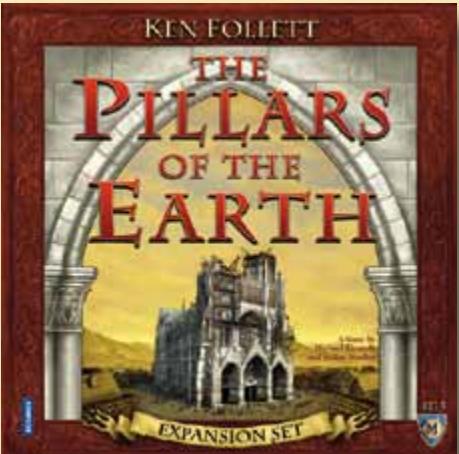
to play with 5 or 6 players!
An
expansion set
for The Pillars
of the Earth game.
For 2-6 players
Aged 12+
MFG4115
WWW.MAYFAIRGAMES.COM
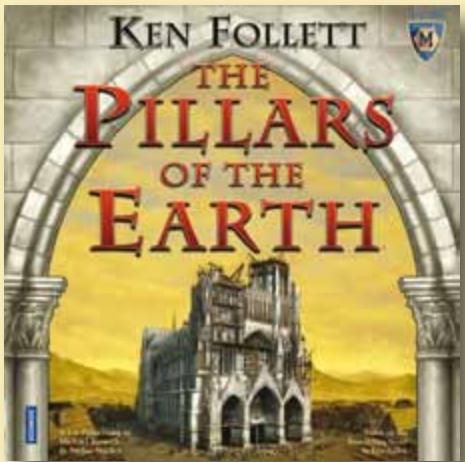
Ken Follett's best-selling novel becomes a gorgeously illustrated game about the building of Kingsbridge Cathedral. Collect resources, perform actions, use workers and builders to earn money, and convert materials into victory points
WWW.MAYFAIRGAMES.COM
on your way to constructing the legendary church!
For 2-4 players Aged 12+
MFG4103
ADDITIONAL RULES
Due to certain event cards, your discard pile may become larger than your action pile. In this case, do not discard a card when you play an action card. Your action and discard piles must end each chapter with 6 cards each.
• If you are required to discard cards that would result in more than 6 cards in your discard pile, discard only enough cards to fill your discard pile to 6 cards.
Whenever you choose to [or are forced to] forego your action [for example when you are called before the royal court), you must still play one card faceup to your action pile and discard another face-down to your discard pile. In such a case, the action of the face-up card isn't carried out.
• Whenever you pay or choose to trade in something, it is immediately returned either to the supply or to the game board.
• Grain and piety are scarce. You should be especially careful to make sure you have enough, particularly in four-player games, as they are subject to mandatory duties.
• Some of the immediate events also have lasting effects [such as adding building projects to the board or covering up favor spaces].
• Trades made possible by immediate events may only be carried out once. For long-term events, you may make the applicable trade once per round.
The covering tiles are used to cover up various parts of the game board. You can use them on the favor track, on market spaces or on building projects where event cards have prohibited further construction.
• Unlike loyalty and piety, you can never lose medical knowledge, willingly or otherwise.
If you cannot pay a mandatory duty at the end of chapter I, then you can protect yourself against losing double victory points by paying 1 loyalty. However, you cannot protect yourself against losing the regular victory points indicated on the summary cards.
• You can't have fewer than 0 victory points. If you score more than 60 victory points, move your scoring marker back to the start of the victory point track and continue scoring.
Designed by: Michael Rieneck & Stefan Stadler
The Authors: Michael Rieneck, born in 1966, lives in northern Germany and designs games of all types for a living. He is especially interested in games based on literature, such as “Around the World in 80 Days” and the worldwide hit “The Pillars of the Earth.
Stefan Stadler, born in 1973, lives in Karkruhe. A book dealer by trade, he is involved in the development of games in many different ways. After “The Pillars of the Earth," this is his third collaboration with Rieneck.
Development: TM- Spiele
Artwork & Graphics: Michael Menzel
Graphic Design: Pohl & Rick
English Translation: Patrick Korner
English Development: Coleman Charlton, Alex Yeager, Pete Fenlon
English Production: Pete Fenlon, Coleman Charlton
Special Thanks: Peter Bromley, Dan Decker, Morgan Dontanville, Bill Fogarty, Robert Hyde,Nick Johnson, Ron Magin, John McBrady, Kim McBrady, Marty McDonnell, Jim Miles, Bridget Roznai, Larry Roznai, Loren Roznai, Guido Teuber, Bill Wordelmann, Elaine Wordelmann.
The Designer and the Publisher would like to thank all the playtesters and rules readers.
Copyright © 2009 Ken Follett. Produced with Kosmos Verlag [Stuttgart) and Sophisticated Games. World Without End and The Pillars of the Earth are trademarks of Ken Follett. All rights reserved.
You have purchased a game of the highest quality. However, if you find any components missing, please contact us for replacement pieces at custserv@mayfairgames.com.


Mayfair Games, Inc. Skokie, IL, USA
WWW.MAYFAIRGAMES.COM
下载 Markdown原文为社区整理/出版社公开资料,版权归原作者,仅供个人学习查阅。