
长江黄河Yellow And Yangtze
一句话概览
长江黄河 是一款已收录于村了吗规则库的桌游,支持 2–4 人,原名 Yellow And Yangtze。
本页内容:一句话概览 · 游戏概述 · 1. 游戏组件 · 2. 游戏设置 · 3. 游戏流程与回合结构 · 4. 行动A:安置一名领袖 · 5. 行动B:放置板块 · 6. 行动C:发起民众暴动 · 7. 行动D:建造宝塔 · 8. 行动E:替换屏风后的板块 · 9. 冲突 · 10. 游戏结束与胜利者 · 11. 板块与领袖效果汇总 · 关键规则与常见问题 · 常见问题
长江黄河 规则速览
以下规则速览由本站整理,与官方规则书表述不同,仅供快速上手参考。
游戏概述
战国时期七国争雄,玩家各自引领一个王朝(狮、牛、弓、壶),通过放置板块、安置领袖来扩张国家、在冲突中胜出,并建造名望宝塔。游戏中每位玩家掌握5名领袖:官员、士兵、农民、商人、工匠,领袖用于收集同类型的胜利分。游戏结束时,你的分数是你最弱(最低)那一类的分数,因此必须兼顾五种颜色,不能偏科。当不同的国家在地图上接触时会发生冲突,要在冲突中获胜,玩家的国家必须在冲突中存活下来、平息民众暴动,并使社会足够安定来建造名望宝塔。
核心机制: 板块放置、区域连接、隐藏信息、多重得分线(取最低分)、即时冲突结算
2-4人 / 14岁以上 / 约90分钟。
1. 游戏组件
| 组件 | 数量/说明 |
|---|---|
| 折叠图板 | 1块(战国时期中国的黄河长江地区) |
| 胜利点指示物(方块) | 150块,5色(黑、红、绿、蓝、黄),2种尺寸:小=1分,大=5分 |
| 玩家屏风 | 4扇 |
| 领袖指示物 | 20枚,黑、红、绿、蓝、黄5色(每位玩家1套共5名) |
| 宝塔 | 9座(黑、红、绿、蓝各2座,黄色1座) |
| 统一标记 | 1枚(红色六边形) |
| 板块 | 138块(黑42、红36、绿24、蓝24、黄12) |
| 布袋 | 1只(装板块用) |
2. 游戏设置
A. 将图板放在游戏区中央。
B. 在图板中标记的格上各放置1块黑色官员板块,这些板块代表七国都城。将其余所有板块装入布袋中。
- 可选(二人游戏): 可经双方商议进行短时游戏,从袋中随机移除24块板块放回游戏盒。
C. 将所有宝塔放在图板旁;将所有胜利点指示物按颜色分开、放在图板旁;将红色六边形统一标记放在图板旁。
D. 每位玩家选择一个王朝(狮、牛、弓、壶),拿取对应屏风放在自己面前,并将5位领袖放在屏风前。未使用的屏风与领袖放回游戏盒。
E. 每位玩家从布袋中抓6块板块,放在屏风后。
F. 从袋中抽取6块板块,面朝上放在图板南方角落的绿色卷轴处,作为贸易板块。
3. 游戏流程与回合结构
随机选择一位起始玩家,然后按顺时针进行。
在你的回合中,必须按任意顺序执行最多2个行动,可选行动共5种;可以执行2个不同的行动,也可以2次执行同一个行动:
| 行动 | 内容 |
|---|---|
| A | 安置(放置、移动或收回)一名领袖 |
| B | 放置板块 |
| C | 丢弃2块蓝色农民板块来发起民众暴动 |
| D | 丢弃2块绿色商人板块来建造宝塔 |
| E | 替换屏风后至多6块板块 |
回合结束: 执行完两个行动后,先根据你控制的宝塔得分(见"宝塔");随后从布袋抓板块补至屏风后6块,其他板块不足6张的玩家也补至6张;若南方角落的贸易板块少于6张,从袋中补至6张。然后下一位玩家开始回合。
国家的定义
- 共边的板块、领袖称为相邻;由一系列相邻的板块或领袖联系起来的板块或领袖称为相互连接。
- 国家由一个或多个相互连接的板块,加上至少一块连接的领袖组成。
- 只要一个国家中只包含不同颜色的领袖,一切相安无事;当同一个国家中出现相同颜色的领袖时,冲突爆发。
4. 行动A:安置一名领袖
领袖可以从图板外进入、从图板上改变位置,或从图板上撤退。必须满足以下限制:
- 领袖必须被放置在图板的空格上(没有其他板块或领袖)。
- 领袖必须与黑色官员板块相邻。
- 领袖无法被放置在会导致两个国家统一并发生冲突的位置(见"冲突")。
- ⚠️ 注意:只要没有引起冲突,放置领袖可以导致2个或更多的国家统一。
- 领袖无法被放置在河流格中。
- 当与领袖相邻的最后一块官员板块被移出图板时,该领袖也必须被移除,返回玩家手中。
5. 行动B:放置板块
从自己屏风后拿取一块板块放到图板上。板块共5种:官员、士兵、农民、商人、工匠。限制条件:
- 板块必须放置在图板的空格上。
- 蓝色农民板块必须放置于河流格中(农业需要灌溉)。
- 除蓝色以外的所有板块都不能放在河流格中。
绿色商人板块的特殊效果:放置后,玩家可以从南方角落面朝上的贸易板块中选择一块,放到自己的屏风后。
蓝色农民板块的特殊效果:放置后,玩家可以在同一个行动中继续打出更多的蓝色农民板块,只要下一块板块与上一块相邻,且上一块板块没有引起冲突或新宝塔的建造。
放置板块的胜利分
胜利分有5种类别。放置板块获得胜利分的情况有两种:
- 若板块放置于国家中,且该国家有对应颜色的领袖,则该领袖的控制者获得分数。
- 若该国家中没有对应颜色的领袖,但有黑色官员领袖,则该黑色官员领袖的控制者获得胜利分。
- 若同一个行动中有数块蓝色农民板块被放置,满足上述条件的每块板块都能带来1分。
不会获得分数的情况: 若放置的板块使两个或更多国家统一并引发了冲突(注意:只要没有引发冲突,满足上述条件的板块仍可得分)。
胜利分隐藏在玩家屏风后。在回合中的任何时候,玩家都可以将5块价值"1"的小指示物换成1块价值"5"的大指示物。
6. 行动C:发起民众暴动
玩家从屏风后拿取2块蓝色农民板块,面朝下丢弃至游戏盒中。接着,玩家必须选择图板上任意一块板块,也面朝下丢弃至游戏盒中。移除了板块的格再次成为空格。
注意:
- 民众暴动可能将国家一分为二或更多部分。
- 若暴动移除了与一个领袖相邻的最后一块黑色官员板块,该领袖也被移除,回到玩家手中。
- 若宝塔下的板块被移除,那么宝塔也被移除,置于图板旁(见"宝塔")。
蓝色农民领袖的特殊效果: 若玩家的蓝色农民领袖在屏风前(即不在图板上),该领袖可以(但不必须)代表要求的两块板块中的一块,玩家只需要从屏风后丢弃一块蓝色农民板块即可发起民众暴动。
⚠️ 注意:民众暴动或冲突可能移除都城格中的起始官员板块。这些格在起始设置后便不再有特殊效果。在之后的行动中,领袖或板块可以被放置在这里,但农民(蓝色)板块不行,因为这些空格不是河流格。
7. 行动D:建造宝塔
宝塔的种类
宝塔有5种:衙门(黑)、兵营(红)、谷仓(绿)、集市(蓝)、作坊(黄)。
何时有机会建造宝塔
放置板块后,若同时满足以下三点,玩家即可建塔(作为放置板块行动的一部分):
- 玩家放置的板块使得同色板块形成了"三角形"。
- 该板块没有引发冲突。
- 这3块板块都没有支撑另一座宝塔。
玩家然后拿取图板旁对应颜色的宝塔,置于这个三角形上。若图板旁没有可用宝塔,玩家从图板上拿取另一座对应颜色的宝塔移动至这里。玩家可以选择不建造宝塔。
注意:形成三角形并支撑宝塔的板块保持面朝上,并仍算作板块。特别是黑色宝塔下的黑色官员板块仍然支撑相邻的领袖。
宝塔如何得分
宝塔有规律地提供胜利分。在玩家回合结束时,他检查自己是否有领袖与同颜色的宝塔处于同一国家中。每个满足此条件的领袖所在国家中的同色宝塔,使他获得该颜色的1胜利分。
⚠️ 注意:黑色官员领袖只有与黑色宝塔(衙门)相连接时才能获得胜利分。尽管放置板块可以允许黑色官员领袖获得其他颜色的胜利分(在对应颜色领袖不在时),这并不适用于宝塔。
行动D:用商人板块补建宝塔
要建造宝塔于之前任何玩家拼成的三角形板块上(无论当时是未放置宝塔还是后来被移除了),玩家必须执行此行动来完成:从屏风后拿取2块绿色商人板块,面朝下丢弃至游戏盒中;之后建立一座与三角形板块颜色相同的宝塔——若图板旁有可用的则拿取,否则从图板上拿取其他宝塔移动至此。
绿色商人领袖的特殊效果: 若玩家的绿色商人领袖在屏风前(即不在图板上),该领袖可以(但不必须)代表要求的两块板块中的一块,玩家只需要从屏风后丢弃一块绿色商人板块即可建造宝塔。
8. 行动E:替换屏风后的板块
作为一个行动,玩家可以从屏风后面朝下丢弃至多6块板块至游戏盒中,然后从布袋中抓取等量的板块放在屏风后,以更新自己的板块。
9. 冲突
当同一个国家中有两名同色领袖时,产生冲突。冲突有两个不同的种类:起义与战争。
任何冲突都立刻结算。 在冲突结算完毕、且所有国家都只有不同色领袖之前,行动不会结束。
9.1 起义
起义发生在领袖被安置在已有同色领袖存在的国家中时。放置新领袖的玩家是进攻方;控制该国家中已存在同色领袖的玩家是防御方。
结算流程:
1. 进攻方和防守方调集各自领袖相邻的黑色官员板块的力量。同一块黑色官员给两个领袖贡献力量是可能的。
2. 首先是进攻方,然后是防御方,可以通过从屏风后向冲突中投入任意数量的额外黑色官员板块(放在屏风前)来增加力量。
总力量(黑色官员板块总数)更高的玩家获得冲突胜利;若平手,防御方获胜。
起义的结果:
- 失败方必须将领袖撤回。
- 胜利方获得冲突领袖颜色的1胜利分。
- 双方玩家面朝下丢弃所投入的黑色官员板块至游戏盒中。
黑色官员领袖的特殊效果: 若参与冲突玩家的黑色官员领袖在屏风前(即不在图板上),该领袖可以(但不必须)为其添加1点额外力量至冲突中。
9.2 战争
战争发生在2个或更多国家由于一块新板块发生统一后,新的大国家含有同色领袖时。记住,放置的板块引起战争时,它不会产生分数;将红色统一指示物置于该板块上。
结算流程:
1. 所有战争的国家调集国内红色士兵板块的力量。
2. 由放置统一板块的玩家左手边的玩家开始,按顺时针顺序,每位玩家现在可以通过从屏风后投入任意数量的额外红色士兵板块(放在图板旁临近所选支持国家的位置),来增加所选一个战争国家的力量。所有玩家都可以为战争出力,即便没有自己的领袖处于冲突中。
3. 放置统一板块的玩家总是最后一个出力的玩家。
总力量(红色士兵板块总数)最高的国家赢得冲突胜利;若平手,由放置统一板块的玩家决定赢得平手的国家。
战争的结果:
- 同时移除所有战败国家中所有冲突领袖和红色士兵板块。非冲突领袖留在战败国中。
- 每个被移除的领袖都回到玩家手中,并使战胜国中同色领袖的控制者获得该颜色的1胜利分。
- 战败国家每个投入的以及被移除的红色士兵板块被收集到一起,置于图板外战败国旁边。每一堆都代表了该战败国刚才的总力量。这些总力量中的最高值决定了战胜国必须丢弃的红色士兵板块数量:首先丢弃战胜国投入的所有红色士兵板块;若数量仍不足,则打出统一板块的玩家选择并移除战胜国中的红色士兵板块,直至丢弃的红色士兵板块总数与所需相同。
战争后,移除红色统一标记放回图板旁,并将所有丢弃的红色士兵板块面朝下返回游戏盒。
红色士兵领袖的特殊效果: 若玩家的红色士兵领袖在屏风前(即不在图板上),该玩家可以(但不必须)将此领袖单独投入,或与红色士兵板块一同投入至一个战争国中。该领袖视为额外一块红色士兵板块。战争后,投入的领袖返还给该玩家。
9.3 战争示例
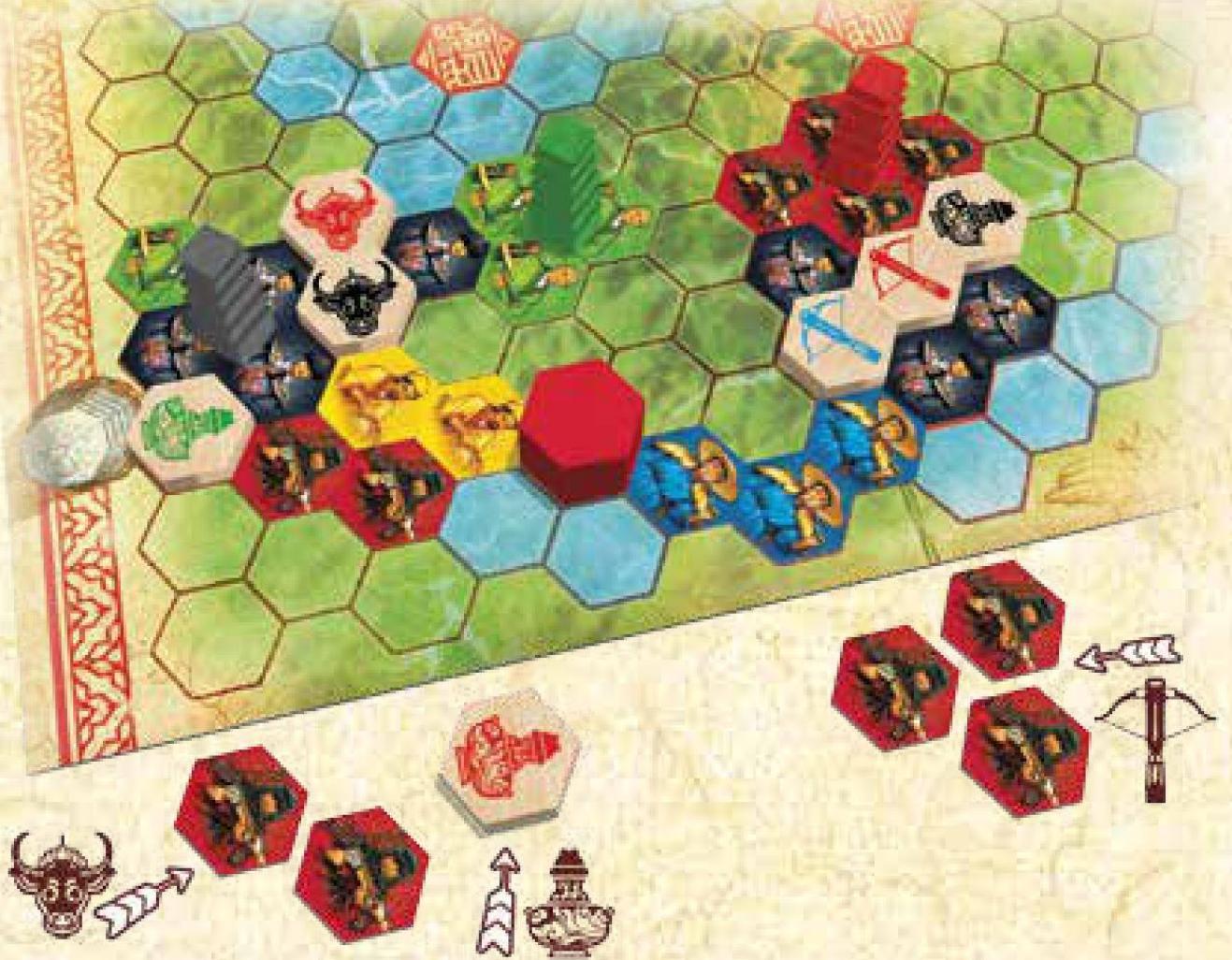
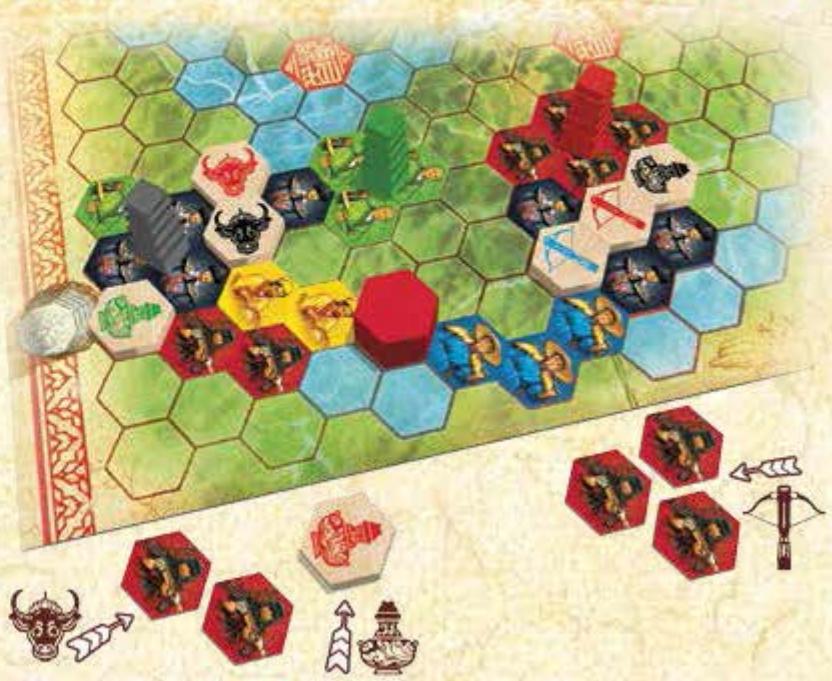
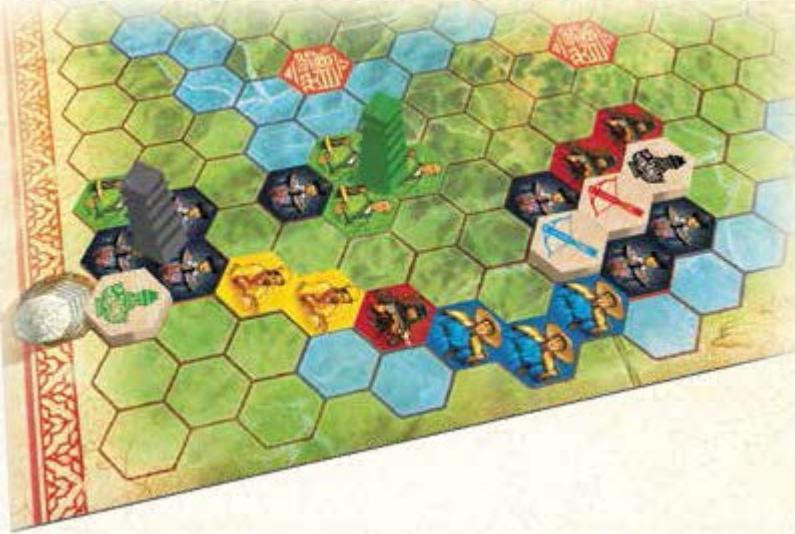
弓手玩家安德鲁放置一块板块使两个国家统一,这一举动导致了战争;放置这块板块不带来分数,并将红色统一标记置于其上。左方国家现有2力量(2块红色士兵板块),右方国家有4力量(4块红色士兵板块)。
公牛玩家芭芭拉坐在安德鲁的下家,她率先投入额外板块,从屏风后拿出2块红色士兵板块放在左方国家旁(她的领袖在那里)。轮到陶工玩家保罗,他不想投入额外板块,但他的红色士兵领袖不在场上,于是用该领袖支持左方国家。最后轮到安德鲁,左方国家当前力量为5,他的领袖所处的右方国家当前力量为4,安德鲁从屏风后投入了3块红色士兵板块放在右方国家附近。
右方国家赢得战争的胜利。参与冲突的红色公牛和黑色公牛被移出战败国,还给芭芭拉;安德鲁获得红色领袖胜利带来的1红分,保罗获得黑色领袖胜利带来的1黑分;绿色领袖和蓝色领袖未受影响,因为没有同色领袖。
从战败国要移除和投入的板块数为5,右方国家投入的3块不足5块。因此,放置统一板块的玩家安德鲁必须再从胜利的右方国家移除2块红色士兵板块——这一行为导致了红色宝塔(兵营)被拆除,放在图板旁。所有投入的和移除的红色士兵板块被面朝下丢弃至游戏盒中;投入的红色领袖还给保罗;红色统一板块被移除,战争结束。
10. 游戏结束与胜利者
游戏会在有玩家需要抓板块但袋子已空时结束。注意:游戏不会在最后一块板块被抽出时结束。
此时所有玩家移开屏风。每位玩家检查自己4种颜色(黑、红、蓝、绿)分数中最低的是多少,并可以任意分配自己手中的黄色胜利分给其他4种颜色(每个黄色胜利分都是万能的,可以代替任何其他颜色)。玩家的最低胜利分即为最终得分。
最终得分最高的玩家即为胜利者。若出现平手,平手玩家比较4种颜色分数中第二低的分数,以此类推。
11. 板块与领袖效果汇总
板块效果
放置板块于图板上后,同国家中的同颜色领袖获得1分。不同板块的额外效果如下:
- 官员(黑): 在起义时给相邻的领袖提供力量;领袖必须与官员板块相邻。
- 商人(绿): 放置商人板块后,可以获得一块贸易板块。
- 农民(蓝): 玩家可以在一个行动中放置多块、相邻的农民(有限制条件)。
- 士兵(红): 在战争中为国家提供力量。
- 工匠(黄): 没有特殊效果,但是所有黄色分数(黄金)在决定胜者时都是万能的。
领袖效果
除了用于获得胜利分和引发冲突,5名领袖还有如下用途:
- 官员(黑): 放置板块后,若同颜色领袖不在该国家,由官员获得分数;官员(若不在场)也可以在起义冲突时为你添加额外1力量。
- 商人(绿): 建造宝塔时(若不在场)可以代替一块绿色板块。
- 农民(蓝): 发起民众暴动时(若不在场)可以代替一块蓝色板块。
- 士兵(红): 在战争中(若不在场)可以当作额外士兵(红色)板块。
- 工匠(黄): 没有特殊效果,但是所有黄色分数(黄金)在决定胜者时都是万能的。
关键规则与常见问题
易错规则
- 最终得分取最低色: 游戏结束时取黑、红、蓝、绿四色中最低的一个;黄色分万能,可任意分配到其他4色后再取最低。
- 平手比较第二低: 最终得分平手时,依次比较第二低的分数。
- 同行动可重复: 一个回合的2个行动可以相同,例如放两次板块。
- 引发冲突的放置不得分: 板块统一了两个以上国家并引发冲突时,该板块不产生分数;未引发冲突则照常得分。
- 领袖必须与黑色官员板块相邻,且不能放在河流格,不能放在会引发冲突的位置。
- 蓝色农民板块只能放在河流格,其他所有颜色板块都不能放在河流格。
- 农民连放: 一块蓝色农民板块放下后,可在同一行动中继续连放,条件是下一块与上一块相邻,且上一块没有引起冲突或新宝塔的建造。
- 领袖离场条件: 与领袖相邻的最后一块官员板块被移出图板时,该领袖必须一并移除并回到玩家手中。
- 起义平手防守方胜;战争平手由放置统一板块的玩家决定。
- 战争结算顺序: 从放置统一板块玩家的左手边玩家起顺时针出力,放置统一板块者最后出力。
- 宝塔建造三条件必须同时满足: 形成同色三角形、未引发冲突、这3块板块都没有支撑另一座宝塔;且玩家可以选择不建塔。
- 黑色宝塔得分限制: 黑色官员领袖只有与黑色宝塔(衙门)相连时才通过宝塔得分。
- 宝塔下的板块仍算板块(黑色宝塔下的黑色官员板块仍支撑相邻领袖);但宝塔下的板块被移除时宝塔也随之移除。
- 游戏结束触发条件: 玩家需要抓板块而袋子已空时才结束,抽走最后一块板块本身并不结束游戏。
- 都城格失去特殊效果: 起始官员板块被移除后,该格在后续可放置领袖或板块,但农民(蓝色)板块不能放在那里。
常见问题
-
Q:放置领袖能否把多个国家统一?
A:可以,只要没有引起冲突;若会导致两个国家统一并引发冲突,则不能这样放置。 -
Q:放置的板块使国家统一并引发战争,还能得分吗?
A:不能,引发冲突的这次放置不产生分数。 -
Q:起义中力量怎么算?
A:双方领袖相邻的黑色官员板块力量之和,加上各自从屏风后投入的额外黑色官员板块;同一块黑色官员可以同时给双方的领袖提供力量;总力量高者胜,平手则防御方胜。 -
Q:我手里的黑色官员领袖(不在场上)有什么用?
A:起义时,若该领袖在屏风前,可以(但不必须)为冲突额外添加1点力量。 -
Q:红色士兵领袖(不在场上)能做什么?
A:可单独或与红色士兵板块一同投入某个战争国,视为额外一块红色士兵板块;战争后返还给玩家。 -
Q:发起民众暴动时必须丢弃几块蓝色农民板块?
A:通常2块;若你的蓝色农民领袖在屏风前(不在图板上),该领袖可代表其中一块,只需丢弃1块蓝色农民板块。 -
Q:建造宝塔时必须丢弃几块绿色商人板块?
A:通常2块;若你的绿色商人领袖在屏风前(不在图板上),该领袖可代表其中一块,只需丢弃1块绿色商人板块。 -
Q:放置绿色商人板块有什么额外收益?
A:可以从南方角落面朝上的贸易板块中选一块放到屏风后。 -
Q:行动E能替换多少板块?
A:至多6块——面朝下丢弃至多6块,然后从布袋抓取等量板块放在屏风后。 -
Q:回合结束时我会获得什么?
A:先根据你控制的宝塔得分(每个与你同色领袖同国的同色宝塔给该色1分),然后将屏风后板块补至6块,并把南方角落的贸易板块补至6块。 -
Q:黄色(工匠)分数有什么用?
A:黄色分数本身没有特殊效果,但在决定胜者时是万能的,可在结算时任意分配到其他4种颜色。
常见问题(FAQ)
以下 1 条问答中 0 条来自站内玩家的真实提问,其余 1 条为本站整理的常见疑问;答复内容保持原样。
长江黄河支持几个人玩?
2–4 人。
去哪查完整规则
想核对具体规则细节、卡牌效果或某个回合的结算方式,可以在村了吗里选中这款游戏后直接提问。
同类桌游
- 卡坦岛德式
- 工业革命:伯明翰德式
- 勃艮第城堡:特别典藏版德式
- 方舟动物园德式
- 卡卡颂抽象
- 瘟疫危机传承:第一季美式
- 阿瑞迪亚:勇踏征途美式
- 重塑宇宙德式
- 幽港迷城美式
- 埃多拉的德鲁伊德式
规则原文(Markdown)
本站收录这款游戏的规则原文 2 个文件,此处内联渲染 2 个,可直接展开阅读或下载。
rules_zh_长江黄河_2652.md19.6 KB

Designed by: Reiner Knizia
Illustrated by: Vincent Dutrait
2-4 players / ages 14+ / 90 minutes
战国时期(公元前475-221年),秦、楚、齐、燕、韩、魏和赵这七国之间战事不断。公元前221年,秦国一统战国,建立秦朝,形成了当今中国以黄河和长江两河为中心的起源。
“黄河与长江”是人气桌面游戏“两河流域”的姐妹篇游戏,让你重回那战火纷飞的年代,引领你的王朝走向胜利。

在“黄河与长江”中,玩家们通过放置板块来建设自己的国家。玩家们手中有5名领袖:官员、士兵、农民、商人、工匠。领袖们用于收集同类型的胜利点。然而,游戏结束时你的分数是你最弱类型的分数。当不同的国家在地图上接触的时候,就会发生冲突。要在冲突中获胜,玩家的国家必须在冲突中存活下来,平息民众暴动,使社会足够安定来建造名望宝塔。
游戏配件:
游戏盒中包含:
- 这本规则书
-1块折叠图板
-5种不同颜色(黑、红、绿、蓝、黄),2种不同尺寸的150块方块
-4扇玩家屏风
-5种不同颜色的20枚领袖指示物(每位玩家1套)
-9座宝塔(黑色、红色、绿色、蓝色各2座,黄色1座)
-1枚统一标记
- 138块板块(42块黑色、36块红色、24块绿色、24块蓝色、12块黄色)
-1只装板块的布袋
设置:
A: 放置图板于游戏区中央。图板显示战国时期中国的黄河长江地区。
B: 在图板中标记的格中各放置1块黑色官员板块。这些板块代表七国都城。将剩余的所有板块装进袋子中。
可选: 二人游戏时, 你们可以经商议进行短时游戏, 从袋子中随机移除24块板块放入游戏盒中。
C: 将所有宝塔放在图板旁。将所有胜利点指示物按颜色分开,放在图板旁。将红色六边形统一标记放在图板旁。
D: 每位玩家选择一个王朝(狮、牛、弓、壶),拿取对应的屏风放在自己面前,拿取5位领袖放在屏风前。将任何未使用的屏风和领袖放回游戏盒。
E: 每位玩家从袋子中抓6块板块放在屏风后。

F: 从袋中抽取6块板块面朝上放在图板南方角落绿色卷轴处,作为贸易板块。
国家:
共边的板块、领袖称为相邻。由一系列相邻的板块或领袖联系起来的板块或领袖称为相互连接。
国家是由一个或多个相互连接起来的板块和至少一块连接的领袖组成的。只要一个国家中只包含不同颜色的领袖,一切都相安无事。当同一个国家中出现了相同颜色的领袖时,冲突爆发。
进行游戏:
随机选择一位起始玩家,然后按顺时针进行游戏。
在一位玩家的回合中,他必须按任意顺序执行最多2个行动。可选行动有5种。玩家可以选择执行2个不同的行动或2次相同的行动。
A) 安置(放置、移动或收回) 一名领袖
B) 放置板块
C) 丢弃2块蓝色 农民 板块来发起民众暴动
D) 丢弃2块绿色商人板块来建造宝塔
E) 替换屏风后至多6块板块
现在将详细讲解这些行动……
A) 安置一名领袖
每位玩家都控制着一个国家的5名领袖:

官员

士兵

农民

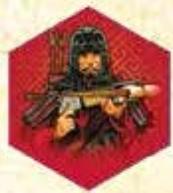
商人

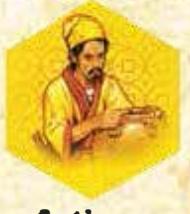
工匠
当玩家执行安置领袖行动时,领袖可以从图板外进入或从图板上改变位置,也可以从图板上撤退。
以下限制条件要满足:
- 领袖必须被放置在图板的空格上(没有其他板块或领袖)。
- 领袖必须与黑色官员板块相邻。
- 领袖无法被放置在会导致两个国家统一并发生冲突的位置——见下文“冲突”。
(注意: 只要没有引起冲突, 放置领袖可以导致2个或更多的国家统一。)
- 领袖无法被放置于河流格中。
当与领袖相邻的最后一块官员板块被移除图板时,该领袖也必须被移除,返回玩家手中。
工匠
B) 放置板块
板块有5种:

官员

士兵

农民

商人

当玩家执行此行动时,从自己屏风后拿取一块板块放置于图板上。
以下限制条件要满足:
- 板块必须被放置在图板的空格上。
- 蓝色 农民 板块必须放置于河流格中(农业需要灌溉)。
- 除蓝色以外的所有板块都不能放在河流格中。
绿色商人板块和蓝色农民板块的特殊效果:
- 在放置了绿色商人板块于图板上后,玩家可以从南方角落面朝上的贸易板块中选择一块放在自己的屏风后。
- 在放置了蓝色农民板块后,玩家可以在同一个行动中继续打出更多的蓝色农民板块,只要下一块板块与上一块相邻且上一块板块没有引起冲突或者新宝塔的建造。
胜利分:
胜利分有5种类别:

放置板块获得胜利分的情况有以下两种:
- 若板块放置于国家中,且其中有对应颜色的领袖,然后该领袖的控制者获得分数。
- 若该国家中没有对应颜色的领袖,但是有黑色官员领袖,则该黑色官员领袖的控制者获得胜利分。
若同一个行动中有数块蓝色农民板块被放置,满足上述条件的每块板块都能带来1分。
不会获得分数的情况:
- 若放置的板块使两个或更多国家统一并引发了冲突。(注意:只要没有引发冲突,满足上述条件的话可以得到胜利分)。
胜利分隐藏在玩家屏风后。在回合中的任何时候,玩家可以将5块价值 “1” 的小指示物换成1块价值 “5” 的大指示物。
C) 丢弃2块蓝色 农民 板块来发起民众暴动:
玩家可以执行行动来使民众暴动。要如此做,玩家从屏风后拿取2块蓝色农民板块并面朝下丢弃至游戏盒中。接着,玩家必须选择图板上任意一块板块,也面朝下丢弃至游戏盒中。移除了板块的格再次成为空格。
注意: 民众暴动可能将国家一分为二或更多部分。若民众暴动移除了与一个领袖相邻的最后一块黑色官员板块, 该领袖也被移除, 回到玩家手中。若宝塔下的板块被移除, 那么宝塔也被移除, 置于图板旁——见下文 “宝塔”。
蓝色 农民 领袖特殊效果:
- 若玩家的蓝色 农民 领袖在屏风前(也即不在图板上), 该领袖可以(但不必须)代表要求的两块板块中的一块。玩家只需要从屏风后丢弃一块蓝色 农民 板块来发起民众暴动。注意: 民众暴乱或冲突(见下文 “冲突”) 可能移除都城格中的起始官员 板块。这些格在起始设置后便不再有特殊效果。在之后的行动中, 领袖或板块可以被放置在这里, 除了 农民 板块 (蓝色) 因为这些空格不是河流格。
D) 丢弃2块绿色商人板块来建造宝塔:
此行动将在下文“宝塔”部分详细介绍。
E) 替换屏风后至多6块板块:
作为一个行动,玩家可以从屏风后面朝下丢弃至多6块板块至游戏盒中。然后他再从布袋中抓取等量的板块放在屏风后以更新板块。
回合结束:
玩家执行完两个行动,回合结束时,会根据其控制的宝塔得分——见下文“宝塔”。
最后,玩家从布袋中抓板块放在屏风后至6块以更新自己的板块。若有其他玩家此时板块少于6张,也抓至6张。若图板南方角落的贸易板块少于6张,也从袋中补充至6张。然后下一位玩家开始回合。
宝塔:
宝塔有5种:

衙门

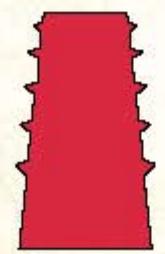
兵营

谷仓

集市

作坊
有时,放置板块后,玩家有机会建造宝塔。机会出现在下述情况中:
- 玩家放置的板块使得同色板块形成了“三角形”。
- 该板块没有引发冲突。
- 这3块板块都没有支撑另一座宝塔。
玩家然后拿取图板旁对应颜色的宝塔置于这个三角形上(作为放置板块行动的一部分)。若图板旁没有可用宝塔, 玩家从图板上拿取另一座对应颜色的宝塔移动至这里。玩家可以选择不建造宝塔。

注意: 形成三角形并支撑宝塔的板块保持面朝上, 并仍算作板块。特别是黑色宝塔下的黑色官员板块仍然支撑相邻的领袖。
宝塔有规律地提供胜利分。在玩家回合结束时,他检查自己是否有领袖与同颜色的宝塔处于同一国家中。每个满足此条件的领袖国家中的同色宝塔使他获得该颜色的1胜利分。
注意: 黑色官员领袖只有与黑色宝塔(衙门)相连接的时候才能获得胜利分。尽管放置板块可以允许黑色官员领袖获得其他颜色的胜利分(在对应颜色领袖不在时), 这并不适用于宝塔。
接下来我们可以解释一下重要的行动:
D) 丢弃2块绿色商人板块来建造宝塔:
要建造宝塔于之前任何玩家拼成三角形板块上(无论是由于当时未放置宝塔还是后来被移除了),玩家必须执行此行动来完成。建造宝塔时,玩家从屏风后拿取2块绿色商人板块,面朝下去弃至游戏盒中。之后,玩家建立一座与三角形板块颜色相同的宝塔。若图板旁有可用的,则拿取,否则从图板上拿取其他宝塔移动至此。
绿色商人领袖特殊效果:
- 若玩家的绿色商人领袖在屏风前(也即不在图板上), 该领袖可以(但不必须)代表要求的两块板块中的一块。玩家只需要从屏风后丢弃一块绿色商人板块来建造宝塔。
冲突:
当同一个国家中有两名同色领袖时,产生冲突。冲突有两个不同的种类:
- 起义
- 战争
任何冲突都立刻结算。在冲突结算完毕且所有国家都只有不同色领袖之前,行动不会结束。
起义:
起义发生在领袖被安置在已有同色领袖存在的国家中时。
起义时,放置新领袖的玩家是进攻方。控制该国家已存在同色领袖的玩家是防御方。
结算起义流程如下:
- 进攻方和防守方调集各自领袖相邻的的黑色官员板块的力量。同一块黑色官员给两个领袖贡献力量是可能的。
- 首先是进攻方,然后是防御方,可以通过从屏风后向冲突中投入任意数量的额外黑色官员板块放在屏风前来增加力量。
总力量(黑色官员板块总数)更高的玩家赢得冲突胜利。若平手, 防御方获胜。
起义的结果如下:
- 失败方必须将领袖撤回。
- 胜利方获得冲突领袖颜色的1胜利分。
- 双方玩家面朝下丢弃投入的黑色官员板块至游戏盒中。
黑色官员 领袖特殊效果:
- 若参与冲突玩家的黑色官员领袖在屏风前(也即不在图板上), 该领袖可以(但不必须)为其添加1点额外力量至冲突中。
战争:
战争发生在2或更多个国家由于一块新板块发生统一后,新的大国家含有同色领袖时。记住,放置的板块引起战争时,它不会产生分数。将红色统一指示物置于该板块上。
一个战争中要将所有同色领袖之间的冲突解决,流程如下:
- 所有战争的国家调集国内红色士兵板块的力量。
- 由放置统一板块的玩家左手边玩家开始按照顺时针顺序,每位玩家现在可以通过从屏风后投入任意数量的额外红色士兵板块放在图板旁临近支持国家的位置,来增加所选一个战争国家的力量。所有玩家都可以为战争出力,即便没有自己的领袖处于冲突中。放置统一板块的玩家总是最后一个出力的玩家。
总力量(红色士兵板块总数)最高的国家赢得冲突胜利。若平手, 由放置统一板块的玩家决定赢得平手的国家。
战争的结果如下:
- 同时移除所有战败国家中所有冲突领袖和红色士兵板块。非冲突领袖留在战败国中。
- 每个移除的领袖都回到玩家手中,并使战胜国中同色领袖的控制者获得该颜色的1胜利分。
- 战败国家每个投入的以及被移除的红色士兵板块被收集到一起置于图板外战败国旁边。每一堆都代表了该战败国刚才的总力量。这些总力量中的最高值决定了战胜国必须丢弃的红色士兵板块数量:
首先丢弃战胜国投入的所有红色士兵板块。若数量仍不足,则打出统一板块的的玩家选择并移除战胜国中的红色士兵板块直至丢弃的红色士兵板块总数与所需相同。
战争后,移除红色统一标记放在图板旁。并将所有丢弃的红色士兵板块返回游戏盒中,面朝下。
红色士兵领袖特殊效果:
- 若由玩家的红色士兵领袖在屏风前(也即不在图板上), 该玩家可以(但不必须) 将此领袖单独投入或与红色士兵板块一同投入至一个战争国中。领袖视为额外一块红色士兵板块。战争后, 投入的领袖返还给玩家。
示例:
弓手玩家安德鲁放置一块板块使两个国家统一。这一举动导致了战争。放置这块板块不会带来分数,并将红色统一标记置于其上。

目前,左方国家有2力量(2块红色士兵板块),右方国家有4力量(4块红色士兵板块)。
公牛玩家芭芭拉,顺时针顺序坐在安德鲁的下家。她率先投入额外板块。她从屏风后拿出2块红色士兵板块放在左方国家旁,她的领袖就在那里。
轮到陶工玩家保罗了。他不想投入额外的板块,但是他的红色士兵领袖不在场上,他决定用该领袖支持左方国家。
最后轮到安德鲁投入额外板块。左方国家当前力量为5,他的领袖所处的右方国家当前力量为4。安德鲁从屏风后投入了3块红色士兵板块并放在图板旁右方国家附近。
右方国家赢得了战争的胜利。参与冲突的红色公牛和黑色公牛被移出战败国,还给芭芭拉。安德鲁获得红色领袖的胜利带来的1 红分,保罗获得黑色领袖的胜利带来的1 黑分。绿色领袖和蓝色领袖未受影响,因为没有同色领袖。
从战败国要移除和投入的板块数为5。右方国家投入的3块板块不足5块。因此,放置统一板块的玩家安德鲁必须再从胜利的右方国家移除2块红色士兵板块。这一行为导致了红色宝塔(兵营)被拆除,放在图板旁。
所有投入的和移除的红色士兵板块被面朝下丢弃至游戏盒中。投入的红色领袖还给保罗。红色统一板块被移除,战争结束。

游戏结束与胜利者:
游戏会在有玩家需要抓板块但袋子已空时结束。(注意:游戏不会在最后一块板块被抽出时结束。)这时,所有玩家移开屏风。每位玩家检查自己4种颜色(黑、红、蓝和绿)分数中最低的是多少,可以任意分配自己手中的黄色胜利分给其他4种颜色。(每个黄色胜利分都是万能的,可以代替任何其他颜色。)玩家的最低胜利分即为最终得分。
最终得分最高的玩家即为胜利者。若出现平手,平手玩家比较4种颜色分数中第二低的分数,以此类推。
实用提示:
回合流程:
你的回合中,执行以下行动中的两个行动(可以执行相同行动两次):
- 安置(放置、移动或收回)一名领袖
- 放置板块(如有可能, 获得分数)
- 丢弃2块蓝色 农民 板块来发起民众暴动
- 丢弃2块绿色商人板块来建造宝塔
- 丢弃并替换屏风后至多6块板块

回合结束时,根据你控制的宝塔获得分数,然后抓取板块至6张(如需要)。
板块:
放置板块于图板上后,同国家中的同颜色领袖获得1分。放置不同的板块也有如下效果:
- 官员(黑):在起义时给相邻的领袖提供力量。领袖必须与官员板块相邻。
- 商人(绿): 放置商人板块后, 可以获得一块贸易板块。
- 农民(蓝):玩家可以在一个行动中放置多块、相邻的农民(有限制条件)。
- 士兵(红): 在战争中为国家提供力量。
- 工匠(黄): 没有特殊效果, 但是所有黄色分数(黄金) 在决定胜者时都是万能的。
领袖:
除了用于获得胜利分和引发冲突,你的5名领袖也有如下用途:
- 官员(黑):放置板块后,若同颜色领袖不在该国家,由官员获得分数。官员(若不在场)也可以在起义冲突时为你添加额外1力量。
- 商人(绿): 建造宝塔时(若不在场)可以代替一块绿色板块。
- 农民(蓝): 发起民众暴动时(若不在场)可以代替一块蓝色板块。
- 士兵(红): 在战争中(若不在场)可以当作额外士兵(红色)板块。
- 工匠(黄):没有特殊效果,但是所有黄色分数(黄金)在决定胜者时都是万能的。
冲突:
起义发生在领袖被安置在已有同颜色领袖的国家中时。
- 总力量(与领袖相邻的与屏风后投入的黑色官员板块数之和)高者胜利。
- 败者的领袖撤出图板,胜者获得冲突领袖颜色的1分,双方丢弃投入的黑色官员板块。
战争发生在多个国家由于一块新板块发生统一,而新的大国家中有同色领袖时。
- 士兵(红色)板块(加上相关玩家和盟友投入的板块)决定了每个国家的力量。
- 战败国移除所有冲突的领袖和士兵板块,战胜领袖获得分数。根据力量相差情况,战胜国也可能移除一些士兵。

www.grailgames.com.au
info@grailgames.com.au
PO Box 4 Ashfield NSW 1800
AUSTRALIA
Credits: Reiner Knizia thanks all the playtesters who contributed to the development of Yellow & Yangtze, in particular Iain Adams, Drak, Gavin Hamilton, Martin Higham, Ross Inglis, Kevin Jacklin, Chris Lawson, and Dave Spring.
This production is ©2018 Grail Games. Grail Games and the Yellow & Yangtze logo are © Grail Games. The Grail Games goblet is TM and © Grail Games. All rights reserved.
Printed in China. Warning: Choking hazard! Keep away from children under the age of 3. Please keep this information for future reference.
Yellow & Yangtze Rules.md24.7 KB
REINERKNIZIA
YELLOW YANGTZE
Also available from Reiner Knizia and Grail Games:
Circus Flohcati
Criss Cross
King's Road **
Medici **
Medici: The Card Game
Stephenson's Rocket ***
* with ort by Heik Günther, ** with ort by Vincent Dutrait, *t with ort by fon O'Toole

Dr. Relner Knizla is one of the worid's most successful and prolific game designers. More than 600 of his games and books have been publlshed worldwlde in over 50 languoges and hove won hin numerous international awords.


Designed by: Reiner Knizia Illustrated by: Vincent Dutrait
2-4 players / ages 14+ / 90 minutes
The period of the Warring States (475-221 BC) describes a time of endless wars between seven rival states Qin, Chu, Qi, Yan, Han, Wei, and Zhao. These states were finally unified in 221 BC under the Qin dynasty to lay the origin of today's China, with its two main rivers: the Yellow and the Yangtze.
Yellow & Yangtze, the sister game to the highly acclaimed board game Tigris & Euphrates, invites you to replay this eventful period and to lead your dynasty to victory.

In Yellow & Yongtze, players build civilizations through tile placement. Players are given five different leaders: a Governor, Soldier, Farmer, Trader, and Artisan. The leaders are used to collect victory points in these same categories. However, your score at the end of the game is the number of points in your weakest category. Conflicts arise when civilizations connect on the board. To succeed, players' civilizations must survive these conflicts, calm peasant revolts, and grow secure enough to build prestigious pagodas.
COMPONENTS:
Your game contains:
- This rule book
- 1 folded game board
- 150 cubes in 5 different solors (black, red, green, blue, yellow) and 2 different sizes (10x large and 20x small for each color)
- 4 player screens
- 20 leader tokens in 5 different colors (1 set per player)
- 9 pagodas (2x black, 2x red, 2x green, 2x blue, 1x yellow)
- 1 red unification marker
- 138 tiles (42x black, 36x red, 24x green, 24x blue, 12x yellow)
- 1 bag to keep the tiles in
SETUP:
A: Place the board in the middle of the play area. It shows China during the warring states period with its two main rivers Yellow and Yangtse.
B: Place one black govemor tile on each of the marked board spaces. These represent the capitals of the seven warring states. Put all remaining tiles into the bag and shufAe them.
Option: With two ployers you may agree to play a shorter game and remove 24 tiles from the bag unseen into the bax.

C Place all the pagodas next to the board. Divide all the victory point tokens by colors and place therm by the board. Place the red, hexagon-shaped unification marker by the board.
D: Each player chooses a dynasty (lion, bull, archer, pot), places
his matching screen in front of him, and his five leaders in front of the screen.
Put any spare screens and leaders back into the box.
E: Each player draws six tiles from the bag and places them behind his screen.
F: A further six tiles are drawn from the bag and placed face up as merchant tiles in the southern comer of the board, indicated by a green scroll.
STATES:
Tiles and leaders with a common edge are odjacont. Tiles or leaders are llnked, if they are adjacent or if they are connected through a chain of adjacent tiles and leaders.
A stet is one or more linked tiles and at least one linked leader on the board. As long as a state only ontains leaders of different colors, everything is peaceful. Conflicts arise when tiere are two like-colored leaders within one state.
PLAY:
Choose a starting player at random, then play proceeds in a clockwise order.
During his turn, the player must resolve up to two actions in any order. There are five possible actions. The player may choose two different actions or the same action twise:
A) Positon (place, move, or withdraw) a leader
B) Place tlle
C) Discard two blue farmner tlles to cause a peasants' rot
D) Discard two groen trador tiles to ostablish a pagoda
E) Raplace up to six tiles from behind hls scraan
These actions will now be explained in deroil..
A) POSITIONING A LEADER:
Each player controls a dynasty of five leaders:

Covernor

Saldler

Farmer

Trader

Artisan
When a player takes this action to position one of his own leaders, the leader can either come from the outside of the boasd or be repositioned from another space on the board. Furthermore, a leader can be withdrawn from the board.
The following restrictions apply:
- A leader must be placed on an empty space on the board (without a tile or leader).
- A leader must be placed adjacent to a black governor tile.
- A leader cannot be placed in such a way as to unite states leading to a conflict - see "Conflicts" below.. (Note: As long as no conflict arises, a leader may be placed to unite two or more states.}
- A leader cannot be placed on a river space.
When the last black governor tile adjacent to a leader is removed from the board, the leader must also be removed and returned to its player.
B) PLACING A TILE: There are five different types of tiles:

Govemors
Saldierg

Farmerg

Traders
Artisans
When a player takes this action, they take one of the tiles from behind their screen and places it on the board.
The following restrictions apply:
- A tile must be placed on an empty space.
- Blue farmer tiles can only be placed on river spaces. (Farming needs irrigation.)
- Any other tiles, apart from blue farmer tiles, cannot be placed on river spaces.
SPECIAL GREEN TRADER TILE AND BLUE FARMER TILE EFFICTS:
- After placing a green trader tile on the board, the player may choose one of the face up merchant tiles from the southem corner of the board and place it behind his screen.
- After placing a blue farmer tile, the player may continue to play further blue farmer tiles within the same action, as long as the next tile is always played adjacent to the previous tile and the previous tile does not lead to a conflict or the placement of a new pagoda.
VICTORV POINTS:
There are five different types of victory points:


Weapons

Crops

Goods

A victory point is gained for placing a tile under the following circumstances:
- If the tile is plaeed in a state, and this state contains a leader of the same color, then the victory point is gained by the player controlling that leader.
- If there is no leader of the respective color, but there is a black goveror leader within the state, then the victory point is gained by the player controlling the black govemor leader.
If several blue farmer tiles are placed within the same action, a blue victory point is gained for each of these tiles if the above circumstances apply.
No victory point is gained:
- If the tile is placed so that it unites two or more states leading to a confict (Note: As long as no conflict arises, a victoiy point is gained if the above circumstances apply.)
Victory points are kept hidden behind the players' screens. At any time during his turn, a player may exchange five small tokens valued at "1* for one large token valued at "5*.
C) DISCARDING TWO BLUE FARMER TILES TO CAUSE A PEASANTS' RIOT:
A player may take an action to cause a peasants' riot To do so, the player takes two blue fanner tiles from behind his screen and discards them face down into the box. As a onsequence, the player must then choose any one tile from the board and also discard it face down into the box. The respective space from where the tile is iemoved becomes empty again.
Noto: A peasants' riot may divide a state into two or more parts. If a peasants' riot removes the last black govemor tile adjacent to a leader, that leader is removed and returned to its player. If a tile is removed from below a pagoda, then the pagoda is also removed and placed next to the board - see "Pagodas" below.
SPICIAL BLUE FARMER LEADER EFFECT:
- If the player has his blue farmer leader in fiont of his screen (hence not on the board), this leader may (but does not have to) represent one of the two required tiles. The player then only discards one blue fammer tile from behind his screen to cause a peasants' riot
Nota: A peasants' riot, or conflict (see "Conflicts" below) may remove a starting governer tile from a capital city space. These spaces have no special purpose after setup. With future actions, leaders and tiles may be placed here, except for farmner tiles (blue) as these spaces are not on rivers.
D) DISCARDING TWO GREEN TRADER TILES TO ESTABLISH A PAGODA: This action will be described in detail under "Pagodasª below.
E) REPLACE UP TO SIX TILES FROM BEHIND VOUR SCREEN:
As an action, a player may discard up to six tiles from behind his screen into the box face down. Then he refreshes his supply of tiles by drawing the same number of tiles from the bag and placing them behind his screen.
END OF A TURN:
At the end of his turn, after resolving up to two actions, the player collects victory points for any pagodas he controls – see "Pagodas" below.
Finally, the player refreshes his tiles by drawing fiom the bag so that he ends his turn with six tiles behind his screen. If other players have fewer than six tiles at this point, they also refresh their tiles to six. If there are fewer than six merchant tiles in the southern corner of the board, these are also replenished from the bag. Then it is the next player's tum.
PAGODAS:
There are five types of pagodas:

Court
Garrison

Granary

Market
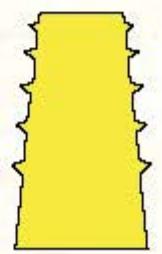
Worlshap
Sometimes, after placing a tile, the player has the opportunity to establish a pagoda. This opportunity arises in the following circumstances:
- The player places a tile in such a way that he creates a "triangle" of three like-olored tiles.
- The placed tile does not create a conflict
- None of the three tiles of the triangle is yet supporting another pagoda.
The player then takes a pagoda of the corresponding color from next to the board and places it on the triangle (as part of the Placing a Tile action). If no such pagoda is available next to the board, he takes any such pagoda from elsewhere on the board and repositions it

The player can decide not to establish a pagoda.
Note: The tiles forming the triangle remain face up and they still count when located under the pagoda. In particular, adjacent leaders are still supported by black governor tiles under a black pagoda.
A pagoda regularly provides victory points. At the end of the player's tum, he determines if one or more of his leaders are in the same state as a like-colored pagoda. For each such leader, he gains one victory point of the leader's color for each like-colored pagoda in the same state.
Note: A black governor leader gains victory points only when linked to a black pagoda (court). While the placement of a tile can allow the black governor leader to gain victory points in other colors (in the absence of the respective leader), this does not apply for pagodas.
Now we are able to describe the outstonding action:
D) DISCARDING TWO GREEN TRADER TILES TO ESTABLISH A PAGODA:
To establish a pagoda on a "triangle* of tiles that has been created earlier by any player (but the pagoda was not placed at the time, or it has since been removed), the player must take this action to do so. To establish a pagoda, the player takes two green trader tiles from behind his screen and discards them face down into the box. As a consequence, the player then establishes a pagoda of the corresponding color on the given triangle. If available, the player takes the pagoda from next to the board, otherwise the player takes any such pagoda from elsewhere on the board and repositions it.
SPICIAL GREEN TRADER LEADER EFFICT:
- If the player has his green trader leader in front of his screen (hence not on the board), this leader may (but does not have to) represent one of the two required tiles. The player then only discards one green trader tile from behind his screen to establish a pagoda.
CONFLICTS:
A conflict occurs when there are two like-colored leaders in a state. There are two different types of conflicts:
- Rrvolts
- Wars
Any conflict is resolved immediately. An action does not end before the conflict is resolved and all states only contain leaders of different colors.
REVOLTS:
A revolt oscurs when a leader is positioned in a state that already contains a leader of the same color.
During a revolt, the player positioning the new leader is the attacker. The player who controls the existing leader of the same color in the state is the defender.
Resolve revolts as follows:
- The attacker and the defender draw their strength from black governor tiles adjaeent to their leaders. It is possible that a black govemor tile counts for both leaders.
- First the attacker, and then the defender, may increase their strength by commiting to the conflict any number of extra black govemor tiles fiom behind their screens, placing them face up in front of their screens.
Whoever has the higher total strength (total number of black governor tiles) wins the conflict If there is a tie, the defender wiins.
The consequenees of a revolt are as follows:
- The loser must withdraw his leader from the board.
- The victor gains one victory point in the color of the conflicting leaders.
- Both players discard their committed black govemor tiles into the box face down.
SPICIAL BLACK GOVERNER LEADER EFFECT:
- If a player involved in a revolt has his black governor leader in front of his screen (hence not on the board), this leader may (but does not have to) add one extra strength to his side of the conflict.
WARS:
Wars occur when two or more states are united through a new tile, and the new, larger state contains leaders of the same color.
Remember that no victory point is gained when a tile is placed leading to a war. Instead the red unification marker is placed on the unifying tile.
All the conflicts between like-coloured leaders are resolved in one large war as follows:
- All warring states draw their strength from red soldier tiles in their state.
- Starting with the player to the left of the player who played the unifying tile and progressing in a clockwise order, each player may now increase the strength of one warring state of their choice by committing any number of extra red soldier tiles from behind his screen, placing them face up next to the board close to the supported state. All the players may contribute to the war, even if none of their leaders is involved in the conflict. The player who played the unifying tile is always the last player to contribute.
Whichever warring state has the highest total strength (total number of red soldier tiles) wins the conflict. If there is a tie, the player who played the unifying tile decides which of the tied states wiins.
The consequenees of a war are as follows:
- Simultaneously remove all conflicting leaders and all red soldier tiles from all the losing states. Only non-conflicting leaders remain in the losing states.
- For each leader removed and retumed to its player, the player who eontrols the like-coloied leader in the winning state gains one victoly point in that eolor.
- All the committed and all the removed red soldier tiles from each losing states are collected next to the board close to each losing state. Each collection represents the fommer total strength of the losing state. The highest of these totals now defines the number of red soldier tiles that must also be discarded for the winning state:
First discard all the led soldier tiles ommited for the winning state. If this number is not suficient, then the player who played the unifying tile chooses and removes red soldier tiles from the winning state itself until the total number of discarded red soldier tiles matches the required total.
After the war, remove the red unification marker and place it by the board. Also retum all discarded red soldier tiles to the box, face down.
SPICIAL RED SOLDIER LEADER EFFECT:
- If a player has his red soldier leader in front of his screen (hence not on the board), the player may (but does not have to) commit this leader alone or together with any ommitted red soldier tiles to support one of the warring states. The leader is treated like an extra red soldier tile. After the war, committed leaders are retumed to their players.
EXAMPLE:
Andrew, the archer, places a tile to unify two states. This causes a war. No victory point is goined for this placerent, instead the red unification marker is placed on the new tile:

Currently, the state on the left has strength 2 (two red soldier tiles) and the state on the right has strengun 4 (four red soldier tiles).
Barbara, the bull, follows Andnew in clockwise onder. She is the first to commit extro tiles. She places 2 red soldier tiles from behind her screen next to the stute on the left where lier leaders ore.
Poul, the potter, follows next He does not want to commit extra tiles, but as his red soldier leader is not on the boord, he decides to use this leader to support the stute on the left
Finally, the order comes back to Andrew to commit extro tiles. The current strenyu is 5 for the state on the left, and 4 for the state on the right where his leoders are. Andrew commits 3 red soldier tiles from behind his screen and places them next to the state on the right
The stote on the right wins the war. 7he conflicting red bull and black bull are removed from the losing state and returned to Barbara. Andrew gains one red victory point for his victorious red leader, and Paul gains one block victory point for his victorious block leader. The green leader and the blue leader remain unaffected as there are no conficting like-coloured leaders.
The totol number of tiles removed and committed from the losing state is 5. The 3 committed tiles for the state on the right are not enough to match this total Therefore, Andrew who ployed the unifying tile must remove 2 more red soldier tiles from the victorious state on the right, This also causes the red pogodo (garrison) to be lost and placed next to the boord.
All the committed and removed red soldier tiles are discarded face down into the bax. The committed red leoder is returned to Paul. The red unificotion tile is ronoved, and the war is over.
GAME END AND WINNER:
The game ends when a player who is at tempting to draw a tile is unable to do so because the bag is empty. (Note: Thie game does not yet end when the last tile is diawn from the bag.)
At this point, all playeis remove their screens. Each player determines in which of the four colors (black, red, blue, and green) he possesses the fewest victory points, with each player fieely allocating his yellow victoiy points to any of the other four colors. (Each yellow victory point is wild and can stand for any other color.) The number of his fewest victory points determines the player's result.
The player with the highest result is the winner. In the case of a tie, the tied players determine in which of the four colors they have their second lowest results and compare these, and so on.

HELPFUL REMINDERS:
TURN SEQUENCE:
On your tum, perforn two of the following actions you may do the same action twice):
- Position (place, move, or withdraw} a leader
- Place a tile (and possibly, earn points)
- Discard two blue farmer tiles to cause a peasants' riot
- Discard two green trader tiles to establish a pagoda
- Discard and replace up to six tiles from behind your screen

At the end of your tum, eam points from any pagodas you control, then draw back up to six tiles (if required).
TILES:
After placing a tile on the board, a like-colored leader in its state will earn one victory point. Placing different tiles also gives the following effects:
- Govemor (black): Gives strength to adjacent leaders in a revolt Leadeis must be adjaoent to a govemer tile.
- Trader (green): After placing a trader tile, the player may draw a tile from the market.
- Farner (blue): Players may place multiple, adjacent farner tiles as part of the same action (with some restrictions.)
- Soldier (red): Gives strength to a state during a war.
- Artisan (yellow): No special effect, but all yellow points (gold) are treated as wild when determining the winner.
LEADERS:
Besides being used to eam victory points and cause eonflicts, your five leaders can give you the following benefits: Govemor (black): After a tile is placed in a state, a govemor will eam the point if the eorresponding leader is absent. The govemor may also be used to add one extra strength to your side of the conflict during a revolt (if of the map).
- Trader (green): May replace a green tile when establishing a pagoda (if off the map).
- Fammer (blue): May replace a blue tile when causing a peasants' riot (if off the map).
- Soldier (red): May be treəted as an extra soldier (red) tile during a war (if off the map).
- Artisan (yellow): No special effect, but all yellow points (gold) are treated as wild when determining the winner.
CONFLICTS:
Revolts occur when a leader is positioned in a state that already contains a leader of the same eolor.
- Whoever has the higher total strength (botal number of black govemor tiles adjacent to leader and ommitted from screen) wins the eonflict
- The loser withdraws the leader from the board, the victor gains one victory point in the color of the onflicting leaders, and both players discard their ommitted black governor tiles.
Wars occur when two or more states are united through a new tile, and the new, larger state contains leaders of the same color.
- Soldier (red) tiles determine the strength of each state (plus the committed tiles from involved players and their allies).
- The losing state removes all eonflicting leaders and soldier tiles, the winning leaders earn points, and, depending on the size of the victory, some soldier tiles may also be removed from the winning state.
GRAIL GAMES
redite Reiner Knizia thanks all tie plylesters who ontributed to the development of Yallow & Yangtze, in particular lain Adarms, Orak, Gavin Hamilton, Martin Higham, Ross Inglis, Kevin Jaddin, Ohris Lawson, and Oave Spring.
VeBow & Yangtze is ©2018 Dr Relner Knizia. All rights reserved.
This production is ©2018 Grail Games. Grail Garnes and the Yallow & Yangte logo are © Grail Games. The Grail Games goblet is TM and Grail Games. All rights reserved. Printed in Ohina. Waming: Choking hazand! Keep away from children under the age of 3. Please losep this inforation for future reference.
下载 Markdown原文为社区整理/出版社公开资料,版权归原作者,仅供个人学习查阅。