
妖怪七重奏Yokai Septet
一句话概览
妖怪七重奏 是一款已收录于村了吗规则库的桌游,支持 3–4 人,原名 Yokai Septet。
本页内容:一句话概览 · 游戏概述 · 1. 游戏组件 · 2. 卡牌解析 · 3. 游戏准备 · 4. 每轮设置 · 5. 核心规则——出牌流程 · 6. 吃下一墩 · 7. 一轮结束 · 8. 轮末计分 · 9. 游戏结束 · 10. 关键规则与常见问题 · 11. 三人规则 · 12. 两人变体规则 · 13. 封印变体规则(四人) · 封底信息 · 设计师寄语 · 常见问题
妖怪七重奏 规则速览
以下规则速览由本站整理,与官方规则书表述不同,仅供快速上手参考。
游戏概述
很久以前,一片名叫日出之地的土地上妖怪肆虐,带来焚烧农田、洪水泛滥、电闪雷鸣等超自然灾害。你是一位能驱使古老神秘力量的阴阳师,为了守护村庄而战——但另一位阴阳师的离去引来了妖怪对你家乡的入侵。与那位阴阳师一较高下,证明自己才是家乡最强的救世主!
核心玩法: 团队制的吃墩类卡牌游戏。每轮每位玩家打出一张卡,最强卡者吃墩,目标是尽可能捕捉高分的妖怪头目(各花色的 7 号牌)。赢下轮次即可计分,率先拿到 7 分或以上的一方获胜整局游戏。
1. 游戏组件
| 组件 | 数量 | 说明 |
|---|---|---|
| 卡牌 | 49 张 | 7 种花色,每种花色 7 张(含该花色的妖怪头目) |
| 镭射卡 | 7 张 | 每种花色的数字 7,可替代对应的普通 7 号妖怪头目卡 |
| 玩家辅助卡 | 4 张 | 每人一张,标注各花色数值范围及强度排序 |
| 领袖玩家卡 | 1 张 | 标识当前轮次的起始出牌者 |
| 分数标记 | 20 个 | 用于计分,每轮赢家拿取对应数量 |
2. 卡牌解析
2.1 花色与数值
游戏共有 7 种花色,每种花色各有 7 张卡牌。每种花色的数值范围和分数各不相同——凤的数值范围最小且分数较小,雪的数值范围最大且分数较大。玩家可通过玩家辅助卡了解各花色的具体数值范围与强度排序。
2.2 妖怪头目卡
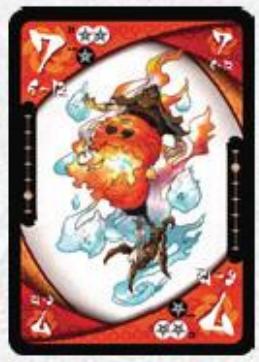
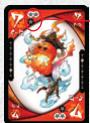
每个花色有一张数值为 7 的卡牌,称为该花色的 妖怪头目卡。每张妖怪头目卡旁印有分数标记。
- ☆ 分数:仅在三人游戏中计分。
- ⭐ 分数:在任何游戏模式中均计分。
- 凤和地的妖怪头目卡 没有分数标记,即在四人游戏中不直接计分。
2.3 妖怪王牌(A 牌)
A 牌属于凤花色,在该花色中数值最小,但被视作 妖怪王牌——它是全场 最大 的卡牌,无出其右。
2.4 强度指示
每张卡牌上印有数值范围尺:若"圆点"位于最上方,则该卡为本花色中最大的牌。
3. 游戏准备
- 每位玩家拿取一张 玩家辅助卡。
- 将四名玩家 平均分为两队:同队的两名玩家相对而坐,另一队的两名玩家坐在你的左右两侧。
- 注意:每种花色只使用一个"7"(可使用镭射卡或常规卡)。
4. 每轮设置
- 将 49 张卡牌洗混,背面朝上发给每位玩家 12 张牌。
- 剩余 1 张牌 正面朝上放在桌面中央,所有玩家可见。此牌的花色即为本轮游戏的 主色。
- 检视手牌后,每位玩家选择 3 张卡牌,背面朝上,与队友 同时互换。本过程不可沟通,也不可查看换来的卡牌后再决定是否换出。
- 确定领袖玩家:
- 第一轮:换牌后持有 A 卡的玩家成为领袖,展示 A 卡并领取领袖玩家卡。
- 若 A 卡在桌面中央,则由持有 13 卡(即 3)的玩家展示并领取。
- 此后每轮:上一轮赢得最后一墩的玩家成为本轮第一墩的领袖玩家。
5. 核心规则——出牌流程
每一轮由多墩组成,每墩每位玩家均从手中打出一张卡牌。
- 起始出牌:由领袖玩家 正面朝上打出一张卡牌。
- 跟牌:其余玩家按顺时针方向依次从手中 正面朝上打出一张卡牌。跟牌必须与领袖打出的卡牌 同花色(该花色称为 领袖花色)。如果手中没有该花色的牌,则可打出任意一张牌。
6. 吃下一墩
所有玩家出完牌后,按以下顺序判定胜负:
- A 卡优先:若有玩家打出了 A 卡,该玩家立即获胜,吃下这一墩。
- 主色优先:若无 A 卡,但有玩家打出了主色牌,则打出 数值最大 的主色牌的玩家获胜,吃下这一墩。
- 领袖花色:若以上两者皆无,但有玩家打出了领袖花色牌,则打出 数值最大 的该花色牌的玩家获胜,吃下这一墩。如果除领袖外无人打出领袖花色牌,则领袖玩家自动获胜。
收墩方式
- 将本墩所有卡牌拿到自己面前。
- 其中 妖怪头目卡正面朝上放置(视为已捕捉)。
- 其余卡牌 背面朝上放置。
- 将每一墩背面朝上的卡牌 分开放置,以便其他玩家看到你吃下了几墩。
- 同队的两名玩家的墩数可以合并放在其中一名玩家面前,方便计算。
- 妖怪头目卡 单独分开正面朝上摆放。
领袖交接
吃下这一墩的玩家拿取 领袖玩家卡,获得下一墩的先手权。
7. 一轮结束
当满足以下任一条件时,本轮结束:
| 条件 | 结果 |
|---|---|
| 某队共赢得 4 张及以上妖怪头目卡 | 该队直接获胜 |
| 某队共赢得 7 墩,其中妖怪头目仅 3 张及以下 | 另一队获胜 |
| 所有玩家手牌打完 | 赢得最后一墩的队伍获胜 |
8. 轮末计分
8.1 基本规则
- 只有本轮赢家可以计分,失败方即使抓到了妖怪头目也不计分。
- 计分对象:非主色的妖怪头目卡。主色妖怪头目 不计分。
- 每张非主色妖怪头目卡上的 ⭐ 标记 = 1 分(忽略 ☆ 标记)。
- 赢家从供应中拿取对应数量的分数标记。
8.2 反杀计分方式
当某队通过"赢得 7 墩但妖怪头目不足"的方式输掉本轮时(即对手以此方式获胜),获胜方可同时对 所有玩家手中剩余的妖怪头目卡 计分——即不仅计自己吃到的,也计对手和自己尚未打出的。
8.3 示例说明
- 正常获胜:抓到若干妖怪头目,排除主色,逐个累加 ⭐ 值得分。
- 反杀获胜:吃掉 + 对手/队友手中剩余的所有非主色妖怪头目,全部一并计分。
9. 游戏结束
当某一队伍累计获得 7 分或以上时,该队伍赢得整局游戏!
否则,继续按第 4 节的方法开始新一轮。上一轮最后一位持有领袖玩家卡的玩家将作为本轮首墩的领袖。
10. 关键规则与常见问题
易错规则
- 换牌须同时进行:你和队友同时交出 3 张牌并互换,不可查看换来牌后再决定自己要换出的牌,不可沟通。
- A 卡为全场最大:无论谁打出 A 卡,该玩家直接吃墩,无视主色和领袖花色。
- 主色妖怪头目不计分:即使抓到也不能得分。
- 领袖花色兜底机制:若只有领袖一人打出领袖花色,他自动赢墩。
- 仅赢家计分:无论抓到多少头目,输家一分不得。
- 反杀时可计所有手牌头目:对手通过"7 墩≤3 头目"获胜时,可对自己手中剩余的头目一并计分。
- 凤的 A 牌强制出牌:若 A 是你最后一张凤牌,且需要跟凤花色,则必须打出 A。
- 每种花色仅用一个 7:49 张牌的框架内,7 张镭射卡替代常规 7 号卡均可,不可重复。
常见问题
- Q:换牌环节如何操作?
A:每人选 3 张牌背面朝上,与队友同时交出并互换。全程不可交流,不可偷看。
- Q:领袖玩家的职责是什么?
A:每墩第一个正面出牌的人。后续跟牌者必须打出领袖花色,除非手中没有。
- Q:A 卡在哪一个花色?
A:A 卡属于凤花色。它在凤花色内数值最小,但作为妖怪王牌是全场的最大牌。
- Q:凤凰和土地的妖怪头目为什么不计分?
A:它们没有 ⭐ 分数标记,因此无法贡献分数。
- Q:如何确定谁是领袖玩家?
A:第一轮由持有 A 卡(或 3 卡,若 A 在桌面)的玩家担任。之后每轮由上一轮赢得最后一墩的玩家接任。
- Q:同队的墩数怎么算?
A:两位队友吃下的卡牌可以合并摆放在其中一方面前,方便清点墩数。
11. 三人规则
11.1 主要差异
- 三位玩家 各自为战,不再组队。
- 每人发 16 张牌。
- 选 3 张牌背面朝上,传给 左侧玩家(而非队友互换)。
11.2 一轮结束条件
| 条件 | 结果 |
|---|---|
| 某玩家赢得 3 张及以上妖怪头目 | 该玩家获胜 |
| 某玩家赢得 7 墩,妖怪头目仅 2 张及以下 | 其余两名玩家同时获胜 |
| 所有玩家手牌打完 | 赢得最后一墩的玩家获胜 |
11.3 轮末计分
- 单人获胜:计分方式同四人基础规则,但 ⭐ 和 ☆ 均算作 1 分。仍排除主色。凤的头目仍无分数标记。
- 双人同时获胜:两名玩家各获 3 个分数标记,忽略所有头目上的分数标记。
11.4 游戏结束
单名玩家拿到 7 分或以上时,该玩家获胜!
若出现平局:必是因为第三人吃下 7 墩且妖怪头目不足 2 张导致前两人联手获胜。此时第三位玩家 左手侧的玩家获胜。
12. 两人变体规则
12.1 目标与结果
- 赢得 4 张及以上妖怪头目 → 获胜。
- 赢得 13 墩但妖怪头目不 3 张 → 落败。
- 打到最后一墩(第 13 墩)仍僵持 → 赢下最后一墩者获胜。
12.2 准备
- 各自为战,每种花色只用一个 7。
- 将 49 张牌洗混后,先 背面朝上发每人 7 张牌,再 正面朝上发每人 6 张牌叠在上面。这套牌组称为 稻草堆。
- 接着 背面朝上再发每人 11 张牌,剩余 1 张花色作为主色。
- 最后从手中 背面丢弃一张牌(不能丢弃妖怪头目卡),被弃卡牌不参与本轮。
此时手中 10 张、稻草堆 13 张。不能查看稻草堆背面的卡牌。
12.3 稻草堆处理
若稻草堆正面 6 张中有妖怪头目卡,可选择其中 1 张将其与下方背面朝上的两张之一交换。必须先决定是否交换后才能查看下方牌。一旦查看了就必须交换。若翻出的也是妖怪头目,你可自行决定哪张面朝上、哪张面朝下。
12.4 核心规则
- 核心规则与四人基础完全相同,唯一区别:稻草堆正面朝上的卡牌视为你的手牌。
- 出牌时可从手牌和稻草堆正面卡中任选一张打出。
- 跟牌时必须打出领袖花色(除非手牌和稻草堆正面都没有该花色)。
- 稻草堆背面的牌在上方所有牌被打完后翻开,变为手牌。
- 轮流担任每墩的领袖玩家(无需再确定 A 卡)。
12.5 轮末计分与游戏结束
- 计分规则同四人基础规则。
- 玩家拿到 7 分或以上时赢得整局。
13. 封印变体规则(四人)
13.1 游戏概览
两个队伍竞争成为 首个封印 7 只不同妖怪头目的一方。封印方法:在一轮游戏中 同时捕捉同一种花色的两张妖怪头目卡(不需要在同一墩内),即可将其封印。
13.2 准备
- 分两队,四人同上。
- 每队领取一组 玩家辅助卡,翻转至圆形图案一面:一张卡有 4 个圆,另一张有 3 个圆。圆代表可封印的头目槽位。
- 使用 两组妖怪头目卡,共计 56 张牌。每种花色仍只使用一个 7(镭射或常规均可)。
- 每组分数标记放在对应花色上,标明已封印的头目。
13.3 每轮设置
- 将 56 张牌混洗,背面朝上发每人 14 张牌(无剩余牌)。
- 每人从手牌中选择 1 张背面朝上传给其他玩家(每人传 3 张)。
- 持有 A 卡的玩家担任领袖,展示并领取领袖卡。
13.4 核心规则
- 领袖打出第一张牌的 花色即为本轮主色。
- 其余玩家跟牌规则同基础版(须跟同花色)。
- 一墩中出现 两张同花色的 7 时,先打出的那张较大。
13.5 吃墩与封印
- 吃墩规则同基础版。
- 吃下的妖怪头目卡正面摆放。若你面前 已有两张相同的妖怪头目卡,则将分数标记放置在辅助卡对应圆圈上,完成封印。
- 吃完 14 墩(每人 14 张牌各出一轮)后本轮结束。
13.6 游戏结束
某队封印了 7 只不同妖怪头目时,游戏立刻结束,该队获胜!通常需要多轮才能达成。
13.7 更短时长变体
- 每只需要封印 4 只不同的妖怪头目即可获胜。
- 每只妖怪头目只能被封印一次。一旦某队率先封印某个头目,另一方不能再封印同一个。
封底信息
游戏设计: 横冢宗之
开发人员: Yirli'kumde, Ayatsurare Ningyoukan
绘师: U
平面设计: Longo Hasegawa, Satsuki Nakayama
美术设计: Fukutarou
规则编辑: Gil Hova
原出版社: Dan Kobayashi
中文代理: 桌游怪
特别感谢所有参与游戏测试的人员以及摩点上的支持者。
设计师寄语
《妖怪七重奏》是基于 2015 年春天于日本出版的一款游戏为基底设计的。该游戏至今仍被日本玩家视为吃墩游戏的入门之作之一。
我的目标是在这种简单又刺激的吃墩机制中加入更多策略性,因此设计了《妖怪七重奏》。我希望这款游戏在未来能成为经典的吃墩游戏之一。
常见问题(FAQ)
以下 1 条问答中 0 条来自站内玩家的真实提问,其余 1 条为本站整理的常见疑问;答复内容保持原样。
妖怪七重奏支持几个人玩?
3–4 人。
去哪查完整规则
想核对具体规则细节、卡牌效果或某个回合的结算方式,可以在村了吗里选中这款游戏后直接提问。
同类桌游
- 卡坦岛德式
- 工业革命:伯明翰德式
- 勃艮第城堡:特别典藏版德式
- 方舟动物园德式
- 卡卡颂抽象
- 瘟疫危机传承:第一季美式
- 阿瑞迪亚:勇踏征途美式
- 重塑宇宙德式
- 幽港迷城美式
- 埃多拉的德鲁伊德式
规则原文(Markdown)
本站收录这款游戏的规则原文 2 个文件,此处内联渲染 2 个,可直接展开阅读或下载。
rules_zh_妖怪七重奏_5670.md18.4 KB

许久以前,在一片名叫日出之地的土地上,妖怪肆虐,影响着人类的生活。虽然妖怪不直接攻击人类,但它们却会造成各种超自然灾害,比如焚烧农田、洪水泛滥、电闪雷鸣、疫病横行。
有一天,一位附近村庄的村长来拜访你并恳求你的帮助。因为你是一位能驱使古老神秘力量的阴阳师。凭借在天文学和神秘学的渊博知识,你发现了拯救村庄的唯一方法。很简单:捕捉妖怪,抓住的妖怪越多,它们造成的危害就越少。
于是,你接受了这位村长的恳求,并在他的村里住了几个月,彻底清除了在那个村庄游荡的妖怪。
然而你没想到的是,妖怪们却跑来了你的村庄大闹。由于你的离开,村长正准备寻求另一位阴阳师的帮助。这真是天大的侮辱!保护你的村庄与人民,本是你的天职,怎可假他人之手!快行动起来吧,跟另一位阴阳师一较高下。你才是家乡的救世主,你才是最强的阴阳师!
1. 游戏概览
在《妖怪七重奏》中,你的目标是尽可能捕捉高分的妖怪头目,也就是赢下各种花色的7号牌。
每个回合,每名玩家各会从手中打出一张卡。其中打出最强卡牌的玩家将吃下这一墩,也就是拿走本回合打出的所有卡牌,这些卡牌中也许就包含妖怪头目。之后,新的回合开始,重复这个过程,直到决出这一轮的赢家。
玩家可以通过吃墩,捕捉一定数量的妖怪头目赢下这一轮游戏并计分。但也要注意,如果你吃下太多墩,但其中却没有足够的妖怪头目时,你也会输掉这一轮。
本规则书会主要介绍四人游戏的规则内容,三人游戏玩法可见第8部分《三人规则》。
2. 游戏组件
• 49 张卡牌(7种花色,每种7张) • 7 张镭射卡(每种花色的数字7)

正面

背面

• 4 张玩家辅助卡 • 1 张领袖玩家卡
- 20个分数标记

· 1 本规则书

正面
背面
領袖
玩家

3. 卡牌解析
游戏中共有7种花色,每种花色各有7张卡牌。每种花色的数值范围和分数都不相同。其中,凤的数值范围最小,且分数较小;雪的数值范围最大,且分数较大。玩家可以在玩家辅助卡上找到每种花色的数值范围。
每个花色都有一张数值为7的卡牌,这张卡牌被称为该花色的妖怪头目卡。
在妖怪头目卡的数值旁边,印有分数标记。其中,☆分数在任何游戏中都会计分,☆分数则只在三人游戏中计分。
凤中数值“最小”的是A,但将其视为妖怪王牌,即为所有卡牌中最大的卡牌。

数值范围尺表示了该卡牌在本花色中的强度。如果“圆点”在最上方,则表示该卡牌是本花色中最大的卡牌。
凤的妖怪头目没有分数标记。
4. 游戏准备
游戏开始前,每位玩家拿取一张玩家辅助卡。
将四位玩家平均分为两队。同队的两个玩家相对而坐,也就是说,另一队的两位玩家将坐在你的左右两侧。
注意:每种花色只使用一个“7”,使用镭射卡或常规卡均可。
5. 每轮设置
将49张卡牌洗混,并背面朝上发给每位玩家12张牌。将剩余的1张牌正面朝上放在桌子中间使所有玩家可以看见。该卡牌的花色被称为本轮游戏的主色。
检视手牌后,每位玩家从中选择3张卡牌,背面朝上,和队友同时互换。注意:此过程中既不可沟通,也不可先查看将换得的卡牌,再选择自己要换出的卡牌。
如果这是第一轮游戏,换牌后拥有A卡牌的玩家成为领袖玩家,展示卡牌A并拿取领袖玩家卡。如果A为桌面中央剩余卡,则拥有13卡牌的玩家展示该卡并拿取领袖玩家卡。
6. 核心规则
每一轮由多个回合组成,在本游戏中我们将每个回合都称为“墩”,每一墩中每位玩家都会从手中打出一张卡牌。
由领袖玩家正面朝上打出一张卡牌作为起始。
剩余玩家按顺时针方向依次也从手中正面朝上打出一张卡牌。该卡牌必须与领袖玩家打出的卡牌同花色(该花色被称为领袖花色)。除非该玩家手中没有该花色卡牌,则可以打出任意一张卡牌。
吃下一墩
在所有玩家都打出一张卡牌后,先确认是否有玩家打出卡牌A。如果有,则该玩家获胜,吃下这一墩。
如果没有,则确认是否有玩家打出主色牌。如果有,则打出数值最大的主色牌的玩家获胜,吃下这一墩。
如果没有, 则确认是否有玩家打出领袖花色卡牌。如果有, 则打出数值最大的该花色卡牌的玩家获胜, 吃下这一墩。如果除领袖玩家外无人打出领袖花色卡牌, 则领袖玩家获胜, 吃下这一墩。
当你吃下一墩时,将这一墩打出的所有卡牌拿到你面前。如果其中有妖怪头目卡,将它正面朝上放在面前(视为捕捉到妖怪头目)。其他卡牌则背面朝上。将每一墩背面朝上的卡牌分开放好,以便其他玩家了解你吃下了几墩。
同队的两名玩家各自吃墩的卡牌可以一起放在其中一名玩家面前,以便计算该队墩数。
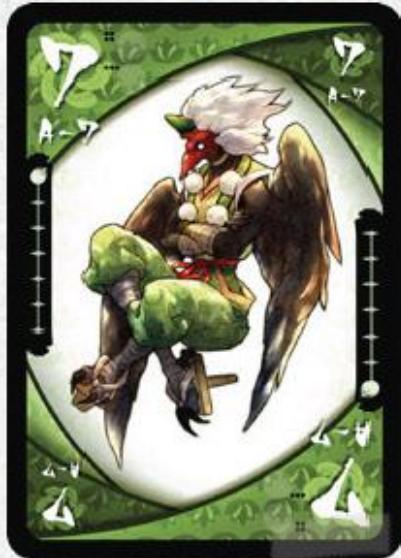
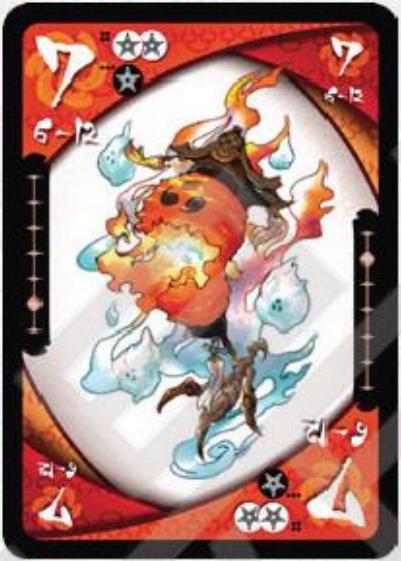
将吃下的妖怪头目牌
正面朝上放在面前

其余吃下的卡牌背面朝上
按照每墩分开在面前放好
接下来,由吃下这一墩的玩家拿取领袖玩家卡。
如果本轮游戏还未结束(确认是否满足一轮结束条件,详见下一页),则继续下一墩,由新的领袖玩家率先出牌。
7. 一轮结束
当游戏过程中满足下列条件任意一项时,一轮结束。
-
某队的两位玩家共赢得4张或4张以上的妖怪头目卡时,该队赢得本轮游戏。
-
某队的两位玩家共赢得7墩,其中妖怪头目卡却只有3张或3张以下时,则另一队赢得本轮游戏。
-
所有玩家手上卡牌被打完时,赢得最后一墩的队伍赢得本轮游戏。
轮末计分
只有本轮赢家可以计分。另一队即使捕捉到妖怪头目,这些卡牌也不计分。

当某队通过第2种方式获胜时(即另一队赢得7墩,却未捕捉到足够的妖怪头目),获胜队伍不仅可以对已捕捉到的妖怪头目卡计分,还可对留在所有玩家手中的妖怪头目卡计分。
获胜队伍将对捕捉到的妖怪头目卡计分(第2种获胜方式见上述注意事项)。其中主色的妖怪头目不计分。其他妖怪头目卡的每一个⭐标记代表1分,忽略⭐标记。拿取对应数量的分数标记。
注意凤和地的妖怪头目卡都没有 ⭐标记,即它们在4人游戏中并不计分。
游戏结束
当一个队伍拿到7个或7个以上分数标记的时候,该队赢得整局游戏胜利!
否则,按照《每轮设置》重新开始新的一轮。上一轮最后一位拿到领袖玩家卡的玩家将成为本轮第一墩的领袖玩家。
计分示例
例1
A 队捕捉到以下 4 只妖怪头目赢下这一轮,则 A 队计分如下:
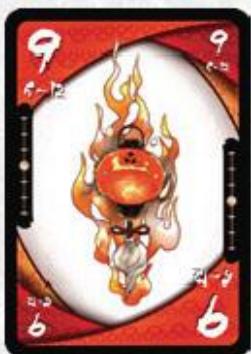
主色牌
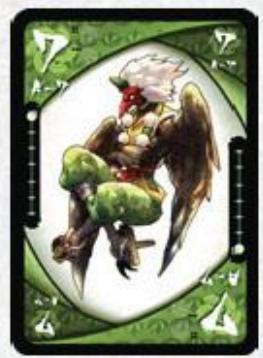
没有 0分
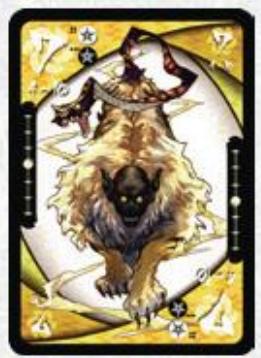
1个
1分
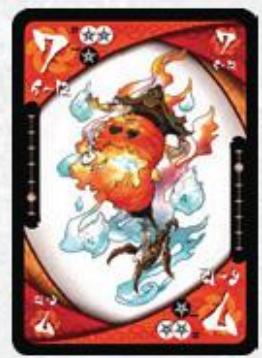
主色7
0分
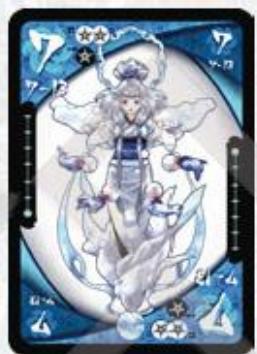
2个
2分
总分 = 3 分
例2
A 队吃下7墩却只捕捉到2只妖怪头目,输了这一轮。因此,B 队得分,A 队不得分。
玩家手中的妖怪头目也会计入B队得分中:
B队吃下的妖怪头目卡

没有 ★
0分
总分 = 4 分

1个
1分
主色7
0分
玩家手中剩余的头目卡

1个
1分

2个
2分
8. 三人规则
当你们进行3人游戏时,游戏规则会有些微不同。
- 你们将各自为战,而非两两组队。
- 每轮游戏开始时,分发给每位玩家16张卡牌,而非12张。
- 每位玩家同时选择3张卡牌传给左侧的玩家。
- 一轮结束的条件以及该轮的赢家依照下列规则:
-
某位玩家赢得3张或3张以上的妖怪头目卡时,该玩家赢得本轮游戏。
-
某位玩家共赢得7墩,其中妖怪头目卡却只有2张或2张以下时,则另两位玩家同时赢得本轮游戏。
-
所有玩家手上卡牌被打完时,赢得最后一墩的玩家赢得本轮游戏。
- 以上不同的获胜方式将有不同的轮末计分方式:
-
当只有一位赢家时,赢家对捕捉到的妖怪头目卡计分。其中主色的妖怪头目不计分。其他捕捉到的妖怪头目卡中,每一个 ⚠ 或 ⚠ 标记均代表1分。拿取对应数量的分数标记。注意凤的妖怪头目卡没有分数标记,即该妖怪头目卡不计分。
-
当有两位玩家通过第2种获胜方式获胜时,均获取3个分数标记,忽略所有妖怪头目卡上的分数标记。
- 当一个玩家拿到7个或7个以上分数标记的时候,游戏结束,拥有最多分数标记的玩家获胜!
注:如果有两位玩家平局,则最后一局结束必是由于第三位玩家吃下7墩,妖怪头目却少于2张。这种情况下,第三位玩家左手侧的玩家获胜!
9. 四人变体规则: 封印
以下部分为使用两组妖怪头目卡的4人变体规则。推荐给理解并玩过基础规则的玩家。
游戏概览
该变体的游戏目标是成为第一个捕捉并封印7个不同妖怪头目的队伍。要封印一个花色的妖怪头目,你们的队伍需要在一轮游戏中同时捕捉这个花色的两张妖怪头目卡(不需要在同一墩内)。
游戏准备
如同基础规则,将四位玩家平均分为两队。同队的两个玩家相对而坐,也就是说,另一队的两位玩家将坐在你的左右两侧。
每队拿取一组玩家辅助卡,将其翻转至圆形图案的一面,其中一张卡有4个圆形图案,另一种有3个。这些圆形图案是用来封印妖怪头目的。
使用两组妖怪头目卡,包括镭射7卡和普通7卡。卡组将由56张卡组成。

两队各自拿取一组玩家辅助卡。将获取的分数标记放在对应花色上表明已封印的妖怪头目。
每轮设置
将56张卡牌混洗,并背面朝上发给每位玩家14张牌。没有卡牌剩余。
每位玩家从手上选择1张卡牌背面朝上,传给其他玩家,也就是说每位玩家都要传3张卡牌。
如果这是第一轮游戏,拥有卡牌A的玩家成为领袖玩家,展示卡牌A并拿取领袖玩家卡。
核心规则
领袖玩家先从手中正面朝上打出一张卡牌。
这张卡牌的花色将被认为是这一轮的主色。
剩余玩家如同基本规则中讲述的也各自打出一张卡牌。即卡牌必须与领袖玩家打出的卡牌同花色。除非该玩家手中没有该花色卡牌,则可以打出任意一张卡牌。
吃下一墩
吃墩的规则和基本规则一致。唯一的特殊情况是一墩中出现两张同花色的7。此时,第一张打出的7较大。
当你吃下一墩时,将这一墩打出的所有卡牌拿到你面前。如果其中有妖怪头目卡,将它正面朝上放在面前。如果此时你面前已经有两张同样的妖怪头目卡,则将分数标记放在玩家辅助卡上对应的圆形图案上(视为封印该妖怪头目)。
接下来,吃下这一墩的玩家拿取领袖玩家卡。继续游戏直到14张卡牌都打完。
一轮结束
当每位玩家打完手中的卡牌,也就是14墩后,一轮游戏结束。
继续进行游戏直到某队封印了7只不同的妖怪头目。通常需要好几轮游戏才会结束。
游戏结束
当某队封印了7只不同的妖怪头目时,游戏立刻结束,该队获胜!
更短时长变体
在该变体中,每队不需要再封印所有7只妖怪头目。每只妖怪头目只能被封印一次,当有一队率先封印了某只妖怪头目后,另一队不能再封印该妖怪头目。当某队率先封印4只不同的妖怪头目时,该队获胜!
特别感谢
该变体规则由 Chris Wray 设计,更短时长变体则由 W. Eric Martin 提供。
特别感谢 Chris 和他的朋友为本游戏提供了变体规则。
易错漏规则细节
- 第一轮游戏的领袖玩家为换牌后拿到卡牌 A 的玩家。
· 之后每轮的领袖玩家为上一轮赢得最后一墩的玩家。
- 每轮游戏只有赢家计分。
- 主色的妖怪头目卡不计分。
- 卡牌A属于凤,当领袖玩家打出凤卡牌时,若卡牌A为你最后一张凤卡牌,则必须打出卡牌A。
设计师寄语
《妖怪七重奏》是基于2015年春天于日本出版的一款游戏为基底所设计的。该游戏至今仍被日本玩家视为吃墩游戏的入门游戏之一。
我的目标是在这种简单又刺激的吃墩机制中加入更多策略性,因此设计了《妖怪七重奏》。我希望这款游戏在未来能成为经典的吃墩游戏之一。

游戏设计:Muneyuki Yokouchi
开发人员:Yirli'kumde, Ayatsurare Ningyoukan
绘师:U
平面设计:Tori Hasegawa, Satsuki Nakayama
美术设计:Fukutarou
规则编辑:Gil Hova
原出版社:Dan Kobayashi
中文代理:桌游怪
特别感谢所有参与游戏测试的人员以及摩点上的支持者。
请通过以下二维码查看游戏的最新规则更新以及勘误。
二人变体规则
以下部分为《妖怪七重奏》的2人变体规则。推荐给理解并玩过基础规则的玩家。
游戏概览
该变体的游戏目标和基础规则一致。如果你捕捉到4只或4只以上妖怪头目则获胜。如果你吃下13墩,其中妖怪头目却不足4只则落败。如果你们僵持到最后一墩即第23墩,则吃下最后一墩的玩家获胜。
游戏准备
每名玩家拿取一张玩家辅助卡,你们将各自为战。
注意:每种花色只使用一个“7”,使用镭射卡或常规卡均可。
每轮设置
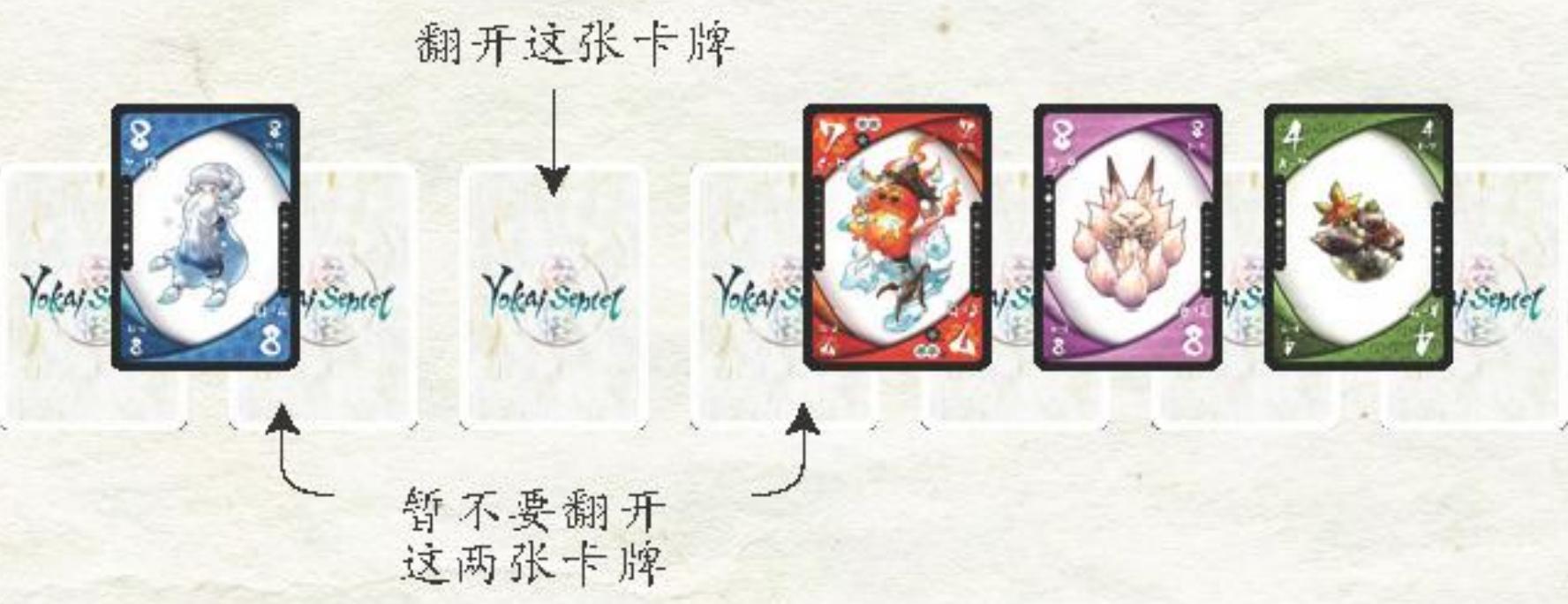
将49张卡牌洗混。先背面朝上发给每位玩家7张牌,再正面朝上发给每位玩家6张牌,置于之前的7张牌上面,如下图所示。这样的一套牌组被称之为稻草堆。

接着,背面朝上发给每位玩家11张牌,剩余的1张牌的花色被称为本轮游戏的主色。
最后,每位玩家从手中背面朝上丢弃一张卡牌。注意:你不能丢弃妖怪头目卡。被丢弃的这张卡牌在这轮游戏中将不会使用。
总结一下,你的手中将有10张卡,稻草堆将有13张卡。每位玩家不能查看稻草堆中背面朝上的卡牌。
每轮设置(续)
如果你的稻草堆正面朝上的6张卡牌中有妖怪头目卡,那么你可以选择其中1张妖怪头目卡,将它与其下面背面朝上的两张卡牌之一进行交换。在决定是否交换之前,不能查看下方的卡牌。也就是说,如果一旦查看了下方的一张卡牌,则必须要进行交换。如果这张背面朝上的卡牌也是妖怪头目卡,那你可以选择哪一张正面朝上,哪一张背面朝上。
发牌的玩家成为该轮第一墩的领袖玩家。在之后的每一轮里,玩家轮流担任第一墩的领袖玩家。
核心规则
该变体的核心规则和基础游戏完全相同,唯一的区别在于,稻草堆里正面朝上的卡牌也视为你的手牌。
也就是说,当你作为领袖玩家出牌时,你可以从手中的卡牌和稻草堆中正面朝上的卡牌中任选一张打出。当你跟牌时,你必须要打出领袖花色卡牌,除非你手中的牌和稻草堆中正面朝上的卡牌中都没有该花色。
对于稻草堆中背面朝上的卡牌而言,如果它上面所有的卡牌都已经被打出,则将该卡牌翻开。现在,这张卡也视为你的手牌。
吃下一墩
该变体的吃墩规则和基础游戏完全相同。吃下一墩的玩家成为下一墩的领袖玩家。
一轮结束
当游戏过程中满足下列条件任意一项时,一轮结束。
- 某位玩家共赢得4张或4张以上的妖怪头目卡时,该玩家赢得本轮游戏。
- 某位玩家共赢得13墩,其中妖怪头目卡却只有3张或3张以下时,则另一位玩家赢得本轮游戏。
- 所有玩家手上卡牌被打完时,赢得最后一墩的玩家赢得本轮游戏。
轮末计分
该变体的计分规则和四人基础游戏完全相同。详见基础规则书的第七部分《一轮结束:轮末计分》。
游戏结束
当某位玩家拿到7个或7个以上分数标记的时候,该玩家赢得整局游戏胜利!
特别感谢
该变体规则由Scan Ross设计。特别感谢Scan给本游戏加入了非合作的稻草人机制。
下载 MarkdownYokaiSeptet-Manual-EN_v1.md17.5 KB
demons known as Yokai were harming human lives. Yokai did not directly attack people, but they were causing supernatural disasters: Yokai caused farmlands to burn, rivers to flood, thunders to roar, and diseases to spread.
One day a chieftain of the nearby village visited you, an Onmyoji, a practitioner of Japanese esoteric cosmology. Through your knowledge of astronomy and occultism, you discover the only way to help save the village. It is simple: the more Yokai you manage to capture, the less the menace caused by these demons. After a few months in the village, you are successful in your efforts; the Yokai menace is completely eradicated in that village!
Then, word reaches you of the havoc being wrecked by the Yokai on your own village. In your absence, the village chieftain has consulted another Onmyoji to help save your village. This is an affront because this is your village and the people under attack are your people. It is your job to save the day!
Do not let another Onmyoji save the day and go down in history as the greatest there ever was and the Savior of your village at the time of need.
1. Game Overview
In Yokai Septet, your goal is to capture high scoring Boss Yokai by strategically playing cards from your hand. Each turn, players play a card from their hand following the rules of the "trick-taking games. (If you don't know what this means, don't worry. This is explained in more details later in the rulebook.)
After everyone has played a card, the player who played the strongest card matching the lead suit takes all the cards played this turn. A new turn continues until one of the round's end condition is met. At the end of the round, the winner of that round is determined.
In a 4-player game, the game is played as a team battle of two players versus two players, whereas in a 3-player game, all players play individually competing. The winner of the round is the team that captured four or more Boss Yokai in a 4-player game, and three or more Boss Yokai in a 3-player game. However, be careful on winning too many turns because you will lose the round if you win 7 turns before collecting the specified number of Boss Yokai!
The winner of the round scores points based on the Boss Yokai they captured. New rounds are played until the game's end condition is met, which can be either 2 points for a basic game, or 7 points for an advanced game.
2. Components
• 49 cards (7 suits - 7 cards each)
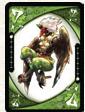
Front

Back
• 18 scoring tokens
• 4 player aids
• 1 lead player card
• 1 rulebook
3. Card Anatomy
• There are 7 suits (colors) with 7 cards in each suit.
• Each suit has different range of card values.

• The card with value [7] in each suit is a special card called Boss Yokai card.
• Boss Yokai card has point value icons next to the card value. This is used for "Advanced Scoring Rules" (see section 8 for details).
• Green suit has a special card with value [A] called the Super Trump card.
• All other cards are called Regular Yokai card.
Card value

Card value range

Range meter indicates the relative strength of the card within its-suit.
If the "dot" is at the top, then that card is the strongest card of its suit.


Point Value
NOTE: Green (Wind) Boss Yokai doesn't have a point value.

4. Before the Game
The game is for 3 to 4 players. In this rulebook, we will describe it as a 4-player game.
this. If you are playing with four, you can ignore them.
Before starting te game...
• Each player takes a Player Aid.
• The game is played as a team battle of two players versus two players. Randomly split up into two teams. The team members should sit across from each other, so that both of your opponents sit next to you.
3The game is played individually, instead of being played as a team battle.
5. Round Setup
Before starting each round...
• Shuffle all 49 cards face down and deal 12 cards face down to each player. Place the 1 remaining card face up at the center of the table visible to all players. This face up card is called the Trump Suit card.
• All players choose 3 cards and pass the chosen cards to your teammate at the same time.
食 Deal 16 cards face down to each player. Each player then passes 3 cards to the player to their left.
Now determine the Lead Player...
If this is the first round of the game:
• The lead player is the player who was dealt the [A] card. Reveal the [A] card and take the Lead Player card. If no player was dealt the [A] card, then the lead player is the player who was dealt the Blue [13] card. (Note: The lead player does not need to start the game by playing the revealed card. The player may put it back into their hand and use it later in the round.)
For all subsequent rounds:
• The lead player is the player with the Lead Player Card. In other words, the player who won the last trick in the previous round.
The round is now ready to begin!
6. Game Play Rules
Each round is divided up into multiple turns called "tricks" where each player will be playing a card from their hand.
• Starting with the player holding the Lead Player card (this player will be referred as the lead player) and going clockwise, each player plays 1 card face up from their hand.
• The lead player may play any card from their hand. The other players must play a card of the same suit as the lead player from their hand.
• If you do not have a card of the same suit as the lead player in your hand, then you may play any card from your hand.
After each player has played a card, the winner of the trick is determined.
Winner of a trick
The winner of a trick is determined in the following order...
1) If the [A] card was played, the player who played it is the winner.
2) If cards of the same suit as the Trump Suit card were played, then the player who played the highest value card among them is the winner.
3) Otherwise, the player who played the highest value card of the same suit as the lead player's card is the winner.

If you are the winner of a trick, do each of the following in order:
1) Take all cards played in this trick (four cards in a 4-player game, three cards in a 3-player game). If you took any Boss Yokai cards (cards with value [7]), then keep those cards face up in front of you. Keep the rest of the cards face down in front of you by creating a separate stack for each trick you win so everyone clearly sees how many tricks you have won in this round.
2) Take the Lead Player card.
3) Check if one of the "end of a round conditions" (see section 7) is met.
4) If the round did not end, then continue to the next trick. You are the lead player for the next trick.
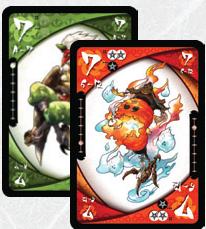
Keep Boss Yokai cards face up in front of you so everyone knows which cards you have taken.

For Regular Yokai cards, create a separate stack for each trick so everyone knows how many tricks you have won.
Examples
Here are some examples to show who wins each trick. The trump suit is Purple for this round.

Trump suit card
Trick 1

Barbara wins this trick since she played the highest card of the lead player's suit (Green). David does not win even though he played the highest card, because his card is not of the lead player's suit.
Trick 2

David wins this trick since he played the highest card of the trump suit (Purple).
Examples
Trick 3

Alice wins this trick since she played the [A] card, which beats every other card in the game. Although the [A] card is a special card, remember that you still need to follow the lead player's suit.
Trick 4

Alice wins this trick since no one else followed her suit, which means that her card is the highest card of the lead player's suit.
7. End of a Round
The round is over if any of the three conditions below has been met.
Condition 1: A team won a total of four or more Boss Yokai cards (cards with value [7]) between the two team members.
Condition 2: A team won a total of seven tricks between the two team members.
Condition 3: Players have no cards left in their hand.
If none of the conditions above has been met, then continue to the next trick (see Game Play Rules in section 6).
Winner of the round
Determine the winner of the round in the following order...
1) If a team won a total of four or more Boss Yokai cards, then that team is the winner.
2) Otherwise, if a team won a total of seven tricks, then the other team is the winner. The winning team takes all Boss Yokai cards left in everyone's hands, and adds them to the stack of Boss Yokai cards they won during the round.
3) If neither of the above happened, then the team with a player who won the last trick is the winner.
The round end conditins and winner f the round changes as follows:
1) If a player won three or more Boss Yokai cards, then that player is the winner.
2) If a player won seven tricks, then the other two players are the winner.
3) Otherwise, the player that won the last trick is the winner.
8. Score Calculation
Only the winner of the round scores points.
The winner scores points based on the scoring rules below.
• Play Basic Scoring Rules if this is your first time playing this game, or if players are new to "trick-taking games".
• Play Advanced Scoring Rules if all players are experienced in "trick-taking games".
Basic Scoring Rules
The winner scores 1 point. Take a scoring token from the supply. The game is over when a team has 2 scoring tokens. That team is the winner.
Otherwise, go back to Round Setup (see section 5) to start a new round.
Advanced Scoring Rules
To determine your score, look at all the Boss Yokai cards that you won in this round.
Each Boss Yokai card has 0 to 2. In a 4-player game, ignore★.
The winner scores 1 point for each except for the Boss Yokai card of the trump suit. You score 0 points for the Boss Yokai card of the trump suit.
Take scoring tokens from the supply equal to the number of points you scored this round.
| Suit | |
| Green | |
| Purple | |
| Pink | ★ |
| Yellow | ★ |
| Black | ★ |
| Red | ★☆ |
| Blue | ☆☆ |
The game is over when a team has 7 or more scoring tokens. That team is the winner.
Otherwise, go back to Round Setup (see section 5) to start a new round.

Advanced Scoring Examples
Example 1
Alice and Charlie are in a team, and Barbara and David are in the other team.
Alice and Charlie won two Boss Yokai each, so the round is over and they are the winner.
The Boss Yokai cards they won were Green [7], Yellow [7], Red [7], and Blue [7]. There is a total of five, but Red suit is the trump suit so they score 0 points for Red [7].
Therefore, the team scores a total of 3 points this round.
Boss Yokai cards that Alice won

No = 0 Points

Boss Yokai cards that Charlie won
Trump suit = 0 Points

Two = 2 Points
Total score = 3 points

Advanced Scoring Examples
Example 2
Alice and Charlie has won 3 tricks each. Charlie just won his 4th trick, so the team has now won a total of 7 tricks. The round is over and Barbara and David's team is the winner.
Barbara and David adds all Boss Yokai cards left in everyone's hands to the stack of Boss Yokai cards they've won during the round. They won Black [7], Purple [7], Yellow [7], Red [7] and Pink [7]. There is a total of five, but Yellow suit is the trump suit, so they score 4 points this round.
Alice won 3 tricks
Charlie won 4 tricks


Barbara and David scores Boss Yokai cards left in everyone's hands, in addition to the cards they won during the round.

Cards they won during the round
Cards left in players' hands
38. Score Calculation
Only the winner of the round scores points.
When playing with 3 players, there may be 2 winners in a round.
The player(s) who score this round changes depending on how the round ended.
Basic Scoring Rules
1) If the round ended because a player won seven tricks, then the other two players each score 1 point.
2) Otherwise, the winner scores 1 point.
Players take scoring tokens from the supply to indicate their points they scored.
The game is over when a player has 2 scoring tokens. That player is the winner.
If there are two players with 2 scoring tokens, then the winner is the left player of the player who won seven tricks in the last round.
If no player has 2 scoring tokens, then go back to Round Setup (see section 5) to start a new round.
Advanced Scoring Rules
1) If the round ended because a player won seven tricks, then the other two players each score 3 points.
2) Otherwise, the winner scores 1 point for each and on the Boss Yokai cards he/she took this round, except for the Boss Yokai card of the trump suit. You score 0 points for the Boss Yokai card of the trump suit.
Players take scoring tokens from the supply to indicate their points they scored.
The game is over if a player has 7 or more scoring tokens. That player with the most scoring tokens is the winner.
If two players are tied for the most scoring tokens, then the winner is the left player of the player who won seven tricks in the last round.
| Suit | |
| Green | |
| Purple | ★ |
| Pink | ★ |
| Yellow | ★★ |
| Black | ★☆ |
| Red | ★★☆★ |
| Blue | ★★★ |
If no player has 7 or more scoring tokens, then go back to Round Setup (see section 5) to start a new round.
Words from the designer
Yokai Septet is based on a game previously released in Japan in Spring 2015. It is still being played in Japan as one of the gateway game to the trick-taking genre.
My goal with Yokai Septet was to add more strategical "advanced" rules to a simple yet thrilling game play. I hope that this becomes one of the classic trick-taking game.

Game Designer: Muneyuki Yokouchi Developer: Yirli'kumde, Ayatsurare Ningyoukan
Illustrator: U
Graphic Design: Tori Hasegawa, Satsuki Nakayama
Art Direction: Fukutarou
Publisher: Dan Kobayashi
Special thanks to all our play testers and Kickstarter backers.
Rochelle Mantanona, yannick citharel, Gael Stevenson, Shingo Ishikawa, William Suzuki, Mary Sutton, }, Tomoki Takeuchi, Nerep Cire, Masanobu, Hiko, Andrew V42B "Kyubey" Ma, 斉藤翔, Brandon Snyder and Joseph Williams, Doug Bass, Rod Holdsworth, tarokichi1030, Jeffrey Hellrung, ユ—サク, 林昭文, Diana Harris, Benjamin Bord, Chris Reimer, Chris Wray, Matt (TechGeek) Travis, Michael 'Esker' Burborough, Markus Nowak, Lara Ming Qi Reinartz, ちのまさる, Stéphane Henry, shyn, Toshiji Nagoshi, ひげ<まごろう, Azlunare, Rodolphe Peccatte, Lil' Boy, Mr Jan Silverudd, Denislav Mievski, Paul Lenkic, Daniel Garsia Rezza, Ian Hopkins, Brian W. Lenz, Timo 'Korttikuningas' Lindi, Ryosuke Tsutsui
Please check our website prior to playing the game for the most updated rules and errata.
Yirlikumde
下载 Markdown原文为社区整理/出版社公开资料,版权归原作者,仅供个人学习查阅。