
ZestreaZestrea
一句话概览
Zestrea 是一款已收录于村了吗规则库的桌游,支持 3–6 人,原名 Zestrea。
本页内容:一句话概览 · 常见问题
这游戏怎么玩
- 本站已收录这款游戏的规则资料,可以在对话里直接提问规则细节。
常见问题(FAQ)
以下 1 条问答中 0 条来自站内玩家的真实提问,其余 1 条为本站整理的常见疑问;答复内容保持原样。
Zestrea支持几个人玩?
3–6 人。
去哪查完整规则
想核对具体规则细节、卡牌效果或某个回合的结算方式,可以在村了吗里选中这款游戏后直接提问。
同类桌游
- 卡坦岛德式
- 工业革命:伯明翰德式
- 勃艮第城堡:特别典藏版德式
- 方舟动物园德式
- 卡卡颂抽象
- 瘟疫危机传承:第一季美式
- 阿瑞迪亚:勇踏征途美式
- 重塑宇宙德式
- 幽港迷城美式
- 埃多拉的德鲁伊德式
规则原文(Markdown)
本站收录这款游戏的规则原文 1 个文件,此处内联渲染 1 个,可直接展开阅读或下载。
Zestrea Manual EN.md14.6 KB
ZESTREA How To Play
Hard Times are coming...
Dear Distant Relative,
IAM LEAVING YOU MY ZESTRE AS INHERITANCE.
because I am dead. You are now the Boyar,
owner of the Estate, with the Land upon which your
villagers live. Take care of them, and may they bring you
prosperity! Because in lyfe, only one thing matters: that
WHICH YOU LEAVE BEHIND. BUT REMEMBER! AS I WRITE THIS NOW
IN MY OWN LAST HOUR. KNOW THAT FOR ALL THE FORTUNE I
have obtained, none of my subjects died of Hunger
while I was alive. So therefore watch out, do not provoke and
betray your neighbour Boyars, and only then you might
multiply your Wealth, with Marriages and Alliances. And, if true Hard Times shall be upon you, protect your villagers, and your coffers, for only they can bring you satisfaction!
May you enjoy good Fate, and a plentiful family!
Old Boyar Romanachi
Game Contents






80 Zestre and Land cards
84 villagers
(Lads and Maidens)
35 Fate cards
3 Good Times cards
14 Hard Times cards
6 Boyar cards
6-sided die
Instructions
Book
INTRODUCTION
Zestrea is a game about marriages and negotiations for 3-6 players. You take the role of Boyars, nobles from Romania. Each Boyar owns an Estate, and takes care of the villagers who live there and work the Land. The goal of the game is to have the most Zestre after the Hard Times have passed.

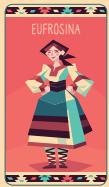
The villagers work the Boyar’s Land to produce Zestre, and they can also make babies (Lads and Maidens).


In Romanian, Zestre means Dowry, the Maiden’s wedding gift.
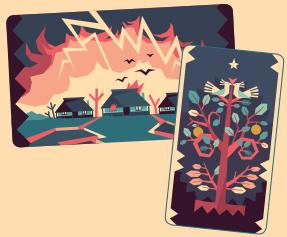
The village is about to be hit by Hard Times, and the villagers Fate is in the Boyar’s hands.
INTRODUCTION
Villagers eat food every turn, but only married Couples produce Zestre. Therefore, you can attempt to arrange marriages with villagers from other Boyars, in order to make them productive.




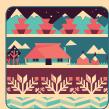


An Estate with two Couples, two Lads and a Maiden.
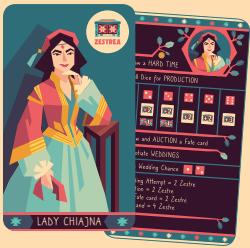
The game is played over several turns. Each turn is divided into 5 steps each, as seen on page 7, or on the Boyar cards.
SETUP
Every Player chooses a Boyar card to represent who they are in the game. You start the game with one married Couple (a Lad and Maiden on top of each other), and 3 Lands.
Next, extract 5 Hard Times at random from the box, and place them in a stack in the middle of the table, face down. Add the 3 numbered Good Times, in order, on top of the stack. For longer games, you can add one or two more Hard Times.
The other cards: place the Fate cards, villagers and Zestre in stacks next to the Hard Times. These stacks belong to the State.


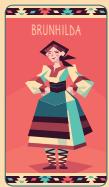
Boyar card
I. Hard Times (page 8)
Every turn, reveal a card from the Hard Times stack. Read it aloud and follow the instructions on it.
II. Production (page 8)
Boyars can choose to roll the die for any Couple that has a Land. They produce Zestre and babies.
III. Auction (page 9)
Reveal a Fate card from the State pile. The Boyars read and auction it for Zestre. The first Boyar who places the highest bid wins.
IV. Weddings and negotiations (page 10)
This step is the main part of Zestrea. Here, Boyars can negotiate, play Fate cards, attempt marriages, in any order they want. When all the Boyars are ready, they go to the Food step.
V. Food (page 13)
Boyars pay for the villagers’ Food.
I. Hard Times

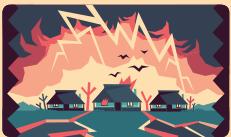
The first 3 turns are always Good Times (their order is written on the back) followed by 5 random Hard Time cards. The Good/ Hard Time card is revealed at the beginning of every turn, and the Boyars must follow the instructions on the card.
II. Production
Each Boyar has the option to roll the die once for every Couple that has a Land under their feet, or skip some Couples if they don’t want to roll for them. The Couples produce Zestre and babies, according to the Production Table (also found on the Boyar cards).
In the unlikely event that the State runs out of Zestre, you can flip the Zestre cards and count one Land in hand as 4 Zestre.

Production roll chart
II. Production
Place babies sideways, because you do not have to feed them for one turn and they cannot marry. Newborn babies grow up at the end of the turn, after the Food step. If you have 7 single villagers (babies or adults) you cannot make any more babies at Production.





Two Couples with Land, one without Land, a single Lad and two babies (Lad and Maiden).
III. Auction

Reveal one Fate card, read it out loud, and start bidding. If a Boyar bids one Zestre, any other Boyar can bid 2 or more to take it. The highest bid is paid to the State. The buyer can play the card immediately or keep it for later. If nobody wants it, discard it and continue. Keep in mind Fate cards can be bought for 2 Zestre, in the Weddings and Negotiations step. Read more about how to play Fate cards on page 12.


Boyars can try to marry two villagers of the opposite sex, from different Boyars only. Certain Fate cards allow same-sex marriages.
Wedding attempts cost 2 Zestre per die roll, payable to the State. The Boyars can decide, per attempt, if they pay one Zestre each, or one of them pays both Zestre.
After the Zestre is paid to the State, the Boyars roll the die, to see if the villagers want to get married. If the die roll is (1, 2) [one or two], the wedding is a success!
The Boyars cannot get their Zestre back after paying it. If the wedding fails, they can pay for another attempt, or give up.

After a successful wedding, the Maiden always goes to the Lad’s Estate to form a Couple. The Boyar who gave away the Maiden draws a Fate card.
For same-sex Couples you must decide in advance which Boyar gets the Couple. The other Boyar gets the Fate card.




The base wedding chance is (1, 2) [one or two], and it can be increased or decreased by Fate cards.
Wedding chances add up. For example, a Musician at the wedding would add (+1), therefore the die roll could be (1, 2, 3) [one, two or three] for a successful wedding. With two Musicians, (1, 2, 3, 4) and so on. Cards like the Evil Eye (-2) decrease the wedding chances.
In this step, the Boyars can also buy or play Fate cards, buy Land from the State, or adopt villagers from the State. They may also trade Fate cards with other Boyars, or give and receive gifts of Zestre or Fate (but not Land or villagers).
Wedding Attempt = 2 Zestre Adoption = 2 Zestre Buy Fate card = 2 Zestre Buy Land = 4 Zestre
IV. Weddings and Negotiations


Fate cards cost 2 Zestre each. They can be revealed to other players or kept secret, and they can be played once, anytime, in the Weddings and Negotiations step. After playing Fate cards, discard them in a pile, face-up.
Timing is important! If you want to play a Fate card that affects the chances of a wedding, you must do so before the Boyars roll the die!

All Fate cards have instructions on them.
Some Fate cards have an extra band under the title. These are Roles. They can be attached to any villager in the game, including other Boyars villagers. A villager can have multiple Roles, which stay attached for the villager’s life.
When the Fate cards in the pile run out, the game carries on without them. Discarded Fate cards must not be reshuffled.
A villager can be adopted from the State (never from other Boyars). Adoptions cost 2 Zestre and can take place anytime during the Weddings and Negotiations step. Adopted villagers are adult from the start, can get married right away and must be fed in the current turn.
Boyars can buy extra Land for 4 Zestre. You can only buy Land during the Weddings and Negotiations step. Land cannot be sold. You can only have maximum 5 Lands, and minimum one Land.
V. food
Each turn ends with Boyars paying for the villagers’ food.
The villagers (or Couples) with Land under their feet are considered fed. Then, the Couples with no Land eat a single unit of food each (one Zestre per Couple, paid to the State), and so does each single villager (one Zestre per single villager).
Babies born in the current turn do not have to eat, instead they grow up (turn their cards upright).

The first two Couples eat from the Land, the Couple and Lad are fed with 2 Zestre. The Zestre goes to the State.
V. food

In this example, the Boyar has no more Zestre and must feed the Maiden. They exchange one Land for one Zestre to pay for the Maiden’s food.
If a Boyar does not have enough Zestre to feed all their villagers, they are forced to lose as many plots of Land as they have villagers (or Couples) that did not eat. If there still are unfed villagers, they die of hunger.
As a rule, a Boyar cannot lose their last remaining Land.
Therefore, the last Couple of any Boyar can never be lost or separated.
Final Turn
In the final turn, after the last Hard Time card was drawn and
played, you cannot buy any more Fate cards. You can still play the
ones in your hand, or get them from weddings. After the final Food step, points are calculated as follows:
Count your remaining Zestre.

Flip your Land cards and count them as one Zestre each.

The Boyar with the most Couples gets +5 Zestre when counting the points. If there is a tie for the most Couples, nobody gets the +5 Zestre.
The Boyar with the most Zestre wins. Congratulations! In case of a draw, the Boyar with the most villagers on their domain wins.
For more Zestrea lore, guides and resources, funny stories from ourselves and our players, Alex’s Tinder profile, Romanian cocktail recipes, Maria’s art, doodles and fisksoppa, Horaţiu’s jazz bar in Copenhagen and Laura’s dragons - visit www.zestrea.net

The Hard Times have passed and everybody rejoices. Life goes on... but before long, the Hard Times will come again.
Thank you for playing!
www.zestrea.net

ZESTREA
Designed by
Horaţiu Roman and Alex Paţiu Art by Maria Surducan
Published by Laura Bularca

Valiant Game Studio AB Bellmansgatan 30, 11847 Stockholm, Sweden
下载 Markdown原文为社区整理/出版社公开资料,版权归原作者,仅供个人学习查阅。