惨剧轮回Tragedy Looper
一句话概览
惨剧轮回 是一款已收录于村了吗规则库的桌游,支持 2–4 人,原名 Tragedy Looper。
本页内容:一句话概览 · 游戏概述 · 1. 游戏组件 · 2. 游戏设置 · 3. 游戏流程 · 4. 行动牌详解 · 5. 标记说明 · 6. 情节、身份与事件 · 7. 多人变体规则 · 关键规则与常见问题 · 常见问题
惨剧轮回 规则速览
以下规则速览由本站整理,与官方规则书表述不同,仅供快速上手参考;其中 1 节为节选,完整内容可在村了吗查询。
游戏概述
在一座封闭的医院与小镇中,主人公拥有让时间回溯的能力,试图打破悲剧循环、创造幸福未来;主谋(剧作家)掌握全部信息,必须在每一次轮回中都令主人公失败。这是一个2–4人游戏:1名剧作家对抗1–3名主人公。核心流程为"打卡→结算→能力→事件"的每日循环,主人公通过多次轮回累积信息,最终或在某次轮回中存活到胜利条件不满足即可获胜,或在所有轮回结束后通过猜测每个身份的隐藏身份来翻盘。
核心机制: 同时出牌、信息不对称、多周目回溯推理、身份隐藏身份
1. 游戏组件
| 组件 | 说明 | |
|---|---|---|
| 游戏版图 | 5个区域:医院(左上)、神庙(右上)、市区(左下)、学校(右下),侧边数据面板(记录天数、轮回数、事件标记) | |
| NPC卡牌 | 最多18张人物卡,包含起始地区、不安上限/触发值、友好度阈值、属性、友好能力/被动能力 | |
| 主人公行动牌 | 含不安、友好度增减、禁止类、移动类卡牌(见第4节详表) | |
| 剧作家行动牌 | 含不安、密谋增减、禁止类、移动类卡牌(见第4节详表) | |
| 不安标记 | 代表人物的惊慌程度,由剧作家或主人公放置 | |
| 友好度标记 | 代表人物对主人公的信任程度,主要由主人公放置 | |
| 密谋标记 | 代表秘密与邪恶计划,仅剧作家可放置于人物或地区上 | |
| 轮回标记 | 放在数据面板,指示当前是第几次轮回 | |
| 日子标记 | 放在数据面板,指示当前是第几天 | |
| 事件标记 | 放在数据面板,标记当天已发生的事件 | |
| 队长卡牌 | 1张,决定每日内主人公首出的玩家,每日顺时针传递 | |
| 额外卡牌 | 4张,用于特殊剧本规则 |
2. 游戏设置
2.1 选择剧本
- 由剧作家从剧作家手册中选择剧本。首次游戏建议使用"第一剧本"(初级模式)。
- 主人公不能阅读剧本内容。 主人公只查看"公开卡",剧作家查看"秘密卡"。
公开卡显示: 剧本标题、情节列表、参与人物及其编号、轮回次数、每天数、特别规则。
秘密卡显示: 人物真实身份分配、每次事件的当事人、当前生效的主/次要情节。
2.2 版图与标记初始化
- 按方位放置四大场景区域:医院左上、神庙右上、市区左下、学校右下。
- 将数据面板置于侧边。
- 将轮回标记、事件标记放至剧本指定位置;日子标记放至第一天。
- 将队长卡牌交给合适的玩家(建议经验丰富的主人公)。
- 根据剧本要求,将所有参与NPC放置在其卡牌标注的起始地区,竖放表示存活。
2.3 桌面交流设定
- "关闭"模式: 主人公间除轮回之间的"时间裂缝"阶段外,禁止任何讨论,不得透露手牌信息。
- "开启"模式: 主人公可以自由讨论。
2.4 NPC生死判定
- 竖放 = 存活: 具有全部属性和能力。
- 横放 = 死亡(尸体): 不能使用任何能力,不具有属性,不再视为"人物",但原有友好度标记保留在卡牌上。存在个别身份可将尸体复活。
3. 游戏流程
3.1 胜利条件
| 玩家类型 | 胜利条件 |
|---|---|
| 主人公 | ① 未触发任何失败条件且无成员死亡;② 活过任意一次轮回的全部天数;③ 通过最终猜测(全轮回后进入) |
| 剧作家 | 在所有轮回中均使主人公触发失败条件或杀死主人公,且主人公未能通过最终猜测 |
失败条件因情节而异,详见第6节各情节条目。
3.2 轮回结构
一个剧本包含若干天(通常6–8天),每一天是一个完整回合。一个剧本包含若干轮回(通常3–4次),每次轮回结束后重置并回溯至第一天。
若主人公在任意轮回中获胜,剩余轮回跳过,直接获得游戏胜利。
3.3 新轮回准备
每次开始新轮回前,依次执行:
- 时间裂缝: 主人公讨论上轮信息与行动计划(限时5–10分钟)。主人公也可选择跳过剩余轮回,直接进入最终猜测阶段——此决定不可撤销。
- 清除标记: 移除人物卡和地区上的所有标记。
- 重置日期: 日子标记归零至第一天,轮回标记推进一格。
- 重置NPC: 所有参与人物放回起始地区,竖放存活。
- 取回手牌: 每位玩家收回该轮已使用的所有行动牌回到手中。
3.4 一日九步骤
每一天按以下顺序进行,由剧作家掌控流程:
| 步骤 | 时点 | 执行者 |
|---|---|---|
| 1 | 日子开始 – 早上 | 剧作家 |
| 2 | 剧作家打出3张暗置行动卡 | 剧作家 |
| 3 | 主人公各打出1张暗置行动卡 | 主人公(从队长起顺时针) |
| 4 | 结算卡牌效果 | 剧作家 |
| 5 | 剧作家能力 | 剧作家 |
| 6 | 队长使用友好能力 | 队长 + 剧作家 |
| 7 | 事件发生 | 剧作家 |
| 8 | 改变队长 | 主人公 |
| 9 | 日子结束 – 夜晚 | 剧作家 |
对主人公而言日常操作很简单:打出一张暗置行动卡,队长决定是否使用友好能力。
步骤1:日子开始
一些身份的能力在"日子开始"时点生效,剧作家可选择在此时使用这些能力。
步骤2:剧作家出牌
剧作家选择3张手牌,背面朝上放置在人物或地区上。同一地点只能放置1张剧作家卡牌。
步骤3:主人公出牌
从队长开始,顺时针方向,每位主人公各选1张手牌背面朝上放置。主人公之间不能在同一个地点放置卡牌(但可以与剧作家已放置卡牌的地点重叠)。
步骤4:结算卡牌效果
剧作家同时展示全部6张卡牌并结算。结算优先级:
- 禁止移动 → 最优先
- 移动类组合(上下+左右=对角;对角+左右=上下;对角+上下=左右)
- 其他卡牌效果
相同效果的移动卡不会互相抵消。结算后卡牌返还对应持有者手牌。标有"每个轮回仅限一次"的卡牌改为正面朝放于该玩家面前,本轮回内不可再次使用。
步骤5:剧作家能力
剧作家可使用任意可用的身份能力(一个身份可能有多个能力,可全部使用)。剧作家只需声明结果,不得透露哪个人物引发了效果或背后的身份身份。
步骤6:队长使用友好能力
队长大声宣布使用哪个身份、哪个能力。由剧作家结算——某些身份可能拒绝或被无效,此时剧作家声明"无事发生"。使用友好能力不会消耗友好度标记(即使被拒绝)。
限制:
- 每次日限使用一次
- 部分身份标有"每轮回仅限一次"
- 需达到该能力的友好度阈值
步骤7:事件发生
检查当天日程表是否有事件。若没有则跳过。若有,剧作家检查:
1. 当事人是否存活?
2. 当事人是否达到不安上限(已恐慌/惊慌)?
两项均满足则事件触发;否则剧作家声明"无事件发生"。即使事件需要额外条件(如医院密谋标记数量)而未满足,剧作家也需声称"事件发生了"但无事发生——这是必要的掩眼法。
步骤8:改变队长
队长卡牌传递给左手边的主人公玩家。
步骤9:日子结束
一些身份的能力在"日子结束"时点生效,剧作家在此时使用。若非轮回最后一天,日子标记推进至下一天,重新开始步骤1。若为轮回最后一天,进入轮回结束判定。
3.5 轮回结束判定
满足以下任一条件时轮回结束:
- 已走完最后一天的所有步骤
- 主人公被杀死
- 剧本的特殊规则触发
剧作家首先检查所有失败条件:
- 无失败条件被触发 → 主人公获胜
- 有失败条件被触发:若非最后轮回,回溯至步骤3.3准备新轮回;若是最后轮回,主人公失败,进入最终猜测。
3.6 最终猜测
在所有轮回均告失败后,主人公仍有一次翻盘机会:
- 重置版图: 清除所有标记,NPC回到起始地区竖放存活。
- 逐一猜测身份: 主人公团队讨论后,剧作家逐一揭晓每人身份的猜测。猜错即败,全部猜对则主人公胜利。
4. 行动牌详解
4.1 卡牌叠加与结算规则
当多张卡牌放置在同一目标上时同时结算。主要互动:
| 组合 | 结算结果 |
|---|---|
| 不安+1 + 不安-1 | +1先结算,-1再结算(净效果取决于数量) |
| 友好度+1 + 不安-1 | +1先结算 |
| 禁止密谋 + 密谋+1/2 | 禁止密谋生效,密谋无效(仅当天唯一一张禁止密谋时) |
| 禁止妄想 + 不安±1 | 禁止妄想生效,相关效果无效 |
| 禁止友好 + 友好度±1 | 禁止友好生效,相关效果无效 |
| 禁止移动 + 移动类 | 禁止移动生效,移动无效 |
| 两张及以上同一天禁止密谋 | 所有禁止密谋互相抵消 |
| 移动-上下 + 移动-左右 | 构成对角移动 |
| 移动-上下 + 对角移动 | 构成左右移动 |
| 移动-左右 + 对角移动 | 构成上下移动 |
将卡牌放在地区上(而非人物上)通常无事发生,可作为伪装手段迷惑对手。
4.2 主人公卡牌
| 卡牌名称 | 效果 |
|---|---|
| 不安+1 | 在人物上放置1个不安标记。与禁止卡一起放置时无效 |
| 不安-1 | <每轮回仅限一次> 移除人物上1个不安标记。与其他移动/放置卡同放时无效 |
| 友好度+1 | 在人物上放置1个友好度标记。与禁止卡一起放置时无效 |
| 友好度+2 | <每轮回仅限一次> 在人物上放置2个友好度标记 |
| 禁止密谋 | 抵消密谋+1/+2。若同日出现≥2张禁止密谋则互相抵消 |
| 移动-上下 | 向上或向下移动人物 |
| 移动-左右 | 向左或向右移动人物 |
| 禁止移动 | <每轮回仅限一次> 抵消一张移动卡 |
4.3 剧作家卡牌
| 卡牌名称 | 效果 |
|---|---|
| 不安+1 | 在人物上放置1个不安标记(剧作家有2张) |
| 不安-1 | 移除人物上1个不安标记 |
| 禁止妄想 | 抵消不安+1/-1 |
| 禁止友好 | 抵消友好度+1/-1 |
| 密谋+1 | 在人或地区放置1个密谋标记 |
| 密谋+2 | <每轮回仅限一次> 放置2个密谋标记 |
| 移动-上下 | 向上或向下移动人物 |
| 移动-左右 | 向左或向右移动人物 |
| 移动-对角 | <每轮回仅限一次> 对角移动人物 |
4.4 剧作家额外限制
- 剧作家每天仅能放置3张行动牌。
- 同一地区或人物上不能放置超过1张剧作家卡牌。
5. 标记说明
5.1 不安
- 由剧作家和主人公都可放置。
- 当人物身上的不安达到卡牌标注的上限时,该人物进入恐慌状态,可被事件利用。
- 不同身份有不同的不安阈值(标注在卡牌顶部)。
5.2 友好度
- 主要由主人公放置。
- 达到一定数值后解锁该人物的友好能力。
- 使用友好能力不会移除友好度标记。
- 某些身份的被动能力会改变友好度(如亲友身份)。
5.3 密谋
- 仅剧作家可放置。
- 可导致多种失败条件和事件。
- 密谋可放置于人物卡牌或地区上。
6. 情节、身份与事件
6.1 悲剧模式
游戏有两种悲剧模式,决定了可选的情节、身份和事件范围:
| 模式 | 主情节 | 次要情节 | 身份 | 事件 |
|---|---|---|---|---|
| 初级悲剧 | 3个 | 1个 | 8个 | 7个 |
| 基本悲剧 | 5个 | 7个 | 12个 | 9个 |
初级模式修正: 无最终猜测阶段;仅1个次要情节。
6.2 主情节
主情节确定核心失败条件和必入身份。
谋杀计划
- 加入身份: 关键人物、主谋、杀手
- 情节规则: 无额外规则
泼仇的火种
- 加入身份: 主谋
- 情节规则: 轮回结束时,如果主谋的起始地区有≥2个密谋标记,主人公失败。
和我签订契约吧!
- 加入身份: 关键人物(必须为女性)
- 情节规则: 轮回结束时,如果关键人物身上有≥2个密谋标记,主人公失败。
被封印的邪灵
- 加入身份: 主谋、邪教徒
- 情节规则: 轮回结束时,如果神庙中有≥2个密谋标记,主人公失败。
巨大定时炸弹X
- 加入身份: 魔女
- 情节规则: 轮回结束时,如果巫女的起始地区有≥2个密谋标记,主人公失败。
守护此地
- 加入身份: 邪教徒(同上章节)
- 情节规则: 无额外规则
改变未来
- 加入身份: 邪教徒、时间旅者
- 情节规则: 轮回结束时,如果本轮回发生过"蝴蝶效应"事件,主人公失败。
6.3 次要情节
次要情节提供背景和部分额外规则/身份。
好友圈
- 加入身份: 2个亲友、传谣人
- 情节规则: 无
恋爱风景线
- 加入身份: 心上人、求爱者
- 情节规则: 无
暗影杀手
- 加入身份: 传谣人、杀人狂
- 情节规则: 无
令人惊骇的剧本
- 加入身份: 传谣人、亲友、0–2个暴徒
- 情节规则: 无
流言四起
- 加入身份: 传谣人
- 情节规则: <每轮回仅限一次> 剧作家可选择为任意一个地区增加1个密谋。
妄想扩大病毒
- 加入身份: 传谣人
- 情节规则: 凡是不安超过3点的人物全部转变为"杀人狂"。
未知因子X
- 加入身份: 不安定因子
- 情节规则: 无
因果线
- 加入身份: 无
- 情节规则: 轮回开始时,任何身上有友好度标记的人物均获得2个不安标记。
6.4 身份一览
关键人物
- 最大数量: 无限制
- 特殊反应: 无
- 能力: [强制][任何时候] 此身份死亡时,主人公立即失败,轮回立刻结束。
- 出现情节: 谋杀计划、和我签订契约吧!
杀手
- 最大数量: 无限制
- 特殊反应: 可选择拒绝使用友好能力
- 能力: [可选][日子结束] 若关键人物有≥2个密谋且与该身份在同一地区,杀死关键人物。[可选][日子结束] 若该身份有≥4个密谋,杀死主人公。
- 出现情节: 谋杀计划
主谋
- 最大数量: 无限制
- 特殊反应: 可选择拒绝使用友好能力
- 能力: [可选][剧作家能力] 在该身份所在地区或同区域的任一人物身上放置1个密谋。
- 出现情节: 谋杀计划、被封印的邪灵
邪教徒
- 最大数量: 无限制
- 特殊反应: 强制性拒绝使用友好能力
- 能力: [可选][结算卡牌效果] 可使与该身份同一地区的任何"禁止密谋"卡牌无效。
- 出现情节: 守护此地、改变未来
亲友
- 最大数量: 2
- 特殊反应: 无
- 能力: [强制][轮回结束] 此身份死亡时,展示该身份是谁,主人公失败。[强制][轮回开始] 若身份已被暴露身份,该人物获得1个友好度。
- 出现情节: 好友圈、潜伏的杀人狂
传谣人
- 最大数量: 1
- 特殊反应: 可选择拒绝使用友好能力
- 能力: [可选][剧作家能力] 在该身份所在地区的任一人物身上放置1个不安。
- 出现情节: 好友圈、流言四起、妄想扩大病毒
杀人狂
- 最大数量: 无限制
- 特殊反应: 无
- 能力: [强制][日子结束] 若杀人狂所在地区只有另一个人物,杀死那个人;若该地区另有1个生存人物且至少有1具尸体,同样杀死那个生存人物。
- 出现情节: 暗影杀手、潜伏的杀人狂、妄想扩大病毒
暴徒
- 最大数量: 无限制
- 特殊反应: 可选择拒绝使用友好能力
- 能力: 无
- 出现情节: 令人惊骇的剧本
时间旅者
- 最大数量: 无限制
- 特殊反应: 无
- 能力: [强制][任何时候] 此身份不能死亡。[强制][结算卡牌效果] "禁止友好"对该身份无效。[可选][最后一天结束时] 若该身份有≤2个友好度,可声明主人公失败(轮回结束)。
- 出现情节: 改变未来
不安定因子
- 最大数量: 无限制
- 特殊反应: 可选择拒绝使用友好能力
- 能力: [强制] 若学校有≥2个密谋,获得传谣人的能力。[强制] 若市区有≥2个密谋,获得关键人物的能力。
- 出现情节: 未知因子X
心上人
- 最大数量: 无限制
- 特殊反应: 无
- 能力: [强制][任何时候] 若求爱者死亡,获得6个不安。[可选][日子结束] 若有≥3个不安和1个密谋,可杀死主人公。
- 出现情节: 恋爱风景线
求爱者
- 最大数量: 无限制
- 特殊反应: 无
- 能力: [强制][任何时候] 若心上人死亡,获得6个不安。
- 出现情节: 恋爱风景线
魔女
- 最大数量: 无限制
- 特殊反应: 强制性拒绝使用友好能力
- 能力: 无
- 出现情节: 巨大定时炸弹X
6.5 事件一览
谋杀
与当事人在同一地区的1个人物死亡。
自杀
当事人本人自杀。
远距离杀人
1个最少有2个密谋标记的人物死亡。
不安扩散(初级)
移走任意人物2个友好度,然后在另一个人物上放置2个友好度。
传播
在任意人物身上放置2个不安,然后在另外一个人物身上放置1个密谋。
医院事故
若医院有≥1个密谋,所有在医院的人物死亡。若医院有≥2个密谋,主人公直接失败。
失踪
将当事人移至任意地区,然后在该地区放置1个密谋。
邪恶污染(基本)
在神庙放置2个密谋标记。
蝴蝶效应
在当事人所在地区的任意人物身上,放置你选择的标记(友好度/不安/密谋任选其一)。
7. 多人变体规则
7.1 2人游戏(1剧作家 + 1主人公)
- 主人公拥有3个不同的卡牌堆,每次可从每个卡牌堆各选1张放置到版图上。
- 由于单次出牌量增多,主人公有较大优势。例如主人公在同一天不会出现2张或以上禁止密谋卡导致互消的情况。
7.2 3人游戏(1剧作家 + 2主人公)
- 队长拥有2个不同的卡牌堆,每次从每个堆各选1张放置(共2张)。另一位主人公每次选1张。
- 传递队长卡牌时,队长同时将1个卡牌堆一并交给下一位玩家。
关键规则与常见问题
易错规则
- 卡牌同时结算,有明确优先级: 禁止移动 > 移动类组合 > 其他效果。
- 禁止密谋需唯一才生效: 同一天有两张或以上禁止密谋时全部抵消。
- 移动组合可以叠加反转: 上下+左右=对角,但对角+左右会反过来变回上下。
- 禁止卡放在地区上无效: 禁止卡只对同放的特定卡有效,放空地上不产生任何效果。
- 每个轮回限一次卡牌用完不回收: 标有"每个轮回仅限一次"的卡牌结算后留在玩家面前,本轮回不可再用。
- 主人公之间不能在同地出牌: 但不能与剧作家的重叠。
- 剧作家每天固定3张卡: 不多不少。
- 友好能力被拒绝也算使用过一次: 不影响次数计数和每日限制。
- 关键人物死亡=立即失败: 不论处于当日哪个阶段。
- 亲友身份死亡=立即失败: 且在轮回结束时暴露身份。
- 时间旅者不会死: 免疫所有致死效果。
- 邪教徒和魔女无法使用友好能力: 无论队长怎么尝试都无效。
- 初级模式无最终猜测: 所有轮回失败即输。
常见问题
- Q:同一地点可以放几张卡?
A:剧作家每天在同一地点最多1张;主人公之间互不重叠,但可与剧作家重叠。因此一个地点最多可以有"剧作家1张 + 3个主人公各1张 = 4张"。
- Q:把卡放在地区(空地)上有什么用?
A:本身不会产生效果,但可以作为障眼法迷惑对手,让他们以为你要针对该地点采取行动。
- Q:时间裂缝期间主人公能不能讨论战术细节?
A:可以,但建议控制在5–10分钟内。过度分析容易偏离重点。
- Q:剧作家可以说"是你杀的"吗?
A:不可以。剧作家应告知"有人死了"而非"XX杀的"。只有在主人公实际死亡时才告知死亡,不能暗示杀手身份。
- Q:规则书里的"心上人/求爱者"和模组纸的"心上人/求爱者"是什么关系?
……(完整内容可在村了吗查询)
常见问题(FAQ)
以下 5 条问答来自站内玩家的真实提问,答复由本站依据规则资料作答;答复内容保持原样,仅对提问做了去口语化的轻微整理。
我说剧作家的能力,就是主持的能力怎么触发?
你问的“剧作家/主持”其实就是规则书中的 Mastermind(主谋/黑幕),也就是主持游戏、暗中操控悲剧的那位玩家。规则书中没有叫“剧作家”的玩家能力,Mastermind 的能力全部来自当前剧本中的阴谋(Plots)、角色的秘密身份(Roles)或某些角色卡上可以供 Mastermind 使用的特殊能力。
下面回答 “主持的能力怎么触发”:
- 先看能力文字开头的方括号 [ ],那就是触发时机
每个 Mastermind 能用的能力,描述最前面都会有一个 [时机],例如:
[Day start]— 一天刚开始的“早晨”阶段触发(第4-1步)[Card resolve]— 卡牌结算过程中触发[Mastermind ability]— 在每天固定的“Mastermind能力阶段”触发(第4-5步)[Day end]— 一天结束的“夜晚”阶段触发(第4-9步)[Loop end]— 一轮循环结束时触发[Loop start]— 每轮循环开始时触发[Always]— 常驻效果,不需要主动“发动”,条件满足就一直生效
- 每天固定的“主持能力阶段”在哪一步?
规则书每天有9个步骤,其中专门有一个步骤是给 Mastermind 使用能力:
> 4-5 Mastermind abilities [Mastermind handles this]
> Here, the Mastermind can use role or plot abilities that have [Mastermind ability] timing. If several can be used, he can use them all.
> ——规则书 IV. Flow of One Loop 第4-5步
也就是说,只要一个能力标注的是 [Mastermind ability],它就在每天打完牌并结算完之后,由 Mastermind 在这一步主动宣布使用。
具体操作:
- Mastermind 先看有哪些角色/阴谋带有
[Mastermind ability]且满足条件; - 如果是 Optional(可选),Mastermind 可选择用或不用;
- 如果是 Mandatory(强制),条件满足时必须使用;
- 如果多个能力同时可用,强制能力先结算,然后可选能力由 Mastermind 自选顺序;
- Mastermind 只宣布结果,不能说出“是哪个角色/哪个能力触发的”。
- 举例
比如 Brain(头脑) 的能力:
……(完整内容可在村了吗查询)
主人公失败和主人公死亡什么意思?
在《惨剧轮回》中,“主人公失败”和“主人公死亡”是两个层级不同的概念:
- 主人公失败(Protagonists lose)
指的是整局游戏判定你输了。规则书中说得很直接:
> 如果主人公们在任意一个循环里同时满足两个条件:
> ① 没有触发当前阴谋的失败条件;
> ② 没有死亡;
> 那么主人公赢得游戏。
> 反之,只要一个循环内触发了失败条件或死亡,主人公就失败了。
> ——规则书「I. Victory Conditions(胜利条件)」
所以“失败”是最终结果,一个循环结束时由 Mastermind 判定。
失败的原因有两种大类:
- 满足当前阴谋的“失败条件”,例如:
- 主阴谋「复仇之光」:循环结束时 Brain 起始地点有至少 2 个 Intrigue,主人公失败。
- 子阴谋「友人的死」:Friend 死亡,循环结束时揭露角色并失败。
- 主人公死亡(下面说明)。
这种情况下,Mastermind 只会说“你们输了”,不会解释具体原因,也不代表角色们“死”了——只是故事走向了悲剧结局。
- 主人公死亡(Protagonists die)
指的是玩家所扮演的“主人公”作为角色直接被杀死。
规则书中单独有一段说明:
> 有些角色(例如杀手)拥有真正杀死主人公的能力。如果主人公死亡,Mastermind 只告诉他们“你们死了”(不要告诉他们是谁杀的),并且循环立即结束。
> ——规则书「A little delve into the details: about Protagonists kills(关于主人公被杀)」
关键点:
- 死亡是触发失败的直接途径,一旦发生,这一轮立刻失败,不必等到循环最后一天。
- 哪些情况会导致主人公死亡?最常见的例子是 Killer(杀手) 的能力:
> [可选] [夜晚] 如果这个角色身上有至少 4 个 Intrigue,你可以杀死主人公。
> ——规则书「First Steps — Roles / Killer」
以及 Loved One(恋人) 的能力:如果有至少 3 Paranoia 和 1 Intrigue,可杀死主人公。
还有某些事件(如「Hospital Incident」在医院有 2 Intrigue 时)也会杀死主人公。
- 主持人宣布“你们死了”时,不能说出凶手身份,但可以明确告诉玩家是死亡导致失败。
- 两者关系总结
……(完整内容可在村了吗查询)
好感度达到了之后两个技能都可以用吗还是只能用一个?
都用,不是只能选一个。具体规则如下:
- 主动的“好感度能力”(Goodwill abilities):满足条件就能全部使用
在每天步骤 4-6「领袖使用好感度能力」,规则书写明:
> 如果领袖想使用多个能力,他可以这样做,并按自己希望的顺序使用。如果一个角色拥有多个能力,他可以使用所有能力。不过,每个能力每天只能使用一次;有些能力每轮只能使用一次。
> ——规则书「IV. Flow of One Loop」步骤 4-6(片段25-27)
所以,当一个角色有两个或以上的主动好感度能力时,只要好感度计数都达到对应要求,当前领袖可以依次发动全部能力,而不是只选一个。
另外,使用好感度能力不会消耗好感度计数,所以不用担心用完一个后另一个就不能用了。
- 被动能力(Passive abilities)没有“选择”问题
被动能力写在角色卡的能力栏里,规则书说:
> 被动能力始终生效,不需要被激活。它们不是由主角“使用”的,而是由 Mastermind 结算。
> ——规则书「Anatomy of a character card」(片段7)
被动能力只要满足条件就会自动触发,不存在“用哪个”的选择。比如 Key Person 的“死亡即主角失败”就是始终在检查的。
- 也要注意“每轮一次”等限制
虽然可以都用,但仍要遵守能力标注的限制:
- 每个能力每天只能使用一次;
- 标注为“once per loop(每轮一次)”的能力,一轮内只能使用一次;
- 如果某个角色能力被隐藏身份的“好感拒绝(Goodwill Refusal)”拒绝,则这次使用仍算使用过,不能再用一次。
总结:好感度足够后,多个技能可以按任意顺序全部发动;被动技能则始终自动生效。 关键限制只是每个能力每天一次、有些每轮一次。
本内容仅供参考,如有冲突以说明书和身边大佬为准。
惨剧轮回,移动牌结算顺序是啥?
结论:同一阶段所有卡牌是同时展示的,但结算按固定先后次序进行。移动相关部分的顺序是:先结算「禁止移动」,再结算「移动牌」(移动-上下/左右/对角),之后才轮到其他禁止牌和其余行动牌。
完整结算顺序(卡牌效果同时展示后依次结算):
1. 禁止移动卡
2. 移动卡
3. 其他禁止卡(如禁止阴谋、禁止友好等)
4. 其余剩余的行动卡(妄想度、友好度、阴谋等)
移动牌之间的组合规则:
- 两张同方向的移动(如两张「移动-上下」或两张「移动-左右」)不会互相抵消,仍是该方向移动。
- 「移动-上下」+「移动-左右」→ 组合成对角移动。
- 「移动-上下」+「移动-对角」→ 组合成左右移动。
- 「移动-左右」+「移动-对角」→ 组合成上下移动。
- 移动牌若与「禁止移动」在一起,禁止移动生效,无事发生。
- 移动牌若放在地区上,无事发生(地区只受阴谋/禁止阴谋影响)。
其他相关细节:
- 「禁止」类卡牌只抵消同类行动卡的效果,不影响角色的友好能力,也不影响由角色、情节或事件效果赋予的能力。
- 当天的「禁止阴谋」若有两名或以上玩家同时使用(无论放在版图何处),则所有禁止阴谋卡互相抵消。
- 结算完毕后,卡牌回到各自拥有者手牌;标注「每个轮回仅限一次」的卡牌正面朝上放在拥有者面前,本轮回不可再用。
- 若多个强制能力同时触发,强制能力先于可选能力结算;多个可选能力冲突时由主谋自由决定顺序(此为能力结算部分,不属于卡牌结算顺序)。
本内容仅供参考,如有冲突以说明书和身边大佬为准。
轮回次数有多少?
《惨剧轮回》的轮回次数不是固定值,而是由每个剧本自己规定的,具体要看剧本卡上的第 6 项“Number of loops(轮回次数)”。
规则书依据
在「How to look at the script card(如何阅读剧本卡)」中写明:
> 6. Number of loops — The maximum number of times the Protagonists may loop (replay). It's usually 3 or 4.
> (第 6 项“轮回次数”:主角最多可以进行的循环次数,通常为 3 或 4。)
> ——规则书「II. Preparations - How to look at the script card」
在「III. Preparing the Loop」中也有对应说明:
> Each script has a set number of loops, which translates to play-throughs of the script. If the set limit of loops is 3, then the Protagonists can only play the script 3 times – which technically means they can rewind it twice.
> (每个剧本都有固定的轮回次数,即该剧本可以游玩的次数。如果限制为 3,那么主角最多只能游玩 3 次——严格说,他们可以回溯 2 次。)
> ——规则书「III. Preparing the Loop」
实际操作
- 开局时按照剧本卡把 Loop 标记放在指定的数字上。
- 每次轮回失败时,将 Loop 标记减 1,然后重置版图进入下一轮。
- 如果失败发生在最后一次轮回,则进入「最终猜测(Final Guess)」(但要注意:First Steps 剧套没有最终猜测,该规则在「First Steps - Major rule changes」中写明)。
所以具体“有多少次轮回”,你只需要看当前使用的剧本卡上写的数字即可,常见为 3 或 4 次。
本内容仅供参考,如有冲突以说明书和身边大佬为准。
去哪查完整规则
想核对具体规则细节、卡牌效果或某个回合的结算方式,可以在村了吗里选中这款游戏后直接提问。
同类桌游
打开网页版继续查 · 微信小程序搜「村了吗」
规则原文(Markdown)
本站收录这款游戏的规则原文 21 个文件,此处内联渲染 3 个,可直接展开阅读或下载。
rules_zh_惨剧轮回_1090.md80.7 KB
TRAGEDY LOOPER
【术语口径】(2026-10-21 按官方用语统一)
本文原为集石《非官方中文规则书》译本,现已按官方用语(摩点中文版 / 台版模组纸 / 社区《QA 至纯版》一致口径)统一:
旧译(本文曾用) 现用(官方) 说明 主谋(指玩家) 剧作家 控制悲剧的那位玩家;摩点简介原文「剧作家(类似DM的玩家)」 主角 / 主角们 主人公 玩家方的角色们 幕后黑手 主谋 一种角色身份,不是玩家;台版模组纸作「主謀」 脚本 剧本 集石扩展名亦称「剧本集」 阴谋(标记) 密谋 台版模组纸作「密謀」 角色(身份义) 身份 「身份上限」「猜所有人的身份」 罪犯 / 肇事者 当事人 引发该事件的那个角色 行动卡牌 行动牌 简称统一 朋友 亲友 模组纸「親友」(上限 2) 连环杀手 杀人狂 模组纸「殺人狂」 脾气暴躁的人 暴徒 模组纸「暴徒」 狂热者 邪教徒 模组纸「邪教徒」 女巫 魔女 模组纸「魔女」 增加的不安 不安扩散 模组纸「不安擴散」 医院事件 医院事故 模组纸「醫院事故」 遥远的谋杀 远距离杀人 模组纸「遠距離殺人」 失踪人口 失踪 模组纸「失蹤」 代理人 不安定因子 模组纸「不安定因子」(无视友好;学校≥2密谋→得传谣人能力,都市≥2密谋→得关键人物能力) 爱人 心上人 模组纸「心上人」(求爱者死亡时自身+6 不安) 情人 求爱者 模组纸「求愛者」 时间旅行者 时间旅者 模组纸「時間旅者」(不死) 未知的X代理人(情节) 未知因子X 模组纸「未知因子X/X異因子」 阴谋家 传谣人 模组纸「傳謠人」、社区 QA 同;能力=放 1 不安、上限 1 光之复仇者(情节) 泼仇的火种 主谋起始区域≥2 密谋即失败 杀手(情节) 开膛者的魔影 传谣人+杀人狂 不安的谣言(情节) 流言四起 传谣人;每轮回 1 次往版图放 1 密谋 最黑暗的剧本(情节) 最黑暗的剧本 传谣人+亲友+0-2 暴徒 记住我!(情节) 和我签订契约吧! 关键人物须少女属性;关键人物≥2 密谋 巨大时间炸弹(情节) 巨大定时炸弹X 魔女初始区域≥2 密谋 朋友圈(情节) 好友圈 2 亲友+传谣人 爱情故事(情节) 恋爱风景线 心上人+求爱者 隐藏的怪物(情节) 潜伏的杀人狂 亲友+杀人狂 妄想病毒(情节) 妄想扩大病毒 平民≥3 不安→身份变杀人狂 命运的威胁(情节) 因果线 轮回开始时上轮带友好者各放 2 不安 封印之物(情节) 被封印的邪灵 主谋+邪教徒;神社≥2 密谋 守护之地(情节) 守护此地 关键人物+邪教徒;学校≥2 密谋 暗影杀手(情节) 火药的味道 该情节只加入「杀人狂」;模组纸中唯一「只含杀人狂」的情节是 MC「火藥的味道」(不安总数≥12 即失败) 医院恐慌(旧译) 医院事故 英文 Hospital Incident;模组纸与社区 QA 一律写「醫院事故/医院事故」 (身份名)传谣人 → 现写作 传谣人 若官方简中对这个身份另有定名,请告知,我按官方改 保留「情节」一词(基础本的 main plot / sub-plot),模组纸里的「规则X/规则Y」即对应该情节体系,两者视为同义。

图注:Anime-style illustration of three anime characters in a dramatic scene with dramatic lighting and no visible text or symbols
玩家手册
HANDBOOK
本书已包含所有进行Tragedy Looper的必要游戏信息,同时对主人公和剧作家。

TO BEGIN WITH
欢迎来到Tragedy Looper, 一个进行时空轮回的桌面游戏. 一个剧作家会展开一个秘密的故事, 同时主人公要尝试揭开真相. 这是一个2-4人游戏,但规则是针对4人的: 3个主人公合力对抗一个剧作家. 2人和3人规则会在第41页中说明.
主人公的目标
你们的目标是跳出时空轮回以创造出幸福的未来。但你不知道谁是谁,事情会如何发展,甚至你根本不知道如何获胜!无论如何,你拥有时空轮回的能力,用来重复经历游戏中的故事场景几次!剧本是相同的;唯一的改变是你在游戏中将会逐步获得诸多的故事信息。而你只需在其中一次轮回中获胜即可!
剧作家的目标
你的目标是引发悲剧和享受你制造出来的不幸。你知道所有的信息,但你必须在每一次的轮回中都获胜。这意味着你要适应主人公不断增长的对剧本信息的认知。作为剧作家比主人公要复杂许多:你必须在大脑中牢记所有的情节和隐藏身份,以顺利的在游戏中进行你的计划。当主人公每一次轮回都失败了,胜利的滋味将会异常令人高兴!
对于新玩家
Tragedy Looper是一个你可以在不同等级获得趣味的内涵丰富的游戏。无论如何,虽然有许多不同选择,最初的几次游戏对于新手而言,依旧较难了解如何进行游戏。下面的指引就是针对那些从来没有玩过本游戏的新手。特别的,如果所有人都是新手,我们强烈建议你根据以下步骤进行游戏。

选择剧作家玩家
首先选择谁作为剧作家. 你必须选择一个有游戏主控经验的人来成为剧作家. 剧作家玩家必须阅读本手册和剧作家手册中的内容. 主人公也必须阅读本手册以了解如何进行游戏.

教导如何进行本游戏
最好由剧作家玩家来解释本游戏。游戏规则可在本手册中找到,但在剧作家手册中也有“游戏指南”,可用作教导其他人进行游戏。

从“初级”悲剧模式开始游戏
一个悲剧是由一系列的情节、隐藏身份和事件组成的。“初级”悲剧模式的框架在本手册之后将会列出,在剧作家手册中已有2个写好的剧本使用“初级”悲剧模式;第一个称之为第一剧本,建议用来指导剧作家如何开展剧本之用。使用它作为你的第一次游戏。

继续游戏使用“基本悲剧”模式。
一旦你已使用初级模式进行了数次游戏, 你已经准备好了开始进行基本的游戏, 使用 “基本悲剧” 模式包含了更多的情节、身份和事件. “基本悲剧” 模式的框架在本手册之后将会列出, 在剧作家手册中有8个写好的剧本使用 “基本悲剧” 模式.

COMPONENTS AND
GAME OVERVIEW
首先,我们会展示给大家看游戏进行的地方,如何布局,同时介绍游戏的版图、卡牌、标示物。
游戏版图 (5部分)
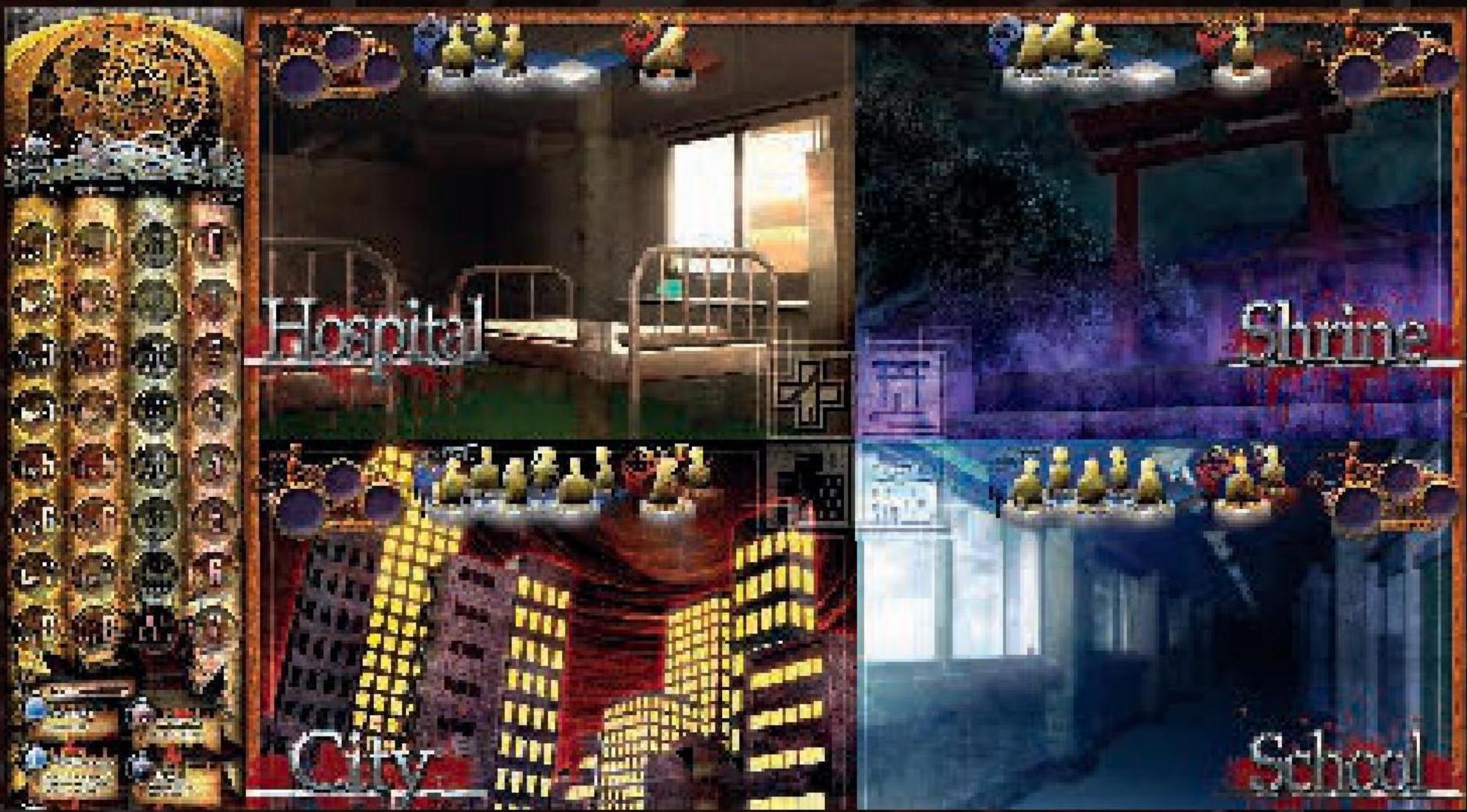
图注:Hospital | Shrine | City | School
游戏主要在医院、神庙、市区、学校 个场景中进行. 每一个地方就是版图中的一个区域,如上图所示.
这些地方就是所有事情发生的场所。主人公在这些场景中进行探索,但必须知道的是,主人公不会被任何的卡牌、棋子、标记所代表。
版图的第5区域只是数据板块. 它表示这是第几天, 什么时候发生了事件, 你已经进行了几次轮回.
在Tragedy Looper中,悲剧并不仅限于主人公。在故事中还有许多其他的重要人物。诸如学生、记者、巫女、艺人,上班族;总共可有18个不同的人物可能参与到剧本当中。

图注:4
每一个剧本都会标注有什么人物参与到游戏中,人物将由卡牌代表。
这些是全部的非玩家人物 (NPCs). 当你与他们达到足够的友好度时,他们有特殊能力可以帮助到你 (主人公). 举例而言,告密者会为你展示秘密信息。
无论如何,这并不是全部,包含在剧本中,很可能人物将有隐藏身份。他可能是引发悲剧的关键人物。或者,他可能是悲剧背后的主谋。他可能是一个杀人狂,一旦处于合适的谋杀场合时而无法控制自己。但在每一个剧本的最开始,主人公不知道各个人物隐藏了什么秘密。你必须经历故事本身,一次又一次进行轮回,根据获得的信息得到结论。

图注:2 | 2 | 3 | 英雄 | 英雄 | 英雄 | 英雄 | 英雄 | 1 | 2 | 3 | 4 | 5 | 5 | 5 | 5 | 5 | 5 | 5 | 5 | 5 | 5 | 5 | 5 | 5 | 5 | 5 | 5 | 5 | 5 | 5 | 5 | 5 | 5 | 5 | 5 | 5 | 5 | 5 | 5 | 5 | 5 | 5 | 5 | 5 | 5 | 5 | 5 | 5 | 5 | 5 | 5 | 5 | 5 | 5 | 5 | 5 | 5 | 5 | 5 | 5 | 5 | Shuohu Xueiden | Shuohu Xueiden | Shuohu Xueiden | Shuohu Xueiden | Shuohu Xueiden | Shuohu Xueiden | Shuohu Xueiden | Shuohu Xueiden | Shuohu Xueiden | Shuohu Xueiden | Shuohu Xueiden | Shuohu Xueiden | Shuohu Xueiden | ShuOH | ShuOH | ShuOH | ShuOH | ShuOH | ShuOH | ShuOH | ShuOH | ShuOH | ShuOH | ShuOH | ShuOH | ShuOH | ShuOH | ShuOH | ShuOH | ShuOH | ShuOH | ShuOH | ShuOH | ShuOH | ShuOH | ShuOH | ShuOH | ShuOH | ShuO | ShuO | ShuO | ShuO | ShuO | ShuO | ShuO | ShuO | ShuO | ShuO | ShuO | ShuO | ShuO | ShuO | ShuO | ShuO | ShuO | ShuO | ShuO | ShuO | ShuO | ShuO | ShuO | ShuO | ShuO | ShuOH | ShuOH | ShuOH | ShuOH | ShuOH | ShuOH | ShuOH | ShuOH | ShuOH | ShuOH | ShuOH | ShuOH | ShuOH | ShuOH | ShuOH | ShuOH | ShuOH | ShuOH | ShuOH | ShuOH | ShuOH | ShuOH | ShuOH | ShuOH | ShuOO | ShuOO | ShuOO | ShuOO | ShuOO | ShuOO | ShuOO | ShuOO | ShuOO | ShuOO | ShuOO | ShuOO | ShuOO | ShuOO | ShuOO | ShuOO | ShuOO | ShuOO | ShuOO | ShuOO | ShuOO | ShuOO | ShuOO | ShuOO | ShuOO | ShuO | ShuO | ShuO | ShuO | ShuO | ShuO | ShuO | ShuO | ShuO | ShuO | ShuO | ShuO | ShuO | ShuO | ShuO | ShuO | ShuO | ShuO | ShuO | ShuO | ShuO | ShuO | ShuO | ShuO | ShuOO | ShuOO | ShuOO | ShuOO | ShuOO | ShuOO | ShuOO | ShuOO | ShuOO | ShuOO | ShuOO | ShuOO | ShuOO | ShuOO | ShuOO | ShuOO | ShuOO | ShuOO | ShuOO | ShuOO | ShuOO | ShuOO | ShuOO | ShuOO | ShuOH | ShuOH | ShuOH | ShuOH | ShuOH | ShuOH | ShuOH | ShuOH | ShuOH | ShuOH | ShuOH | ShuOH | ShuOO | ShuOO | ShuOO | ShuOO | ShuOO | ShuOO | ShuOO | ShuOO | ShuOO | ShuOO | ShuOO | ShuOO | ShuO | ShuO | ShuO | ShuO | ShuO | ShuO | ShuO | ShuO | ShuO | ShuO | ShuOO | ShuOO | ShuOO | ShuOO | ShuOO | ShuOO | ShuOO | ShuOO | ShuOO | ShuOO | ShuOO | ShuOO | ShuOO | ShuOO | ShuO | ShuO | ShuO | ShuO | ShuO | ShuO | ShuO | ShuO | ShuO | ShuOO | ShuOO | ShuOO | ShuOO | ShuOO | ShuOO | ShuOO | ShuOO | ShuOO | ShuOO | ShuOO | ShuOO | ShuOO | ShuOO | ShuOO | ShuO | ShuO | ShuO | ShuO | ShuO | ShuO | ShuO | ShuO | ShuO | ShuOO | ShuO | ShuOO | ShuOO | ShuOO | ShuOO | ShuOO | ShuOO | ShuOO | ShuOO | ShuOO | ShuOO | ShuOO | ShuOO | ShuOO | ShuOO | ShuOO | ShuOO | ShuOO | ShuOO | ShuOO | ShuOO | ShuOO | ShuOO | ShuOO | ShuO | ShuOO | ShuOO | ShuOO | ShuOO | ShuOO | ShuOO | ShuOO | ShuOO | ShuOO | ShuOO | ShuOO | ShuOO | ShuOO | ShuOO | ShuOO | ShuOO | ShuOO | ShuOO | ShuOO | ShuOO | ShuOO | ShuOO | ShuO | ShuOO | ShuO | ShuOO | ShuOO | ShuOO | ShuOO | ShuOO | ShuOO | ShuOO | ShuOO | ShuOO | ShuOO | ShuOO | ShuOO | ShuOO | ShuOO | ShuOO | ShuOO | ShuOO | ShuOO | ShuOO | ShuOO | ShuOO | ShuO | ShuOO | ShuOO | ShuO | ShuOO | ShuOO | ShuOO | ShuOO | ShuOO | ShuOO | ShuOO | ShuOO | ShuOO | ShuOO | ShuOO | ShuOO | ShuOO | ShuOO | ShuOO | ShuOO | ShuOO | ShuOO | ShuOO | ShuOO | ShuOO | ShuO | ShuO | ShuO | ShuOO | ShuOO | ShuOO | ShuOO | ShuOO | ShuOO | ShuOO | ShuOO | ShuOO | ShuOO | ShuOO | ShuOO | ShuOO | ShuOO | ShuOO | ShuOO | ShuOO | ShuOO | ShuOO | ShuOO | ShuOO | ShuO | ShuOO | ShuO | ShuO | ShuOO | ShuOO | ShuOO | ShuOO | ShuOO | ShuOO | ShuOO | ShuOO | ShuOO | ShuOO | ShuOO | ShuOO | ShuOO | ShuOO | ShuOO | ShuOO | ShuOO | ShuOO | ShuOO | ShuOO | ShuOO | ShuOO | ShuO | ShuO | ShuOO | ShuOO | ShuOO | ShuOO | ShuOO | ShuOO | ShuOO | ShuOO | ShuOO | ShuOO | ShuOO | ShuOO | ShuOO | ShuOO | ShuOO | ShuOO | ShuOO | ShuOO | ShuOO | ShuOO | ShuOO | ShuO | ShuO | ShuOO | ShuO | ShuOO | ShuOO | ShuOO | ShuOO | ShuOO | ShuOO | ShuOO | ShuOO | ShuOO | ShuOO | ShuOO | ShuOO | ShuOO | ShuOO | ShuOO | ShuOO | ShuOO | ShuOO | ShuOO | ShuOO | ShuO | ShuOO | ShuOO | ShuOO | ShuO | ShuOO | ShuOO | ShuOO | ShuOO | ShuOO | ShuOO | ShuOO | ShuOO | ShuOO | ShuOO | ShuOO | ShuOO | ShuOO | ShuOO | ShuOO | ShuOO | ShuOO | ShuOO | ShuOO | ShuOO | ShuO | ShuOO | ShuO | ShuOO | ShuO | ShuOO | ShuOO | ShuOO | ShuOO | ShuOO | ShuOO | ShuOO | ShuOO | ShuOO | ShuOO | ShuOO | ShuOO | ShuOO | ShuOO | ShuOO | ShuOO | ShuOO | ShuOO | ShuOO | ShuOO | ShuO | ShuO | ShuOO | ShuOO | ShuO | ShuOO | ShuOO | ShuOO | ShuOO | ShuOO | ShuOO | ShuOO | ShuOO | ShuOO | ShuOO | ShuOO | ShuOO | ShuOO | ShuOO | ShuOO | ShuOO | ShuOO | ShuOO | ShuOO | ShuOO | ShuO | ShuO | ShuO | ShuOO | ShuO | ShuOO | ShuOO | ShuOO | ShuOO | ShuOO | ShuOO | ShuOO | ShuOO | ShuOO | ShuOO | ShuOO | ShuOO | ShuOO | ShuOO | ShuOO | ShuOO | ShuOO | ShuOO | ShuOO | ShuO | ShuOO | ShuOO | ShuOO | ShuOO | ShuO | ShuOO | ShuOO | ShuOO | ShuOO | ShuOO | ShuOO | ShuOO | ShuOO | ShuOO | ShuOO | ShuOO | ShuOO | ShuOO | ShuOO | ShuOO | ShuOO | ShuOO | ShuOO | ShuOO | ShuO | ShuOO | ShuOO | ShuO | ShuOO | ShuO | ShuOO | ShuOO | ShuOO | ShuOO | ShuOO | ShuOO | ShuOO | ShuOO | ShuOO | ShuOO | ShuOO | ShuOO | ShuOO | ShuOO | ShuOO | ShuOO | ShuOO | ShuOO | ShuOO | ShuO | ShuOO | ShuO | ShuOO | ShuOO | ShuO | ShuOO | ShuOO | ShuOO | ShuOO | ShuOO | ShuOO | ShuOO | ShuOO | ShuOO | ShuOO | ShuOO | ShuOO | ShuOO | ShuOO | ShuOO | ShuOO | ShuOO | ShuOO | ShuOO | ShuO | ShuOO | ShuO | ShuO | ShuOO | ShuO | ShuOO | ShuO | ShuOO | ShuO | ShuOO | ShuO | ShuOO | ShuO | ShuOO | ShuO | ShuOO | ShuO | ShuOO | ShuO | ShuOO | ShuO | ShuOO | ShuO | ShuOO | ShuO | ShuOO | ShuO | ShuOO | ShuOO | ShuOO | ShuOO | ShuOO | ShuOO | ShuOO | ShuOO | ShuOO | ShuOO | ShuOO | ShuOO | ShuOO | ShuOO | ShuOO | ShuOO | ShuOO | ShuOO | ShuO | ShuOO | ShuO | ShuOO | ShuO | ShuOO | ShuO | ShuOO | ShuO | ShuOO | ShuO | ShuOO | ShuO | ShuOO | ShuO | ShuOO | ShuO | ShuOO | ShuO | ShuOO | ShuO | ShuOO | ShuO | ShuO | ShuOO | ShuO | ShuOO | ShuO | ShuOO | ShuO | ShuOO | ShuO | ShuOO | ShuO | ShuOO | ShuO | ShuOO | ShuO | ShuOO | ShuO | ShuOO | ShuO | ShuOO | ShuOO | ShuOO | ShuOO | ShuOO | ShuO | ShuOO | ShuO | ShuOO | ShuO | ShuOO | ShuO | ShuOO | ShuO | ShuOO | ShuO | ShuOO | ShuO | ShuOO | ShuO | ShuOO | ShuO | ShuOO | ShuO | ShuO | ShuOO | ShuO | ShuOO | ShuOO | ShuOO | ShuOO | ShuOO | ShuOO | ShuOO | ShuOO | ShuOO | ShuOO | ShuOO | ShuOO | ShuOO | ShuOO | ShuOO | ShuOO | ShuOO | ShuOO | ShuOO | ShuO | ShuO | ShuOO | ShuO | ShuOO | ShuO | ShuOO | ShuO | ShuOO | ShuO | ShuOO | ShuO | ShuOO | ShuO | ShuOO | ShuO | ShuOO | ShuO | ShuOO | ShuO | ShuOO | ShuO | ShuOO | ShuOO | ShuOO | ShuO | ShuOO | ShuO | ShuOO | ShuO | ShuOO | ShuO | ShuOO | ShuO | ShuOO | ShuO | ShuOO | ShuO | ShuOO | ShuO | ShuOO | ShuO | ShuOO | ShuO | ShuOO | ShuO | ShuO | ShuOO | ShuOO | ShuOO | ShuOO | ShuOO | ShuOO | ShuOO | ShuOO | ShuOO | ShuOO | ShuOO | ShuOO | ShuOO | ShuOO | ShuOO | ShuOO | ShuOO | ShuOO | ShuOO | ShuO | ShuOO | ShuO | ShuOO | ShuO | ShuO | ShuOO | ShuO | ShuOO | ShuO | ShuOO | ShuO | ShuOO | ShuO | ShuOO | ShuO | ShuOO | ShuO | ShuOO | ShuO | ShuOO | ShuO | ShuOO | ShuOO | ShuOO | ShuOO | ShuOO | ShuOO | ShuOO | ShuO | ShuOO | ShuO | ShuOO | ShuO | ShuOO | ShuO | ShuOO | ShuO | ShuOO | ShuO | ShuOO | ShuO | ShuOO | ShuO | ShuOO | ShuO | ShuO | ShuOO | ShuO | ShuOO | ShuO | ShuOO | ShuOO | ShuOO | ShuOO | ShuOO | ShuOO | ShuOO | ShuOO | ShuOO | ShuOO | ShuOO | ShuOO | ShuOO | ShuOO | ShuOO | ShuOO | ShuOO | ShuOO | ShuOO | ShuO | ShuO | ShuO | ShuOO | ShuO | ShuO | ShuOO | ShuO | ShuOO | ShuO | ShuOO | ShuO | ShuOO | ShuO | ShuOO | ShuO | ShuOO | ShuO | ShuOO | ShuO | ShuOO | ShuO | ShuOO | ShuO | ShuOO | ShuO | ShuO | ShuOO | ShuO | ShuO | ShuOO | ShuO | ShuOO | ShuO | ShuOO | ShuO | ShuOO | ShuO | ShuOO | ShuO | ShuOO | ShuO | ShuOO | ShuO | ShuOO | ShuO | ShuOO | ShuO | ShuOO | ShuOO | ShuO | ShuOO | ShuO | ShuOO | ShuO | ShuOO | ShuO | ShuOO | ShuO | ShuOO | ShuO | ShuOO | ShuO | ShuOO | ShuO | ShuOO | ShuO | ShuOO | ShuO | ShuOO | ShuO | ShuOO | ShuOO | ShuO | ShuOO | ShuO | ShuO | ShuOO | ShuO | ShuOO | ShuO | ShuOO | ShuO | ShuOO | ShuO | ShuOO | ShuO | ShuOO | ShuO | ShuOO | ShuO | ShuOO | ShuO | ShuOO | ShuO | ShuO | ShuOO | ShuO | ShuOO | ShuO | ShuO | ShuOO | ShuO | ShuOO | ShuO | ShuOO | ShuO | ShuOO | ShuO | ShuOO | ShuO | ShuOO | ShuO | ShuOO | ShuO | ShuOO | ShuO | ShuOO | ShuO | ShuO | ShuO | ShuOO | ShuO | ShuOO | ShuO | ShuOO | ShuO | ShuOO | ShuO | ShuOO | ShuO | ShuOO | ShuO | ShuOO | ShuO | ShuOO | ShuO | ShuOO | ShuO | ShuOO | ShuO | ShuOO | ShuO | ShuO | ShuO | ShuOO | ShuO | ShuOO | ShuOO | ShuOO | ShuOO | ShuOO | ShuOO | ShuOO | ShuOO | ShuOO | ShuOO | ShuOO | ShuOO | ShuOO | ShuOO | ShuOO | ShuOO | ShuOO | ShuOO | ShuO | ShuOO | ShuO | ShuO | ShuOO | ShuO | ShuO | ShuOO | ShuO | ShuOO | ShuO | ShuOO | ShuO | ShuOO | ShuO | ShuOO | ShuO | ShuOO | ShuO | ShuOO | ShuO | ShuOO | ShuO | ShuO | ShuOO | ShuO | ShuOO | ShuO | ShuOO | ShuO | ShuO | ShuOO | ShuO | ShuOO | ShuO | ShuOO | ShuO | ShuOO | ShuO | ShuOO | ShuO | ShuOO | ShuO | ShuOO | ShuO | ShuOO | ShuO | ShuO | ShuOO | ShuO | ShuOO | ShuOO | ShuOO | ShuOO | ShuO | ShuOO | ShuO | ShuOO | ShuO | ShuOO | ShuO | ShuOO | ShuO | ShuOO | ShuO | ShuOO | ShuO | ShuOO | ShuO | ShuOO | ShuO | ShuOO | ShuO | ShuOO | ShuOO | ShuOO | ShuOO | ShuO | ShuOO | ShuO | ShuOO | ShuO | ShuOO | ShuO | ShuOO | ShuO | ShuOO | ShuO | ShuOO | ShuO | ShuOO | ShuO | ShuOO | ShuO | ShuO | ShuOO | ShuO | ShuO | ShuOO | ShuO | ShuO | ShuOO | ShuO | ShuOO | ShuO | ShuOO | ShuO | ShuOO | ShuO | ShuOO | ShuO | ShuOO | ShuO | ShuOO | ShuO | ShuOO | ShuO | ShuOO | ShuOO | ShuOO | ShuOO | ShuO | ShuOO | ShuO | ShuO | ShuOO | ShuO | ShuOO | ShuO | ShuOO | ShuO | ShuOO | ShuO | ShuOO | ShuO | ShuOO | ShuO | ShuOO | ShuO | ShuOO | ShuO | ShuO | ShuOO | ShuO | ShuO | ShuOO | ShuO | ShuOO | ShuOO | ShuOO | ShuOO | ShuOO | ShuOO | ShuOO | ShuOO | ShuOO | ShuOO | ShuOO | ShuOO | ShuOO | ShuOO | ShuOO | ShuOO | ShuOO | ShuOO | ShuO | ShuOO | ShuOO | ShuOO | ShuOO | ShuOO | ShuO | ShuOO | ShuOO | ShuOO | ShuOO | ShuOO | ShuOO | ShuOO | ShuOO | ShuOO | ShuOO | ShuOO | ShuOO | ShuOO | ShuOO | ShuOO | ShuOO | ShuOO | ShuOO | ShuO | ShuOO | ShuOO | ShuOO | ShuO | ShuOO | ShuO | ShuOO | ShuOO | ShuOO | ShuOO | ShuOO | ShuOO | ShuOO | ShuOO | ShuOO | ShuOO | ShuOO | ShuOO | ShuOO | ShuOO | ShuOO | ShuOO | ShuOO | ShuOO | ShuO | ShuOO | ShuOO | ShuO | ShuOO | ShuOO | ShuO | ShuOO | ShuOO | ShuOO | ShuOO | ShuOO | ShuOO | ShuOO | ShuOO | ShuOO | ShuOO | ShuOO | ShuOO | ShuOO | ShuOO | ShuOO | ShuOO | ShuOO | ShuOO | ShuO | ShuOO | ShuOO | ShuO | ShuO | ShuOO | ShuOO | ShuOO | ShuOO | ShuOO | ShuOO | ShuOO | ShuOO | ShuOO | ShuOO | ShuOO | ShuOO | ShuOO | ShuOO | ShuOO | ShuOO | ShuOO | ShuOO | ShuOO | ShuOO | ShuO | ShuOO | ShuOO | ShuO | ShuO | ShuOO | ShuO | ShuOO | ShuOO | ShuOO | ShuOO | ShuOO | ShuOO | ShuOO | ShuOO | ShuOO | ShuOO | ShuOO | ShuOO | ShuOO | ShuOO | ShuOO | ShuOO | ShuOO | ShuOO | ShuO | ShuO | ShuOO | ShuOO | ShuOO | ShuOO | ShuO | ShuOO | ShuOO | ShuOO | ShuOO | ShuOO | ShuOO | ShuOO | ShuOO | ShuOO | ShuOO | ShuOO | ShuOO | ShuOO | ShuOO | ShuOO | ShuOO | ShuOO | ShuOO | ShuO | ShuO | ShuOO | ShuOO | ShuO | ShuOO | ShuO | ShuOO | ShuOO | ShuOO | ShuOO | ShuOO | ShuOO | ShuOO | ShuOO | ShuOO | ShuOO | ShuOO | ShuOO | ShuOO | ShuOO | ShuOO | ShuOO | ShuOO | ShuOO | ShuO | ShuO | ShuOO | ShuO | ShuOO | ShuOO | ShuO | ShuOO | ShuOO | ShuOO | ShuOO | ShuOO | ShuOO | ShuOO | ShuOO | ShuOO | ShuOO | ShuOO | ShuOO | ShuOO | ShuOO | ShuOO | ShuOO | ShuOO | ShuOO | ShuO | ShuO | ShuOO | ShuO | ShuO | ShuOO | ShuO | ShuOO | ShuO | ShuOO | ShuO | ShuOO | ShuO | ShuOO | ShuO | ShuOO | ShuO | ShuOO | ShuO | ShuOO | ShuO | ShuOO | ShuO | ShuO | ShuOO | ShuOO | ShuOO | ShuOO | ShuO | ShuOO | ShuOO | ShuO | ShuOO | ShuOO | ShuOO | ShuOO | ShuOO | ShuOO | ShuOO | ShuOO | ShuOO | ShuOO | ShuOO | ShuOO | ShuOO | ShuOO | ShuOO | ShuOO | ShuO | ShuOO | ShuOO | ShuOO | ShuOO | ShuOO | ShuOO | ShuOO | ShuO | ShuOO | ShuOO | ShuOO | ShuOO | ShuOO | ShuOO | ShuOO | ShuOO | ShuOO | ShuOO | ShuOO | ShuOO | ShuOO | ShuOO | ShuOO | ShuOO | ShuO | ShuOO | ShuOO | ShuOO | ShuOO | ShuO | ShuOO | ShuOO | ShuO | ShuOO | ShuOO | ShuOO | ShuOO | ShuOO | ShuOO | ShuOO | ShuOO | ShuOO | ShuOO | ShuOO | ShuOO | ShuOO | ShuOO | ShuOO | ShuO | ShuOO | ShuOO | ShuOO | ShuOO | ShuOO | ShuOO | ShuOO | ShuOO | ShuO | ShuOO | ShuOO | ShuOO | ShuOO | ShuOO | ShuOO | ShuOO | ShuOO | ShuOO | ShuOO | ShuOO | ShuOO | Sh
1. 卡牌名称
- 不安限制
如果人物最少有这么多不安标记,他/她将会处于惊慌状态,并可能引发事件。
注意: 一个人物可以拥有比卡牌印制上更多的不安标记.
3. 地区
这表示着人物起始地区(白色). 同样会标注人物不可能进入的地区(打叉).
4. 属性
这是人物的属性. 一些规则和卡牌效果针对特定的人物属性.
5. 友好能力/被动能力
这些是人物能力, 通常会帮助到主人公. 如果该人物达到能力的友好度限制要求, 主人公可以使用该能力。使用能力并不
会引发友好度标记被移除. 一个被限定为每轮回仅限一次的能力,明显的仅仅限制于每一个轮回只可使用该能力一次.
在特殊情况下,剧作家玩家也可以使用友好能力,他与主人公拥有相同的限制。
被动能力总是生效,也不需要被激发。它们并不被主人公使用;代替的,将由剧作家进行结算。
一点细节探究
关于人物和尸体
一个人物是生或死,是由卡牌在版图上的摆放方式所表示的。一个生存的人物的卡牌竖放,而死亡的人物的卡牌则横放。一个死亡的人物是“尸体”且不能使用任何能力,没有任何属性,也不被视为一个人物,但任何原有的友好度标记继续停留在卡牌上。游戏中存在一个人物可以将尸体复活。

图注:ARIDAY | ARIDAY-ONE
生存

图注:Pixelated grayscale image of a person in a dimly lit setting with abstract background (no visible text or symbols)
死亡
我们已经了解了游戏版图和人物卡牌. 现在,下面将介绍玩家们在游戏中可以干什么. 我们将介绍游戏中的行动牌(玩家用来影响游戏中的人物).

图注:6
行动牌
(34 PCS)
玩家们,包括主人公和剧作家,在游戏中将使用行动牌放在人物或地区上。所有玩家背面朝上放置卡牌,当所有玩家放置好卡牌后,同时展示卡牌和进行结算。
主人公卡牌

图注:THE BIG CREAM | TRAGGUNG LUGO
剧作家卡牌

图注:Dark, low-contrast image of a person in a dark, glowing, figure-eight shape (no visible text or symbols)
所有卡牌都有不同卡背以标示哪个玩家使用什么卡牌。
每一个玩家都使用拥有相同卡背的卡牌库。

图注:MOVIMENT | 1 | +1 - x | x - x | MOVIMENT | 1 - x | x - x | MOVIMENT | 1 - x | x - x
移动卡牌
这些卡牌将令人物进行特定的移动.
图注:INTRIGUE | +1 | TRICUE | +2 | TURADO | TRICUE
密谋卡牌
这些象征着围绕人物和地区的秘密.
每一个情节都有不同的意义. 只有剧作家拥有这些卡牌; 主人公拥有禁止卡.

图注:GOONION | +1 | GOONION | +2 | GOONION | +2
友好卡牌
这些卡牌用来增加人物的友好度,用以达到使用友好能力的条件。主人公拥有这些卡牌;剧作家拥有禁止卡。

图注:PARANOIA | - I | PARANOIA | + I | PARANOIA | - I
妄想卡牌
这些用来增加人物的不安。用来让人物引发事件。
卡牌列表
这是主人公和剧作家使用的行动牌列表, 以及卡牌如何运作的细节说明. 如果在结算效果上产生争议请参考这里. “一起” 这里代表 “放置在同一个地区或人物上”.
主人公卡牌

图注:PARAMIN | +1! | 2015
不安 +1
放置一个不安标记在人物卡牌上.
如果与一张禁止卡一起,禁止卡发挥效用,无事发生。
如果与一张不安-1在一起, 则 +1 先发挥效用。
如果放置在地区上,无事发生。

图注:PARANANA | -
不安 -1
<每一个轮回仅限使用一次>
移除人物卡牌上的一个不安标记。
如果与一张禁止卡一起,禁止卡发挥效用,无事发生.
如果与一张不安+1在一起, 则 +1 先发挥效用。
如果放置在地区上,无事发生.

图注:GOLDWILL | + 1
友好度 +1
放置一个友好度标记在人物卡牌上.
如果与一张禁止卡一起,禁止卡发挥效用,无事发生.
如果与一张不安-1在一起, 则 +1 先发挥效用。
如果放置在地区上,无事发生.

图注:GOODWIK | +2!
友好度 +2
<每一个轮回仅限使用一次>
放置2个友好度标记在人物卡牌上。
如果与一张禁止卡一起,禁止卡发挥效用,无事发生。
如果与一张不安-1在一起, 则 +1 先发挥效用。
如果放置在地区上,无事发生.
图注:FORGID | INTRIGUE
禁止密谋
如果与密谋 +1 或 +2 在一起, 本卡发挥效用, 无事发生. 但是, 如果有 2 个或以上玩家同一天内使用了禁止密谋 (无论放置在版图何处), 所有禁止密谋卡互相抵消.

图注:MOVATION
移动-上下
该人物向上或向下移动.
如果与另一张移动-上下在一起,依旧是上下移动(他们不会互相抵消).
如果与移动-左右在一起,构成组合成为了对角移动。
如果与对角移动在一起,构成组合成为了左右移动。
如放置在地区上,无事发生。

图注:MOVATION
移动 - 左右
该人物向左或向右移动.
如果与另一张移动-左右在一起,依旧是左右移动(他们不会互相抵消).
如果与移动-上下在一起,构成组合成为了对角移动.
如果与对角移动在一起,构成组合成为了上下移动。
如放置在地区上,无事发生。

图注:FORBIO | MATEMENT
禁止移动
<每一轮回仅限一次>
如果与一张移动卡在一起,禁止移动发挥效用,无事发生。
剧作家卡牌
图注:PARAMOIS | +1
不安 +1
放置一个不安标记在人物卡牌上.
如果与一张不安-1在一起, 则 +1 先发挥效用。
如果放置在地区上,无事发生.
剧作家有2张该卡牌.
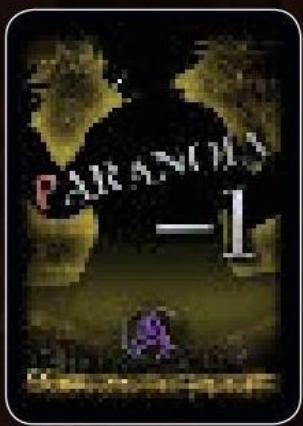
图注:PARANOL | -1
不安 -1
移除人物卡牌上的一个不安标记.
如果与一张不安+1在一起,则+1先发挥效用。
如果放置在地区上,无事发生.

图注:PARKO | PARKO
禁止妄想
如果与不安+1或-1在一起,禁止妄想发挥效用,无事发生.
如果放置在地区上,无事发生。

图注:FORRED | GONKWI
禁止友好
如果与友好度+1或-1在一起,禁止友好发挥效用,无事发生.
如果放置在地区上,无事发生.

图注:INTRIGUE | +1
密谋 +1
放置一个密谋标记在人物或地区卡牌上. 如果与禁止密谋在一起,而且当天只打出了唯一一张禁止密谋,则禁止密谋发挥效用,无事发生.

图注:INTRIGUE | +2
密谋 +2
<每一个轮回仅限一次>
放置2个密谋标记在人物或地区卡牌上. 如果与禁止密谋在一起,而且当天只打出了唯一一张禁止密谋,则禁止密谋发挥效用,无事发生.

图注:MORIQUA | 1 1 - 1 | 1 + - x | 1 x - 1
移动-上下
该人物向上或向下移动.
如果与禁止移动在一起,禁止移动发挥效用,无事发生。如果与另一张移动-上下在一起,依旧是上下移动(他们不会互相抵消).
如果与移动-左右在一起,构成组合成为了对角移动.
如果与对角移动在一起,构成组合成为了左右移动。如放置在地区上,无事发生。

图注:NATIONAL | -1 -1 -x | -1 x -1
移动 - 左右
该人物向左或向右移动.
如果与禁止移动在一起,禁止移动发挥效用,无事发生。如果与另一张移动-左右在一起,依旧是左右移动(他们不会互相抵消).
如果与移动-上下在一起,构成组合成为了对角移动.
如果与对角移动在一起,构成组合成为了上下移动。如放置在地区上,无事发生。
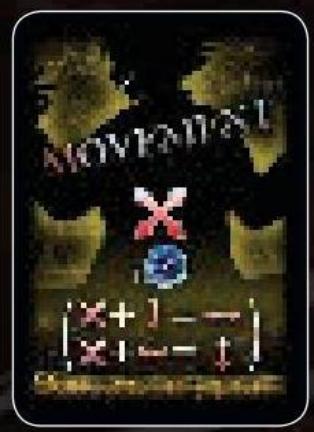
图注:NONFINAL | X | Y | X+1--+ | X+1--+1
移动 - 对角
<每一个轮回仅限一次>
人物可以进行对角移动.
如果与禁止移动在一起,禁止移动发挥效用,无事发生。
如果与移动-左右在一起,构成组合成为了上下移动。
如果与移动-上下在一起,构成组合成为了左右移动。
如放置在地区上,无事发生。
使用这些行动牌,你可以改变游戏版图上的状况。人物会在上面移动,他们的不安、友好度、密谋会发生改变。让我们简单的了解一下各种标记指示物。
标记 (118 PCS)
人物可以处于不同的情绪中. 他们可能对玩家们友好 (友好度), 或者达到足够的不安引发灾难. 在游戏中, 有3中标记指示物代表人物的不同情绪. 还有一些标记指示物让游戏可以更流畅的进行.

图注:Two circular images showing pink heart icons, one with a pixelated face and the other with a pixelated face (no text or symbols)
友好度标记
这些代表人物对主人公的友好度. 主要只是主人公来放置这些标记在人物卡牌上, 如果一个人物达到足够的友好度, 他的友好能力可以被使用.

图注:Two circular images showing purple pixelated patterns, one with a dark central shape and the other with a bright central shape (no text or symbols)
不安标记
这些代表人物有多惊慌。剧作家和主人公都可放置这些标记在人物卡牌上,一旦人物达到足够的不安,人物将处于惊慌状态,并可引发事件的发生。

图注:Two circular images showing food items, one with dark brown and green filling and the other with a white patterned outline (no visible text or symbols)
密谋标记
这些代表围绕着人物和地区的密谋、秘密。只有剧作家能够放置这些标记在人物或地区卡牌上。具体可以引发什么事情需要根据具体情节,但这些将引领主人公的失败。

轮回标记
这是用来标记现在游戏处于第几个轮回。它被放置在数据板块中。

日子标记
这是用来标记现在游戏处于第几天.
它被放置在数据板块中.

事件标记
这是用来标记游戏中某天发生了事件.
它被放置在数据板块中.

特别标记
这些标记用来标注一些剧本中的特别规则.

Boss势力标记
这个标记用来标注Boss的势力地区,作为他的一个能力.
最后,还有一些卡牌需要说明。

图注:Pixelated illustration of a person holding a book, surrounded by three children (no text or symbols visible)
队长卡牌 (1 pc)
这是用来标注主人公谁是队长。它被放置在玩家的正前方,每一轮,它将被交给左手边的主人公玩家。

图注:EXTRA | CARD
额外卡牌 (4 pcs)
这些用作一些剧本的特别规则使用.

GAME RULES
这一节讲述如何进行游戏的规则. 如果这是你第一次进行游戏, 我们强烈建议你看完本节内容.
一旦你感到对规则已熟知, 你可以改变剧本, 相应地改变情节.
Tragedy Looper原则上是一个简单的游戏, 但它有许多的情节、人物、身份需要熟悉, 特别是第一次, 在同一时间请不要介绍过多的内容.

胜利条件
针对不同玩家胜利条件不同:
主人公获胜
如果主人公做到以下2点:
- 不满足当前情节下的失败条件。
- 没有死亡
在任何一个轮回当中,他们获胜。
他们如果成功通过最终猜测,一样获得胜利 (见27页).
剧作家获胜
如果剧作家令到主人公失败 (无论是达到任何一个的失败条件或杀死他们) 在每一次轮回中, 他获得胜利, 除非主人公能够通过最终猜测.
“失败条件”根据具体情节而改变.
一点细节的探究
关于主人公的死亡
在游戏中有些身份, 举例而言, 杀手, 可以杀死主人公. 如果主人公死亡, 剧作家只是告诉他们, 他们死了 (并不告诉他们谁杀了他们) 然后轮回立刻结束.

准备
这是每一次游戏的开始设置.
2-1 选择剧本
建议你根据我们的游戏开始说明;并以标题为“第一剧本”来开始游戏。它使用初级悲剧模式,而不是基本悲剧模式,需要关注更少的事情。只有剧作家可以查看剧作家手册里面的剧本内容;它包含第一剧本的所有内容,根据提示来进行你的第一次游戏。
请注意主人公是不能阅读剧本内容的,这会破坏他们找出悲剧真相的乐趣。
2-2 展示剧本的信息
每一个剧本有2张卡牌; 它们有相同的数字在左上角. 主人公应该获得 “公开” 的一张, 在左边标注了 “主人公” 的卡牌. “秘密” 的一张仅限于剧作家可以查看, 并列出了人物是什么身份, 事件的当事人是谁, 以及当前生效的情节是什么.
2-3 构成游戏场景
首先,设置地区,它们需要按照第4页所示放置。医院在左上方,神庙在右上方,市区在左下方和学校在右下方.数据板块在侧面,根据剧本指示放置轮回标记、事件标记;并且根据剧本,将日子标记放置在第一天.
然后决定谁是队长,使用一个适合的方式。拥有更多游戏经验的成为队长会更佳。让该玩家获得队长卡牌。
2-4 设置桌面交流
这标示着玩家们是否可以互相讨论. 如果设置为 “关闭”, 玩家们将会被限制在游戏中不能进行交流讨论, 除了在轮回之间 (“时空裂缝”). 除非所有玩家同意, 否则不能告诉其他玩家拥有什么卡牌在手上.
如何查看剧本卡牌

图注:| Category | Column 1 | Column 2 | Column 3 | Column 4 | | | --- | --- | --- | --- | --- | | | Cast | X | X | X | X | | | Role | X | X | X | X | | | Day | X | X | X | X | | | Incident | X | X | X | X | | | Culprit | X | X | X | X |
秘密卡牌 - 仅限剧作家查看
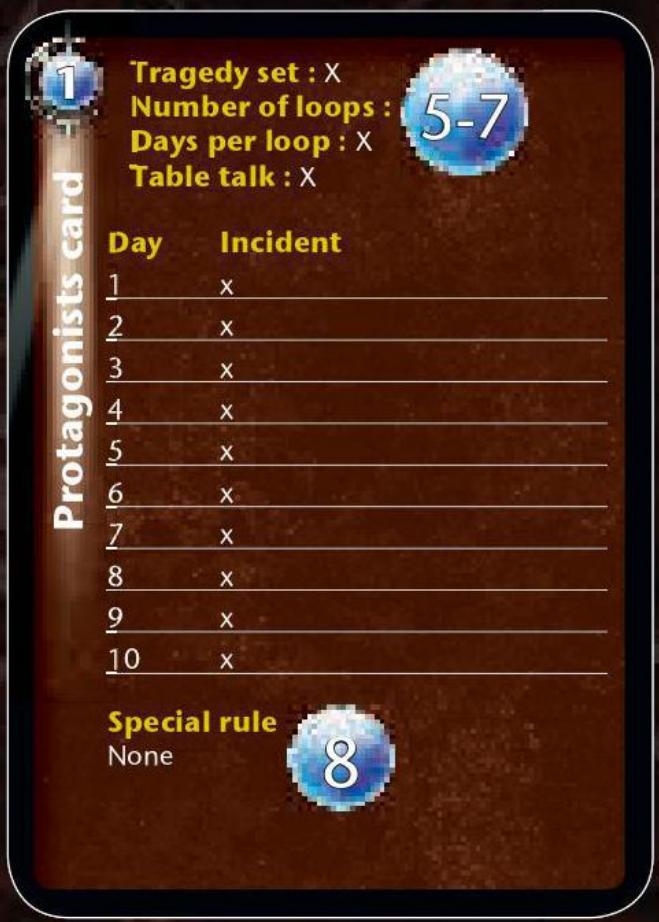
图注:1 Tragedy set : X | Number of loops : | Days per loop : X | Table talk : X | Day Incident | 1 X | 2 X | 3 X | 4 X | 5 X | 6 X | 7 X | 8 X | 9 X | 10 X | Special rule | None 8
公开卡牌 - 供主人公使用
1. 剧本标题
2. 主要情节和次要情节(s)
每一个剧本都包含一个主要情节和一个次要情节。
当使用基本悲剧模式,将有2个次要情节。
3. 人物和身份
剧本中包含哪些人物的列表, 以及他们分别是什么身份. 以括号包含的数字代表该人物在剧本中的哪个轮回出现.
4. 事件时间表和当事人
一个列表显示哪天可能发生什么事件,谁是该事件的当事人。没有人物可以作为2个事件的当事人。
【校注·例外】模组纸「連續殺人」事件明写「1 名角色可以同時擔任多個連續殺人事件的當事人」(MC / MZ 模组纸事件表)。属事件级覆盖:同一角色可担任多个「连续杀人」事件的当事人;与上文「剧本设计时每个事件指定不同当事人」的通则并存,具体以该事件文本为准。
5. 悲剧模式
使用了什么模式:
标示了哪些情节是可用的.
6. 轮回的次数
最大的轮回次数 (重复). 通常会是3或4.
7. 一个轮回有几天
一个轮回包含多少天 (回合). 通常会是6-8天.
8. 特别规则
如果剧本包含特别规则,会在这里标注.
一点细节探究
剧本有什么构成?
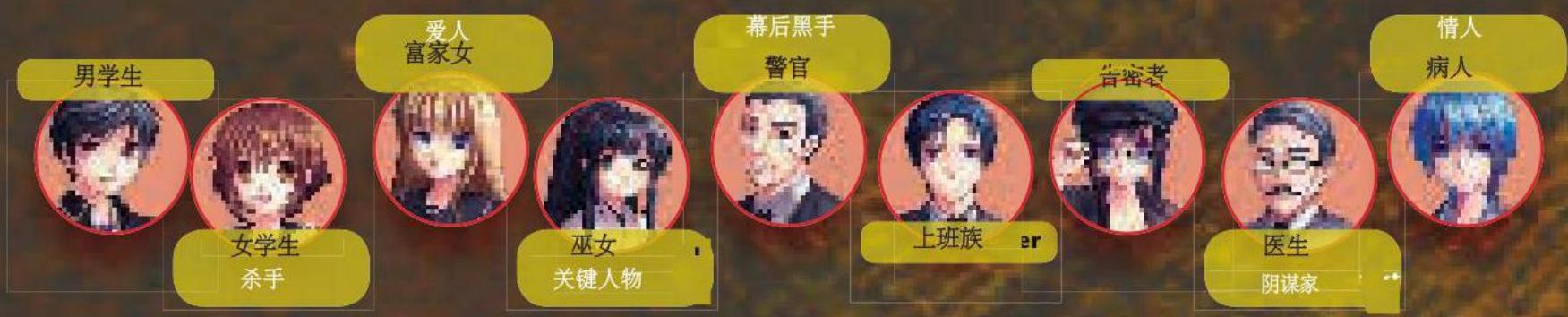
剧本包含一系列写好的情节,一些参与的人物和一些事件。情节确定了游戏中会有哪些身份和主人公的失败条件。根据你选择哪种悲剧模式将会有不同的可选情节(事件)。在本基础版游戏中有2种模式:初级悲剧模式将会有限制可选的情节和身份,而基本悲剧模式将会有更多选择。主人公总会知道现在是使用哪种模式,所以他们可知道现行游戏将有可能出现哪些情节和身份。
主情节: 谋杀计划
剧本的核心, 主要用来确定主人公的失败条件。
次要情节: 恋爱风景线
次要情节:流言四起
没有那么重要,主要用来确定剧本背景。
被选的人物的身份是根据情节而确定的.
图注:
mermaid | graph LR | A["男学生"] --> B["女学生\n杀手"] | B --> C["心上人\n富家女"] | C --> D["巫女\n关键人物"] | E["主谋\n警官"] --> F["上班族\ner"] | F --> G["告密者"] | H["医生\n传谣人"] --> I["病人"] | I --> J["求爱者"] |
确定事件和相应地当事人

图注:
mermaid | graph LR | A["第2日当事人"] --> B["杀手"] | B --> C["心上人"] | C --> D["第5日当事人\n关键人物"] | D --> E["主谋"] | E --> F["第7日当事人"] | F --> G["传谣人"] | G --> H["求爱者\n第4日当事人"] |
如何设计一个剧本
剧本设计者从可选范围内选择2个情节;且必须为一个主情节和一个次要情节.如果你使用基本悲剧模式,你需要选择2个次要情节.举例而言,剧本设计者可选择“谋杀计划”作为主情节,“恋爱风景线”和“流言四起”作为次要情节.
这些情节确定了有哪些身份存在于剧本当中。在我们的例子中,主情节,“谋杀计划”表明你需要一个关键人物、一个主谋和一个杀手存在于游戏的人物当中。而2个次要情节“恋爱风景线”和“流言四起”表明你还需要的身份包括:心上人、求爱者和传谣人。
然后剧本设计者需要确定有哪些人物,以及人物的隐藏身份分别是什么。在上图中可看到哪个人物被选为哪个身份。请注意没有人物能够有2个身份。没有身份的人物就简单的认为他的身份是“普通人”。
最后,为了让游戏更为有趣,剧本设计者需要设计事件发生的日程表。根据你使用的悲剧模式,从可选的事件列表中选择适当的事件,安排在不同的日子中,并确定事件的当事人是谁。任何人物(包括“普通人”和情节中的身份)都可以是事件的当事人,但注意的是没有人物能够成为2个事件的当事人。

轮回的准备
这是每一个轮回之前你要做得事情. 每一个剧本
都有数次的轮回, 令你可以重新经历该剧本的剧情。
如果轮回的限制为3, 这意味着主人公只能经历该剧本的剧情3
次- 技术上而言就是再度重来2次 (一些人会认为第一次进行剧本剧情被称为一个轮回是有争议的. 但必须安慰他们的是: 由于主人公一开始已经知道哪一天将可能发生事件, 那意味着他们已经是第一次轮回了.)
如果主人公在任何一次轮回中获胜,又或者在轮回结束时没有达到失败条件,剩余的轮回将不再进行;代替的是主人公获得了游戏的胜利。
新轮回之前, 你必须按照如下进行:
- 时间裂缝
- 移除和重置标记指示物
- 重置人物
- 取回所有行动牌
3-1 时间裂缝
“时间裂缝”是主人公讨论他们行动计划的阶段。如你们决定将桌面讨论设置为“关闭”,时间裂缝将会是主人公唯一可自由讨论的阶段。剧本越复杂,这里将会更耗时,但请不要太深入分析和追求涵盖所有事情;应该将本阶段限制为5分钟或10分钟。
这里,主人公也可决定跳过余下的所有轮回,直接去到最终猜测阶段。但是,一旦选择了直接进行最终猜测,将不再可重新轮回,所以只有当你们确定无误的知道了所有事实真相且想获胜的话才如此。
3-2 移除和重置标记指示物
将地区和卡牌上的所有标记指示物移除. 然后, 将游戏的起始标记指示物重置. 移动日子指示物到第一天, 移动轮回指示物到下一格.
3-3 重置人物
将所有参与的人物放置到他们的起始地区上. 每个人物都有一个确定好的起始地区,印制在卡牌上。
3-4 取回所有行动牌
每个玩家取回他行动牌堆的所有卡牌到手中.

进行一个轮回
本节会介绍一个轮回的进程.
剧本确定了每一个轮回有几天. 一天在游戏中就是一个回合, 每一个玩家都有一轮. 当一日(回合)结束, 明天开始然后如此重复.
简单而言,每天都如下: 每个玩家背面朝上的放置卡牌. 同一时间展
开卡牌然后结算. 然后,激活能力和发生事件. 接着,明天开始.
但时点依然重要,所以一日将细分为9小步骤。剧作家将会掌控整个游戏的进程。如下:
- 日子开始 - 早上 [剧作家]
- 剧作家打出3张背面朝上的行动牌 [剧作家]
- 主人公各打出一张背面朝上的行动牌 [主人公]
- 结算卡牌效果 [剧作家]
- 剧作家的能力 [剧作家]
- 队长使用友好能力 [主人公的队长和剧作家]
- 事件发生 [剧作家]
- 改变队长 [主人公]
- 日子结束 – 夜晚 [剧作家]
看上去很复杂,但并不是;只有时点是重要的。
对于主人公而言非常简单: 只是打出一张背面朝上的行动牌,然后队长选择是否使用一个友好能力. 下面我们开始逐个介绍这些步骤.
4-1 日子开始 - 早上
[剧作家行动]
一些剧本或身份的能力 (剧作家可使用) 会在 “日子开始” 的时候生效,所以剧作家可选择在这个阶段使用这些能力。
4-2 剧作家打出3张背面朝上的行动牌
[剧作家行动]
剧作家选择手牌中的3张行动牌,背面朝上打出,放置在地区或人物卡牌上。他不能在同一个地区或人物上放置多于一张行动牌。

图注:1点密谋 | 富家女: 2点不安 | 病人 | 男学生: 2点友好度 | 告密者: 3点不安 | 女学生 | 上班族: 死亡 | 1点密谋 | 巫女: 4点友好度 | 警官: 剧作家行动牌 | 医生 | 剧作家行动牌 | 剧作家行动牌
如上图的例子,这是轮回2的第7天。剧作家放置行动牌在神庙、学校和警官上。
一点细节探究
放置行动牌在版图上
行动牌不止能放置在人物卡牌上,也可放置在地区上。由于地区只能获得密谋标记,唯一对地区有影响的卡牌是剧作家的“密谋+1”和“密谋+2”,以及主人公的“禁止密谋”。但是,你依旧可以放置其他卡牌在地区上,它们不会产生效用,但可作为障眼法,这已经很有价值了。
4-3 主人公各放置一张背面朝上的行动牌 [主人公行动]
从队长开始,顺时针方向依次每个主人公放置一张背面朝上的行动牌在人物或地区上。每个主人公仅可放置一张行动牌。你可放置一张行动牌在剧作家已放置行动牌的地方,但不可放置在另一位主人公放置行动牌的地方。
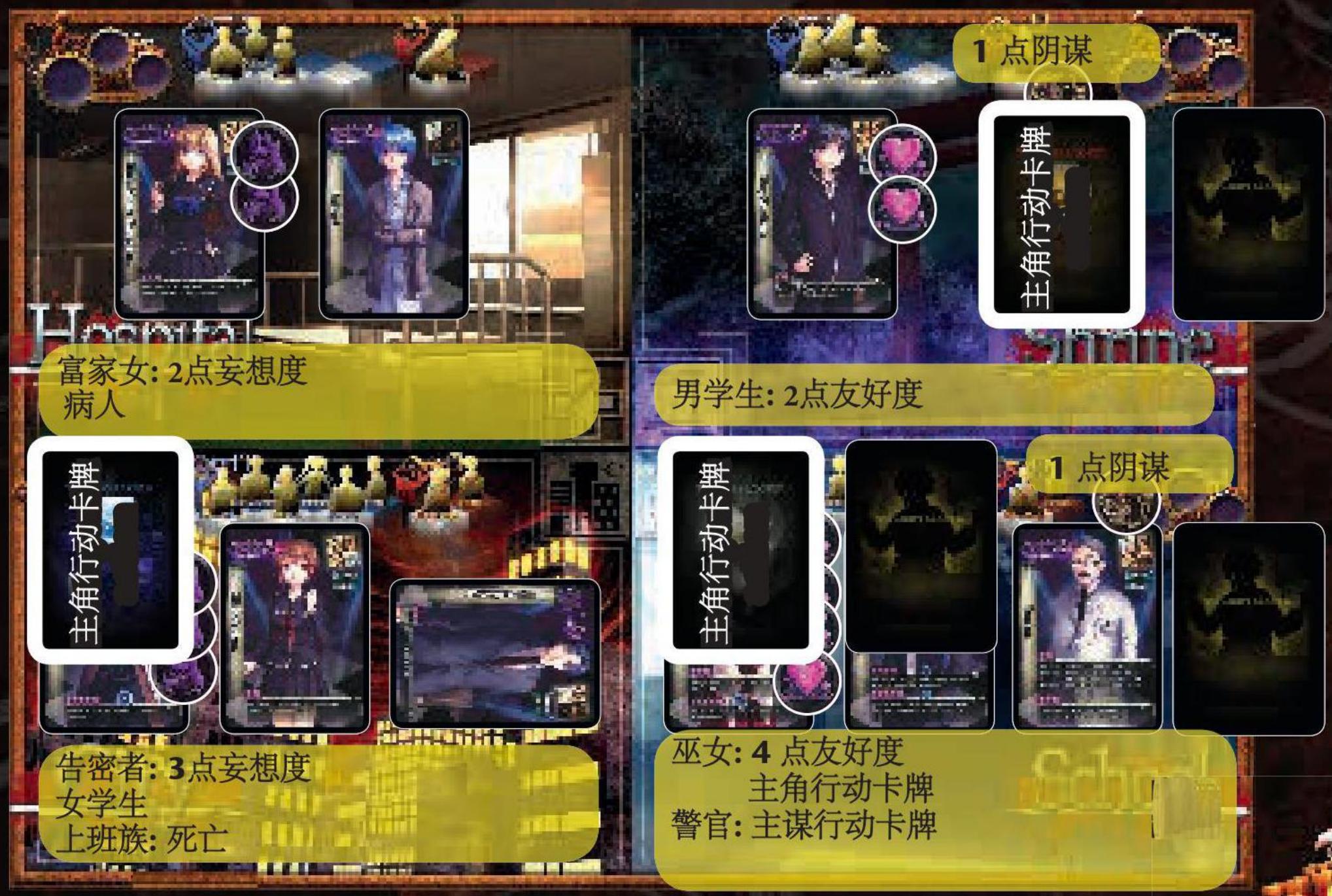
图注:1 点密谋 | 富家女: 2点不安 | 病人 | 男学生: 2点友好度 | 1 点密谋 | 主人公行动牌 | 主人公行动牌 | 主人公行动牌 | 告密者: 3点不安 | 女学生 | 上班族: 死亡 | 巫女: 4点友好度 | 主人公行动牌 | 警官: 剧作家行动牌
继续前面的例子, 主人公放置行动牌在巫女、神庙、学校上.
4-4 结算卡牌效果
[剧作家行动]
现在有6张背面朝上的行动牌在版图上.
剧作家同时展示它们和结算卡牌效果, 移动和禁止卡牌优先结算 (禁止移动卡牌最优先结算).
当卡牌结算完毕, 它们返回到对应拥有者手牌中, 除了注明 “每个轮回仅限一次” 的卡牌, 这些卡牌将在本轮回中正面朝上放置在拥有者面前, 本轮回之后都不能再次使用.

图注:剧作家行动: 不安 +1 | 主人公行动: 禁止密谋 | 主人公行动: 不安 -1 | 主人公行动: 友好度 +1 | 剧作家行动: 上下移动 | 剧作家行动: 不安 +1
卡牌同时展示.

结算卡牌效果后,版图上的状况。需要注意的是放置在学校上的不安 +1 是一个障眼法。
4-5 剧作家能力
[剧作家行动]
这里,剧作家可使用含有 [剧作家能力] 时点的身份能力. 如果有几个可用能力,他可选择全部使用. 如果一个人物拥有超过一个能力,他依旧可以选择全部使用. 但是,重点是他只向全部玩家声明使用能力的结果是什么——并不说出哪个人物使用了能力,是如何发生事件而导致这个结果的.
需要注意的是, 一些剧作家可使用的能力不具备本阶段时点可用, 但却可在[日子结束]或者[轮回结束]的时点上处于可用状况.
4-6 队长使用友好能力
[主人公的队长和剧作家行动]
这里,主人公的队长选择使用人物的友好能力或者情节上已说明可使用的任何能力。要使用一个友好能力,相应地人物必须达到友好度限制。
队长大声说出使用哪个能力,对象是谁(大部分友好能力都需要一个使用的对象).
但是, 由剧作家结算能力的效果, 因为一些隐藏的身份将自由或强制性的拒绝使用友好能力。一旦队长选择的人物是一个这样的身份, 剧作家可以 (或者必须) 声明“无事发生”. 这依旧被视为已使用能力. 注意的是, 一旦能力被拒绝使用, 将让主人公可以有机会察觉该人物的隐藏身份是什么.
如果队长希望使用多个能力, 他可以按照他希望的顺序来依次使用. 如果一个人物有多个能力, 他也可以全部使用. 但是, 每个能力一天只能使用一次, 每次使用后都由剧作家声明能力的生效与否. 也有一些能力在每个轮回仅限使用一次. 最后, 使用友好能力并不会移除友好度标记 (即使被拒绝使用).
一点细节探究
剧作家应该或不应该说什么
当剧作家使用能力或结算效果时, 他不应该说出这些效果为什么会发生, 哪一个人物或身份引致这个结果, 或者这是一个情节规则、人物效果或者无论其他什么事情. 但是, 一旦主人公失败了, 是因为他们被杀死了, 则剧作家应告诉主人公他们被杀死了, 而不是他们失败了. 如果主人公因为情节的规则或能力而导致失败, 他们将只会被告诉他们失败了.
一些例子:
错误: 我使用医生的身份 “主谋” 的能力放置一个密谋标记在巫女身上.
正确: 一些邪恶的事情发生在巫女身上, 她获得了一个密谋标记。
4-7 事件发生
[剧作家行动]
本阶段, 剧本中事件将可能按对应日子发生. 如果这一天在日程表中没有事件, 则跳过本阶段.
如果本日在日程表上显示有事件可能发生, 剧作家检查下面的状况是否符合:
1) 事件的当事人是否依旧生存
2) 当事人是否已达到不安限制 (=灾难)
如果任一条件不符合, 剧作家只是声明 “无事件发生”.
如果2个条件均符合,则事件发生: 剧作家说明发生了事件,并结算。
依旧不说出谁引发了该事件(即使这已经是很明显的事情). 由剧作家选择确定事件会影响到什么人或事. 请注意如果需要符合一些额外条件才能引发事件的话(例如“医院事故”要求医院达到足够的密谋标记〔旧译“医院恐慌”〕), 并且该条件未符合, 剧作家依旧需要声称事件发生了, 但无事发生. 例如, 剧作家可以这么说, “谋杀差一点就发生了, 但被一些事情阻止了.” 注意: 在这里, 警官的第一个友好能力可发挥作用.
下图例子中,剧作家可以这么说,“发生了谋杀事件,女学生被杀。”

图注:告密者: 3 点不安 | 女学生: 死亡 | 上班族: 死亡
4-8 改变队长
本阶段, 队长将队长卡牌交给左手边主人公玩家.
4-9 日子结束 – 夜晚
[剧作家行动]
类似于日子开始; 一些剧本或身份能力在 “日子结束” 阶段发挥效用.
除非这是轮回的最后一天, 移动日子标记到下一格, 然后从“日子开始”阶段开始下一天. 如果这是轮回的最后一天, 很明显这是轮回结束的时候, 下面将会进行结算...

轮回结束
S一些事情每当轮回结束的时候将会发生。特别的,许多失败条件都是在轮回结束的时候进行检查。有3种方法可以导致轮回结束:
1) 你已经来到轮回的最后一日,且已经日子结束了。
2) 主人公死亡了.
3) 一些剧本的其他规则导致轮回的突然结束. 一旦轮回结束, 第一时间
要检查失败条件;
这由剧作家进行. 如果没有符合任何失败条件, 主人公获胜; 你通过努力得到了幸福. 祝贺你.
只要符合任何一个失败条件, 主人公失败。除非这是最后一次的轮回, 主人公时空旅行回到轮回的第一天: 移动轮回标记到下一格和重置所有事情.
如果这是最后一个轮回,主人公失败,剧作家获胜...但是,还有最后的一个机会,最终猜测,下面将会进行介绍。

最终猜测
即使主人公在每一个轮回中都失败了, 他们依旧还有最后一个获胜的机会. 他们可以利用不断轮回累积而来的知识来指出每个人物分别是什么身份.
最终猜测按下列方式进行:
1) 重置游戏版图
重置游戏版图,恢复到“轮回开始”时的状态。原因是令游戏中任何可能发生的身份改变都恢复到最初的状况。
* 从游戏版图中移除所有标记指示物.
* 将所有人物放回起始地区上,生存的。
* 任何额外的记录使用了,恢复到0.
2) 猜测每一个人物的身份是什么
主人公可以讨论确定,然后逐一选取人物进行猜测,每猜测一个人物的身份是什么,剧作家仅回答正确与否。如果正确,则继续。一旦猜错一个人物的身份,则主人公失败。如果主人公将所有人物的身份都猜测正确,他们比剧作家更聪明和获得了游戏的胜利!
图注:Illustration of a man in traditional attire holding a cane, standing beside a decorative circular emblem with the number 27 (no text or symbols on the main subject)

WHAT'S A TRAGEDY SET?
一个悲剧包括了一系列的情节、身份和事件,用来构成一个剧本。用另一种方法形容的话:你使用了哪种悲剧模式,则限制了你设计剧本可选择的情节、身份、事件。主人公需要知道使用了哪个悲剧模式,好尝试去发现游戏中到底使用了哪个情节,每个人物将会是什么身份。
本基础版包含了2种悲剧模式,初级悲剧模式和基本悲剧模式。初级模式包括3个主情节,3个次要情节,8个身份和7个事件。基本模式则包含5个主情节,7次要情节,12个身份和9个事件。
如何查看情节列表
1 M
泼仇的火种
■加入身份:主谋
情节规则:
轮回结束时,一旦主谋的起始地区有2个密谋标记,主人公失败。
1. 情节类型
表示这是主情节 (M) 或者次要情节 (S)
2. 情节名字
情节的名字
3. 加入身份:
如果你使用了该情节,将要加入什么身份到游戏中。
4. 情节规则
一旦选择本情节,将为游戏添加的情节规则.
如何查看身份列表

杀手
最大限制: 无
3 可选择拒绝使用友好能力
能力:
[可选] [日子结束]如果关键人物最少有2点密谋,且与该身份身处同一地区,则杀死关键人物.
[可选] [日子结束]如果该身份最少有4点密谋,你可杀死主人公.
出现情节: 谋杀计划(主情节)
1. 杀手
身份的名字
2. 最大限制
最大有几个人物可以是这个身份.
3. 友好能力的反应
该身份拥有“可选择拒绝使用友好能力”或必须选择拒绝.
4. 能力
身份的额外能力.
5. 出现情节:
这个身份会在什么情节中出现.
如何查看事件列表

谋杀
效果:
- 一个与该身份同一地区的人物被杀死.
1. 事件名字
事件的名字
2. 事件效果
一旦该事件发生,将会有什么后果。

FIRST STEPS
初级悲剧模式就是基本悲剧模式的简单版本, 是设计来将本游戏介绍给新玩家的. 剧作家手册中有2个剧本使用该模式, 你也可试着设计自己的剧本. 它被设计为主要设计6-7个人物, 每个轮回为4-6天; 这将减少可能的组合, 令游戏更容易推理, 且减少游戏的时间和增加游戏的流畅性.
主要的规则修正
1: 没有最终猜测
在初级悲剧模式中将没有最终猜测,一旦主人公每个轮回都失败了,则他们失败了。
2: 只有一个次要情节
基本悲剧模式会有2个次要情节,但在初级模式下,只会有一个次要情节。
主情节
主情节是剧本的核心,一般会包含失败条件.

谋杀计划
加入身份:
关键人物,幕后黑
手、杀手
情节规则: 无

泼仇的火种
加入身份:
主谋
情节规则:
轮回结束时,如果主谋的起始区域有最少2点密谋,主人公失败.

守护此地
加入身份:
关键人物,狂热
者
情节规则:
在轮回结束时, 如果学校有最
少2点密谋,则主人公失败.
次要情节
作为剧本背景的情节. 他们可能增加一些其他的失败条件和规则.

暗影
开膛者的魔影
加入身份:
传谣人, 杀人狂
情节规则:
无

流言四起
加入身份:
传谣人
情节规则:
[可选] <每轮回一次> 剧作家可随
意选择为一个地区增加一点密谋.

最黑暗的剧本
加入身份:
传谣人, 亲友, 0-2 个暴徒
情节规则:
无
身份
人物背后隐藏的身份

关键人物
最大限制: 无
能力:
[强制地] [任何时候]
当这个身份死亡,主人公立刻失败,轮回立刻结束.
出现情节:
谋杀计划 (主情节),和我签订契约吧! (主情节)

杀手
最大限制: 无
可选择拒绝使用友好能力
能力:
[可选] [日子结束] 如果关键人物有最少2点密谋且与该身份处于同一地区,你可杀死关键人物.
[可选][日子结束] 如果该身份最少有4点密谋,你可杀死主人公.
出现情节:
谋杀计划(主情节)

主谋
最大限制: 无
可选择拒绝使用友好能力
能力:
[可选] [剧作家能力] 你可在该身份所在的地区或同一地区的任何一个人物身上放置一点密谋.
出现情节:
谋杀计划(主情节), 被封印的邪灵(主情节)

邪教徒
最大限制: 无
强制性拒绝使用友好能力
能力:
[可选] [结算卡牌效果] 可使与该身份同一地区的任何 “禁止密谋” 卡牌无效.
出现情节:
守护此地 (主情节), 改变未来 (主情节)

亲友 最大限制: 2
能力:
[强制地] [轮回结束]
如果该身份死亡,展示该身份是什么人物,且主人公失败。
[强制地] [轮回开始]
如果这个人物的身份已被展示,该人物获得一点友好度.
出现情节:
好友圈 (2 个亲友),
潜伏的杀人狂(次要情节)

传谣人 最大限制: 1
能力:
[可选] [剧作家能力] 你可以在该身份所在地区任意一个人物身上放置一点不安.
出现情节:
好友圈(次要情节),
流言四起(次要情节),
妄想扩大病毒(次要情节)

杀人狂 最大限制: 无
能力:
[强制地] [日子结束]
如果杀人狂所在地区仅有另外一个人物,杀手该人物;如果杀人狂所在地区有另外一个生存人物和一具或更多尸体,依旧杀死那个生存的人物。
出现情节:
火药的味道 (次要情节)

暴徒 最大限制: 无
可选择拒绝使用友好能力
能力:
无
出现情节:
最黑暗的剧本(次要情节)
事件
剧本中的事故和恐慌. 它们是被谋划好的亦或是命定的?

谋杀
效果:
与肇事
者在同一地区的一个
人物死亡.

不安扩散
效果:
放置2点不安在任意一个
人物身上,然后放置在另
外一个人物身上一点密谋.

自杀
效果:
当事人本人自
杀.

医院事故
效果:
如果医院最少有1点密谋,所有在医院的人物死亡。如果医院有2点或以上密谋,主人公死亡。

远距离杀人
效果:
一个最少有2点密谋的人物
死亡.

失踪
效果:
移动当事人到任意地区. 然后
放置一点密谋在该地区上.

传播
效果:
移除任意一个人物身上2点友
好度,然后放置2点友好度在
另外一个人物身上.

BASIC TRAGEDY
基本悲剧模式是游戏的基本方式. 它的内容更丰富,但请先确认你已经熟悉了初级模式中的所有情节、身份、事件。
主情节
主情节是剧本的核心,一般会包含失败条件。

被封印的邪灵
加入身份:
主谋,狂
热者
情节规则:
在轮回结束时,如果神庙中最少
有2点密谋,主人公失败.

和我签订契约吧!
加入身份:
关键人物 (必须为女性)
情节规则:
轮回结束时,如果关键人物身上最
少有2点密谋标记,主人公失败.

改变未来
加入身份: 邪教徒,
时间旅者
情节规则:
轮回结束时, 如果本轮回发生
了“蝴蝶效应”事件,主人公
失败.

巨大定时炸弹X
加入身份:
魔女
情节规则:
轮回结束时,如果巫女起始地区
最少有2点密谋,主人公失败。

谋杀计划
加入身份:
关键人物,幕后黑
手,杀手
情节规则: 无
次要情节
剧本的背景情节. 它们可能增加失败条件和身份. 次要情节相对更容易发现. 剧作家必须想法作出适当的掩眼法来推进轮回的进程.

好友圈
加入身份:
2个亲友, 传谣人
情节规则:
无

恋爱风景线
加入身份:
心上人,求爱者
情节规则:
无

潜伏的杀人狂
加入身份:
亲友,杀人狂
情节规则:
无

未知因子X
加入身份:
不安定因子
情节规则:
无

流言四起
加入身份:
传谣人
情节规则:
[可选] <每轮回仅限一次> 主谋
可选择任意一个地区增加一点密谋.

妄想扩大病毒
加入身份:
传谣人
情节规则:
凡是超过3点不安以上的人
物全部转变为“杀人狂”。

因果线
加入身份:
无
情节规则:
轮回开始的时候,任何身上有友
好度标记的人物,均获得2点妄
想度标记.
身份
人物隐藏的身份

关键人物 最大限制:无
能力:
[强制地] [任何时候]
当这个身份死亡,主人公立即失败且轮回结束.
出现情节:
谋杀计划(主情节),和我签订契约吧!(主情节)

杀手 最大限制: 无
可选择拒绝使用友好能力
能力:
[可选] [日子结束] 如果关键人物有最少2点密谋且与该身份处于同一地区, 你可杀死关键人物.
[可选] [日子结束] 如果该身份最少有4点密谋,你可杀死主人公.
出现情节:
谋杀计划(主情节)

主谋 最大限制: 无
可选择拒绝使用友好能力
能力:
[可选] [剧作家能力] 你可在该身份所在的地区或同一地区的任何一个人物身上放置一点密谋.
出现情节:
谋杀计划(主情节), 被封印的邪灵(主情节)

邪教徒 最大限制: 无
强制性拒绝使用友好能力
能力:
[可选] [结算卡牌效果] 可使与该身份同一地区的任何“禁止密谋”卡牌无效.
出现情节:
守护此地(主情节),改变未来(主情节)

时间旅者
最大限制:无
能力:
[强制地] [任何时候] 这个身份不能死亡.
[强制地] [结算卡牌效果]
“禁止友好”对该身份无效.
[可选] [最后一天结束时] 如果该身份身上只有2点或更少的友好度,你可以声明主人公失败了.如果你这样做,轮回结束.
出现情节:
改变未来(主情节)

不安定因子
最大限制: 无
可选择拒绝使用友好能力
能力:
[强制地] 如果学校最少有2点密谋,该身份获得传谣人的能力。
[强制地] 如果市区最少有2点密谋,该身份获得关键人物的能力
出现情节:
未知因子X
(次要情节)

亲友
最大限制: 2
能力:
[强制地] [轮回结束]
如果该身份死亡,展示该身份是什么人物,且主人公失败。
[强制地][轮回开始]
如果这个人物的身份已被展示,该人物获得一点友好度.
出现情节:
好友圈 (2个亲友),
潜伏的杀人狂 (次要情节)

传谣人
最大限制: 1
能力:
[可选] [剧作家能力] 你可以在该身份所在地区的任意一个人物身上放置一点不安.
出现情节:
好友圈 (次要情节),
流言四起(次要情节),
妄想扩大病毒(次要情节)

杀人狂 最大限制: 无
能力:
[强制地] [日子结束]
如果杀人狂所在地区仅有另外一个人物,杀手该人物;如果杀人狂所在地区有另外一个生存人物和一具或更多尸体,依旧杀死那个生存的人物。
出现情节:
潜伏的杀人狂 (次要情节),
妄想扩大病毒 (次要情节; 未知的数量)

魔女 最大限制: 无
强制地拒绝使用友好能力
能力: 无
出现情节: 巨大定时炸弹X (主情节)

心上人
最大限制: 无
能力:
[强制地] [任何时候] 如果求爱者死亡,该身份获得6点不安.
[可选] [日子结束] 如果该身份最少有3点不安和一点密谋,你可杀死主人公.
出现情节:
恋爱风景线(次要情节)

求爱者
最大限制: 无
能力:
[强制地] [任何时候] 如果心上人死亡,该身份获得6点不安.
出现情节:
恋爱风景线 (次要情节)
关于身份的一般信息
一些主人公和剧作家都必须注意的地方:
(1) 某些身份一旦死亡将会发生重大影响 (关键人物, 亲友, 不安定因子, 求爱者, 心上人)
(2) 某些身份能力可以让人获得不安标记 (传谣人, 不安定因子)
(3) 某些身份单独与另一个人物在一起的时候不会死亡 (杀人狂, 时间旅者)
(4) 某些身份不能使用友好能力 (邪教徒, 魔女)
(5) 什么身份有可能隐藏至最终猜测依旧难以发现 (杀手, 主谋, 传谣人).
事件
剧本中的事故和恐慌. 它们是被谋划好的亦或是命定的?

谋杀
效果:
与当事人在同一地区的
…一个人物死亡

不安扩散
效果:
放置2点不安在任意一个人物身上,然后放置1点密谋在另外一个人物身上.

邪恶污染
效果:
放置2点密谋到神庙.

自杀
效果:
当事人本人自杀.

远距离杀人
效果:
一个最少有2点密谋的人物死亡.

医院事故
效果:
如果医院最少有1点密谋,所有在医院的人物死亡;如果医院最少有2点密谋,主人公死亡。

失踪
效果:
移动当事人到任意地区. 然后
放置1点密谋到该地区.

传播
效果:
从任意一个人物身上移除2点友好度,然后在另一个人物身上放置2点友好度。

蝴蝶效应
效果:
在当事人所在地区的任意一个人物身上,放置一个你选择的标记(友好度,不安,密谋).
2人规则
一个人作为剧作家,另一个作为主人公。主人公拥有3个卡牌堆,并且从每一卡牌堆中选一张放置到版图上。注意这个游戏模式将让主人公有很大优势。举例而言,主人公将不会在同一天放置2张或以上的禁止密谋卡牌,导致互相抵消的状况。
3人规则
这种情况下,将有一个剧作家和2个主人公。主人公的队长将使用2个卡牌堆,且各选取一张放置到版图上。一旦转移队长卡牌时,他还需将一个卡牌堆也一并交给下一位玩家。

CREDITS
Game design: BakaFire
Graphic design
(of the Japanese manual): BakaFire
Character design: Rei Konno
Illustrations: Rei Konno
Rulebook text: BakaFire
Test players: Izayoi, Irie, Iwasawa, Gajini, Kanepi, Kabo, Gayusu, gleipnil, Satoru Sawamura, BakaFire, Suiyou, Radio head, Ripper, re_ne, retlet, Rerashiu, Rokirusu
Special thanks: Makoto Akiyama, option, Masahiro Sakudo, sugech, Makoto Tanaka, Jun Tsuchiya, Yusue Suwashida, hibo(RooP), Madame Zaza, Hiroaki Watanabe (General Bubble).
Graphic design (English version): Z-Man Games
© 2014 Z-Man Games Inc.
31 rue de la Coopérative
Rigaud QC J0P 1P0
Canada

图注:Z-MAN | games

图注:Abstract geometric design with intersecting lines and a circular emblem featuring the number 43 (no text or symbols)

TURN SUMMARY
日子开始-早上
日子开始效果在这里发挥效用。
剧作家的行动
放置3张背面朝上的行动牌在人物或地区上(同一个地方不放置超过一张)
主人公的行动
每个主人公放置一张背面朝上的卡牌在人物或地区上(主人公之间不能在同一个地方放置超过一张卡牌)
结算卡牌效果
展示所有卡牌并结算它们. 然后, 返回所有卡牌到它的拥有者手上, 除了每一轮回仅限使用一次的卡牌放在一旁。
剧作家能力
使用任何可能的能力。
队长使用友好能力
队长宣称使用哪个能力针对哪个目标.
剧作家结算效果. 如果使用友好能力的人物拥有拒绝友好,可以拒绝使用能力。
事件发生
如果这一天有事件, 说明发生与否 (当事人存活和达到惊慌度), 如可能, 则结算。
改变队长
队长将队长卡牌交给下一位主人公玩家。
日子结束-夜晚
日子结束效果在这里发挥作用。如果这不是最后一天: 去到明天的日子开始阶段如果这是最后一天: 去到轮回结束的结算.
下载 Markdownrules_en_tragedy-looper.md54.5 KB
Tragedy Looper — Rulebook (English, RulesPal mirror)
英文原文,供中英对照;中文为准(rules_zh_惨剧轮回_1090.md)。
Tragedy Looper Rulebook | RulesPalRulesPalChatRulebookTragedy LooperTragedy Looper Rulebook Table of Contents Table of Contents To Begin With Goal for the Protagonists
Goal for the Mastermind
For newcomers
Components and Game Overview Game Boards (2 pcs)
Anatomy of a character card
Action Cards (34 pcs)
Card List Protagonist Cards
Mastermind Cards
Counters (118 pcs)
Game Rules I. Victory Conditions
II. Preparations How to look at the script card
How to create a script
III. Preparing the Loop
IV. Flow of One Loop
V. End of the Loop
VI. Final Guess
What's a Tragedy Set? How to read the plot list
How to read the role list
How to read the Incident list
First Steps Major rule changes
First Steps — Main Plots
First Steps — Subplots
First Steps — Roles
First Steps — Incidents
Basic Tragedy Basic Tragedy — Main Plots
Basic Tragedy — Subplots
Basic Tragedy — Roles
General info about the roles
Basic Tragedy — Incidents
Rules for 2 Players
Rules for 3 Players
Turn Summary
Credits
To Begin With
Goal for the Protagonists
Your goal is to break out of the time loop maze and create a happy future. But you don't know who is who, you don't know what is what, and you don't even know how to win! However, you have the ability to travel back in time so you can replay the same script multiple times! The script remains the same; the only thing that changes is how much you've learned. And you only have to be victorious once!
Goal for the Mastermind
Your goal is to trigger tragedies and feast your eyes upon misery. You have all the information, but you have to win every single loop. And that means you have to adapt to the knowledge gained by the Protagonists. Being the Mastermind is more complicated than being a Protagonist: you must have all the plots, all the hidden roles in your mind, in order to play out your plan smoothly. And when the Protagonists lose every loop, the taste of victory is so much sweeter!
For newcomers
Tragedy Looper is a very deep game that you can enjoy on many levels. However, due to the many choices you have, it's a bit hard to know how to play the first couple of times. What follows here is a guide for those who have never played this game before. Specifically, if all four players are new to the game, we strongly advise you to proceed with the following steps.
I. Choose the Mastermind. First, choose who will be the Mastermind. You should choose the one who has experience in game mastering role playing games or something similar. The Mastermind should read through this document and the Mastermind's Handbook document. The Protagonists should also read through this document to grasp the ideas of the game.
II. Teaching the game. It's best if the Mastermind tries to explain the game. The game rules are in this document, but in the Mastermind's Handbook, there is also a "game teaching guide" that one can follow, that will help a Mastermind teach the game to others.
III. Start with the "First Steps" Tragedy Set. A "Tragedy Set" is a number of plots, hidden roles and Incidents. The "First Steps" Set contents are listed later in this document, and in the Mastermind's Handbook, there are 2 pre-written scripts using this set; the first one, called The First Script, even comes with suggestions for the Mastermind on how to play out the script. Use this as your first game.
IV. Continue with the standard "Basic Tragedy" Set. Once you've played a couple of games with the First Steps set, you're ready to take on the standard game, using the Basic Tragedy Set which has a bigger setup of plots, roles and Incidents. The Basic Tragedy Set contents are also listed in this document, and in the Mastermind's Handbook you've got 8 scripts using the Basic Tragedy Set.
Components and Game Overview
First, we'll show you where all this is taking place. In this section, we'll describe the layout of the game, while introducing you to the boards, cards and tokens.
Game Boards (2 pcs)
The location board shows four locations, arranged in a 2×2 grid — Hospital and Shrine on the upper row, City and School on the lower row:
Hospital — The place where body and soul are mended. Likewise, the place where your worst fears are confirmed. And where darkness can easily capture a weakened heart.
Shrine — A place for worshiping the supernatural. But who is actually there – or what? Is it something that wishes us good – or ill?
City — The nightly fortress that never sleeps, bathed in eternal neon lights. It's also the home for countless dark alleys, where evil thoughts germinate and grow.
School — The place of learning for all young souls. But those untrained souls are often lost, fooled, and at times, open doors that should be left closed.
The data board tracks Day (Day 1 through Day 8), the Incident Loop and Extra values, and includes a turn summary:
Turn summary
Morning — Start of the day
Playing cards — Mastermind plays cards; Protagonists play cards; Cards are resolved
Abilities — Mastermind abilities; Leader (Goodwill) abilities
Incidents — Incidents happen
Night — Change Leader; End of round
This game is centered around the Hospital, the Shrine, the City and the School. Each location is represented on the board.
These locations are where everything happens. The Protagonists are walking around in these locations, but do note that the Protagonists are not represented by any cards, pawns or markers.
The second board is just a data board. It keeps track of what day it is, when Incidents happen, and how many times you've looped.
In Tragedy Looper, the tragedy isn't limited to just the Protagonists. There are a lot of other important characters in these stories. Students, a Journalist, a Shrine Maiden, a Pop Idol, an Office Worker; there are a grand total of 18 different individuals that can take part in the scripts.
Each script defines what characters will be in the game and the characters are represented by cards.
These are all Non-Player Characters (NPCs). They have special abilities they'll use to help you (the Protagonists) if you form Goodwill bonds with them. For example, the Informer will reveal secret information to you.
However, that's not all they are. It's perfectly possible they have a secret role, and are involved in the script. They might be the key person who triggers the tragedy. Or, they might be the brain behind the tragedy itself. They might be a serial killer, unable to restrain themselves if they are in a situation where murder is possible. But at the start of each script, you, the Protagonists, have no idea which of the characters carries what secret. You have to experience the story, loop after loop, and come to conclusions based on the knowledge gained.
Anatomy of a character card
-
Card name
-
Paranoia limit — If the character has at least this many Paranoia counters, he/she is in a state of panic and will be able to trigger Incidents. Note: A character card can have more Paranoia tokens on it than the actual number printed on the card.
-
Locations — This signifies the starting location for the character (in white). It may also show which locations are forbidden to this character (crossed out).
-
Traits — This character's traits. Some rules and card effects refer to characters with certain traits.
-
Goodwill ability / Passive ability — These are the character's abilities, that (usually) help the Protagonists. If the character has at least as many Goodwill counters as the ability shows, the Protagonist may use that ability. Using an ability does not cause Goodwill to be removed. Abilities that are limited to once per loop can, obviously enough, only be used once per loop.
In the special case that the Mastermind player can use a Goodwill ability, he does so with the same limitations as the Protagonists.
Passive abilities are always in effect and do not need to be activated. These are not "used" by the Protagonists; instead they are resolved by the Mastermind.
A little delve into the details: about characters and corpses
Whether a character is alive or dead is shown by how the card is laid on the board. A living character is placed vertically and a dead character is placed sideways. A dead character is a "corpse" and can not use any abilities, nor has any traits, nor is it even considered a character, but any Goodwill counters they have stay where they are. There is one character in the game who can resurrect corpses.
So, we've taken a look at the board and the characters. Now, we're getting into what you, the players, are to do in the game. We'll explain the action cards that players use to affect the characters in the game.
Action Cards (34 pcs)
What the players, both Protagonists and Mastermind, will actually do in the game is play action cards on the characters or the locations. All players play their cards face down, and when everyone has played a card, they are all revealed and resolved at the same time.
All cards have different backs so you can see who played what card. See to it that each player has the same back on all his/her cards.
Movement cards — These will move a character in the specified direction.
Goodwill cards — These are used to increase the characters' Goodwill, so they can use their Goodwill abilities. Protagonists have these; the Mastermind has a forbiddance card.
Intrigue cards — These symbolize secrecy surrounding characters and locations. Their meaning varies with each plot. Only the Mastermind has these; the Protagonists have forbiddance cards.
Paranoia cards — These are used to increase the character's Paranoia level, so they will start triggering Incidents.
Card List
This is a list of the action cards that the Protagonists and the Mastermind use, together with some details on exactly how the cards work. Use this if some effects conflict and/or you don't know in what order to resolve things. "Together" here means "played on the same location or character".
Protagonist Cards
Paranoia +1
Place 1 Paranoia counter on this character.
If together with a Forbid Paranoia, the Forbid takes precedence and nothing happens.
If together with a Paranoia –1, the +1 goes first.
Placed on a location, nothing happens.
Paranoia –1 (only once per loop)
Remove 1 Paranoia counter from this character.
If together with a Forbid Paranoia, the Forbid takes precedence and nothing happens.
If together with a Paranoia +1, the +1 goes first.
Placed on a location, nothing happens.
Goodwill +1
Place 1 Goodwill counter on this character.
If together with a Forbid Goodwill, the Forbid takes precedence and nothing happens.
Placed on a location, nothing happens.
Goodwill +2 (only once per loop)
Place 2 Goodwill counters on this character.
If together with a Forbid Goodwill, the Forbid takes precedence and nothing happens.
Placed on a location, nothing happens.
Forbid Intrigue
If on the same spot as an Intrigue +1 or +2, this takes precedence and nothing happens. However, if 2 or more players have played Forbid Intrigue on the same day (no matter where on the playing field), they nullify each other.
Movement - vertical
This character moves either up or down.
If together with another vertical movement, it's still a vertical movement (they do not nullify each other).
If together with a horizontal movement, they combine to form a diagonal movement.
If together with a diagonal movement, they combine to form a horizontal movement.
If placed on a location, nothing happens.
Movement - horizontal
This character moves either left or right.
If together with another horizontal movement, it's still a horizontal movement (they do not nullify each other).
If together with a vertical movement, they combine to form a diagonal movement.
If together with a diagonal movement, they combine to form a vertical movement.
If placed on a location, nothing happens.
Forbid movement (only once per loop)
If together with a Movement card, the Forbid takes precedence and nothing happens.
Mastermind Cards
Paranoia +1
Place 1 Paranoia counter on this character.
If together with a Paranoia –1, the +1 goes first.
If placed on a location, nothing happens.
The Mastermind has 2 of these.
Paranoia –1
Remove 1 Paranoia counter from this character.
If together with a Paranoia +1, the +1 goes first.
If placed on a location, nothing happens.
Forbid Paranoia
If together with a Paranoia +1 or Paranoia –1, the Forbid takes precedence and nothing happens.
If placed on a location, nothing happens.
Forbid Goodwill
If together with a Goodwill +1 or Goodwill +2, the Forbid takes precedence and nothing happens.
If placed on a location, nothing happens.
Intrigue +1
Place 1 Intrigue counter on this character or location.
If together with a Forbid Intrigue card, and only one Forbid Intrigue card is played this day, the Forbid takes precedence and nothing happens.
Intrigue +2 (only once per loop)
Place 2 Intrigue counters on this character or location.
If together with a Forbid Intrigue card, and only one Forbid Intrigue card is played this day, the Forbid takes precedence and nothing happens.
Movement - vertical
This character moves either up or down.
If together with Forbid Movement, the Forbid takes precedence and nothing happens.
If together with another vertical movement, it's still a vertical movement (they do not nullify each other).
If together with a horizontal movement, they combine to form a diagonal movement.
If placed on a location, nothing happens.
Movement - horizontal
This character moves either left or right.
If together with Forbid Movement, the Forbid takes precedence and nothing happens.
If together with another horizontal movement, it's still a horizontal movement (they do not nullify each other).
If together with a vertical movement, they combine to form a diagonal movement.
If placed on a location, nothing happens.
Movement - diagonal (only once per loop)
This character moves diagonally.
If together with Forbid Movement, the Forbid takes precedence and nothing happens.
If together with a horizontal movement, they combine to form a vertical movement.
If together with a vertical movement, they combine to form a horizontal movement.
If placed on a location, nothing happens.
Counters (118 pcs)
By playing these action cards, you will change the situation on the board. Characters will move around and their Goodwill, Paranoia and Intrigue will change. Let's take a brief look at the counters used to signify this.
The characters can be in different moods. They might be friendly towards the players (Goodwill), or be paranoid enough to panic. In this game, there are three counters used to represent how a character feels mentally. And, there are a few counters used to make the game play a bit smoother.
Goodwill counters — These represent how friendly the character is towards the Protagonists. Mainly only the Protagonists can place these onto characters, and if a character has enough, his/her Goodwill ability can be used.
Paranoia counters — These represent how afraid the character is. Both Mastermind and Protagonists can place these on characters, and if they reach a certain level, the character is in panic mode and can start triggering Incidents.
Intrigue counters — These represent secrecy and conspiracies, on either locations or characters. Only the Mastermind can place these on characters or locations. Exactly what they do depends on the plot, but they lead towards failure for the Protagonists.
Loop marker — This is used to mark what loop the game is currently on. It's placed on the data board.
Day marker — This is used to mark which day it is. It's placed on the data board.
Incident markers — These are used to mark on which days something will happen. They're placed on the data board.
Extra markers — These are counters to use for whatever strange extra rules some script writers may come up with.
Boss Turf marker — This counter is used to mark the Boss's turf, as per his ability.
And lastly, we have some final cards to mention:
Leader card (1 pc) — This is used to mark which Protagonist is the current group Leader. It sits in front of the current Leader, and each turn, it goes to the player on the left.
Extra cards (4 pcs) — These are here to be used for whatever strange extra rules some script writers may come up with.
Script cards (20 pcs) — Each script has 2 cards; They have the same number on the back of the card. They present a synopsis of the most important information concerning the chosen script. One of these always concerns the Protagonists and is known by every player. The other one is to be kept secret by the Mastermind.
Game Rules
This section goes through the rules you need to know to play the game. If this is the first time playing, we have recommendations throughout this section.
Once you're feeling a bit comfortable with the rules, you can change scripts, and plots accordingly. Tragedy Looper is in principle a very simple game, but there are a lot of plots, characters and roles to learn, especially at first, so don't introduce too many new aspects at the same time.
I. Victory Conditions
The victory conditions are different for each player:
Victory for the Protagonists
If the Protagonists manage to both:
Not fulfill the loss conditions of the current plot(s)
Not die
during even one single loop, they win.
They also win if they succeed in the Final Guess.
Victory for the Mastermind
If the Mastermind makes the Protagonists lose (either by fulfilling any one loss condition or by killing them) in every single loop, he wins, unless the players succeed in the Final Guess.
The "loss conditions" vary depending on what plots are active.
A little delve into the details: about Protagonists kills
There are roles in the game, for example, the Killer, that can actually kill off the Protagonists. If the Protagonists die, the Mastermind just tells them that they're dead (don't tell them who killed them) and the loop ends immediately.
II. Preparations
Here's how you set up before each game.
2-1 Decide script
We strongly recommend that you go by what we lined up under "To Begin With"; that you start with the script entitled "The First Script". It uses the simple plot set First Steps which isn't as massive as the basic one, so there's less to keep track of. Only the Mastermind can look up the script in the Mastermind's Handbook; it's the very first script listed, complete with hints on how to play it out.
Please note that the Protagonists should NOT read the script as it will ruin their enjoyment of figuring out what is going on.
2-2 Reveal the script information
Each script has 2 cards; They have the same number in the top left corner. The Protagonists should be given the "Open" card, marked, "Protagonists card" on the left side. The "Secret" one is just for the Mastermind's eyes, and lists what roles the characters have, who the culprits of Incidents are, and what plots are active.
2-3 Build the stage
First, set up the location board. Put the data board beside the location board, and put the Loop Counter on the number specified by the script, the Incident Counters on the days these events happen; also specified by the script, and the Day Counter on Day 1.
Then decide who'll be first Leader, in any suitable fashion. The player who has played the most Tragedy Looper will do nicely. That player gets the Leader card.
2-4 Set Table Talk
This indicates whether the players may assist each other during the game or not. If set to "off", the players will be limited in what they can say during the game, except in between loops (the "Time Spiral"). Exactly to what extent they're limited is up to the players (all players) to agree on, but a typical limitation is to not allow players to tell (or show) the others what cards they are going to play.
How to look at the script card
-
Script title
-
Main plot and Subplot(s) — Each script contains one main plot and one subplot. When you start using the Basic Tragedy Set, you'll have 2 subplots.
-
Characters and roles (Mastermind card) — A list of what characters are in this script, and what roles they have. A number in parentheses marks their loop number appearance in the script.
-
Incident schedule and culprit (Mastermind card) — A list of what Incidents may happen on what day, and who the culprit behind it is. No character can be the culprit for two Incidents.
-
Tragedy Set — What plot set this script uses, meaning: What possible plots could be running.
-
Number of loops — The maximum number of times the Protagonists may loop (replay). It's usually 3 or 4.
-
Days in one loop — How many days (turns) one loop consists of. It's usually 6–8.
-
Special rules — If the scenario contains special rules, it will be listed here.
The Mastermind card is the secret card — this card is for Masterminds only. The Protagonists card is the open card — this card is given to the Protagonists; it lists the Day/Incident schedule and any special rule.
A little delve into the details: what does a script consist of?
A script consists of a couple of pre-written plots, a set of characters and some scripted Incidents. A plot determines what roles will be in the game, and the loss conditions for the Protagonists. What plots (and Incidents) are available to choose from depends on what "Tragedy Set" you use. There are two Tragedy Sets in this base box: "First Steps" which has a limited number of possible plots and roles, and "Basic Tragedy" which has a bigger number. The Protagonists will always know what Tragedy Set is used, so they have full knowledge of what plots and roles might be in the current script.
Main plot: MURDER PLAN — The central plot of the script, mostly defining the loss conditions for the Protagonists.
Subplot: A LOVE AFFAIR / Subplot: AN UNSETTLING RUMOR — Less important plots that mostly set the background for the script.
The selected characters get roles according to the plots. In the example: Boy Student = Loved One; Rich Man's Daughter = Brain; Police Officer = Lover; Girl Student = Killer; Shrine Maiden = Key Person; Doctor and Office Worker have no plot role; Informer and Patient = Conspiracy Theorist.
Determine Incidents and culprits. In the example: the Killer is Culprit Day 2, the Key Person is Culprit Day 5, the Conspiracy Theorist is Culprit Day 7, and another character is Culprit Day 4.
How to create a script
The script writer chooses two "plots" from the list of available ones; it must be one main plot and one subplot. If you use a script that is based on the "Basic Tragedy" Set, you'll actually have TWO subplots. For example, the script writer may select "Murder Plan" as the main plot and "Love Affair" and "Unsettling Rumor" as the subplots.
These plots determine what secret roles will exist in the game. In our example, the main plot, "Murder Plan" states that you need to have a Key Person, a Brain and a Killer among the characters. The subplots "Love Affair" and "An Unsettling Rumor" state that you need the roles, Lover, Loved One and Conspiracy Theorist.
Then the script writer decides what characters will be in the script, and which one will have what role. In the graphic above you can see who was chosen to be what role. Please note that no character may have two roles. The characters that have no roles are simply referred to as "persons".
Lastly, to spice up the script a bit, the script writer adds scheduled Incidents to the script, from the list of possible Incidents determined by the Tragedy Set, and decides day and culprit. Any character (both "persons" and plot roles) can be a culprit behind an Incident, but note that no character can be the culprit of two Incidents.
III. Preparing the Loop
This is what you do before each loop begins. Each script has a set number of loops, which translates to play-throughs of the script. If the set limit of loops is 3, then the Protagonists can only play the script 3 times – which technically means they can rewind it twice. (Some might argue that there is a semantic illogicality in calling the first play-through a "loop". But we can console even them thematically: As the Protagonists actually already know what Incidents will happen, that means they have already looped once.)
If the Protagonists win in any loop, i.e. manage to finish the loop without losing, the remaining loops are not played out; instead the Protagonists win the game.
Before each new loop, you should do the following:
Time Spiral
Return characters
Remove and replace counters
Take cards
3-1 Time Spiral
The "Time Spiral" is when the Protagonist agree on a plan of action. If you have decided to set table talk to "off", this is the only point in the game where the Protagonist can talk freely. The more complicated the script, the more time is needed here, but do take care to not over-analyze and cover everything; set a limited time of 5 minutes or 10 minutes.
Here, the players may also agree to skip the remaining loops and go directly to the Final Guess to win the game. However, once they have gone to the Final Guess, they can't loop anymore, so only do this if you're absolutely sure of all facts and just want to win.
3-2 Return characters
Place all participating characters on their respective starting locations. Each character has a defined starting position as shown on their cards.
3-3 Remove and replace counters
Remove all counters from the locations and cards. Then, if there are any counters to place at the start of the loop, do so. Move the Day Counter back to Day 1. Move the Loop counter down one step.
3-4 Take cards
Each player returns all their Action cards back to their hand.
IV. Flow of One Loop
This section describes how a loop goes.
The script determines how many days there are in each loop. A "day" in this game is translated to one round, where every player gets one turn each. When one day (round) has ended, the next day begins and so on.
Simplified, each day is as follows: All players play cards face down on the characters or locations. Then all cards are resolved at the same time. After that, special abilities are activated and then Incidents happen. Then the next day begins.
But the timing is important enough that we get a little 9-step list instead. As the Mastermind is… well, the Mastermind, he controls all the neutral aspects of the game. Like this:
Day start – morning [Mastermind]
Mastermind plays 3 action cards face down [Mastermind]
Protagonists play one card each face down [Protagonists]
Cards are resolved [Mastermind]
Mastermind abilities [Mastermind]
Leader uses Goodwill abilities [Protagonist Leader and Mastermind]
Incidents happen [Mastermind]
Switch Leader [Protagonists]
Day end – night [Mastermind]
It looks like a lot, but it's not; it's only the timing that's important. For the Protagonists it's exceedingly simple: First play a card face down, and then the Leader chooses whether to use a Goodwill ability or not. But let's go into the details of each of these steps.
4-1 Day start – morning [Mastermind handles this]
Some scripts or role abilities (that the Mastermind uses) will happen at "day start." So they happen at this step.
4-2 Mastermind plays 3 action cards face down [Mastermind handles this]
The Mastermind chooses 3 cards from his hand and plays them face down on any location(s) or character(s) he chooses. He cannot play more than one card on each location or character.
Example: An example of a game in progress. It is the 7th day of Loop 2. Mastermind places cards on the Shrine, the School, and the Police Officer.
A little delve into the details: setting action cards on the board
Action cards cannot only be placed on characters, but also on the four locations. Since locations can only receive Intrigue counters, the only cards that have an effect on locations are "Intrigue +1" and "Intrigue +2" for the Mastermind player, and "Forbid Intrigue" for the Protagonists. However, you can still place other cards on locations; they just won't have any effect other than acting as bluffs, which of course might be effective enough.
4-3 Protagonists play one action card each face down [Protagonists handle this]
Starting with the Leader and proceeding clockwise, each Protagonist chooses one of their cards and plays it face down, like the Mastermind, onto any location or character. Each Protagonist will play one card each. You're allowed to play a card on a location or character that the Mastermind played on, but you're not allowed to play a card where another Protagonist has played.
Example: Continuing the action from the example above, the Protagonists play cards on the Shrine Maiden, the Shrine and the Informer.
4-4 Cards are resolved [Mastermind handles this]
At this point there are 6 face down cards on the playing field. The Mastermind reveals them all at the same time. Then, he resolves them all in the following order:
Forbid Movement cards.
Movement cards.
Other Forbid cards.
Other remaining action cards.
"Forbid" cards cancel the effects of the Action cards of the same type. These cards do not affect the characters' Goodwill abilities or abilities granted by roles, plots or Incident's effect.
When cards have been resolved, they all return to their respective hands, except the cards that state "once per loop". They are put face up in front of their owners so that all can see the card cannot be used again this loop.
Example: The cards are revealed. State of playing field after cards are resolved. Note the Paranoia +1 on the School and on the Shrine were bluff moves.
4-5 Mastermind abilities [Mastermind handles this]
Here, the Mastermind can use role or plot abilities that have [Mastermind ability] timing. If several can be used, he can use them all. If a character has more than one ability, he can still use them all. However, what's important here is that he only announces the result – not what character(s) triggered it or what actually happened.
Some abilities are Mandatory. This means that the ability must be applied if the conditions are met. If several abilities that should happen at the same time conflict, in this case, the Mandatory abilities happen before Optional abilities.
Some other abilities are Optional. This means that the ability may be applied if the conditions are met. But first, any Mandatory abilities must be resolved. If several optional abilities that should happen at the same time conflict, the Mastermind chooses freely in which order to apply them.
Also note that some abilities or effects that the Mastermind uses do not have this timing, but instead the [Day end], [Loop end] or [Script creation] timing related to different roles or plots. Some characters also have "passive" abilities described directly on their card.
4-6 Leader uses Goodwill abilities [Protagonist Leader and Mastermind handle this]
At this point, the Protagonist Leader can use character Goodwill abilities or any abilities the plot states that he can use here. In order to use a Goodwill ability, that character has to have enough Goodwill counters. The Protagonist Leader announces aloud what ability he uses and also the target (most Goodwill abilities have some sort of target).
However, it's the Mastermind who resolves the effect, because some hidden roles can either freely or forcibly refuse the activation of Goodwill abilities. "Goodwill Refusal" is a restriction that only affect the abilities of the character currently playing that role. However, other characters can still use their own abilities to affect the restricted character.
So if the character the Protagonist Leader chose was of such a role, the Mastermind may (or must) say that "nothing happens". This still counts as if the ability was used, though. Do note that if a Goodwill ability was refused that refusal gives a clue toward identifying the role of the character.
A little delve into the details: what the Mastermind should or should not say
When the Mastermind uses abilities or resolves effects, he should not say why these effects happen, what character or what role triggered the result, or if it's a plot rule or a character effect or whatever. However, if the Protagonists lose because they are killed, they are informed that they are killed, not just that they lost. If they lose because of a plot rule or ability, they are just told that they have lost.
Some examples:
[WRONG]: I use the Doctor's role ability of the Brain to place an Intrigue counter on the Shrine Maiden. [RIGHT]: Something weird happens to the Shrine Maiden, and she gets an Intrigue Counter.
[WRONG]: Too bad, guys, the Rich Man's Daughter was the Loved One so you all die! [RIGHT]: I'm sorry to announce that you are all dead.
If the Leader wants to use several abilities, he may do so, in any order he wishes to. If a character has several powers, he may use all of them. However, each ability can only be used once per day, and for each use, the Mastermind says if it happens or not. Also, some abilities can only be used once per loop.
Also, some abilities are "passive" or will bring extra markers into play. The ruling for those abilities is printed directly on the card.
Finally, remember that Goodwill counters are not removed when a Goodwill ability is used (and/or refused).
4-7 Incidents happen [Mastermind handles this]
At this point, the script's scheduled Incidents might happen. If no Incident is scheduled for this day, then just skip this step.
If an Incident is scheduled to happen, the Mastermind checks if the below conditions are met:
The Incident's culprit is still alive AND
The culprit has at least reached his/her Paranoia limit (state of panic)
If either condition is unfulfilled, the Mastermind just states that "No incident happens".
If both conditions are met, the Incident happens: the Mastermind declares that the incident happens, and resolves it, again without revealing who did it (though it might be obvious). In case there is some sort of choice on who or what the Incident affects, it's the Mastermind who decides.
Please note that if there are some extra conditions that need to be met in order for an Incident to happen (like the Hospital Horror that requires that the Hospital has Intrigue counters), and they are not fulfilled, the Mastermind must still declare that the Incident occurs, but nothing happens.
For example, the Mastermind can say, "A murder almost took place, but something prevented it."
Note: the Police Officer's first Goodwill ability would work in this case.
4-8 Switch Leader
At this point, the Leader card is handed to the next Protagonist in turn.
4-9 Day end – night [Mastermind handles this]
Same as Day start; some script rules or role abilities activate at "Day end".
Unless this was the last day of the loop, move the Day counter one step down and begin a new day from "Day start". If this was the last day of the loop, obviously the loop ends and what happens then is described next in…
V. End of the Loop
Some things happen each time a loop ends. Most importantly, many loss conditions are checked at loop end. There are three ways for the loop to end:
You've reached and played through the final day of the loop.
The Protagonists have died.
Some other plot rule or effect causes the loop to end prematurely.
Once the loop ends, what's done first is check the loss conditions; this is done by the Mastermind. If no loss conditions are met, the Protagonists win; you have managed to maintain your happiness. Congratulations.
If even one loss condition is met, the players have lost. Unless this was the final loop, the Protagonists now travel back in time to day one once again: Move the Loop Counter one step down and reset everything.
If this was the final loop, then the Protagonists have lost and the Mastermind has won… but there is one final chance, the Final Guess, described below.
VI. Final Guess
Even if the Protagonists have lost in every loop, this is their final chance to win the game. They use what knowledge they have gained from each loop to figure out the roles of each character.
The Final Guess is done in this way:
1) Reset the gaming field
Reset the gaming field to return it to the "Loop starts" state. The reason this is done is to see that any possible role changes that might have occurred during the final loop are reverted back to their starting state.
Return all characters to their starting positions, alive.
Take away all counters from the gaming field.
If the Extra gauge has been used, return it to 0.
2) Guess every single character's role
The Protagonists can now confer with each other, picking one character at a time and guessing that character's role. For each character, the Mastermind replies right or wrong. If they guess right, they get to guess the next character. But if they guess wrong, the Protagonists have finally and totally lost. If the Protagonists successfully point out the roles of all participating characters, they have outsmarted the Mastermind and win the game!
What's a Tragedy Set?
A "Tragedy Set" contains a set of plots, roles and Incidents that are used to create a script. Put the other way around: What plots, roles and Incidents that the script writer can pick from is limited by the Tragedy Set being used. The Protagonists need to know what Tragedy Set is used in order to try to figure out what plots are active and what roles belong to which characters.
This base box contains two Tragedy Sets: "First Steps" and "Basic Tragedy". First Steps contains 3 main plots, 3 subplots, 8 roles and 7 Incidents. The Basic Tragedy Set contains 5 main plots, 7 subplots, 12 roles and 9 Incidents.
How to read the plot list
-
Plot type — Denotes if it is a Main plot (M) or Subplot (S).
-
Plot name — The name of the plot.
-
Roles to add — This is a list of what roles should be in the game if you use this plot.
-
Plot rule — List of rules that are added to the game if you use this plot.
Example: M — LIGHT OF THE AVENGER. Roles to add: Brain. Plot rule: At loop end, if there are at least 2 Intrigue counters on the Brain's starting location, the Protagonists lose.
How to read the role list
-
Role name — The name of the role.
-
Max Limit — The maximum allowed number of characters that can have this role.
-
Goodwill reaction — Whether the role can or must nullify this character's Goodwill abilities.
-
Abilities — Extra abilities that are given to the character that has this role.
-
Appears in plots — For reference, which plots this role appears in.
Example: KILLER. Max limit: none. Optional Goodwill Refusal. Abilities: [Optional] [Day end] If the Key Person has at least 2 Intrigue and is in this character's location, you may kill the Key Person. [Optional] [Day end] If this character has at least 4 Intrigue, you may kill the Protagonists. Appears in plot: Murder Plan (main plot).
How to read the Incident list
-
Incident name — Name of the Incident.
-
Incident effect — What happens when this Incident is triggered.
Example: MURDER. Effect: One character in the same location as the culprit dies.
First Steps
First Steps is basically a stripped down Basic Tragedy Set, designed to work as an introductory set for new players. In the Mastermind's Handbook there are two scripts using this set, and then you can experiment yourself with creating own scripts. It's designed to work with about 6–7 characters, each loop being about 4–6 days; to reduce the amount of possible combinations in order to facilitate deduction, but also to cut down on game time and run the game smoothly.
Major rule changes
1: No Final Guess — There is no Final Guess in the First Steps Set. If the Protagonists fail in every loop, they've lost.
2: Just one subplot — The basic idea is to have two subplots, but in the First Steps Set you just have one.
First Steps — Main Plots
Main plots are the core of the script, normally containing the loss conditions.
M — MURDER PLAN
Roles to add: Key Person, Brain, Killer
Plot rule: none
M — LIGHT OF THE AVENGER
Roles to add: Brain
Plot rule: At loop end, if there are at least 2 Intrigue counters on the Brain's starting location, the Protagonists lose.
M — A PLACE TO PROTECT
Roles to add: Key Person, Cultist
Plot rule: At loop end, if there are 2 or more Intrigue counters on the School, the Protagonists lose.
First Steps — Subplots
Plots that work in the script's background. They might add other loss conditions or rules.
S — SHADOW OF THE RIPPER
Roles to add: Conspiracy Theorist, Serial Killer
Plot rule: none
S — AN UNSETTLING RUMOR
Roles to add: Conspiracy Theorist
Plot rule: [Optional] The Mastermind may add an Intrigue counter to a location of his choice.
S — A HIDEOUS SCRIPT
Roles to add: Conspiracy Theorist, Friend, 0–2 Curmudgeons
Plot rule: none
First Steps — Roles
What the characters are hiding
KEY PERSON — Max limit: none
Ability: [Mandatory] [Always] When this character dies, the Protagonists immediately lose and the loop ends.
Appears in plots: Murder Plan (main plot), A Place to Protect (main plot)
KILLER — Max limit: none
Optional Goodwill Refusal
Abilities: [Optional] [Day end] If the Key Person has at least 2 Intrigue and is in this character's location, you may kill the Key Person. [Optional] [Day end] If this character has at least 4 Intrigue, you may kill the Protagonists.
Appears in plot: Murder Plan (main plot)
BRAIN — Max limit: none
Optional Goodwill Refusal
Ability: [Optional] [Mastermind ability] You may place 1 Intrigue counter on this location or on any character in this location.
Appears in plots: Murder Plan (main plot), Light of the Avenger (main plot)
CULTIST — Max limit: none
Mandatory Goodwill Refusal
Ability: [Optional] [Card resolve] You may ignore all "Forbid Intrigue" effects on this location and on all characters in this location.
Appears in plot: A Place to Protect (main plot)
FRIEND — Max limit: 2
Abilities: [Mandatory] [Loop end] If this character is dead, reveal its role, and the Protagonists have lost. [Mandatory] [Loop start] If this character's role has been revealed, it gets one Goodwill counter.
Appears in plot: A Hideous Script (subplot)
CONSPIRACY THEORIST — Max limit: 1
Ability: [Optional] [Mastermind ability] You may place 1 Paranoia counter on a character in this location.
Appears in plots: A Hideous Script (main plot), An Unsettling Rumor (subplot), Shadow of the Ripper (subplot)
SERIAL KILLER — Max limit: none
Ability: [Mandatory] [Day end] If there is exactly 1 other character in this location, that character dies. If a Serial Killer is in a location with one character and one or more corpses, the Serial Killer will still be able to kill the character.
Appears in plot: Shadow of the Ripper (subplot)
CURMUDGEON — Max limit: none
Optional Goodwill Refusal
Ability: None
Appears in plot: A Hideous Script (subplot)
First Steps — Incidents
Accidents and horrors during the script. Are they intentional or fated to be?
MURDER — Effect: One character in the same location as the culprit dies.
INCREASING UNEASE — Effect: Place 2 Paranoia on any character, then 1 Intrigue on any other character.
SUICIDE — Effect: The culprit dies.
HOSPITAL INCIDENT — Effect: If the Hospital has at least 1 Intrigue, everyone in the Hospital dies. Also, if the Hospital has at least 2 Intrigue, the Protagonists die.
FARAWAY MURDER — Effect: One character with at least 2 Intrigue dies.
MISSING PERSON — Effect: Move the culprit to any location. Then place 1 Intrigue on that location.
SPREADING — Effect: Remove 2 Goodwill from any character, then place 2 Goodwill on any other character.
Basic Tragedy
Basic Tragedy is the base set for this game. It's rich in content but be sure that you have fully memorized all roles, Incidents and plots from the First Steps Set before you go here.
Basic Tragedy — Main Plots
Main plots are the core of the script, normally containing the loss conditions.
M — THE SEALED ITEM
Roles to add: Brain, Cultist
Plot rule: At loop end, if there are at least 2 Intrigue counters on the Shrine, the Protagonists lose.
M — SIGN WITH ME!
Roles to add: Key Person (must be a girl)
Plot rule: At loop end, if there are 2 or more Intrigue counters on the Key Person, the Protagonists lose.
M — CHANGE OF FUTURE
Roles to add: Cultist, Time Traveler
Plot rule: At loop end, if the Butterfly Effect Incident has happened this loop, the Protagonists lose.
M — GIANT TIME BOMB
Roles to add: Witch
Plot rule: At loop end, if there are at least 2 Intrigue counters on the Witch's starting location, the Protagonists lose.
M — MURDER PLAN
Roles to add: Key Person, Brain, Killer
Plot rule: none
Basic Tragedy — Subplots
Plots that work in the script's background. They might add other loss conditions or rules. The subplots are comparatively easy to find out. The Mastermind should try to bluff his way through in order to gain a loop count.
S — CIRCLE OF FRIENDS
Roles to add: 2 Friends, Conspiracy Theorist
Plot rule: none
S — AN UNSETTLING RUMOR
Roles to add: Conspiracy Theorist
Plot rule: [Optional] The Mastermind may add an Intrigue counter to a location of his choice.
S — A LOVE AFFAIR
Roles to add: Lover, Loved One
Plot rule: none
S — PARANOIA VIRUS
Roles to add: Conspiracy Theorist
Plot rule: All Persons with more than 3 Paranoia on them turn into Serial Killers.
S — THE HIDDEN FREAK
Roles to add: Friend, Serial Killer
Plot rule: none
S — THREADS OF FATE
Roles to add: none
Plot rule: At loop start, place 2 Paranoia counters on each character who or whose corpse had Goodwill counter(s) at the end of the previous loop.
S — UNKNOWN FACTOR X
Roles to add: Factor
Plot rule: none
Basic Tragedy — Roles
What the characters are hiding
KEY PERSON — Max limit: none
Ability: [Mandatory] [Always] When this character dies, the Protagonists immediately lose and the loop ends.
Appears in plots: Murder Plan (main plot), Sign with Me! (main plot)
KILLER — Max limit: none
Optional Goodwill Refusal
Abilities: [Optional] [Day end] If the Key Person has at least 2 Intrigue and is in this character's location, you may kill the Key Person. [Optional] [Day end] If this character has at least 4 Intrigue, you may kill the Protagonists.
Appears in plot: Murder Plan (main plot)
BRAIN — Max limit: none
Optional Goodwill Refusal
Ability: [Optional] [Mastermind ability] You may place 1 Intrigue counter on this location or on any character in this location.
Appears in plots: Murder Plan (main plot), The Sealed Item (main plot)
CULTIST — Max limit: none
Mandatory Goodwill Refusal
Ability: [Optional] [Card resolve] You may ignore all "Forbid Intrigue" effects on this location and on all characters in this location.
Appears in plots: The Sealed Item (main plot), Changing the Future (main plot)
TIME TRAVELER — Max limit: none
Abilities: [Mandatory] [Always] This character cannot die. [Mandatory] [Card resolve] "Forbid Goodwill" on this character is ignored. [Optional] [End of last day] If this character has 2 or less Goodwill, you may declare a loss for the Protagonists. If you do, the loop ends.
Appears in plot: Changing the Future (main plot)
FACTOR — Max limit: none
Optional Goodwill Refusal
Ability: [Mandatory] If the School has at least 2 Intrigue, this character gets the abilities of the Conspiracy Theorist. [Mandatory] If the City has at least 2 Intrigue, this character gets the abilities of the Key Person.
Appears in plot: Unknown Factor X
FRIEND — Max limit: 2
Abilities: [Mandatory] [Loop end] If this character is dead, reveal its role, and the Protagonists have lost. [Mandatory] [Loop start] If this character's role has been revealed, it gets one Goodwill counter.
Appears in plots: Circle of Friends (2 friends), The Hidden Freak (subplot)
CONSPIRACY THEORIST — Max limit: 1
Ability: [Optional] [Mastermind ability] You may place 1 Paranoia counter on a character in this location.
Appears in plots: Circle of Friends (subplot), An Unsettling Rumor (subplot), Paranoia Virus (subplot)
SERIAL KILLER — Max limit: none
Ability: [Mandatory] [Day end] If there is exactly 1 other character in this location, that character dies. If a Serial Killer is in a location with one character and one or more corpses, the Serial Killer will still be able to kill the character.
Appears in plots: The Hidden Freak (subplot), Paranoia Virus (subplot)
LOVED ONE — Max limit: none
Abilities: [Mandatory] [Always] If the Lover dies, this character gets 6 Paranoia. [Optional] [Day end] If this character has at least 3 Paranoia and 1 Intrigue, you may kill the Protagonists.
Appears in plot: A Love Affair (subplot)
WITCH — Max limit: none
Mandatory Goodwill Refusal
Ability: none
Appears in plot: Giant Time Bomb (main plot)
LOVER — Max limit: none
Ability: [Mandatory] [Always] If the Loved One dies, this character gets 6 Paranoia.
Appears in plot: A Love Affair (subplot)
General info about the roles
Some comments on what both Protagonists and Mastermind should pay attention to:
How many characters are there that affect something when they die (Key Person, Friend, Factor, Lover, Loved One)
From where will you get Paranoia counters (Conspiracy Theorist, Factor)
Did they die or not when alone with another character (Serial Killer, Time Traveler)
Could they use the Goodwill ability or not (Cultist, Witch)
What roles can you keep secret for the Final Guess (Killer, Brain, Conspiracy Theorist).
Basic Tragedy — Incidents
Accidents and horrors during the script. Are they intentional or fated to be?
MURDER — Effect: One character in the same location as the culprit dies.
HOSPITAL INCIDENT — Effect: If the Hospital has at least 1 Intrigue, everyone in the Hospital dies. Also, if the Hospital has at least 2 Intrigue, the Protagonists die.
INCREASING UNEASE — Effect: Place 2 Paranoia on any character, then 1 Intrigue on any other character.
MISSING PERSON — Effect: Move the culprit to any location. Then place 1 Intrigue on that location.
FOUL EVIL — Effect: Place 2 Intrigue on the Shrine.
SPREADING — Effect: Remove 2 Goodwill from any character, then place 2 Goodwill on any other character.
SUICIDE — Effect: The culprit dies.
BUTTERFLY EFFECT — Effect: Place a counter of your choice (Goodwill, Paranoia, Intrigue) on any character in the culprit's location.
FARAWAY MURDER — Effect: One character with at least 2 Intrigue dies.
Rules for 2 Players
One player plays the Mastermind and the other, the Protagonist. The Protagonist will have all three decks of cards, and he will play one card from each deck. Note that this version gives the Protagonist a slight advantage over the Mastermind. For example, the Protagonist will not end up playing two Forbid Intrigue cards on the same day, which would nullify each other.
Rules for 3 Players
In this version, there will be one Mastermind and two Protagonists. However, the Protagonist Leader of each day will play one card each from two Protagonist decks. And when the Leader card is passed, he will also pass one deck of Protagonist cards over to the next person.
Turn Summary
Day start – morning — Day start effects happen here.
Mastermind action — Plays 3 cards face down on characters/locations (not more than one on same spot).
Protagonists action — Play one card each face down on characters/locations (not more than one on same spot as another Protagonist card).
Cards are resolved — Reveal all cards and resolve them. After that, return all cards to their respective owners, except "once per loop" cards that are put to the side for this loop.
Mastermind abilities — Uses whatever abilities are applicable.
Leader uses Goodwill abilities — Leader declares which abilities he uses, and any targets. Mastermind resolves the effects. May refuse to resolve the effects if the character using the ability has Goodwill Refusal.
Incidents happen — If there is an Incident for this day, announce if it happens or not (culprit is alive and has enough Paranoia), and then resolve if possible.
Switch Leader — Leader gives Leader card to next player in turn.
Day end – night — Day end effects happen here. If this was not the last day: Go back to Day start of next day. If this was the last day: Go to Loop end resolve.
Credits
Game design: BakaFire
Graphic design (of the Japanese manual): BakaFire
Character design: Rei Konno
Illustrations: Rei Konno
Rulebook text: BakaFire
Test players: Izayoi, Irie, Iwasawa, Gaijin, Kanepi, Kabo, Gayusu, gleipnil, Satoshi Sawamura, BakaFire, Mizuha, Radio head, Ripper, re_ne, retlet, Rerasiu, Rokirusu
Special thanks: Makoto Akiyama, option, Masahiro Sakudo, sugech, Makoto Tanaka, Jun Tsuchiya, Yusuke Tokita, hibo(RooP), Madame Zaza, Hiroaki Watanabe (General Bubble).
Graphic design (English version): Marie-Eve Joly, Olivier Lamontagne
© 2016 F2Z Entertainment Inc. — 31 rue de la Coopérative, Rigaud QC J0P 1P0, Canada
www.zmangames.com | [email protected]
下载 Markdown角色.md14.8 KB
惨剧轮回 QA · 角色
逐字转录,未润色;问答编号与分节标题保留原表结构。
与官方规则书冲突时,以规则书为准;本文件用于解释边界与常见争议。
关于医生
1. Q:医生有1友好,可以给医生友好+2,给住院患者移动然后让住院患者移动吗?
A:不能,必须先在主人公能力阶段发动医生能力
2. Q:医生有必定无视,剧作家可以发动他的能力并结算吗?
A:可以,无视友好在剧作家能力阶段不生效
3. Q:医生是邪教徒,住院患者能离开医院吗?
A:必须成功发动医生能力不被拒绝,住院患者才能离开医院
关于班长
4. Q:班长能空发友好能力吗?
A:不能,队长必须有使用过的每轮限一次行动牌
5. Q:班长有傀儡无视友好,剧作家能发动她的能力回收【绝望+1】吗?
A:可以,如果本轮获得过【绝望+1】并且已使用,就可以回收【绝望+1】
关于刑警
6. Q:护卫指示物如果在不死的角色身上,那名角色死亡时如何结算?
A:因为角色不会死亡,所以,护卫指示物也不会移除
7. Q:从者与特性对象在同一区域,并且从者身上有护卫指示物,如果他们同时死亡,如何结算?
A:移除护卫指示物,从者死亡,因为在此时从者死了两次
关于情报商
8. Q:导入+规则后,情报商可以声明【超越世界线】吗?
A:可以
关于AI
9. Q:AI的性别是?
A:既不是男性也不是女性
10. Q:AI能力发动事实上是伪造事件的事件如何结算?
A:以公开信息表为准
11. Q:AI能力发动事实上是伪造事件的事件,但是写了【灭绝之火】不是MZ的事件,如何结算?
A:如果不是模组里有的事件,按照没有事件效果处理
12. Q:AI能力发动了封锁,如何结算?
A:没有现象
13. Q:AI能力可以发动群众事件吗?
A:可以,这时可以视为当事人是都市群众
14. Q:AI的能力选择了灭绝之火,该如何结算?
A:没有任何现象,因为AI的能力不视为事件发生。
关于护士
15. Q:如果护士是魔女,友好技能该如何结算
A:按描述正常结算
关于手下
16. Q:手下是强迫症,同区域有预言家,事件发生吗?
A:不发生
17. Q:手下愚者触发连续杀人,杀死关键人物之后,需要移除不安吗?
A:需要,两个强制能力同时结算
18. Q:手下愚者触发猎奇杀人,杀死关键人物之后,需要移除不安吗?
A:不需要,轮回立即结束
关于神灵
19. Q:神灵的性别是?
A:男性和女性,对于所有角色神灵都是异性
20. Q:剧本中有神灵或转校生,我要告诉主人公有吗?
A:不需要
21. Q:剧本有4轮,可以让神灵第5轮登场吗?
A:不能,转校生也是同理
22. Q:神灵是强迫症并且还没登场,他的事件能发生吗?
A:不能
23. Q:神灵是时间旅者并且还没登场,剧作家可以用他的能力吗?
A:不能
关于局外人
24. Q:BTX游戏局外人可以分配侦探(MC)吗?
A:不能
25. Q:最终决战需要猜测局外人的身份吗?
A:需要
26. Q:模仿犯可以模仿局外人吗?
A:可以
27. Q:【古墓活尸】,局外人可以是丧尸吗?
A:可以
28. Q:局外人是丧尸,并且当前区域只有他一个角色,也没有其他尸体,回合结束时如何结算?
A:此时该区域丧尸数多于非丧尸角色数,只能选局外人并杀害
29. Q:【捏造的秘密】,局外人是秘钥,可以通过规则追加杀手或主谋吗?
A:不能,因为剧本中存在秘钥
30. Q:用了+规则,局外人可以是因果残片吗?
A:不能
关于大人物
31. Q:大人物是杀人狂,领地有角色,原地没有,可以如何结算?
A:可以选择在领地还是在原地,选在领地就杀死领地的角色
32. Q:大人物是杀手,领地有2密谋关键人物,可以视为在领地杀死关键人物吗?
A:可以
33. Q:大人物是2密谋关键人物,领地有杀手,可以视为在领地杀死大人物吗?
A:不能
34. Q:大人物是侦探,不在领地,EX0可以触发领地的事件吗?
A:由剧作家决定
35. Q:大人物是强迫症,不在领地,可以视为在领地发事件吗?
A:不能
36. Q:大人物是侦探,不在领地,可以视为在领地被谋杀指为目标吗?
A:不能
37. Q:大人物是鬼魂,死亡之后能视为在领地加不安吗?
A:不能,尸体的特性一般无效
38. Q:大人物是胆小鬼,可以视为在领地并移动吗?
A:可以
39. Q:大人物是布道者在医院,领地都市,死亡时绝望指示物如何放置?
A:绝望放置在医院或都市的任意一名角色身上
40. Q:Ex为3时,大人物是邪教徒,在所在区域和领地各有一张禁止密谋,可以把这些禁止密谋都无效吗?
A:不能,因为是同时结算,所以只能选择一个区域的禁止密谋无效
关于黑猫
41. Q:黑猫的性别是?
A:既不是男性也不是女性
42. Q:黑猫触发银弹Ex槽上升吗?
A:上升
43. Q:黑猫触发猎奇杀人Ex槽上升几?
A:1
44. Q:黑猫触发封锁,如何声明?
A:事件发生了,但是没有现象
关于异界人
45. Q:异界人杀死一个发动过能力的角色并在同一天把他复活,角色能再使用一次能力吗?
A:不能
46. Q:同区域没有尸体能发动异界人第二个友好能力吗?
A:不能
关于军人
47. Q:发动了军人的友好5能力,能力在军人死亡后依然有效吗?
A:依然有效
关于转校生
48. Q:【因果线】,上轮转校生有友好,可以在轮回开始时给转校生不安吗?
A:不能,转校生在轮回开始时不在场
49. Q:【因果之绊】【诸神之骰】,上轮转校生死亡,可以在轮回开始时给转校生Ex牌吗?
A:不能,转校生在轮回开始时不在场
50. Q:上轮结束时转校生有2友好并存活,是因果残片,可以在轮回开始时给主人公希望+1吗?
A:不能,转校生在轮回开始时不在场
51. Q:上轮结束时转校生死亡,是因果残片,可以在轮回开始时给剧作家绝望+1吗?
A:不能,转校生在轮回开始时不在场
52. Q:转校生第三天登场,可以把转校生设置为第二天事件的当事人吗?
A:可以
53. Q:可以将转校生设置为第X+1天登场(X为当前的Ex槽)吗?
A:不能,必须为固定值
54. Q:转校生的能力可以对没有密谋的角色使用吗?
A:可以,但此时不会增加友好指示物
55. Q:神灵使用友好能力询问转校生担当的事件,这时转校生没有登场,此时如何声明?
A:正常声明当事人是转校生,神灵能力直接作用于非公开信息表,与角色无关
关于鉴别员
56. Q:鉴别员的能力可以指定两个没有指示物的角色吗?
A:可以
57. Q:鉴别员的能力可以指定有指示物的角色但是不移动指示物吗?
A:如果两个角色身上有指示物,必须选1枚移动
58. Q:鉴别员在使用能力时可以移动希望、绝望、护卫指示物吗?
A:可以
59. Q:忍者的尸体被鉴别员揭示时怎么声明?
A:只能声明忍者
60. Q:鉴别员验出了死亡的亲友,然后亲友被异界人复活,下轮开始时需要给亲友友好吗?
A:需要,因为亲友这时候是存活的角色
关于学者
61. Q:学者放指示物是剧作家决定还是主人公决定?
A:剧作家
62. Q:学者在轮回开始时可以放置希望、绝望、护卫指示物吗?
A:不能
63. Q:学者在每轮回开始时必须放置相同的指示物吗?
A:可以每轮轮回都不同
64. Q:学者在使用能力时如果模组用了Ex槽必须选择+1或-1吗?
A:必须选择
65. Q:学者在使用能力时也会移除希望、绝望、护卫指示物吗?
A:会
关于幻想
66. Q:在幻想所在版图放置了移动↑↓和友好+1,如何结算?
A:先结算移动↑↓,然后因为幻想已经不在该版图,友好+1不对幻想生效。
67. Q:在幻想所在版图放置了移动↑↓,在移动后的版图放置友好+1,如何结算?
A:先结算移动↑↓,然后因为幻想在移动后版图,友好+1对幻想生效,放置1枚友好。
68. Q:幻想是时间旅者,在幻想所在版图放置了友好禁止和友好+1,友好禁止生效吗?
A:生效,友好禁止没有放置在幻想上。
69. Q:幻想移除之后是再也不会登场了吗?
A:在每轮轮回准备时重新登场
70. Q:【因果线】,上轮幻想有友好,但被移除,可以在轮回开始时给幻想不安吗?
A:可以,幻想虽然被移除但是指示物保留
71. Q:幻想是秘钥,在发动第二个友好能力后,会发动秘钥的能力吗?
A:不会,因为幻想在友好能力结算之后已经被移除
72. Q:幻想是预言家,狼人或者受到伪装自杀(EX)的影响时,版图的行动牌能对幻想起效吗?
A:能
关于御神木
73. Q:御神木可以转移希望、绝望、护卫指示物吗?
A:可以
关于教主
74. Q:教主触发可疑信件,可以先移动自己,然后再移动现在所在区域的其他人吗?
A:可以
75. Q:教主触发阴谋活动,可以先移动自己,然后再杀害现在所在区域的其他人吗?
A:可以
76. Q:教主触发猎奇杀人需要几枚不安?EX上升几?
A:5枚,EX上升2
77. Q:教主触发前兆需要几枚不安?
A:1枚
关于模仿犯
78. Q:模仿犯在模仿时会受到诸如【和我签订契约吧!】【男子汉的战争】的剧本制作时效果的限制吗?
A:会
79. Q:模仿犯可以模仿局外人吗?
A:可以
80. Q:模仿犯发友好能力的时候是只声明复制身份的那名角色吗?
A:声明每个当前场上与模仿犯身份一样的存活角色的角色名
81. Q:模仿犯的能力会声明尸体的角色名吗?
A:不会
82. Q:模仿犯的能力会声明不在场的角色名吗?
A:不会
83. Q:模仿犯的能力发动时场上不存在与其相同身份的角色,如何声明?
A:声明:不存在
关于妹妹
84. Q:妹妹可以是关键人物/主谋吗?
A:可以,剧本制作时表里身份不受妹妹的不能拥有无视友好身份的限制
关于从者
85. Q:从者的初始区域怎么有两个?
A:剧本制作时选择其中一个作为初始区域,游戏中不能变更
86. Q:从者是杀人狂,回合结束跟大小姐独处如何结算?大小姐有不死又如何结算?
A:代替大小姐死亡,如果有不死则没有现象
87. Q:从者【禁止移动】大小姐【左右移动】,如何处理?
A:从者跟随大小姐移动
88. Q:从者与特性对象在同一区域,如果他们同时死亡,如何结算?
A:只有从者死亡,从者死两次
89. Q:从者与特性对象在同一区域,并且从者身上有护卫指示物,如果他们同时死亡,如何结算?
A:移除护卫指示物,从者死亡,因为在此时从者死了两次
90. Q:从者与特性对象在同一区域,特性对象因为事件或角色能力进行移动,也要进行跟随吗?
A:是
91. Q:从者在大人物的领地,大人物是胆小鬼,可以视为大人物在领地移动,并且跟随大人物移动吗?
A:如果视为大人物在领地移动,就跟随大人物移动
92. Q:孤守需要移动大小姐和从者,这时候从者如何跟随?
A:先决定所有人的移动位置,然后从者无视并跟随大小姐移动
93. Q:从者指定了幻想跟随,幻想因为友好能力移除,从者跟随吗?
A:移除不是移动
关于临时工/临时工?
94. Q:临时工/临时工?在剧本制作时如何使用?
A:剧本制作时只能使用临时工,以成人/男性进行剧本制作,不能使用临时工?,也不能给临时工?分配事件
95. Q:临时工死亡,下一天开始时临时工?登场,再下一天还有临时工?登场吗?
A:不能,只有一张
96. Q:【和我签订契约吧!】临时工能是关键人物吗?
A:不能,临时工不是少女,临时工?不在非公开中记录
97. Q:【因果之绊】,临时工放置EX牌,他的身份现在是?
A:关键人物
98. Q:临时工的尸体被鉴别员揭示时怎么声明?
A:平民
99. Q:临时工是强迫症,必须让他担任当事人吗?
A:是的
100. Q:如果临时工和临时工?都在场并且同时满足事件的触发条件该怎么结算?
A:声明:事件发生,两人同时发生事件,指定两人各自的结算效果后同时进行结算。
101. Q:【因果之绊】【诸神之骰】,上轮临时工?死亡,可以在轮回开始时给临时工?Ex牌吗?
A:不能,临时工?在轮回开始时不在场
102. Q:【因果线】,上轮临时工?有友好,可以在轮回开始时给临时工?不安吗?
A:不能,临时工?在轮回开始时不在场
103. Q:上轮结束时临时工?有2友好,是因果残片,可以在轮回开始时给主人公希望+1吗?
A:不能,临时工?在轮回开始时不在场
104. Q:上轮结束时临时工?死亡,是因果残片,可以在轮回开始时给剧作家绝望+1吗?
A:不能,临时工?在轮回开始时不在场
关于上位存在
105. Q:上位存在的能力被剧作家使用后,主人公还能使用吗?
A:不能
106. Q:上位存在的能力被主人公使用后,剧作家还能使用吗?
A:不能
107. Q:上位存在的能力被主人公声明然后拒绝,剧作家还能使用吗?
A:能
下载 Markdown原文为社区整理/出版社公开资料,版权归原作者,仅供个人学习查阅。